Why a Site That Took a Grant Needs a Decal
Why a Site That Took a Grant Needs a Decal
An Illinois riding site may look private, charge an entry fee and still require an access decal because public grant money helped support it. The rule can be confusing when you already bought a usage stamp or a park permit. Here’s how the decal requirement fits into the funding arrangement, what it covers and what to check before unloading.
What a grant-assisted riding site is
A grant-assisted riding site is a place where grant funding helped develop, improve or maintain off-highway vehicle recreation. The site might be operated by a public agency, a nonprofit, a club or another eligible organization. What matters for the decal requirement is not simply who owns the land, but whether the riding area is part of the state’s grant-assisted OHV program.
Grant support can help pay for work that makes a site usable for riders, such as developing or improving trails and related facilities. A grant does not necessarily mean the state owns the property, runs the daily operation or pays every ongoing expense. The operator may still handle staffing, maintenance, reservations, rules and day-use charges.
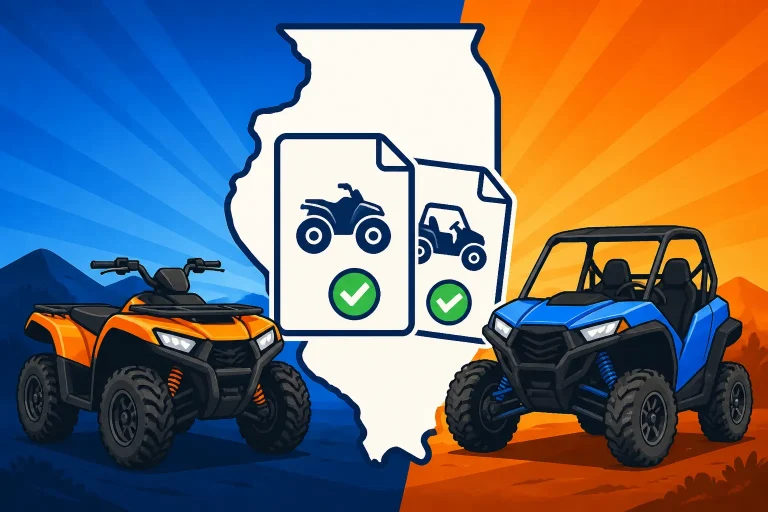
The public-access decal is part of the system associated with those grant-supported riding opportunities. The decal requirement helps connect machine use at designated sites with the program that supports them. It is not a general sticker for every Illinois trail, park or parcel of public land.
If you are unsure whether a particular property is included, don’t decide based on the name of the operator or whether the gates look public. Check the site’s current rider information and the Illinois rules for grant-assisted locations. What a Grant-Assisted Riding Site Actually Is explains the basic distinction between a grant-assisted OHV area and other places where riding might be allowed.
Why a grant can come with access conditions
Public recreation grants generally aim to create or improve opportunities for the public, not to provide an unrestricted private benefit to a landowner. A grant agreement can attach conditions to the project, including conditions related to public use and site operation. The exact terms depend on the program and agreement.
That arrangement is one reason a site may require riders to carry or display a decal even when the site is privately operated. The decal is tied to the grant-supported access program, while the operator may separately charge for admission or impose site rules. Those are different parts of the arrangement.
A grant does not mean that any person can ride at any time. The operator can set operating hours, capacity limits, reservation procedures and safety rules. A site can close for weather, maintenance or other reasons. It can also require a day-use payment, waiver or check-in in addition to the state decal.
The practical takeaway is simple: a decal requirement identifies an obligation associated with use of a designated grant-assisted site. It does not promise that the site will be open, that a trail will suit every machine or that entry is free.
What the decal does and does not cover
The decal is an access requirement for designated grant-assisted riding sites. It is not a substitute for the site’s own check-in process, day-use fee, reservation or waiver. Nor does it give permission to ride anywhere else in Illinois.
Think of it as one part of the paperwork and access requirements for a ride. Before you travel, confirm both the statewide requirements and the specific site’s rules. Illinois Public Access Decal Explained covers the decal itself, while Illinois Decal Rules at a Grant Site focuses on its use at the riding area.
| Requirement | What it generally addresses | What it does not automatically provide |
|---|---|---|
| Public access decal | Access to designated grant-assisted OHV sites, subject to applicable rules | Admission to every private park or permission to ride anywhere in Illinois |
| OHV usage stamp | The applicable state stamp requirement for riding covered public land | Entry to a grant-assisted site that requires the access decal |
| Site admission or permit | The operator’s entry process, reservation or day-use charge | Compliance with separate state decal or stamp requirements |
| Waiver and site rules | Conditions for riding at that particular location | A right to ride when the site is closed or full |
The relationship between the usage stamp and access decal is an easy place to make a mistake. They are not two names for the same sticker. They relate to different parts of the state’s OHV access system, and the requirement depends on where you plan to ride. What the Stamp Covers and What the Decal Covers explains that distinction in more detail.
For a ride at a grant-assisted site, do not assume a usage stamp will take the place of the required access decal. Likewise, buying a decal for a grant-assisted site does not necessarily cover riding on other public land where a usage stamp applies. Check the rule for the exact riding location and the machine you plan to bring. Illinois OHV Usage Stamp Explained is useful if your trip includes public land beyond the grant-assisted site.
The decal also does not replace ownership paperwork, a local street-use permit or the operator’s machine requirements. If a park checks proof of ownership, requires a particular equipment setup or limits which vehicles can use certain trails, the access decal does not override those conditions.
Why a usage stamp may not be enough
A usage stamp and an access decal serve different purposes. One does not automatically work as a universal pass for the other’s use case. The state’s system provides separate ways to address riding on covered public land and riding at grant-assisted areas, so a rider needs to match the requirement to the location.
A common assumption is that paying one state fee should cover every kind of public riding. That is understandable, but it can lead to a problem at the gate. A machine may have a current stamp and still need the decal for a grant-assisted site. Conversely, a decal should not be treated as permission for any public-land ride outside the locations it covers.
The detail that matters is where the machine will be operated. If your weekend includes more than one kind of riding area, make a location-by-location checklist rather than relying on one sticker to cover the whole trip. The Usage Stamp Opens No Gates by Itself is a helpful reminder that a stamp alone does not guarantee access to a particular riding site.
How the decal supports grant-assisted riding
The decal requirement helps fund and administer the public-access program connected to grant-assisted OHV recreation. In broad terms, riders using designated sites contribute through the decal system to the program that supports these riding opportunities. That creates a connection between use of the sites and the public funding mechanism behind them.
This does not mean every dollar paid for a decal goes directly to the specific trail you ride that day. A state program may support multiple projects, sites or eligible activities, and funding arrangements can vary. It is more accurate to think of the decal as part of a statewide support system than as a ticket purchased for one named trail. Where the Decal Money Goes provides more context on that funding relationship.
That shared structure helps explain why a grant-assisted site can require a decal even if it also charges for entry. The site’s admission charge may support local operations, while the decal is associated with the broader state program. Those payments can have different purposes.
There is a trade-off for riders. A decal requirement adds another thing to check before a ride, but a shared program can support access at more than one eligible location. If you ride several grant-assisted sites, confirm whether the same decal applies at each one. One Access Decal Covers Every Grant-Assisted Site discusses how the decal can apply across participating locations.
Do not infer eligibility solely from the fact that a site received some kind of public funding. A grant for a different purpose, or a past improvement that is not part of the OHV access program, may not make the decal rule apply. The relevant question is whether the riding area is designated under the applicable grant-assisted OHV program. When the site’s status is unclear, ask the operator or check the state’s current program information before your trip.
What to check before you ride
A little preparation can prevent a frustrating drive to a gate. Check the decal requirement alongside the site’s operating details rather than treating the sticker as your only entry requirement.
- Confirm that the site is grant-assisted. Look for current rider information from the operator or the state. Don’t assume that every public park, club area or private off-road property uses the same rules.
- Check which machine needs the decal. Confirm the requirement for each ATV or UTV you plan to bring. Do not assume one decal covers every machine in a group.
- Determine whether you also need a usage stamp. If your route includes other public land, check the requirement for each location. A decal for a grant-assisted site does not necessarily cover the rest of the trip.
- Review the site’s separate entry process. Confirm operating days, hours, capacity, reservations, fees, waivers and any check-in steps.
- Read the placement instructions. If the decal must be displayed on the machine, follow the current instructions for where and how to attach it. Illinois Decals Mounted Front and Center discusses placement, but confirm the current rule before applying it.
- Keep a record of the purchase. Save the confirmation or receipt until the decal is properly in place and the site’s check-in is complete. If you buy through a vendor, verify that you have the correct decal for the machine and rider situation.
- Ask before departure if anything conflicts. If the operator’s instructions and the information you found elsewhere appear different, contact the site or the relevant state program. That is easier than trying to resolve it at the entrance.
The operator can still have requirements beyond the decal. Some sites use reservations, daily capacity limits, waivers, wristbands or vehicle checks. Others may have restrictions on machine type, size, noise or equipment. A current decal does not guarantee that your particular ATV or UTV will be admitted.
For visiting riders, don’t assume another state’s registration, sticker or permit replaces Illinois’s site requirement. Ask the operator what Illinois decal or stamp applies, and check whether your machine also needs proof of ownership or other documents. Rules for riding on streets are separate again; a site decal is not street registration or permission to use public roads.
If you are bringing a rented machine, check who is responsible for the decal and whether the rental operator has already arranged the required access authorization. Do not assume the rental company’s paperwork covers every location. The same goes for a borrowed machine: confirm that the machine itself meets the site’s requirements before you load it.
Common misunderstandings about grant-site decals
“The site is private, so the decal cannot apply”
Ownership alone does not settle the question. A privately operated site may be part of a grant-assisted public-access program. If it is a designated site subject to the decal requirement, the operator’s private status does not by itself remove that condition.
“I already paid the park, so I should be covered”
The site’s day-use charge and the state access decal can serve different purposes. One payment does not automatically replace the other. Check the site’s instructions and the state requirement rather than relying on the total amount you paid at checkout.
“My machine has a usage stamp, so I can enter”
A usage stamp is not a blanket ticket for every riding location. At a grant-assisted site that requires the access decal, a stamp may not satisfy the decal requirement. Review Illinois Stamp and Decal Compared if you are sorting out which sticker applies.
“The decal lets me ride anywhere in Illinois”
It does not. The decal is connected to designated grant-assisted sites, not every public parcel, private park or road. Land access and street-use rules still apply independently. A riding sticker cannot replace permission from a landowner or a local ordinance that permits street use.
“The decal guarantees the trails will be open”
The decal does not control weather closures, maintenance, reservations or daily capacity. Check the operator’s current status before towing a machine to the site. If an area is closed, a valid decal does not create an exception.
“If one machine has a decal, the whole group is covered”
Do not assume that. Requirements can be machine-specific. Confirm how many decals are needed for the machines you intend to ride and whether each machine must display its own decal. The site may also have separate rider-based charges or check-in requirements.
Frequently Asked Questions
Why does a grant-assisted site require an access decal?
The decal is part of the access system connected to designated grant-assisted OHV sites. It helps support the broader public-access program, while the grant may come with conditions related to public recreation.
Does the decal replace a site’s admission fee?
Not necessarily. A site may charge separately for admission, reservations or other services. Check the operator’s current rules as well as the state decal requirement.
Can I use an OHV usage stamp instead of the access decal?
Do not assume so. The stamp and decal address different parts of the access system. If the grant-assisted location requires a decal, confirm that requirement specifically before riding.
Does the decal let me ride on any public land?
No. It is not a general permit for every public property or road. Check the rules for each location, including any separate usage-stamp, land-access or street-use requirements.
Disclaimer
This article is for general informational purposes only and does not constitute professional advice. Laws, prices and regulations vary by location and change over time. Consult a qualified professional for guidance on your specific situation.