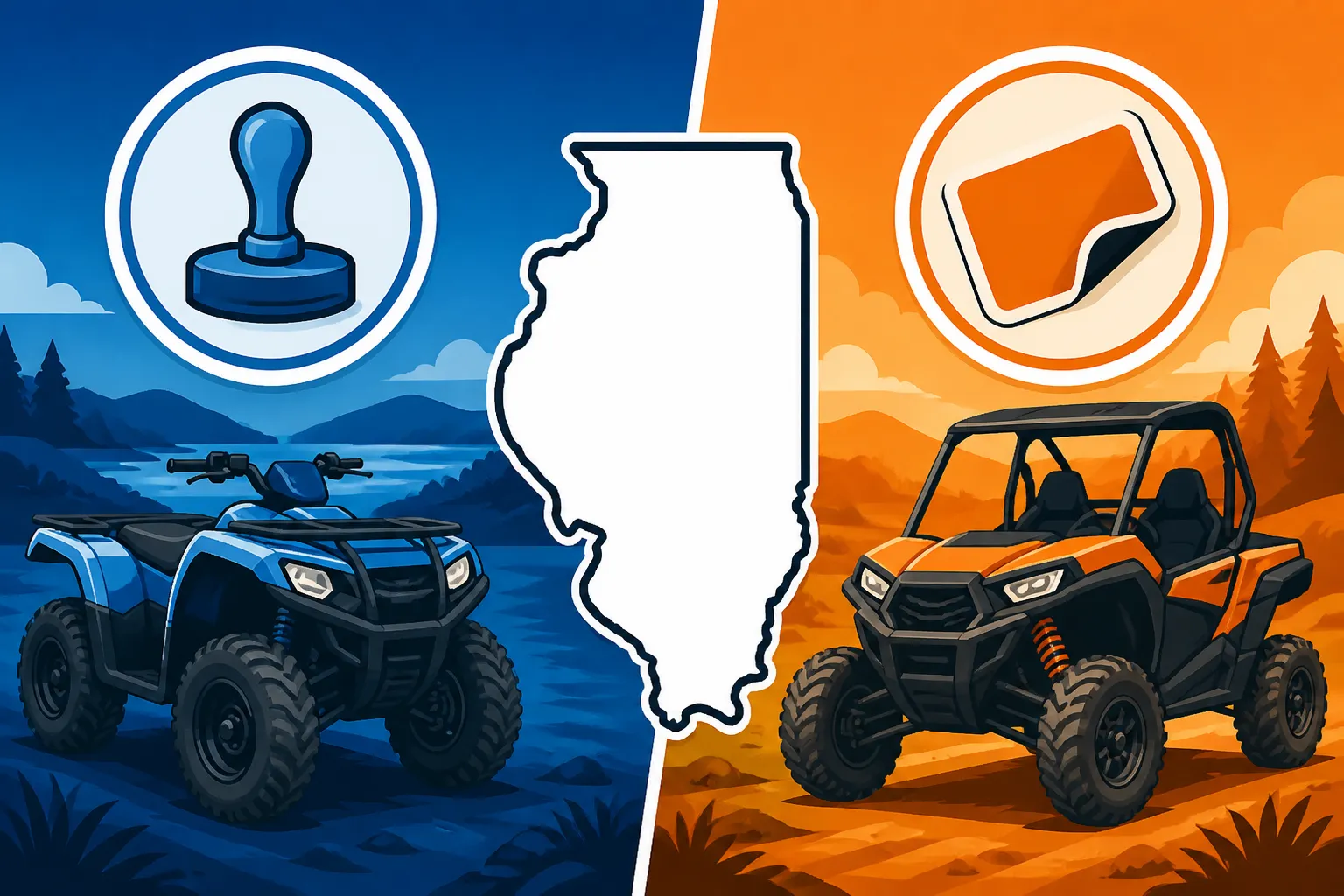
What the Stamp Covers and What the Decal Covers
Illinois riders often hear “stamp” and “decal” used as if they mean the same thing, then discover that a sticker does not necessarily meet every riding-area rule. The difference matters for public land, grant-assisted sites and visiting riders. Here’s what each Illinois requirement covers, where the two overlap, and what to verify before you haul a machine to the trail.
What the stamp and decal are for
The Illinois OHV usage stamp and the Illinois public access decal are separate parts of the state’s off-highway vehicle system. Both relate to where a machine may be ridden, but they serve different purposes. Neither is a general permit to ride anywhere in Illinois.
The usage stamp is associated with operating an off-highway vehicle on eligible public land. It is an authorization tied to the state’s OHV rules, not a universal pass for public property. The land must allow the type of riding you plan to do, and other site rules may apply. For more detail on the stamp’s role, see Illinois OHV Usage Stamp Explained.
The public access decal is associated with riding at grant-assisted OHV sites. These are riding areas connected to Illinois’ public access program. The decal is intended to support that program and is a requirement for machines using covered sites. It is not the same as the site’s own admission, reservation or day-use permit. Illinois Public Access Decal Explained covers the decal’s role in more detail.
Think of the distinction this way: the stamp relates to eligible public-land OHV use; the decal relates to access at grant-assisted riding sites. A machine may need one or the other, depending on where it will be ridden and which requirement applies. In some cases, the decal can take the place of buying a separate usage stamp. That does not make the two stickers interchangeable for every purpose.
| Question | Usage stamp | Public access decal |
|---|---|---|
| Main purpose | Meets the applicable OHV stamp requirement for eligible public-land use | Meets the access requirement for covered grant-assisted riding sites |
| Does it make a riding area open to OHVs? | No. The site must allow OHV riding | No. A site must allow riding and may have its own entry process |
| Is it a day pass for a specific park? | No | No |
| Can it affect whether a separate stamp is needed? | It is the stamp itself | It can serve as an alternative to a separate stamp for covered use |
| Does another state’s registration automatically replace it? | Do not assume so; confirm the rule that applies | No. Registration is not the Illinois access decal |
| Does one sticker cover every machine you own? | Do not assume so; check the current issuance rule | No. Plan on an applicable decal for each machine |
The practical takeaway is to start with your destination, not with the stickers. A rider who buys a stamp without checking the site’s rules may still arrive without a required decal or site permit. A rider who gets a decal may not need to buy a separate stamp, but still needs to confirm that the decal covers the planned use.
Where each requirement applies
A stamp or decal does not turn every field, trail, forest road or public parcel into a legal riding area. The land manager’s rules still matter. Some public land is closed to OHVs, and some places allow only specific kinds of vehicle use or routes. A sticker cannot replace permission from a landowner or an open riding designation.
Eligible public land and the usage stamp
The usage stamp is relevant when an OHV is operated in a setting where Illinois requires that stamp. But “public land” is not a synonym for “open to riding.” Before setting out, confirm both parts of the question:
- Is OHV riding allowed at the location?
- If it is allowed, which stamp, decal or other permit does the location require?
A stamp can satisfy a state requirement without granting a right to enter a site, use a particular trail or ride outside posted boundaries. That is why The Usage Stamp Opens No Gates by Itself is an important distinction. A gate, reservation system, daily capacity limit or site-specific permit can still control access.
Also check whether the machine or its use qualifies for an exemption. Exemptions can depend on the situation and should not be guessed from the fact that a machine is owned, titled or used for a particular purpose. Illinois Usage Stamp Exemptions explains why it is worth checking the actual conditions rather than assuming that an exemption applies.
Grant-assisted riding areas and the access decal
The access decal is the requirement to focus on when planning to ride at a grant-assisted OHV site. Having a usage stamp does not automatically mean a rider has met a site’s decal requirement. The site may also have its own entry fee, operating schedule, reservation process, waiver or vehicle rules.
Keep these requirements separate when planning:
- State sticker: the usage stamp or access decal that applies to the machine and its intended use.
- Site permission: any reservation, day permit, admission or other authorization required by the riding area.
- Site rules: conditions such as vehicle limits, hours, closures, waivers and equipment requirements.
For example, a machine may display the correct decal and still be turned away if the rider has not completed the site’s registration process or the area is full. Likewise, a rider may have a site reservation but still need the correct sticker on the machine. The reservation and sticker answer different questions.
Private property and private riding parks
A privately owned riding park sets its own entry conditions, subject to applicable law. It may require a paid day pass, waiver, membership or proof of insurance. Do not assume a state decal is the park’s admission ticket, and do not assume the park’s day pass replaces a state requirement that applies to the machine.
Riding on property you own is a different situation from riding on public land or at a grant-assisted site. Some uses may qualify for an exemption, but property ownership alone is not a reason to assume that every rule disappears. If you ride on multiple kinds of land, check each use separately. A machine used only in a yard may be treated differently from one taken to a public riding area; Machines Ridden Only on Your Own Yard Skip the Stamp discusses that distinction.
How the stamp and decal interact
The two requirements can overlap, and that is where riders most often get confused. Under Illinois’ system, an eligible public access decal can serve as an alternative to purchasing a separate usage stamp for covered use. That does not mean a usage stamp is a substitute for the decal at a grant-assisted site.
A useful way to decide what to buy is to identify the strictest requirement for your planned ride:
- If you will ride only at a grant-assisted site, check that site’s current decal and entry requirements.
- If you will ride on other eligible public land, check whether a usage stamp is required for that use.
- If you will ride in both settings, confirm whether the decal you obtain covers the stamp requirement for your situation and whether each site still requires separate authorization.
The relationship is explained further in Illinois Decal Holders Skip the Stamp. The central point is not “always buy both” or “one sticker always covers everything.” It is to avoid paying for a second state sticker when an applicable decal already serves that purpose, while also avoiding the mistaken belief that a stamp satisfies a grant site’s decal rule. See Illinois Stamp Holders at a Grant Site for that specific situation.
When a rider may need both
A rider may encounter both stickers in the same planning process because different places have different rules. That does not always mean both need to be purchased for the same machine and the same period. Check the current state requirements and the site’s instructions before buying. If the state’s information is unclear, ask the issuing agency or a participating vendor to explain which option applies to the machine and the intended riding location.
A machine used across several locations needs a little more planning than one that stays at a single site. Make a list of the places you intend to ride, then record the applicable state sticker, site permit and any additional conditions for each. This helps avoid buying a stamp that does not meet a site’s decal requirement or assuming a decal will cover a use outside its scope.
Stickers are machine-specific
Do not treat a sticker as a household pass that can be moved freely between machines. The requirements are generally tied to the machine displaying the sticker. If you have a quad and a side-by-side, check the rules for each machine rather than assuming one sticker covers both. The same applies if you bring a second machine for another rider. [Illinois Permit for a Second Machine] explains why a second vehicle can require its own authorization.
Keep the sticker legible and mounted where Illinois or the site requires it. If it is lost, damaged or no longer readable, check the correct replacement process rather than assuming a receipt or photograph will substitute at the gate. Placement and display details are covered in Illinois Permit Placement on a Machine.
What visitors and machine owners should check
Illinois residents are not the only riders who need to think about the decal and stamp system. Visitors should check Illinois requirements before traveling, even if their machine is titled, registered or permitted in another state. A home-state document is not automatically the Illinois public access decal, and out-of-state status does not by itself answer which Illinois requirement applies.
For a visiting rider, separate three questions:
- What does Illinois require for this machine and this use? Check whether the stamp or access decal applies.
- What does the destination require? Confirm whether the site requires advance registration, a site pass or a waiver.
- What does the home-state paperwork cover? Do not assume it replaces Illinois’ site-specific requirements.
If you are bringing a machine from another state, use Illinois Rules for an Out-of-State Machine as a starting point. Reciprocity questions can be nuanced: the fact that a machine is legally registered elsewhere does not automatically establish that it meets every Illinois OHV or site requirement. Confirm the current rule for your specific situation before you travel.
Check the date and current terms
A sticker’s validity period matters. The usage stamp year runs from April through March, and a stamp that was valid earlier in the season may no longer be valid after its expiration date. Check the expiration information and current renewal instructions before spring riding. The Usage Stamp Year Runs April Through March explains the annual cycle.
Do not rely solely on a sticker from a prior season, an old receipt or a previous visit to the same park. Requirements, issuance instructions and site procedures can change. Verify the current information through the appropriate Illinois source or the riding area before leaving home, especially when a trip depends on a reservation or a limited number of daily entries.
Confirm which machine the paperwork identifies
Before you buy, check the machine details and make sure the sticker or transaction is associated with the correct vehicle. This is especially useful when a household has multiple ATVs or UTVs, when a machine has recently been sold, or when a rental is involved. If you are borrowing a machine, ask the owner which requirements have been handled and confirm that the sticker displayed is valid for that vehicle.
For rented machines, do not assume the renter’s personal paperwork covers the rental vehicle. The rental company may have its own obligations and instructions, and the rider may still need to complete the riding area’s entry process. Ask the rental provider and the destination what is required before the rental begins.
A simple pre-ride checklist
A few checks before loading the trailer can prevent a wasted trip. Work through them in this order:
- Name the exact destination. “Public land” or “a trail in Illinois” is not specific enough. Confirm that the location allows OHVs and that the intended route is open.
- Identify the site category. Determine whether it is eligible public land, a grant-assisted riding area, a private park or another type of location.
- Check the state sticker requirement. Find out whether the use calls for a usage stamp or an access decal, and whether the decal serves as an alternative to a separate stamp in your situation.
- Check the site’s entry requirements. Look for reservations, day permits, admission, waivers, vehicle limits, opening hours and closures. A state sticker is not a substitute for these.
- Check every machine. Confirm that each vehicle you plan to ride has the required sticker and that a second machine is not being treated as covered by the first.
- Check expiration and display. Make sure the sticker is current and displayed as required. Keep relevant confirmation or purchase records with your trip paperwork.
- Verify visitor requirements. If the machine is from another state, confirm the Illinois rules instead of relying on home-state registration alone.
- Recheck shortly before departure. Site schedules, capacity and operating conditions can change. Confirm the current instructions before making a long drive.
This process is more reliable than buying both stickers “just in case.” It also avoids the opposite mistake: buying one, then assuming it gives access to any area that looks rideable. If you are uncertain whether the usage stamp or access decal applies, describe the machine, where it will be ridden and whether it is registered out of state when you contact the relevant office or vendor.
For a quick summary of how the two requirements work together, see Illinois Stamp and Decal Together. The short version is that the stamp and decal have distinct jobs: the stamp relates to eligible public-land use, while the decal is tied to grant-assisted sites and may replace a separate stamp for covered use. Neither one replaces permission to ride, a site’s own permit or its operating rules.
Frequently Asked Questions
Does an Illinois usage stamp let me ride anywhere on public land?
No. It addresses a state OHV requirement where applicable, but it does not open land that is closed to OHVs or authorize riding outside designated areas. Confirm that the location and route allow the type of machine you plan to ride.
If I have an access decal, do I also need a usage stamp?
An eligible access decal can serve as an alternative to a separate usage stamp for covered use. Check the current Illinois instructions for your machine and destination rather than purchasing both automatically.
Is the access decal a day pass for a grant-assisted site?
No. The decal meets an access-related requirement, but the site may also require a reservation, admission, day permit or waiver. Check the riding area’s own instructions.
Does another state’s OHV registration replace the Illinois decal?
Do not assume it does. Out-of-state paperwork is not the Illinois public access decal. Confirm the Illinois requirements for your machine and planned riding location before traveling.
Disclaimer
This article is for general informational purposes only and does not constitute professional advice. Laws, prices and regulations vary by location and change over time. Consult a qualified professional for guidance on your specific situation.