Illinois OHV Permits: Two Stickers Explained
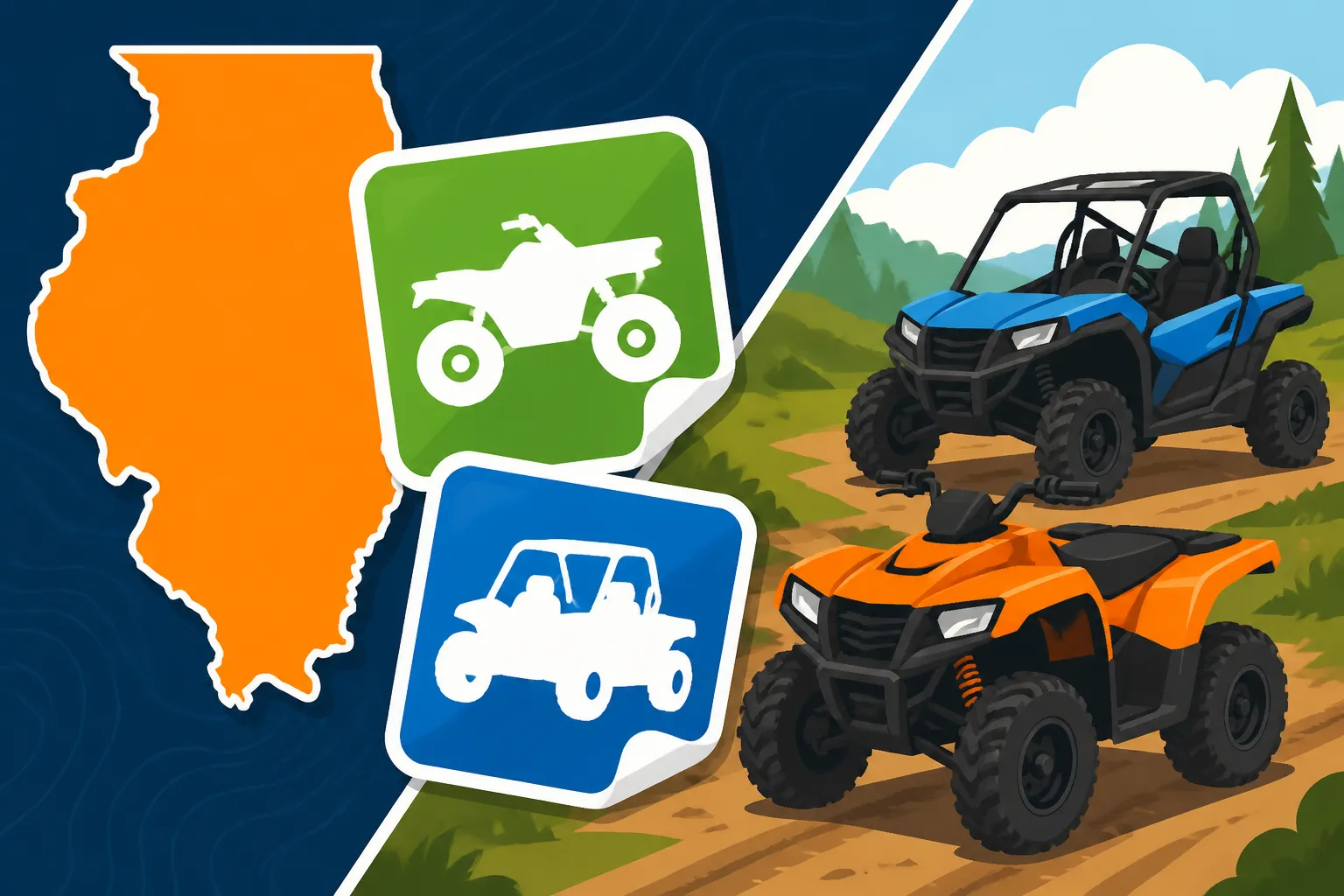
When you’re getting an ATV or UTV ready for an Illinois ride, two stickers can look like one confusing permit problem. The usage stamp and public access decal serve different purposes, and neither automatically replaces a park’s own admission rules. This guide explains what each sticker does, how residency and out-of-state registration affect your checklist, and what to verify before you unload.
The Two Illinois OHV Stickers Have Different Jobs
What the usage stamp is for
The Illinois OHV usage stamp is the state’s annual stamp for qualifying off-highway machines used in settings where the stamp is required. Think of it as a state-level requirement connected to using a machine on applicable public riding areas—not as a ticket that opens every gate or grants permission to ride anywhere.
That distinction matters when you’re planning a destination ride. A stamp does not give you permission to ride on private land, make a closed trail legal to use, or replace a park’s reservation, admission, waiver, or day-permit requirements. It is one part of the paperwork picture. The location’s rules still apply.
The stamp period follows a spring-to-spring cycle, rather than a calendar year. Riders who buy one late in the season can be surprised by how soon they need to think about renewal. For a fuller explanation of the stamp itself, see Illinois OHV Usage Stamp Explained and The Usage Stamp Year Runs April Through March.
What the public access decal is for
The Illinois public access decal is connected to access at grant-assisted riding sites. These are sites that receive state assistance for OHV-related purposes and have rules requiring the decal for applicable machines. It is not simply another version of a park entrance ticket: it addresses a state access requirement, while the individual site may also have its own entry procedures.
This is why the decal matters even to a rider who already has a usage stamp. A stamp alone does not necessarily satisfy a grant-assisted site’s decal requirement. Before you go, check whether your destination is a grant-assisted riding area and what that site expects each rider and machine to have.
The decal is generally associated with the machine, not just the person who owns it. If you bring two machines, don’t assume one sticker covers both. The exact obligation can depend on the machine, rider, and use, so review Illinois Public Access Decal Explained and Illinois Decal Rules at a Grant Site when you’re sorting out a particular trip.
Why having both stickers is not always the answer
It’s easy to assume that because there are two stickers, every rider needs both. That can lead to unnecessary purchases or a last-minute scramble to figure out which one applies. The better approach is to start with the destination and determine which requirement covers the trip.
For some riders and situations, holding the qualifying public access decal means a separate usage stamp is not needed for that machine during the relevant period. That’s why the two stickers are not always cumulative. But don’t infer that one sticker covers every purpose: a decal does not grant access to any site that is closed, private, or subject to separate admission rules.
If you are unsure whether a decal replaces the stamp in your circumstances, check the state’s current guidance before buying. Why an Access Decal Cancels the Usage Stamp explains the relationship, while What the Stamp Covers and What the Decal Covers is a useful side-by-side reference.
| Requirement | What it generally addresses | What it does not automatically provide |
|---|---|---|
| OHV usage stamp | State stamp requirement for qualifying use where applicable | Permission to ride anywhere or admission to a park |
| Public access decal | Access requirement at applicable grant-assisted riding sites | A site reservation, day pass, or waiver |
| Site-specific permit | A particular park’s entry or riding-day rules | A substitute for state requirements that also apply |
| Landowner permission | Permission to ride on private property | A substitute for state or park rules |
Work Out Which Requirement Applies to Your Ride
Start with the destination
Before shopping for a sticker, write down where you plan to ride. A public riding area, a grant-assisted site, a private pay-to-ride park, and a farm field can all have different access rules. The machine type and how it will be used can matter too.
A common real-life mistake is preparing for the wrong kind of trip. Someone may buy a usage stamp because a friend says it is “the ATV permit,” then arrive at a grant-assisted area and discover the site requires a public access decal. Another rider may buy a decal but still need to register for the park’s own riding day. The problem isn’t necessarily that either sticker is useless; it’s that each answers a different question.
Confirm the site’s designation and its rider instructions before you leave home. If the destination has a booking page or gate office, check whether it requires a reservation, signed waiver, printed confirmation, wristband, or vehicle sticker in addition to state credentials. For a broader explanation of site rules, see Illinois Grant Site Rules for Riders.
Check the machine and the rider
A machine’s status can affect the answer. A privately owned ATV, a rental, a dealer machine, and a machine used for an exempt purpose may not follow the same path. Don’t assume that a rule you used for one quad automatically applies to a side-by-side, a borrowed machine, or a vehicle from a rental fleet.
Rider circumstances matter as well. Residency can affect which decal category applies and what it costs, while a visitor’s out-of-state registration does not necessarily settle every Illinois requirement. If a child is riding, the child’s permit or site-access obligations may differ from the parent’s, and the park may have additional age, supervision, or machine-size rules.
When in doubt, make a short list for each machine: who owns it, who will operate it, whether it is rented or borrowed, where it will be ridden, and whether an exemption may apply. That makes it easier to ask the state or site manager a precise question instead of getting a vague answer to “Do I need a permit?”
Treat state requirements and park rules as separate checks
Think of compliance as two layers. First, determine whether state requirements call for a usage stamp, public access decal, or an exemption. Then determine what the riding destination requires for that specific day. Both layers may apply, and meeting one does not automatically meet the other.
For instance, a rider might have the correct state decal but still need to reserve a day at a park. Another rider might have a park confirmation but still need the relevant state credential attached to the machine. It is frustrating to discover the difference at the gate, especially after hauling a trailer several hours, so make these checks before loading.
A practical habit is to save the site’s rules and your state-permit confirmation together. If you’re checking whether a particular machine qualifies for an exception, review Illinois Usage Stamp Exemptions rather than relying on an old sticker, a friend’s recollection, or an assumption based on how the machine is used at home.
Out-of-State Riders and Reciprocity
Don’t assume another state’s registration replaces an Illinois decal
Visitors often arrive with a registration card, an out-of-state OHV sticker, or both and reasonably assume those documents will be enough. They may help identify the machine or show that it is authorized under another state’s system, but that does not automatically mean Illinois treats them as a substitute for its public access decal at a grant-assisted site.
Reciprocity can be easy to misunderstand because different states use different terms. One state may issue a registration, another may issue a trail permit, and Illinois may use a usage stamp or access decal for a specific purpose. Similar-looking stickers do not necessarily grant the same rights. The important question is not only whether your machine is registered at home, but also whether Illinois requires a separate credential for your intended ride.
If you’re visiting from Indiana, Missouri, Wisconsin, or another nearby state, check the Illinois rule for visitors before you travel. The focused guide Does Illinois Accept Another State’s OHV Registration? can help you frame that question. Do not rely on a home-state registration alone as proof that every Illinois requirement has been met.
Understand how visitor status can affect the decal
Residency may affect which access decal category applies. A nonresident rider should not assume that an Illinois resident’s sticker or fee instructions will apply to them. Likewise, owning a machine in Illinois does not always answer whether a rider or machine falls into a particular category under the state’s rules.
For a visiting family, work through each machine individually. If a resident and a visitor are riding separate machines, the paperwork may not be identical. If one machine is borrowed or rented, ask who is responsible for the decal and whether the machine already has the required credential. Never assume a decal attached to a friend’s quad covers the one you brought on your trailer.
Visitors can use Illinois Stamp Rules for a Visitor as a starting point, then confirm the details for their destination. If a site’s website is unclear, contact the site directly and describe your home state, machine type, and planned riding location. Those details are more useful than asking only, “Do you accept out-of-state permits?”
Separate reciprocity from street legality
An OHV sticker is not a street-use permit. A machine that has a valid Illinois stamp or decal is not automatically legal on a village street, county road, or state highway. Road use is governed by separate rules, including local ordinances and equipment requirements, and a town’s rules may not match the next town’s.
That distinction can trip up visitors who are staying near a trail system and hope to ride from a campground to a restaurant or gas station. A sticker that satisfies a riding-area requirement does not by itself authorize that road trip. Check the laws and local ordinances for every road segment you plan to use, and don’t infer street permission from the fact that a machine can legally ride at a park.
Keep your planning questions separate: “Which state OHV credential do I need for this riding area?” and “May I legally operate this machine on this road?” The first is about permits and access; the second is about street-use law. For street-specific questions, review the local ordinance rather than relying on a permit sticker as proof.
Exemptions and Special Situations
Farm, yard, and other limited uses
Some machines may qualify for exemptions based on how and where they are used. For example, an owner who keeps a quad on a farm or uses it only on private residential property may have different obligations from someone riding on a public trail or grant-assisted site. But an exemption is not a general pass that travels with the machine wherever it goes.
This is where practical details matter. A machine used around a farm most of the year may still be taken to a public riding area for a weekend. The fact that it is a farm machine at home does not automatically answer what is required at the destination. Similarly, riding only in your own yard may be treated differently from taking the same machine across a road or onto another person’s land.
Read the relevant exemption language carefully and match it to the actual use. Illinois Residential Property Exemption and Illinois Farm and Livestock Exemption cover two situations riders commonly ask about. If your use is mixed, or the machine is used by multiple people for different purposes, confirm how the rule applies rather than assuming the broadest possible exemption.
Rentals, borrowed machines, and dealer machines
A rental machine can create a frustrating paperwork gap: the customer assumes the rental company handles every permit, while the rental business assumes the customer will buy a site-specific pass. Before paying or signing the rental agreement, ask what state credentials are already on the machine and what you must arrange yourself.
For a borrowed machine, check the sticker on that exact vehicle. A permit or decal associated with another machine should not be assumed to transfer. If you’re borrowing a friend’s side-by-side for a weekend, ask them to show you the machine’s credentials and confirm that they are valid for the destination and riding period.
Dealer and fleet machines can also have distinct rules. If you are picking up a rental or dealer demonstration vehicle at a site, ask both the provider and the site who is responsible for the required credential. Useful references include [Illinois Permit for a Rented Machine] and Illinois Stamp for a Rental Machine.
Machines that may qualify for specific exemptions
Some exemptions are tied to a purpose or ownership category, such as competition, government use, or a grant-site arrangement. These are not interchangeable categories, and a machine that qualifies for one exemption may not qualify for another. The owner should be prepared to show why the exception applies if asked.
A rider may also confuse “not required to have a stamp” with “allowed to ride at this location.” Those are different questions. An exemption from one state credential does not remove private-property boundaries, park restrictions, safety rules, age limits, or other conditions of access.
If an exception seems relevant, read the rule that describes it and keep supporting documentation with the machine when practical. Don’t rely on a verbal explanation passed from one owner to the next. The guides Illinois Competition Machine Exemption and Illinois Government Machine Exemption explain examples of purpose-based categories.
Buying, Placing, and Renewing the Stickers
Buy through an appropriate channel and keep proof
Illinois OHV credentials may be available through state systems or authorized vendors, depending on the credential. Use the state’s current purchasing instructions to find an appropriate channel, and double-check that you are purchasing the right item for your machine and use. A hunting or fishing license vendor may sell some state products, but that does not mean every vendor sells every OHV credential.
Before submitting payment, review the machine details and residency information carefully. Small errors—such as selecting the wrong category or entering the wrong machine information—can be hard to sort out when you are standing at a gate. If you are buying for more than one machine, take a moment to match each credential to the correct vehicle.
Save the receipt or confirmation where you can retrieve it. A printed copy can be useful if a phone loses reception, runs out of battery, or gets muddy. If you like to keep paperwork together, a simple waterproof document pouch—available from outdoor retailers or marketplaces such as Amazon—can help protect a printed confirmation without turning the machine’s required sticker into a removable substitute.
Put each sticker where its instructions say
Do not guess at placement based on where another rider put a sticker. The usage stamp and access decal can have different placement instructions, and the machine’s body shape may make a convenient spot hard to see. Follow the directions issued with the credential and make sure the display is secure and legible.
Clean and dry the surface before applying a sticker. Dust, old mud, wax, and moisture can keep an adhesive from holding well, especially if you apply it in a cold garage or just before loading. Avoid placing it where a rack, cargo bag, splash, or body panel could hide it from inspection.
If you are uncertain about the correct location, check Where the Usage Stamp Goes on Your Machine and the applicable decal instructions. A clear photograph of the sticker after application can be handy for your records, but it is not a replacement for displaying the actual required credential on the machine.
Plan around expiration and replacement
A credential’s validity period may not match the date you bought it. Because the usage stamp cycle runs from spring into the following spring, a late-season purchase may have less remaining time than you expect. Keep a reminder for renewal, particularly if your machine is stored through winter and you only think about permits when the trails reopen.
If a sticker is damaged or lost, don’t assume you can simply print another one or reuse an old sticker. Check the official replacement process and whether you need proof of purchase or machine information. Waiting until the morning of a ride can turn a minor problem into a missed trip.
Build permit checks into your spring maintenance routine. When you check the battery, tires, fluids, trailer lights, and straps, also inspect the sticker’s condition and expiration. That small habit is more reliable than discovering a faded or missing credential at the trailhead.
Get Ready for the Riding Site
Check the site before you tow
A valid state credential does not guarantee that a riding area is open, accepting riders, or suitable for your machine. Sites can have their own schedules, capacity limits, reservation procedures, and vehicle restrictions. Those conditions can change with weather, maintenance, events, or seasonal operations.
Before leaving, confirm the site’s status directly and check its latest rider instructions. Ask whether the site requires an advance booking, a daily permit, a waiver, or a check-in step. If you are bringing a side-by-side, verify that the trails allow its size; a machine that meets state permit rules may still be too wide for a particular route.
This step is especially valuable for riders making a long drive from northern or central Illinois to a southern riding area. Call or check the site’s designated information channel before loading the trailer, and save the confirmation. Don’t treat an old social post or a friend’s past visit as a guarantee that the same conditions apply to your trip.
Keep your confirmation and basic documents accessible
A gate check goes more smoothly when you can quickly show the confirmation or answer questions about the machine. Keep your permit receipt, site booking details, waiver confirmation, and ownership or rental information together. If you are riding with a group, make sure each operator knows where the relevant documents are kept.
A phone is convenient, but it isn’t infallible. Reception may be weak at a trailhead, a screen can crack, or a battery can die after a long day. Save essential information offline where possible, and consider carrying a printed confirmation in a protected pouch. A basic waterproof document holder found at an outdoor store or on Amazon can keep paper legible through rain and mud.
For route planning, especially where cell coverage may be limited, a paper map can provide a useful backup. Some riders look for map cases or waterproof storage through local outdoor shops or Amazon, but the important point is to bring a map that matches the area and not to rely on a phone alone. A paper map is not a permit; it is simply a practical backup for navigating.
Know what the site staff may check
Staff or officers may check that the required sticker is displayed, that the machine matches the information provided, and that the rider has followed site entry procedures. They may also ask for proof of a reservation or waiver, depending on the location. Keep your answers straightforward and have documents ready instead of digging through a muddy cargo box.
A passenger should know the site’s rules too. A driver may have completed the booking, but passengers can still be subject to age, helmet, wristband, or conduct requirements. If a child is riding, review the site’s age and supervision rules before arrival rather than trying to resolve them at check-in.
Follow staff instructions even if another site handles the same issue differently. A park’s wristband, permit sticker, or access procedure is tied to that site’s rules. Don’t remove or transfer a site-issued item until the staff says it is no longer needed, and don’t assume that a previous visit’s process will be identical this time.
Common Mistakes and a Simple Pre-Ride Checklist
Mistaking the stamp for admission
The most common misunderstanding is treating the usage stamp as an all-purpose pass. It does not automatically grant access to every public or private riding area. A stamp addresses a particular state requirement; admission, permission, and local site rules are separate matters.
The reverse mistake happens too: a rider has booked a park and assumes that the booking covers all state obligations. A reservation confirms the place or day under that site’s system, but it may not replace the sticker required for the machine. Confirm both layers before the trip.
A helpful way to keep the distinction straight is to ask: “What state credential does this machine need?” and then, “What does this specific site require me to do?” If you can answer both questions clearly, you are much less likely to arrive missing a sticker or reservation. For other common questions, see Illinois Permit Questions Riders Ask.
Assuming one sticker covers every machine
A household may own several ATVs and a side-by-side, but the fact that one vehicle has a current decal does not mean the rest are covered. Check each machine individually. If a family member brings a second quad or swaps vehicles at the last minute, revisit the permit checklist for that machine.
The same goes for shared machines. A sticker on the vehicle may be associated with that machine and its permitted use, but it does not make every rider exempt from site rules or rider-specific requirements. Keep the vehicle’s credentials and the riders’ documents distinct in your planning.
Before departure, walk around each vehicle and confirm that its sticker is present, readable, and correctly placed. A quick photo can help you remember which machine has which credential, especially when several similar quads are parked together. But always rely on the physical sticker and official documentation for compliance.
Use this checklist before you leave
A five-minute check can prevent an expensive and disappointing turnaround. Start with the destination, then match the machine and rider to the relevant state requirement. Verify the site’s rules separately, and make sure everyone in the group knows what to show at check-in.
Use this checklist as a starting point:
- Confirm the riding area is open and allows your type of machine.
- Determine whether the machine needs an Illinois usage stamp, public access decal, or qualifies for an applicable exemption.
- If visiting from another state, confirm whether your home-state registration changes anything for this destination.
- Check whether the site requires a reservation, day permit, waiver, wristband, or other entry step.
- Verify every machine’s sticker, placement, and validity.
- Save or print confirmations and keep them accessible.
- Review rider age, supervision, helmet, passenger, and machine-size rules.
- Recheck the site’s instructions before loading, especially after a weather change or a long gap between visits.
If one item is unclear, contact the state office or riding site with specific details: your residency, machine type, ownership or rental status, and destination. That is more likely to get you an accurate answer than asking whether “an ATV permit” is needed in general.
Disclaimer
This article is for general informational purposes only and does not constitute professional advice. Laws, prices and regulations vary by location and change over time. Consult a qualified professional for guidance on your specific situation.