Illinois Has No Statewide Safety Course
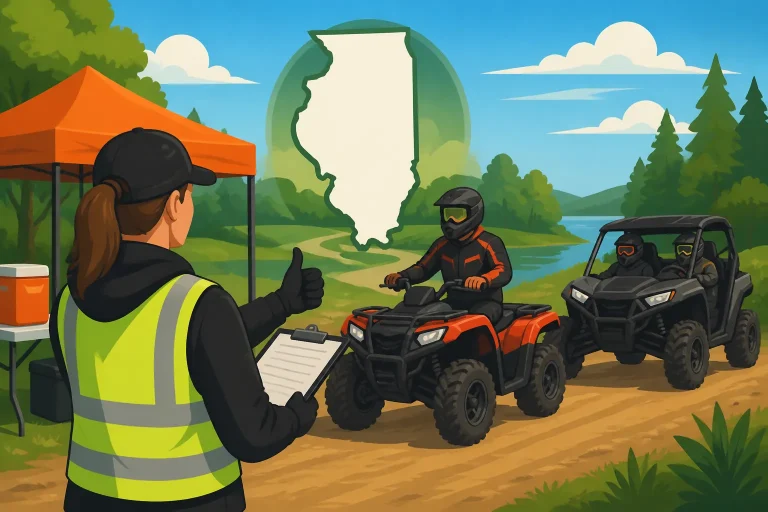
Illinois riders often hear that a safety certificate is required, then struggle to find one statewide rule that applies to every ATV, UTV, trail and rider. The key distinction is that Illinois does not impose one general safety-course requirement for all off-highway riding. A riding site, event or local road ordinance may still set its own conditions, so check the rules for the place and type of riding you have planned.
What “No Statewide Safety Course” Means
There is no single Illinois ATV or UTV safety-course certificate that every rider must earn before riding everywhere in the state. Completing a course may be useful, and a particular riding site may require training or proof of instruction, but that is different from a universal state requirement.
The phrase “no statewide safety course” can be misunderstood. It does not mean every rider can operate any machine, anywhere, without meeting other rules. It means that a safety-course certificate is not a general substitute for, or prerequisite to, the separate requirements that may apply to your age, machine, location and activity.
For example, you may still need to:
- Follow state rules that apply to off-highway vehicles and their operators.
- Meet a park’s minimum age, supervision, equipment or waiver requirements.
- Obtain any required stamp, access decal or site permit.
- Get permission before riding on private property.
- Meet the rules for street use if the machine is being driven on an authorized road.
- Follow the terms of an organized event or rental agreement.
It helps to ask the right question. Instead of asking only, “Does Illinois require a safety course?” ask: “Does the site where I am riding require a course, and what other rules apply to my machine and rider?”
That distinction is especially important for families and visitors. A rider may not need a state-issued safety certificate but could still be too young for a particular trail, lack a required driver’s license for a specific activity, or be unable to ride because the machine does not meet the site’s specifications.
A course is best viewed as one part of preparation, not as a universal riding pass. It can teach useful habits, but it does not grant land access, make a machine street-legal, replace a required decal or guarantee that a park will admit you.
Separate Training From Permits, Licenses and Site Rules
Several different requirements can sound like “permission to ride.” They serve different purposes, and meeting one does not automatically meet the others.
| Requirement | What it generally addresses | What it does not automatically provide |
|---|---|---|
| Safety course or training | Knowledge and practical riding skills | Access to a particular property or trail |
| Usage stamp or access decal | A state program requirement tied to certain riding access | A safety certificate, street license or permission to trespass |
| Site permit or reservation | Entry to a particular park or riding area | A general state riding authorization |
| Driver’s license | A qualification that can matter for street operation or a site’s operator rules | Permission to ride on any road or trail |
| Landowner permission | The right to ride on the specific private property | Exemption from other applicable laws |
| Insurance | Financial coverage, and sometimes proof required for a particular use | A permit, training credential or legal right to ride |
The sticker requirements are a common source of confusion. Illinois uses different mechanisms for different purposes. A stamp and an access decal are not interchangeable, and neither is a course certificate. Review Illinois Usage Stamp vs Access Decal and What the Stamp Covers and What the Decal Covers before assuming that one payment or sticker covers every place you want to ride.
Likewise, a permit for a particular park is not the same thing as a statewide safety credential. Some areas require reservations, waivers, wristbands or machine stickers. Others have different entry procedures. A course certificate may satisfy a site’s training rule if the site accepts it, but it does not replace the site’s own admission process. Check Illinois Grant Site Rules for Riders if you are planning to use a grant-assisted riding area.
Street use is another separate category. An ATV or UTV that is allowed on a particular road may be subject to qualifications and equipment requirements that do not apply in the same way on a private trail. A training certificate does not make a machine road-legal or authorize road travel. Start with Illinois Requires a Driver’s License and Illinois UTV Street Legal Rules by Town when your plans include riding on streets.
The practical rule is simple: identify the requirement, then identify who sets it. State agencies, local governments, property owners, park operators and event organizers can each have rules within their area of responsibility. Do not treat “I took a course” as proof that you have satisfied all of them.
Where a Course May Still Be Required or Useful
A course may matter even when Illinois does not have one general course requirement for every ATV and UTV rider. The most likely place to encounter a course condition is at the specific riding site or event where you plan to go.
A park’s own admission rules
A public or private riding area may set conditions for entry and operation. Those conditions can address operator age, supervision, machine size or condition, helmets, waivers, passenger limits and other safety matters. A site may also require a particular form of instruction or a certificate for some riders.
These are site rules, not necessarily a statewide mandate. A requirement at one park does not automatically apply at every Illinois riding area. On the other hand, the absence of a statewide course requirement does not stop a park from setting reasonable conditions for use of its property.
Before towing your machine, check the riding area’s current rules directly. Ask whether training is mandatory, which riders it applies to, what proof is accepted and whether the course must be completed before arrival. If the requirement is vague, ask for the exact rule in writing or ask the operator to point you to its current admission information.
This matters at both public and private sites. A publicly accessible area may have its own entry procedures, while a privately operated park may impose conditions through its admission rules or waiver. A waiver is not a safety course, and signing one does not mean a rider has passed an assessment. Treat each item separately.
Events, rentals and organized rides
An event organizer or rental business can impose conditions beyond the general state rules. A rental operator may give a safety briefing, require an orientation or restrict who can operate the rented machine. A poker run, group ride or private event may have its own rider requirements.
Do not assume that a short briefing is an approved safety course, or that a course certificate is accepted in place of an orientation. Ask what the organizer means by “training,” how it is delivered, and whether every rider or only the operator must participate. If the ride includes children, passengers or unfamiliar machines, ask about those details before paying or traveling.
Why training is still worth considering
Even when it is optional, training can help a new rider understand basic controls, balance, braking, terrain choices and the consequences of carrying a passenger. It can also give parents and caregivers a structured way to discuss risk before a child rides.
A course is particularly useful when:
- The rider is new to off-highway machines.
- The machine is larger, heavier or more powerful than one the rider has used before.
- The rider has moved from a quad to a side-by-side, or the other way around.
- Several family members will share a machine.
- The group expects to ride unfamiliar trails, steep ground or changing conditions.
- A young rider needs practice with supervision before entering a busier area.
Training does not eliminate risk. It also does not replace close supervision, a properly fitting helmet, sound judgment or following the park’s rules. A rider who has completed a course can still make a poor decision; a certificate should never be treated as proof that a person is ready for every machine or trail.
For an overview of possible training pathways, see Illinois Safety Course Options. If you are comparing remote programs, Illinois Online Safety Courses can help you understand what to ask before enrolling. Confirm that a course is recognized by the park or organizer if you are taking it to meet a particular requirement.
Children, Teens and First-Time Riders
The absence of one statewide safety-course requirement does not mean that age is irrelevant. Rules for younger riders can involve more than training. Depending on the setting, age, supervision, machine and activity may all matter.
For a child or teen, check the rules from two directions:
- State and local requirements: Confirm the rules that apply to the rider and the type of riding.
- Site requirements: Ask the park or property owner about minimum ages, supervision, machine specifications, passengers and required equipment.
Do this before selecting a course. A training certificate may not override a minimum age or supervision rule. It may also fail to qualify a young rider for a particular machine if the site sets machine-specific restrictions.
Match the machine to the rider
A machine can be too large or demanding even if the rider has completed training. When choosing a machine, consider whether the rider can comfortably reach and operate the controls, steer, brake and stop it. Follow the manufacturer’s age guidance and do not treat it as a guarantee that a particular child is ready.
Parents should also think about the riding environment. A calm, open practice area is different from a crowded trail with blind corners, mud, steep slopes or adult-sized machines. Build experience gradually rather than using a course certificate as a reason to move quickly to more difficult terrain.
If children will be passengers in a UTV, ask whether the machine is designed for that number of occupants and whether the site permits the arrangement. A course for the operator does not make an unsafe seating setup acceptable.
For age-specific information, use [Illinois Rules for Young Riders] as a starting point, then confirm the requirements that apply to your actual destination. If the operator’s rules are unclear, contact the site rather than relying on a general statement from another rider.
Supervision is not the same as training
An adult watching a child ride can be important, but supervision does not automatically satisfy every legal or site condition. Likewise, a course does not replace required supervision. These are separate safeguards.
Set clear expectations before the engine starts: where the child may ride, how fast, what to do if separated, when to stop, and how to signal for help. Keep the first ride short enough that the child does not become tired or overwhelmed. Fatigue, excitement and pressure to keep up with a group can all affect judgment.
A youth course can support these conversations, but parents should ask what the course actually teaches and whether the child will get practical instruction. A completion card by itself tells you little about the rider’s current ability on a specific machine.
Out-of-State Visitors and Reciprocity
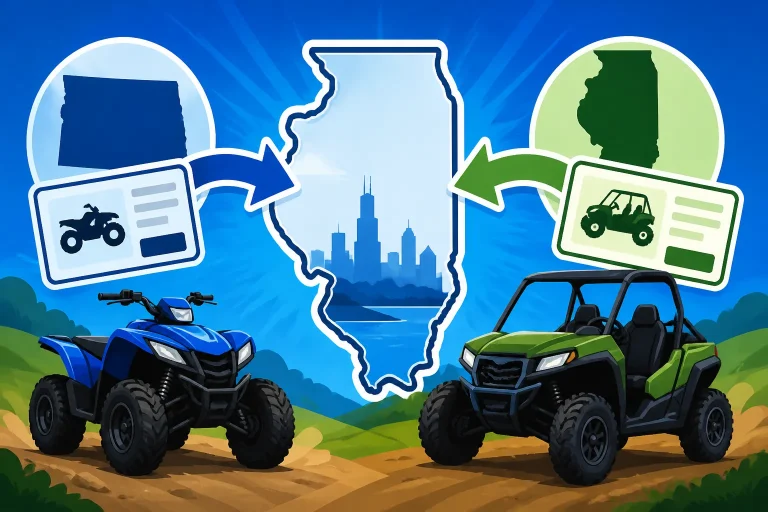
Visitors sometimes expect a safety card from their home state to function like a pass in Illinois. The safer approach is to separate training recognition from riding permission.
A certificate may show that someone completed a course, but it does not automatically satisfy Illinois access requirements, a park’s reservation rules or local street rules. Nor should a visitor assume that an Illinois course certificate is needed simply because a home state has a different approach. Ask what the Illinois destination requires.
For a visit, confirm these points before leaving home:
- Does the site require a course, orientation or other safety credential?
- If it does, will it accept the course you already completed?
- Does the rider’s age affect admission or supervision?
- Does each machine need its own required sticker, decal or permit?
- Is a site reservation required, and does it apply to each rider or each machine?
- Are there equipment or machine-condition checks at the entrance?
- Are local road rules relevant to any part of the planned route?
Visitors also need to distinguish access decals from training cards. An out-of-state registration or certificate should not be assumed to replace an Illinois access requirement. Start with [Illinois Public Access Decal Rules] and Illinois Visitors From Indiana if those topics fit your trip; visitors from other states should check the corresponding requirements for their own situation.
Reciprocity is not a single yes-or-no question. A state may recognize a credential for one purpose but not another. A park may accept a training card from elsewhere while still requiring its own waiver and permit. A local road ordinance may impose qualifications that have nothing to do with a trail-access sticker.
If you are visiting a private park, its operator is the most direct source for admission requirements. If you plan to use a public or grant-assisted site, confirm the applicable state access requirements and the site’s current procedures. If you will ride on streets, check the relevant local ordinance as well; trail training does not grant street privileges.
How to Check Whether a Course Is Required
A quick, direct check can prevent a wasted trip. Use this sequence whenever the rules are not clear.
- Name the exact riding location. “Riding in Illinois” is too broad. Identify the park, trail system, event, private property or road route.
- Identify who controls access. It may be a state agency, local government, park district, private operator, club or landowner.
- Ask about the specific rider. Provide the rider’s age, whether they will operate or ride as a passenger, and whether the machine is an ATV or UTV.
- Ask what “course” means. Find out whether the condition is a formal course, an orientation, a safety briefing, an online certificate or a site-specific assessment.
- Ask which proof is accepted. If you already have a card, provide the course name and ask whether it meets the site’s rule.
- Check all other entry requirements. Verify permits, decals, reservations, waivers, helmets, machine specifications and supervision separately.
- Save the answer. Keep a copy of the site’s current rules or written response with your trip information.
When contacting a site, a short, specific question is more useful than asking whether “Illinois requires a course.” For example: “I am bringing a 14-year-old operator on a youth-sized ATV. Does your site require a safety course or orientation, and what documents or supervision will you require at check-in?”
If the answer is “no course required,” follow up about the remaining conditions. A no-course answer does not necessarily resolve whether the rider can operate that machine, whether a parent must supervise, or whether the site requires a separate waiver.
If the answer is “course required,” ask whether there is a minimum course age, whether an online course is accepted, whether practical riding instruction is part of it and whether proof must be shown at the gate. Do not pay for a course based only on a vague recommendation if you need it to meet a particular rule. Verify the site’s acceptance first.
For broader questions about entry and riding documents, Illinois Permit Questions Riders Ask can help you keep the different requirements straight.
Build a Practical Safety Plan Without Treating a Course as a Pass
A course is only one piece of a safe ride. Whether or not it is required, make a plan that fits the riders, machines and terrain.
Before the trip, inspect the machine according to its manual. Check the controls, tires, brakes, lights where applicable, fuel or battery status, and any protective parts that matter for the planned terrain. Make sure each rider understands the controls and knows how to shut the machine down. Do not assume that experience on one model transfers perfectly to another.
Choose protective gear for the machine and conditions. A properly fitting helmet is a central part of off-highway safety. Eye protection, gloves, long sleeves, long pants and sturdy footwear can help reduce common riding injuries. Site rules may specify particular equipment, so check those requirements rather than relying on a general checklist.
If you are buying gear or a printed training resource online, Amazon may be one option for comparing products, but confirm that any helmet or protective equipment meets the requirements that apply to your activity. A product listing or customer review is not a substitute for checking fit, labeling and the site’s rules. Amazon can also be useful for assembling basic supplies such as a first-aid kit, but inspect what arrives and make sure it suits your group and trip.
Plan the route and riding pace for the least experienced person in the group. Agree on a stopping point if someone feels tired or uncomfortable. Keep a first-aid kit and communication plan appropriate to the location; cell coverage can be unreliable in some riding areas. On a longer trip, tell someone where you are going and when you expect to return.
For family rides, make sure every rider knows how to respond if the group gets separated. Establish a meeting place, simple hand signals and a rule against following an unfamiliar route alone. A course may introduce some of these habits, but it is the group’s responsibility to use them consistently.
Do not let the lack of a state course requirement become an excuse to skip preparation. Conversely, do not assume that taking a course gives you permission to ride on land or roads where machines are not allowed. Verify the site, obtain the required access documents and follow the rules that apply to your exact ride.
Common Misunderstandings to Avoid
“No statewide course means no safety rules.”
No. Other laws and site rules can still apply. Age, supervision, equipment, access permits, landowner permission and street-use requirements are separate issues.
“A course certificate lets me ride anywhere.”
No. Training does not grant access to private land or open a closed public area. It is not a substitute for an access decal, a park permit or a local road authorization.
“A park briefing counts as a state course.”
Not necessarily. A briefing may be a site requirement, but it is not automatically a formal course or a credential recognized elsewhere. Ask the operator what the briefing covers and what it satisfies.
“My home-state card settles the question.”
Not always. A site may accept it for training purposes, but it may not replace Illinois permits or other entry requirements. Confirm recognition with the specific operator.
“If a child has a certificate, they can operate any machine.”
No. Training does not establish that a rider is physically or developmentally ready for every machine, nor does it override age or supervision rules.
“A course makes a UTV legal on the road.”
No. Street use depends on the laws and local rules that apply to the road and vehicle. A course certificate does not replace a driver’s license, required equipment, insurance or local authorization.
The most reliable approach is to treat training as a safety tool and verify each legal or site requirement independently. That keeps a helpful course from being mistaken for a universal permit.
Disclaimer
This article is for general informational purposes only and does not constitute professional advice. Laws, prices and regulations vary by location and change over time. Consult a qualified professional for guidance on your specific situation.