Illinois Rules for a Fourteen-Year-Old Rider
A fourteen-year-old may be able to ride an ATV or UTV off-road in Illinois, but age alone does not settle whether a particular ride is allowed. The answer depends on where the machine will be used, the site’s rules, the child’s supervision and the vehicle’s size. Here’s how to check those pieces before unloading.
Start With Where the Fourteen-Year-Old Will Ride
Illinois does not have one simple age rule that makes every ATV or UTV ride legal at fourteen. A rider’s eligibility can depend on the type of land, the rules of the operator or land manager, and whether the ride is off-road or on a public street. Treat those as separate questions rather than assuming that permission at one location carries over to another.
Public streets are a different case
A local ordinance may allow certain non-highway vehicles on designated streets, but that does not automatically make a fourteen-year-old eligible to drive one there. Illinois street-use rules include an operator’s license requirement. A young rider who cannot meet that requirement should not operate a UTV or other covered machine on a public road, even if the town allows some vehicles on some streets.
Street access also comes with equipment, insurance and route restrictions. A machine that can be used on a private trail is not automatically street legal, and a town permit does not cancel state requirements. Before planning a road route, check Can You Drive a UTV on the Road in Illinois? and the specific local ordinance. If the trip would involve only off-road riding, keep the machine off public streets except where a lawful crossing is permitted.
A parent driving the UTV does not necessarily make it acceptable for a fourteen-year-old to operate on the road. The person at the controls must meet the rules for that operation. For a closer look at the distinction, see Illinois Rules for Riding a Village Street.
Off-road permission depends on the site
Off-road access is not the same thing as unrestricted access. A state or grant-assisted riding area, a county-run park, a private riding park and private land can each have their own conditions. One site may admit a fourteen-year-old operator with an adult and a signed waiver; another may set a higher minimum age, restrict the type of machine, or apply manufacturer age guidance.
Do not rely on a friend’s experience at a different park. Before leaving home, ask the site operator these specific questions:
- May a fourteen-year-old operate a machine at this site?
- Must a parent or other adult remain with the rider, and what does “supervision” mean there?
- Are there limits based on the machine’s type, size, speed or seating?
- Does the operator need a driver’s license, safety credential or other proof?
- Does a parent or guardian need to sign a waiver or attend check-in?
- Are there separate rules for passengers?
For more on how supervision can work at a riding area, see Illinois Supervision at a Riding Park. If the destination is a private park, check Illinois Private Park Age Minimums as well as the park’s current admission rules. A private operator may set conditions that are stricter than the minimum you expected.
Private land still requires permission
Riding on a family property or other private land may avoid some public-site admission procedures, but it does not remove the need for permission or sensible safety limits. Get permission from the landowner if the rider is not on property the family controls, and confirm that the land is suitable for riding. A field, farm lane or private yard is not permission to cross onto a neighboring property or continue onto a public road.
For private-property access and landowner consent, see Illinois Private Land Permission Rules. Also remember that permission to ride a property does not settle whether the vehicle is properly titled, whether a permit applies elsewhere, or whether the rider is using the machine safely.
Match the Rider to the Machine and the Site
A fourteen-year-old’s age is only one part of the decision. The machine’s dimensions, controls, power and handling matter too. A vehicle that is too large or powerful can be difficult for a young operator to control, especially on uneven ground, in mud or around other riders. An adult should assess the fit before the first ride, not after the child is already on a busy trail.
Check the manufacturer’s age guidance
Read the owner’s manual and the age guidance shown on the machine. Use that information as a safety limit, not as a target to work around. If the vehicle is marked for a younger age group, that does not mean it is automatically appropriate for every younger child. Conversely, a fourteen-year-old being tall enough to reach the controls does not prove they can manage the machine’s weight, braking, steering or acceleration.
The adult should check that the rider can:
- Sit comfortably and reach the controls without stretching.
- Operate the throttle and brakes smoothly.
- Turn the handlebars and keep a stable riding position.
- Stop the machine promptly and understand how to shut it off.
- Follow instructions without being distracted by passengers or other riders.
A youth ATV is not necessarily suitable just because it is sold as a youth model. Consider the rider’s size and experience, the terrain, and the type of riding planned. If a park checks machines against factory specifications, modifications may also affect whether the machine is admitted. Confirm those requirements before driving to the site.
Set supervision expectations before arriving
“An adult is coming along” can mean different things to different operators. One site may expect a parent to remain nearby; another may require an adult to ride with the child or be present at check-in. Some may have a separate rule for whether the supervising adult needs to be on their own machine. Ask the site what it requires rather than assuming that being somewhere on the property is enough.
Parents and guardians should also decide what supervision is appropriate for the terrain and the child’s skill. A first ride on a quiet, open area calls for a different plan from a crowded trail with blind turns. If the child has little experience, begin on suitable, low-traffic terrain and stay close enough to intervene. Do not let the child follow faster riders beyond the adult’s ability to keep them in view.
For broader youth-rider considerations, see Illinois Rules for Young Riders and Illinois Parent Riding With a Child. A site’s minimum requirement is a starting point, not a promise that every route or machine is a good fit.
Confirm passenger rules separately
A fourteen-year-old may be an operator in one situation and a passenger in another, but the rules can differ. The machine must be designed for passengers, and the site must allow them. A child should never ride on a machine with no appropriate passenger seat or footrests, and the operator must not exceed the vehicle’s seating capacity.
Do not assume that a passenger can ride simply because the vehicle has room. Ask the park whether it allows a fourteen-year-old passenger, whether an adult must operate the vehicle, and whether any age or size restrictions apply. For more detail, see Illinois Rules for Passengers on a UTV.
Permits, Decals, Waivers and Safety Gear
Age and site access are separate from paperwork. A permit or decal does not override an age restriction, and an adult’s permit does not necessarily cover a child’s machine. Confirm what applies to the specific location and vehicle before the trip.
| Item to check | What to confirm before riding |
|---|---|
| Site admission | Whether the destination admits a fourteen-year-old operator and what supervision it requires |
| Machine access | Whether the machine type, size and factory setup meet the site’s rules |
| Permits or decals | Which requirements apply to the location and whether they are tied to each machine |
| Waiver | Who must sign for a minor and whether a parent or guardian must be present |
| Proof of ownership | What documents the rider or adult should carry |
| Safety equipment | Helmet and protective-gear requirements, plus any stricter site rules |
Do not confuse a stamp with an access decal
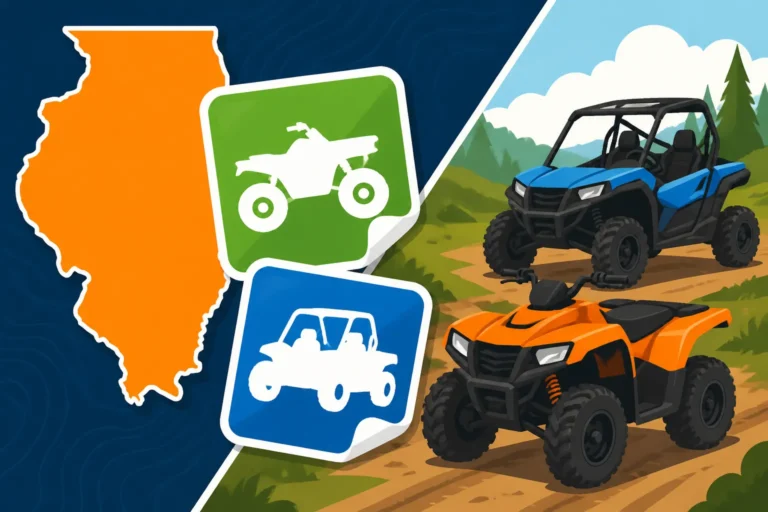
Illinois OHV stickers serve different purposes. A usage stamp and a public-access decal are not interchangeable, and neither one grants entry to every place that offers riding. A riding site may also require its own reservation, day permit or check-in. The rules can vary with where the machine will be used, so check the destination’s current instructions and the relevant state requirements.
The distinction is explained in Illinois OHV Permits: Two Stickers Explained. If you are unsure whether a particular location requires an access decal, start with Illinois Public Access Decal Rules. For a general comparison of what each sticker covers, see What the Stamp Covers and What the Decal Covers.
Do not buy a permit on the assumption that it makes a fourteen-year-old eligible to ride. First establish that the site permits the child to operate that machine. Then confirm which paperwork applies to the vehicle and the site.
Ask who signs the waiver
A fourteen-year-old should not assume they can complete all admission paperwork alone. Some operators require a parent or guardian to sign a minor’s waiver, and the adult may need to be present. Ask whether the form can be completed before arrival, whether every rider needs an individual form, and whether the supervising adult must check in with the child.
A waiver does not replace safety rules or give permission to use a machine that the site will not admit. Keep the site’s confirmation, reservation details and any required documents accessible at check-in. For related information, see Parents Must Sign the Waiver for a Child.
Bring suitable safety gear
Check both state requirements and the riding site’s rules for helmets and other protective equipment. Even when a particular item is not listed as a condition of entry, a properly fitted helmet, eye protection, gloves, long sleeves, long pants and over-the-ankle footwear are sensible basics for off-road riding. The gear should fit the child; adult-sized equipment that shifts or leaves gaps may offer poor protection.
Review Illinois ATV Helmet Rules and Illinois Helmet Rules on State Areas for the setting you plan to visit. A park may impose its own rules, so ask whether it requires a particular helmet standard or other equipment. Pack protective gear before travel rather than hoping to borrow a suitable fit at the gate.
A Practical Check Before the First Ride
Use this sequence whenever a fourteen-year-old will ride somewhere new. It prevents the common mistake of checking only the permit while overlooking age limits, machine rules or waiver requirements.
- Identify the exact riding location. Separate public land, a grant-assisted site, a private park and private property. Confirm the name and operator of the place, not just the general area.
- Ask whether a fourteen-year-old may operate the machine. Get the site’s answer directly, including any minimum age, adult-supervision or license conditions.
- Describe the machine accurately. Give the operator its type and relevant details, including whether it is an ATV or UTV and whether it has been modified. Ask about age guidance, factory specifications and passenger capacity.
- Clarify what supervision means. Find out whether the adult must stay at the gate, ride alongside, remain within sight or meet another requirement.
- Check permits and admission separately. Confirm any state stamp or decal requirements, site reservation or day permit, and whether each machine needs its own paperwork. Start with Do Illinois Kids Need Their Own Permit? if you are sorting out permit responsibilities.
- Ask about documents and signatures. Confirm who signs the waiver, whether a parent must attend, and what proof of ownership or reservation information to bring.
- Review the route and conditions. Choose terrain that suits the child’s experience. Check the site’s hours, closures and trail conditions before towing there.
- Set boundaries with the rider. Agree on where the child may ride, how to stay with the supervising adult, what to do if separated and when to stop.
If the operator gives an unclear answer, do not treat silence as approval. Call again or choose a destination whose age and supervision rules are clear. When a site’s policy and a broader state requirement seem to conflict, ask the relevant site operator or state agency which rule applies before riding.
A fourteen-year-old can have a safe, enjoyable off-road outing when the location, machine and supervision are a good match. The key is to confirm eligibility at the exact destination, rather than assuming that a permit, an adult’s presence or the child’s riding experience settles every requirement. For general youth-safety training options, see Illinois Safety Course Options.
Disclaimer
This article is for general informational purposes only and does not constitute professional advice. Laws, prices and regulations vary by location and change over time. Consult a qualified professional for guidance on your specific situation.