Putting an Illinois Child on Too Much Machine
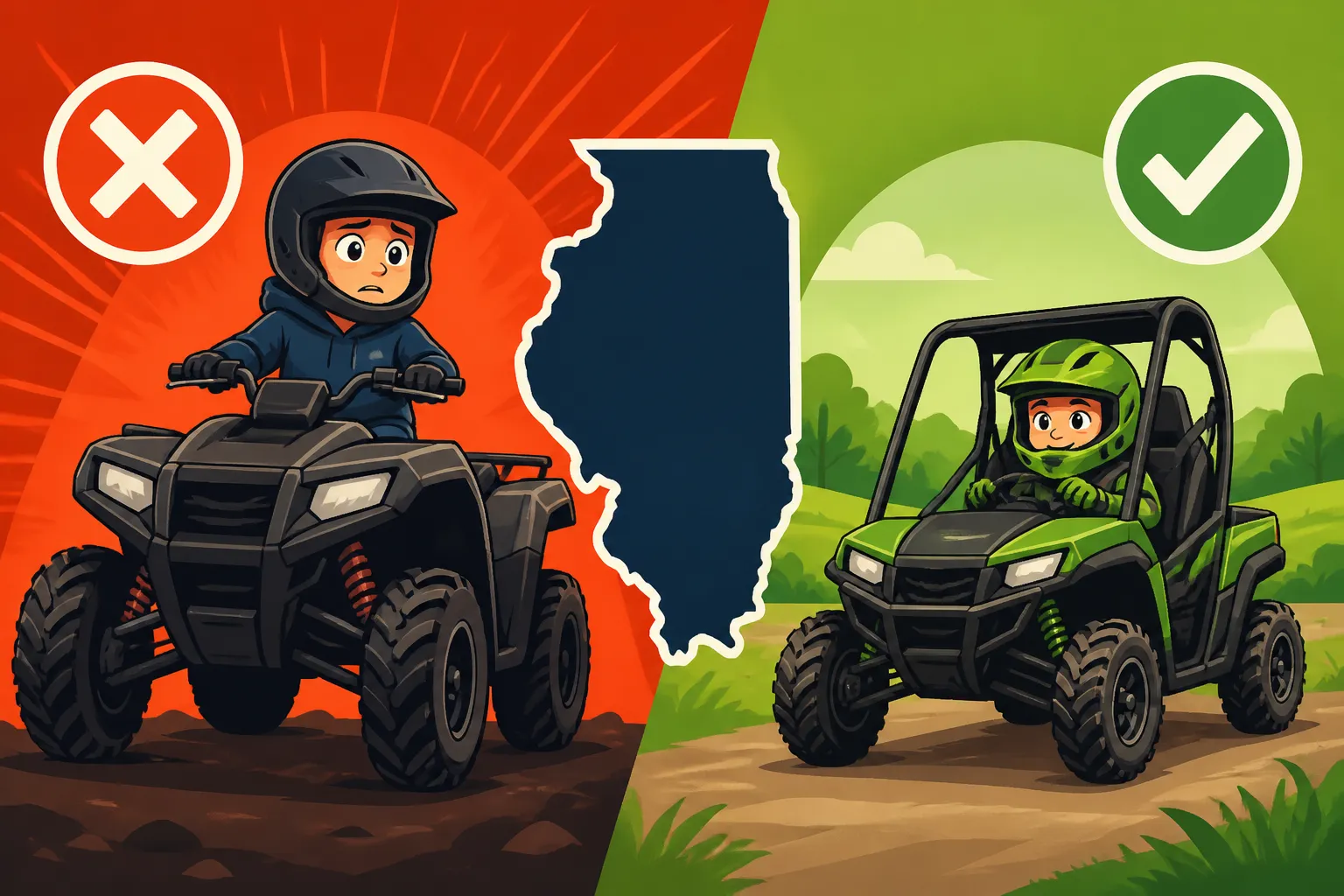
Putting an Illinois child on too much machine is not just a question of age or engine size. A quad or side-by-side that is hard to reach, steer, or stop can overwhelm a young rider before a trail gets difficult. Use fit, control, experience, and the riding site’s rules to choose a safer match—and know when the right choice is to wait.
What “too much machine” really means
A machine is too much for a child when the child cannot operate it smoothly and reliably in the conditions they will face. Engine size matters, but it is only one part of the decision. A smaller machine can still be a poor fit if the child cannot reach the controls or handle its weight, while a capable young rider may still be unprepared for unfamiliar terrain, passengers, or a busy trail.
Start with the manufacturer’s age and size guidance for the specific model. Treat that as a minimum screening step, not a guarantee that the child is ready. The guidance cannot account for every child’s strength, coordination, judgment, or experience. Park policies may also refer to manufacturer recommendations, so check both before you travel. Manufacturer Age Guidance at a Park explains why a machine’s published guidance can matter at the gate.
A good fit lets the child operate the vehicle without stretching, twisting, or shifting position to reach controls. On an ATV, the rider should be able to sit securely, hold the handlebars, use the controls, and move their body as needed. They should also be able to reach and use the brakes confidently. If the child’s hands cannot operate the controls or their feet cannot find a stable position, the machine is not a suitable choice just because it is available.
Weight and stopping ability matter as much as acceleration. A child who can twist a throttle may not have the strength or coordination to slow down, brake on a slope, or control a machine that starts to slide. A heavier ATV can be difficult to turn or recover after a tip. A powerful machine may respond quickly to a small throttle movement, leaving little time to correct a mistake.
For a UTV, assess whether the child is an eligible operator under the site’s rules and can reach and use the controls while seated properly. A passenger seat is not an operator’s seat, and a child’s ability to ride as a passenger does not mean they are ready to drive. A UTV’s enclosed or larger appearance can create a false sense of security; it still has weight, momentum, blind spots, and rollover risk.
The child’s behavior is another part of fit. A young rider who follows directions in a quiet setting may react differently when a machine is noisy, the trail is crowded, or another rider is close behind. Consider whether the child can remember instructions, avoid racing friends, stop when asked, and tell an adult when they feel unsure. If they hide fear or become impulsive when excited, they may need more practice on a smaller, more manageable machine.
A child can also outgrow a machine’s physical fit before they are ready for a larger one. Growth alone does not establish skill. Moving up should follow demonstrated control on easier terrain, not a birthday, a friend’s upgrade, or the desire to keep up with adults.
How to test whether the child can control it
Do the fit check while the machine is parked, switched off, and on level ground. Follow the owner’s manual and the machine maker’s instructions. Do not use a moving trail ride as the first test of whether the child can reach a brake or manage the throttle.
Use this checklist:
| Check | What to look for | Warning sign |
|---|---|---|
| Riding position | The child can sit securely and keep a stable posture | They slide around, lean awkwardly, or cannot stay balanced |
| Reach | Hands and feet reach the controls without stretching | They must release a grip or shift position to operate a control |
| Braking | The child can use the brake as instructed and understands how to stop | They hesitate, use the wrong control, or cannot apply it effectively |
| Steering | The child can turn the handlebars or steering wheel smoothly | Steering requires excessive effort or causes them to lose position |
| Throttle | The child can apply power gradually and release it when told | They jerk the throttle, grip it tightly, or struggle to let go |
| Judgment | The child stops, listens, and follows directions consistently | They speed up to catch others, ignore signals, or take risks to impress friends |
| Protection | The helmet and other required gear fit and stay secure | The helmet shifts, blocks vision, or is not appropriate for the activity |
A stationary check is not a substitute for instruction. If the child passes it, begin in a controlled, open area permitted by the property owner or riding site. Keep the first practice slow and simple. Teach starting, stopping, turning, and yielding before attempting hills, ruts, mud, or narrow trails. Change only one challenge at a time: for example, introduce a gradual turn before adding uneven ground.
Watch the child’s hands and body, not just the machine’s path. A rider who repeatedly grabs the throttle, locks their arms, looks down, or struggles to hold a line may be overwhelmed even if they have not crashed. Stop and reassess rather than encouraging them to push through. Fatigue also changes control. A child may ride competently early in the day and become less attentive later, especially in heat or after a long stretch of concentration.
Set clear boundaries before the engine starts. Agree on where the child may ride, how far ahead they may go, what signal means “stop,” and what to do if they lose sight of the adult. Make stopping an ordinary part of the ride, not a punishment. If a child feels pressured to continue after becoming uncomfortable, they may conceal a problem instead of asking for help.
Protective equipment should fit the rider, not just the machine. A properly fitted helmet is essential, and other gear should suit the riding conditions and the site’s requirements. For details about local riding-area requirements, see [Helmet Rules at an Illinois Riding Park]. If you are shopping for youth-sized protective gear, Amazon may offer multiple brands and sizes, but check the product’s fit guidance and return conditions; a convenient listing is not proof that the gear fits safely.
Check Illinois rules and the riding site before you go
There is no one-size-fits-all answer to whether a particular child may operate a particular ATV or UTV in Illinois. Requirements and policies can depend on the type of machine, where it will be ridden, and the site’s own rules. Do not assume that a child who can legally ride in one setting may operate the same machine at every Illinois park or public riding area.
Before loading the machine, check the current rules for the specific destination. Ask whether the site has minimum age or operator requirements, whether the rules differ for ATVs and UTVs, and whether the machine must meet factory specifications. Also ask what supervision is required and whether a youth rider needs separate paperwork, a permit, or a waiver. Illinois Rules for Young Riders provides a broader overview, while Illinois Supervision at a Riding Park focuses on adult oversight at riding areas.
Some sites may check the machine against its factory specifications or apply manufacturer age guidance. A modified throttle, speed control, suspension, or other equipment may affect whether a machine is allowed, even if the change was made with a child in mind. Check the destination’s policy rather than relying on what was permitted at another park. See Machines Checked Against Factory Specifications at the Gate and Why a Modified Machine Gets Turned Away for related considerations.
The child’s permit or access requirements are separate from whether the machine is a safe fit. Confirm what the child and vehicle need for that specific site, and do not assume a parent’s permit automatically covers a child or another machine. Do Illinois Kids Need Their Own Permit? can help clarify the permit question.
A useful pre-trip call can be brief. Give the site the child’s age, the machine’s make and model, and whether the child will operate or ride as a passenger. Ask the staff to confirm the current policy and what documents or equipment they expect at check-in. If an answer is unclear, ask for the relevant written rule or a link to the site’s posted requirements. Bring the child’s protective gear and any required paperwork, but do not treat paperwork as a substitute for safe sizing.
Rules for young operators can be specific enough that a child’s age alone does not settle the matter. For example, a ten-year-old and a fourteen-year-old may have different questions to resolve about experience, equipment, supervision, and the destination. The related pages Illinois Rules for a Ten-Year-Old Rider and Illinois Rules for a Fourteen-Year-Old Rider address those age-specific concerns. Whatever the child’s age, verify current site requirements before leaving home.
Choose a slower progression, not a bigger machine
A safer progression gives the child time to develop control before adding power, speed, passengers, or difficult terrain. Begin with a machine that fits the child’s body and ability, then build skills on terrain where stopping and turning are straightforward. Move to more demanding conditions only when the rider can consistently manage the basics without constant adult correction.
Do not treat a speed limiter as a complete solution to a machine that is too large or heavy. Limiting speed may reduce one risk, but it does not make an oversized seat, difficult brake, heavy chassis, or sharp throttle response disappear. If the child cannot steer or stop the machine confidently, choose a better-fitting machine instead.
Avoid using an adult ATV as a temporary youth vehicle simply because it is already in the garage. The child may be able to sit on it or reach the throttle while stationary but still lack the leverage, strength, and balance to manage it in motion. A child should not operate a machine that is outside the manufacturer’s guidance or against the riding site’s rules, even for a short lap.
For a UTV, keep operator and passenger roles distinct. Do not let a child drive from a passenger position or take the wheel in an area where the site does not allow it. When the child rides as a passenger, use the vehicle’s intended seating positions and restraints as directed, and follow the site’s rules for passengers. A child who is too small to sit securely or use the restraint correctly is not made safe by an adult sitting nearby.
Make the first outing short enough to end before the child is exhausted or overwhelmed. Choose simple terrain and keep the group together at a pace the least experienced rider can manage. An adult should be close enough to supervise, see the child, and intervene if necessary; riding far ahead and checking in occasionally is not effective supervision. If the trail becomes more difficult than expected, turn back rather than asking the child to follow adults through it.
If the child has a close call, loses control, or repeatedly ignores instructions, stop the ride and reassess. Do not respond by giving the child a more powerful machine to “grow into,” or by expecting confidence to appear after more exposure. The useful question is not whether the child can make the machine move, but whether they can manage it predictably, stop when needed, and make good decisions in the place they are riding.
When the fit is uncertain, choose the smaller and easier option, or make the outing a passenger ride instead of an operating lesson. A child who is ready for more will show it through consistent control and good judgment, not simply through enthusiasm. The safest upgrade is the one the child can handle—not the one that looks most like the adults’ machines.
Disclaimer
This article is for general informational purposes only and does not constitute professional advice. Laws, prices and regulations vary by location and change over time. Consult a qualified professional for guidance on your specific situation.