Illinois Rules for a Ten-Year-Old Rider
A ten-year-old may be able to ride an ATV or UTV in Illinois, but age alone does not settle the question. Adult supervision, the machine’s size and seating, the place you plan to ride, and that site’s own rules all matter. Here’s how to check those pieces before you load up.
What Illinois rules mean for a ten-year-old
Illinois places restrictions on off-highway vehicle operation by people under 16. For a ten-year-old, the practical rule is clear: do not plan on independent riding. An adult should supervise closely, and you should confirm the current state requirements and the riding location’s rules before setting out. A parent’s presence does not automatically override a park’s age limit or make every machine suitable for a child.
The important distinction is between riding an off-highway vehicle on a permitted trail or private property and driving a vehicle on a public road. A child who is allowed to operate a small ATV in a supervised riding area is not thereby allowed to drive a UTV on streets. Illinois street use has separate requirements, including a driver’s license and vehicle equipment rules. A ten-year-old does not meet the licensing requirement for street driving. See Do You Need a License for a UTV in Illinois? and Can You Drive a UTV on the Road in Illinois? for that separate issue.
For off-road riding, check three layers before the child starts:
- Illinois law: Confirm the rules that apply to under-16 operators and the type of land where the machine will be used.
- Site rules: Ask the riding area about minimum ages, required supervision, machine types, passenger limits, and any check-in requirements.
- Machine guidance: Follow the manufacturer’s age recommendation and make sure the controls and size are appropriate for the child.
A facility can set stricter rules than the broad state baseline. For example, a park may restrict children to certain trails, require a parent to ride with them, or reject a machine that does not meet its specifications. If a site’s answer is unclear, call or message the operator before traveling rather than relying on a rule from another park.
Illinois does not have a single statewide safety-course requirement that makes a ten-year-old eligible to ride every machine at every location. A safety course can still be worthwhile, but it is not a substitute for checking age limits, supervision rules, and the site’s conditions. For the wider age and supervision picture, see Illinois Rules for Young Riders and Illinois Parent Riding With a Child.
Choosing an ATV or UTV a child can control
A child’s age is only a rough guide to whether a machine is manageable. Height, reach, strength, coordination, experience, and the vehicle’s weight and power all matter. A ten-year-old who can sit on an ATV may still be unable to reach the brake comfortably, turn the handlebars while standing, or control the machine on a slope.
Before riding, have the child sit on the machine with the engine off. Check that they can:
- Reach and operate the throttle and brakes without stretching or shifting awkwardly.
- Keep both hands on the handlebars and maintain a stable posture.
- Place their feet securely where the manufacturer intends them to go.
- Turn the handlebars through their full range without losing balance.
- Understand how the controls respond and stop the machine predictably.
Follow the manufacturer’s age guidance for the specific model. Do not assume a machine is suitable just because it has a youth-sized seat, because an adult says the child is careful, or because another child rides the same model. Avoid letting a ten-year-old operate an adult-sized ATV or UTV that is too heavy or powerful for them to control. A machine that is difficult to stop or steer can become dangerous even at low speed.
A UTV has different risks from a youth ATV. Its seat belt, rollover protection, doors or nets, and passenger arrangement matter, but they do not make every UTV suitable for a child operator. Check the manual and the riding area’s rules. A child who is permitted as a passenger is not necessarily permitted to drive.
A child as a passenger
Treat carrying a child as a separate question from letting them operate. An ATV built for one rider should not be used to carry a passenger, even if the child can hold on. The extra weight can affect balance and control, and many single-rider models do not have a proper passenger seat or footrests.
For a UTV, use only a seating position designed for a passenger. The child should fit the seat and restraint correctly, and the belt should be secured as the manufacturer directs. Do not carry a passenger in a cargo bed or on an improvised seat. Check both the machine manual and the site’s passenger policy; either one may be more restrictive than your own judgment.
Where a ten-year-old can ride
The place matters as much as the machine. Private property, a designated riding area, a grant-assisted public site, and a public road do not all follow the same rules. Permission to ride on one kind of land does not carry over to another.
On private land, get the landowner’s permission and check any applicable rules for the property. Permission is not a blanket exemption from safety requirements, and it does not allow riding onto a road or neighboring land. See Illinois Private Land Permission Rules for what to sort out before riding on someone else’s property.
At a public riding area, confirm that the land is actually open to off-highway vehicles and that the site allows children of the rider’s age. Illinois has public land that is not designated for ATV or UTV riding, so a public trail or parking area should not be assumed to be open to machines. Illinois Land You May Not Ride explains why checking the land designation matters.
A designated site can have its own admission, permit, waiver, and supervision requirements. Some public riding locations require vehicle paperwork or a sticker, while private parks may use their own passes and procedures. Those items do not grant permission to ride on unrelated land or roads. For help distinguishing the state’s OHV stickers, see Illinois OHV Permits: Two Stickers Explained.
| Riding location | What to check for a ten-year-old |
|---|---|
| Private property | Landowner permission, applicable age and supervision rules, safe boundaries, and whether the child can operate the machine |
| Public riding site | Whether the area is designated for OHVs, current operating rules, age limits, adult-supervision requirements, and required permits |
| Private off-road park | The park’s minimum age, approved machine types, passenger rules, waiver process, and trail restrictions |
| Public road | A ten-year-old cannot meet Illinois’ driver’s-license requirement for street operation; off-road permission does not make road use legal |
Permits are not child riding permission
Illinois’ OHV usage stamp and public access decal serve different purposes from a park’s rules about who may ride. The stamp and decal relate to machine use and access requirements; they do not establish that a ten-year-old may operate that machine at a particular site. A required sticker on the vehicle cannot replace adult supervision, a facility’s age policy, or the right machine for the rider.
Check the rules for the actual destination and the machine, not just whether an adult has bought a permit. If you are riding at a grant-assisted site, confirm what decal applies and where it must be displayed. Illinois Public Access Decal Rules covers the decal’s role, while Illinois Usage Stamp vs Access Decal explains how the two requirements differ.
A practical pre-ride check for parents
Use this checklist before the first ride and again whenever the location or machine changes:
- Call the site. Ask whether a ten-year-old may operate the specific type of machine, whether direct adult supervision is required, and whether children have to stay on designated trails or beginner routes.
- Read the machine manual. Check the manufacturer’s age guidance, passenger limits, operating instructions, and recommended safety equipment.
- Check fit and control. With the engine off, confirm the child can reach the controls, maintain a stable position, steer, and stop the machine.
- Set a clear riding plan. Agree on where the child may go, how close the supervising adult will stay, and what signal means stop immediately. Avoid letting the child ride out of sight or ahead on unfamiliar trails.
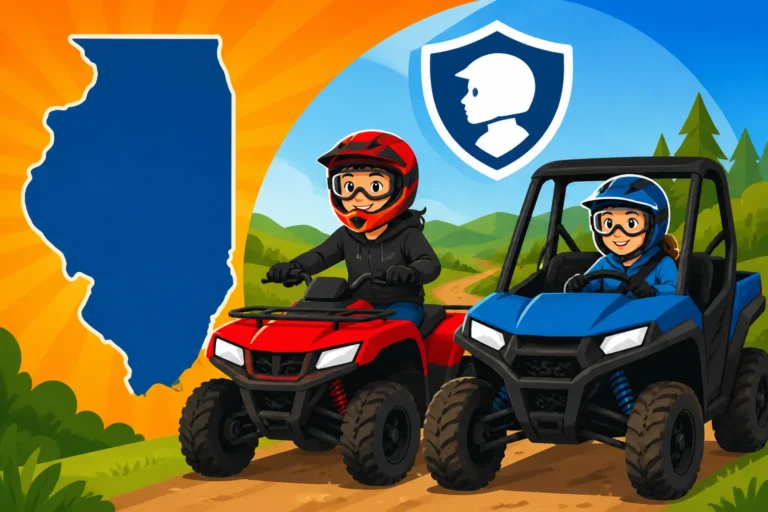
- Use protective gear. Choose a properly fitted helmet and other protective equipment suited to the machine and riding conditions. Make sure the child can see and move freely while wearing it. If buying equipment online, including through Amazon, verify the product’s size, intended use, and safety markings rather than relying on a product title alone.
- Check the route and conditions. Mud, loose gravel, hills, traffic, and other riders can make an otherwise manageable trail unsuitable. Start on terrain appropriate to the child’s ability and stop if conditions change.
- Keep permits and site instructions straight. Carry or display whatever the destination requires, but remember that paperwork does not authorize riding where machines are prohibited.
Adult supervision should be active, not just nearby. Stay close enough to notice loss of control and respond quickly. Do not supervise while distracted, and do not let a child ride beyond what the adult can see and manage. If the child is tired, upset, confused by the controls, or struggling to keep pace, end the ride or take a break.
The safest decision is not always to ride. If the child cannot reach the controls, the park does not permit their age group, the machine is too large, or the route exceeds their ability, choose another machine or wait. A ten-year-old’s eligibility depends on the rules at the specific location and on whether the child can control the specific vehicle—not simply on having an adult nearby.
Disclaimer
This article is for general informational purposes only and does not constitute professional advice. Laws, prices and regulations vary by location and change over time. Consult a qualified professional for guidance on your specific situation.