Illinois Hunting License and Machine Access
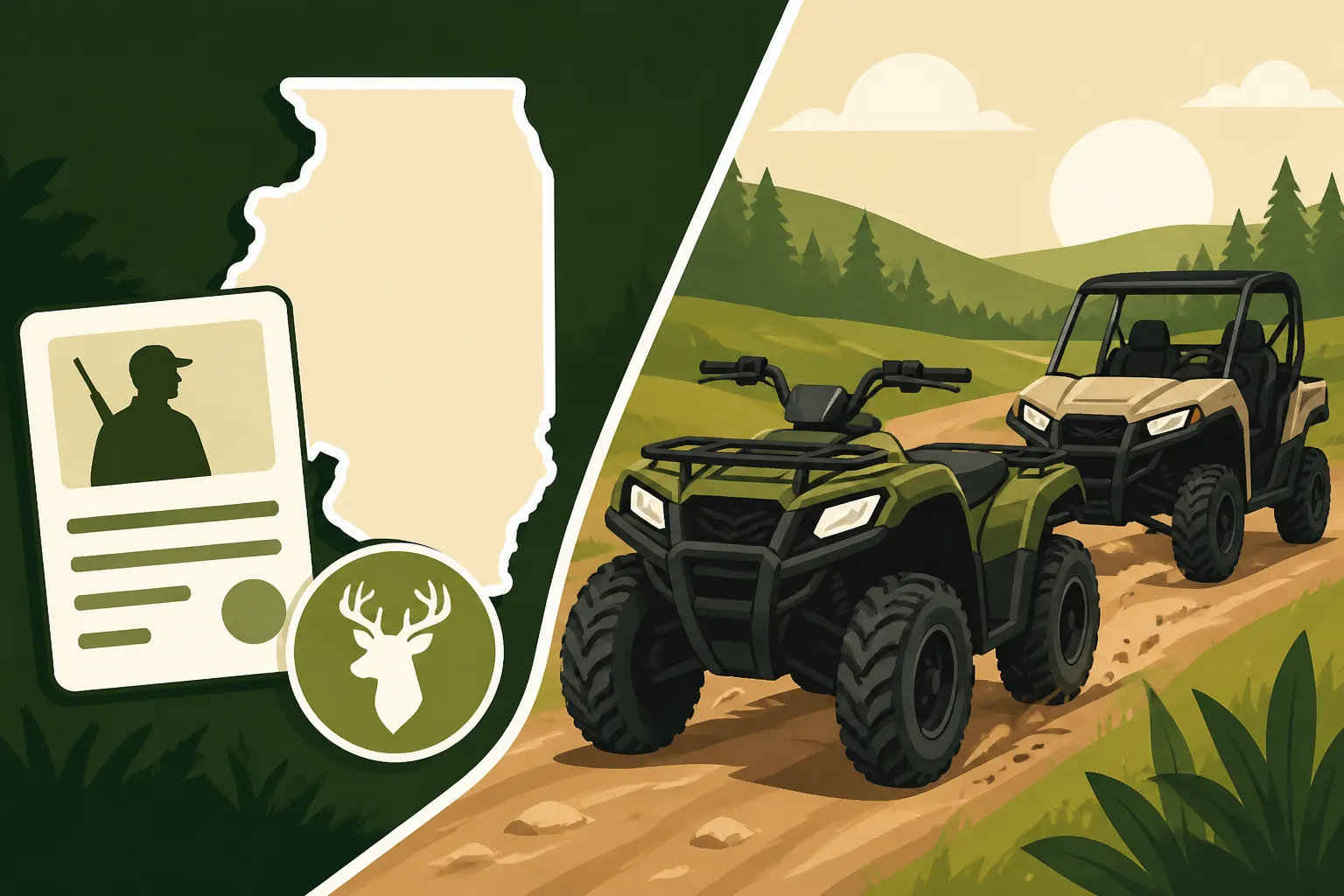
An Illinois hunting license can make a hunt legal, but it does not automatically make the trip to your hunting spot legal by ATV or UTV. Machine access depends on where you ride, which routes are open, and what permits the vehicle needs. Keep those questions separate before you load your gear: a hunting credential is not a general riding pass.
What a hunting license does and does not allow
A hunting license is about the person hunting. It does not, by itself, authorize an ATV or UTV to travel across public land, enter a riding area, or use a road closed to motorized vehicles. Nor does it give you permission to cross private property on the way to a hunting location.
That distinction matters because a trip can involve several separate permissions:
- Hunting authority: Do you have the license, tags, stamps, or other credentials required for the species and activity?
- Land access: Is hunting allowed on this property, and do you have the required permission or reservation?
- Vehicle access: Are motorized vehicles allowed, and is the route you plan to use open to your machine?
- Machine paperwork: Does the ATV or UTV need an Illinois off-highway permit, title, or other documentation for the way you intend to use it?
A “yes” to one does not answer the others. A hunting license does not open a closed trail. A riding permit does not give you hunting permission. And permission to hunt a property does not necessarily include permission to drive an ATV across it.
The practical rule is simple: verify the hunting rules and the motor-vehicle rules independently for every property or site. If you are hunting on private land, confirm vehicle access directly with the landowner. If you are on public land, check the managing agency’s current rules and any posted signs before unloading.
For a fuller explanation of the basic distinction, see Your Hunting License Is Not a Riding Permit. For broader context on the relationship between a hunt and motorized travel, Illinois Hunting Access by Machine is also relevant.
How Illinois machine permits fit into a hunting trip
Illinois has separate requirements for off-highway machine use. The relevant permit depends on the machine, where it will be operated, and whether the location has a specific access requirement. A hunting license does not replace a required usage stamp or public-access decal.
A usage stamp and an access decal serve different purposes. In general terms, the stamp is associated with operating a qualifying off-highway vehicle on public land, while the decal is associated with access to grant-assisted riding sites. The details can depend on the machine and location, so do not assume that one item covers every kind of public-land travel. The distinctions are explained in Illinois Stamp and Decal Compared and Illinois Public Access Decal Rules.
| What you have or want to do | What it addresses | What it does not automatically authorize |
|---|---|---|
| Illinois hunting license | Your eligibility to hunt, subject to applicable rules | Riding an ATV or UTV on a closed or unauthorized route |
| Landowner’s permission to hunt | Hunting access to the property, within the permission given | Driving the machine across the property unless vehicle use is included |
| Off-highway usage stamp | Applicable machine use under Illinois stamp rules | Hunting permission or access to every public property |
| Public-access decal | Access requirements at applicable grant-assisted riding sites | Permission to hunt or ride outside that site’s rules |
| Local or site-specific authorization | Use allowed by that particular land manager | A statewide right to ride elsewhere |
The table is a planning aid, not a substitute for checking the current rules. Permit requirements can vary with the vehicle and the kind of property. Review Illinois OHV Usage Stamp Explained and Illinois Decal Rules at a Grant Site before relying on a stamp or decal for a particular trip. If an exemption may apply, verify its conditions rather than assuming that hunting activity qualifies; Illinois Usage Stamp Exemptions explains the issue.
Also distinguish a machine permit from road authorization. A stamp or decal does not make an ATV or UTV street legal and does not let you ride on any public road you choose. Road use is a separate question governed by the road’s jurisdiction and applicable local rules. If your plan includes a road connection between a parking area and hunting ground, check that connection separately instead of treating the machine permit as permission to use it.
Checking access before hunting season
The most reliable way to avoid a wasted trip is to check each property and route before you haul the machine. Public hunting access can be limited to specific areas, dates, roads, or vehicle types. A route that appears on a map may not be open to motorized use, and a gate or trailhead may have rules that differ from the general hunting regulations.
Use this process for each location:
- Identify who manages the land. Find out whether it is private property, a public hunting area, a riding site, or land managed by another organization. Rules from one property do not automatically carry over to another.
- Confirm that hunting is allowed. Check the current hunting information for the property and the species you plan to pursue. Confirm any required license, tag, reservation, or season condition through the appropriate official source.
- Ask specifically about the machine. Find out whether ATVs or UTVs are allowed at all, which routes are open, and whether access is limited to parking, loading, or designated travel.
- Check the machine’s permit requirements. Confirm whether the location calls for a usage stamp, access decal, separate site authorization, or no machine permit under the applicable rules. Do this for the specific vehicle, not just for the trip.
- Check dates, gates, and closures. Hunting season does not guarantee that a route is open. Weather, maintenance, safety restrictions, or seasonal management can change access.
- Keep proof and follow posted instructions. Carry the required hunting credentials and machine documents, and follow signs at entrances and along routes. Written landowner permission is useful where applicable; it should clearly cover the vehicle as well as hunting if you intend to ride.
For private property, ask directly whether you may drive to the hunting area, where the machine may be parked, and whether you may use it to retrieve equipment or game. A landowner might permit hunting but expect you to walk in. Avoid treating silence or a previous season’s arrangement as permission for a new trip. Keeping a Landowner’s Written Permission on You covers why clear, documented permission can help.
For public land, use the managing authority’s current information rather than relying only on a general trail map or another rider’s recollection. Read notices at the site, and do not bypass a barrier because a route looks passable. Check Illinois Land You May Not Ride if you need a broader reminder about areas that are off limits to machines.
If your destination is a designated grant-assisted riding site, its access rules still apply even if you are going there to hunt nearby. The site’s decal requirement is not a hunting permit, and your hunting license does not satisfy the decal requirement. For general permit information, see What the Stamp Covers and What the Decal Covers.
Deer season, vehicle use, and common mistakes
Deer season adds a timing issue: the property may have hunting-specific rules, temporary closures, or restrictions on where vehicles can travel. Do not assume that because the land is open to hunters, every trail or road on it is also open to ATVs and UTVs. Confirm whether motorized access is permitted during the dates you intend to hunt. Illinois Deer Season Trail Access is a useful related topic when planning a seasonal trip.
A machine can be useful for hauling gear or reaching an authorized parking area, but convenience does not expand your permission. If vehicle access is limited, follow the stated boundary. Do not use a machine to cross fields, cut around gates, create a new route, or drive through vegetation to get closer to a hunting spot. Besides creating access and safety problems, that can damage property and jeopardize future permission.
Common mistakes include:
- Treating the hunting license as a riding pass. It covers a hunting requirement, not general off-highway travel.
- Assuming hunting permission includes machine use. Ask whether the permission covers the vehicle and the route, not only the hunt.
- Confusing a stamp with a site-access decal. Check what each credential covers and whether the location requires one or the other.
- Assuming a public property allows unrestricted riding. Public access for hunting does not mean open access for every vehicle.
- Following an old map or an old routine. Routes, dates, and closures can change. Confirm current information before leaving home.
- Using a road because it is the shortest route. A machine permit does not override road restrictions or local requirements.
- Relying on someone else’s permit. Check which vehicle the credential applies to and whether it must be displayed on that machine.
- Leaving required paperwork behind. Carry applicable proof of hunting authorization, land permission, and machine permits. See Carrying Papers at a Grant Site for practical document planning at a riding location.
If the rules are unclear, ask the land manager or property owner a narrow, specific question: “May I ride this ATV on this named route on these dates to reach this hunting area?” That is more useful than asking whether “ATVs are allowed,” which may leave out route, season, or vehicle restrictions.
Before driving, match your plan to the rules you confirmed. If hunting is allowed but machine travel is not, park where authorized and continue on foot. If the route is open but the machine needs a permit you do not have, obtain the required credential before riding. If you cannot confirm access, do not use the machine until you have a clear answer. A valid hunt and a lawful ride are separate parts of the same trip, and both need to be in order.
Disclaimer
This article is for general informational purposes only and does not constitute professional advice. Laws, prices and regulations vary by location and change over time. Consult a qualified professional for guidance on your specific situation.