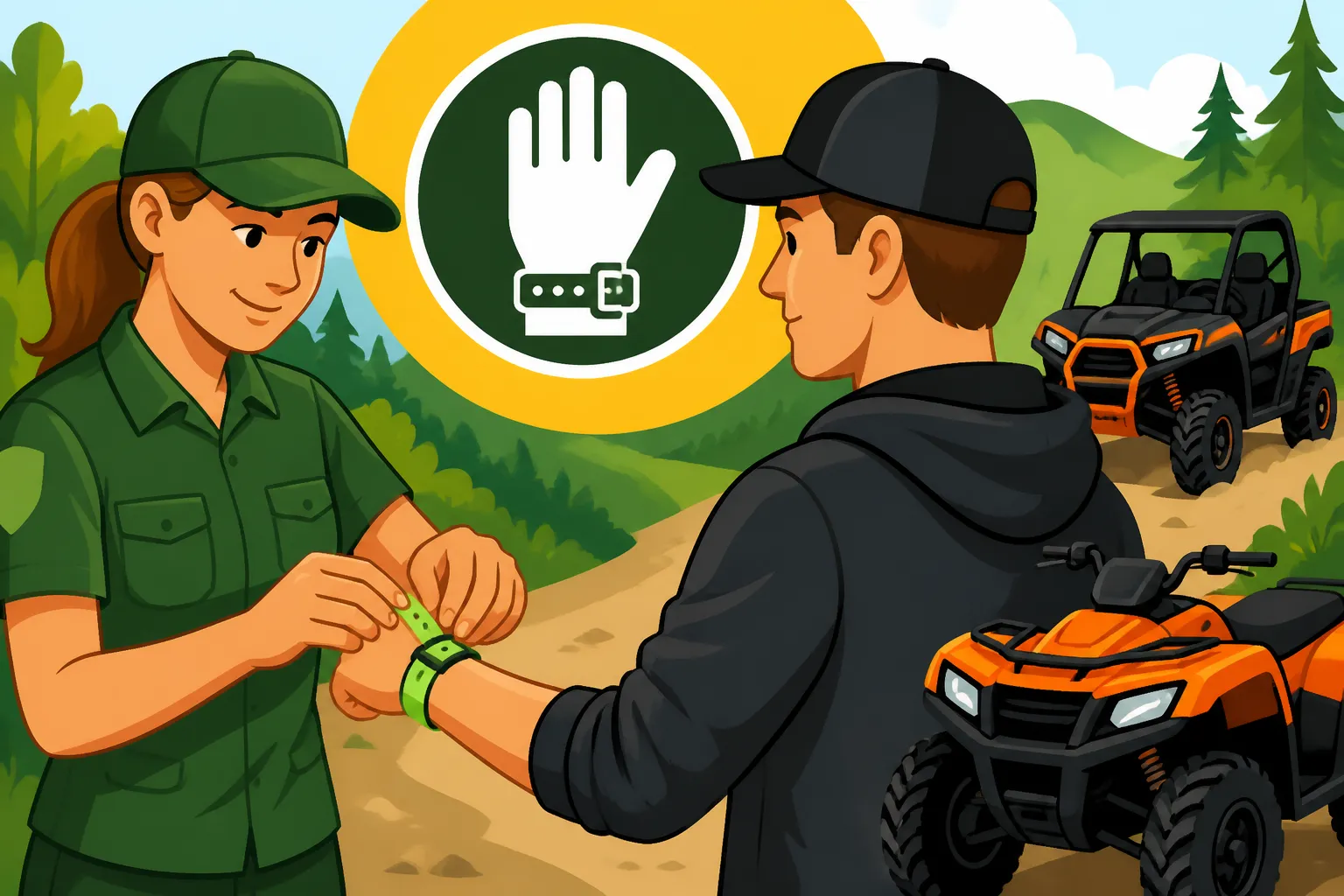
Why Staff Check Wristbands Out on the Trail
A wristband check on an Illinois OHV trail can feel like an interruption, especially when you have already checked in at the gate. Staff are usually confirming that each person on the trail is authorized to be there, not just looking for a sticker on a machine. Knowing what the wristband proves—and what to do if it is missing or damaged—can prevent an avoidable problem.
Why staff check wristbands on the trail
A wristband is a visible way for staff to verify that a person has completed the site’s check-in process and has permission to ride there that day. Checking it away from the entrance helps staff distinguish authorized visitors from people who entered without registering, came in through an unapproved access point, or are riding after their admission no longer applies.
The practice is most relevant at managed riding areas that issue wristbands at check-in. Policies differ among state, grant-assisted and privately operated sites, so a wristband procedure at one park should not be assumed to apply everywhere. At Sahara Woods, for example, riders should follow the current permit and check-in instructions for that site. Other areas may use a different credential or process.
A check on the trail also helps staff make sure the number of people admitted is being managed. If a site has a daily limit or requires advance registration, confirming credentials can help staff see whether riders on the property have been admitted under the site’s rules. That matters to visitors, too: an unmanaged crowd can affect parking, trail conditions and the experience of people who reserved or paid for access.
Staff may have additional reasons to check credentials at a particular location. They might be verifying that a rider is part of an event, has completed required registration, or is in an area open to their admission. Those details are site-specific, not a universal Illinois rule. Check the park’s instructions before unloading rather than relying on another site’s routine.
For a closer look at how the check-in process works, see Every Rider Gets a Wristband at Check-In. If you are planning a visit to a state OHV site, Illinois Sahara Woods Permits explains why checking the site’s current permit instructions before traveling is important.
A wristband helps staff check the rider, not just the machine
A vehicle sticker or decal is attached to a machine. A wristband is worn by a person. That distinction is useful when several riders share a vehicle, when a child is riding as a passenger, or when members of a group spread out along a trail. Staff can check the people they encounter instead of trying to identify every rider from the machine’s registration or appearance.
A wristband is not proof of ownership, insurance, or permission to ride on every public or private property in Illinois. It applies only as the site says it applies. It also does not replace a required statewide permit, access decal, waiver or other site credential. The exact combination depends on the location and the kind of riding being done.
What a wristband does and does not prove
The best way to avoid confusion is to treat each credential as serving its own purpose. A state usage stamp, an access decal, a park permit and a rider wristband are not interchangeable. Some sites require only a subset of these; others have their own admission process in addition to applicable state requirements.
| Credential | What it generally identifies | What it does not automatically prove |
|---|---|---|
| Rider wristband | That the person has been checked in or admitted under the site’s wristband system | Ownership of the machine or permission to ride elsewhere |
| Machine sticker | That a particular machine has met a site’s vehicle check-in requirement | That every person on or riding the machine is admitted |
| Illinois usage stamp | Compliance with the applicable state stamp requirement | Admission to a particular park or access to every riding area |
| Illinois public access decal | The applicable access credential for designated grant-assisted riding sites | A reservation, day pass or permission to ride on land that is not open to OHVs |
| Site permit or reservation | Admission under the terms of that site’s booking system | Permission to ignore site rules or statewide requirements |
The table describes common functions, not a guarantee that every park uses every credential. The state stamp and access decal have separate purposes. For a fuller comparison, see Illinois Stamps and Decals Compared and What the Stamp Covers and What the Decal Covers. A rider who has the applicable public access decal still needs to confirm that a particular location is open to riding and follow its admission procedures.
Likewise, having a site wristband does not mean the machine is allowed on every trail at that property. A park may have vehicle, passenger, route or operating restrictions. A staff member checking a wristband may also be able to direct a rider to a different area or explain a separate site rule.
If you are visiting a grant-assisted site, do not assume that buying a wristband at a private park satisfies the state’s access requirements, or that a state decal substitutes for a park’s own admission. One Access Decal Covers Every Grant-Assisted Site explains the decal’s role, while Illinois Grant Site Rules for Riders covers the need to follow the specific site’s rules as well.
What happens during an on-trail check
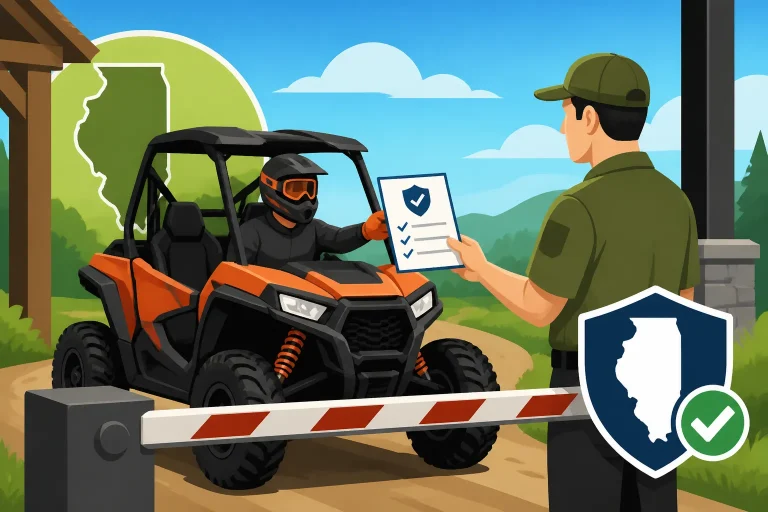
A check is usually a brief request to show the credential the site issued. The exact routine can vary, but the following steps are sensible:
- Slow down and give staff room. Follow any signal to stop, and pull over only where it is safe to do so. Avoid stopping in a blind turn, on a steep section or where other riders cannot see you.
- Show the wristband clearly. Keep it on the wrist and make the printed or colored portion visible if staff ask. Do not remove it just to hand it over unless staff specifically instruct you to.
- Answer basic questions directly. Staff may ask whether you checked in, who is riding with you, or whether the group has its other required credentials. A calm, straightforward answer is usually the quickest way to resolve a routine check.
- Follow any direction about the route or site rules. A wristband check may lead to a reminder that a trail is closed, a vehicle is not permitted on a particular route, or a site requirement still needs attention.
- Ask for clarification if something does not match. If you believe your check-in was completed but staff cannot verify it, explain where and when you registered and ask what they need to confirm it.
Staff may be checking more than one person in a group. Each rider should be ready to show their own wristband if the site issues one per person. Do not assume that one adult’s wristband covers a child, passenger or companion unless the park’s instructions explicitly say so.
Site staff may also check vehicle stickers or other admission records, depending on the property. For instance, some sites issue a vehicle sticker as well as wristbands. That is why it helps to know what you received at the gate and where each credential belongs. Illinois Wristband Rules for Riders covers common rider responsibilities, and Illinois Wristband Rules for Riders is useful to review before you set out with a group.
A check does not necessarily mean staff suspect a particular rider of doing something wrong. The point is often to verify admission consistently across the property, including areas far from the entrance. If you have a concern about the way a check is being handled, remain polite, ask who can explain the site policy, and resolve the question away from active trail traffic.
How to avoid wristband problems
Most wristband issues are easier to prevent at check-in than to sort out on the trail. Before leaving the gate area, make sure every person who needs a wristband has received one and knows to keep it on for the duration required by the site.
Check the band before riding
Look for a secure closure and make sure it is not so loose that it could slide off. Do not cut, loosen, switch or modify it. A band that has been removed or appears altered may be difficult for staff to verify, even if you paid for admission. If the closure is faulty or the band is uncomfortable, ask gate staff to address it before heading out.
Follow the site’s directions about where to wear it. If staff specify a wrist, keep it there. Do not attach it to a machine, backpack or another person unless the site explicitly permits that. A rider credential needs to remain associated with the rider it was issued to.
For a child or passenger, check that the wristband fits securely without restricting circulation or movement. If it does not fit properly, speak with staff rather than improvising a different attachment method. A child should not be expected to keep track of an adult’s wristband or explain an adult’s admission.
Keep the credential visible and intact
Mud, gloves or clothing can cover a wristband. You do not need to make it conspicuous throughout the ride, but you should be able to show it when asked. At a stop, move a glove or sleeve as needed so staff can see it without reaching toward them or stepping into a moving trail.
Water, sweat and ordinary riding conditions can make a wristband harder to read or damage its closure. Avoid picking at it or writing on it. If it is becoming unreadable or looks as if it may come off, return to the check-in point or contact site staff for instructions. Do not try to create a replacement yourself; a homemade substitute cannot verify that the site issued admission.
Report a lost or damaged band promptly
If a wristband comes off, breaks or is lost, stop riding and contact the site office or staff as soon as it is safe. Explain what happened and provide whatever check-in information you have. A receipt, booking confirmation or other record may help staff locate the admission, but it may not replace the wristband under that site’s policy.
Do not borrow someone else’s wristband or continue on the assumption that staff will understand later. A borrowed band can make it appear that the wearer was never admitted, and it can create problems for both people. Ask whether staff can verify the original check-in and what they want you to do next. Replacement procedures, if available, are set by the site.
Keep group members on the same page
Before the ride, make sure everyone knows that wristbands are personal credentials and should stay with their assigned riders. A group leader can remind riders to check that their band is secure when stopping for water or changing gear. Parents should check a child’s band themselves rather than relying on the child to remember it.
If your group has people arriving at different times, confirm how each person must check in. Do not assume that a reservation holder can collect credentials for the entire group or that late arrivals can join on the trail. Booking and check-in instructions vary. Booking Before You Drive Down and Illinois Waivers Signed Before You Ride can help you plan the administrative steps before everyone unloads.
Common misunderstandings about trail checks
“I have a sticker on the machine, so nobody needs to check my wristband.” A vehicle sticker and a rider wristband can identify different things. If the site issued both, expect to follow the instructions for each. One does not necessarily stand in for the other.
“My wristband means I can ride anywhere in Illinois.” It does not. A wristband generally relates to admission at the property that issued it. It does not grant access to land that is closed to OHVs, replace landowner permission, or establish that a route is legal for riding.
“A state decal means I do not need a site wristband.” Not necessarily. The decal and the site’s admission system have different jobs. A public access decal may be relevant at a grant-assisted site, while a wristband may show that an individual has checked in under that site’s process. Confirm both requirements with the site.
“Staff only check wristbands at the gate.” A gate check does not prevent staff from checking credentials elsewhere on the property. On-trail checks are one way to verify that riders found beyond the entrance have been admitted.
“If I paid, a missing wristband will be accepted as proof.” Payment records can help staff investigate, but the site decides what evidence it accepts and whether it can issue a replacement. Report a missing or damaged band promptly and follow staff instructions.
“The check means I am being accused of trespassing.” Not by itself. Staff may check everyone, or particular groups, as part of routine admission control. If a problem is identified, ask what requirement is missing and how to resolve it. Do not argue while blocking the trail or continue riding while an access question remains unresolved.
Policies may also differ between public riding sites and private parks. A private park can set its own wristband, waiver and vehicle rules within applicable law. A state or grant-assisted site may have a different permit or access process. Before a trip, check the specific property’s current instructions, especially if you are bringing children, passengers, a rental machine or a group.
Frequently Asked Questions
Does every Illinois ATV or UTV trail use wristbands?
No. Wristbands are used by some managed riding areas, but there is no reason to assume every trail or riding property issues them. Check the specific site’s admission instructions.
Can one wristband cover several riders?
Usually, a wristband identifies the person wearing it. If each person is required to check in, one rider’s band should not be treated as admission for the rest of the group. Follow the site’s directions.
Can I keep riding if my wristband falls off?
Contact staff or the site office as soon as it is safe. Do not use someone else’s band or assume another credential will be accepted instead. The property determines whether it can verify or replace a lost wristband.
Should I wear the wristband after leaving the riding area?
Follow the site’s instructions. Some places require riders to keep it on through the end of the visit or until they leave the property. If the policy is unclear, ask at check-in.
Disclaimer
This article is for general informational purposes only and does not constitute professional advice. Laws, prices and regulations vary by location and change over time. Consult a qualified professional for guidance on your specific situation.