Manufacturer Age Guidance at a Park
A child may meet a park’s age minimum and still be too small or inexperienced for a particular ATV or UTV. Manufacturer age guidance is one useful safety check, but it is not the same as a park’s admission rules, a permit, or a legal age requirement. Here’s how Illinois families can use the guidance to choose a suitable machine and avoid a gate-day surprise.
What manufacturer age guidance means
Manufacturers often provide age guidance for youth machines, and the operator’s manual may include advice about the rider’s size, experience, and ability. Treat this information as a starting point for deciding whether a machine is appropriate—not as a guarantee that a child can safely operate it.
Age alone is a rough measure. Two children of the same age can differ substantially in reach, strength, coordination, judgment, and experience. A child should be able to reach and operate the controls comfortably, understand basic instructions, and respond to changing terrain without being overwhelmed. If the manufacturer’s guidance does not fit the child’s situation, ask the manufacturer or dealer for clarification rather than assuming the machine is suitable.
Also check what the guidance applies to. A machine may be marketed for youth use, but its recommendations may not answer every practical question, such as whether it is suitable for a particular rider on uneven trails, whether it can carry a passenger, or what supervision is appropriate. Read the manual for the exact model and configuration. Do not rely only on a product listing, a seller’s description, or a general age chart.
For a family trying to decide what is appropriate, it helps to separate three questions:
- Is the child ready to operate or ride on this type of machine?
- Does the manufacturer’s guidance support that choice?
- Does the riding site allow the child and machine under its current rules?
A “yes” to one does not settle the other two. A child might be ready for a small youth quad on a private property but not for a faster, heavier machine on a busy public trail. A park may also set age, supervision, equipment, or passenger rules that are stricter than the manufacturer’s general guidance.
For more on the different rules that can apply to children, see Illinois Rules for Young Riders. If the question is specifically about who may operate a machine at a park, Illinois License Rules for Young Operators is a useful related topic—but check the site’s own requirements too.
How a park’s rules differ from a manufacturer’s guidance
A manufacturer describes how its machine is intended to be used and may offer recommendations for a suitable rider. A riding park sets the conditions for using its property. Those rules can cover admission, permitted vehicles, supervision, waivers, safety equipment, and conduct on the trails. Neither set of guidance should be treated as a substitute for the other.
This distinction matters in Illinois because riding locations do not all operate under identical arrangements. A designated public site, a grant-assisted area, and a private riding park may have different procedures and conditions. Before traveling, identify the specific site and confirm its current rules directly. A permit or decal does not, by itself, establish that a child is eligible to ride a particular machine or that the machine will be accepted at the gate. For background on permits and stickers, see Illinois OHV Permits: Two Stickers Explained.
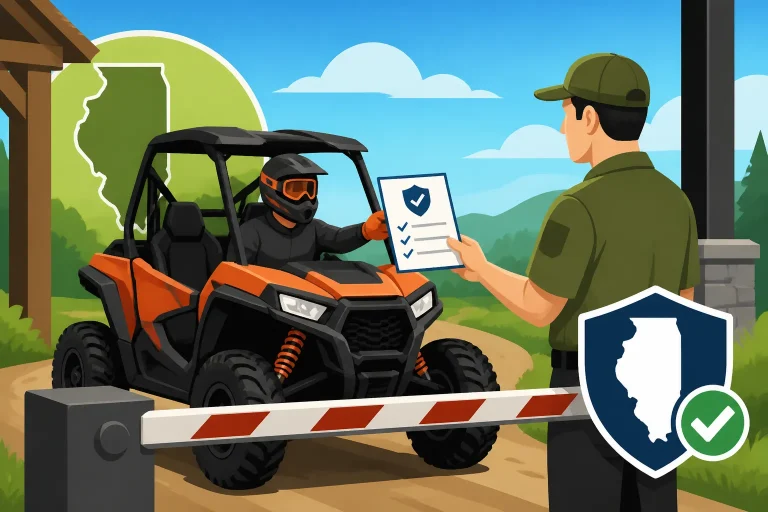
At Sahara Woods, site entry involves more than showing up with a machine. The site has park-specific requirements, and machines may be checked against factory specifications. A machine that has been modified may be turned away if it no longer meets those specifications. That is separate from the question of whether its rider fits the manufacturer’s age guidance. Families planning a visit should review Machines Checked Against Factory Specifications at the Gate and Why a Modified Machine Gets Turned Away, then confirm current details with the site before making the drive.
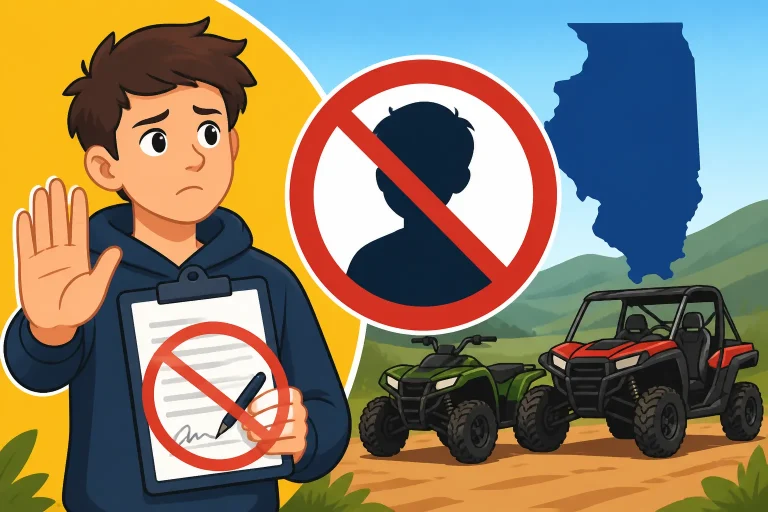
A park may also require an adult to supervise a child, set rules about who may accompany a young rider, or require a parent or guardian to complete paperwork. Do not assume that one adult’s presence automatically meets every supervision requirement. Ask whether the adult must remain nearby, ride with the child, or be present at check-in. Illinois Supervision at a Riding Park and Parents Must Sign the Waiver for a Child address common parts of that planning.
Use this comparison to keep the categories straight:
| Question | Manufacturer guidance | Park rules | What to do |
|---|---|---|---|
| Is the machine intended for this rider? | May offer age, size, or experience recommendations | May impose additional eligibility rules | Read the exact model’s manual and check the site’s requirements |
| Can the child operate the controls safely? | May describe intended use and operating precautions | Staff may not be able to assess every child’s ability | Check reach, control, judgment, and experience before the trip |
| Is this machine allowed at the site? | Describes the machine, not a particular park’s admission policy | Determines which machines and configurations are accepted | Confirm the machine type and condition with the park |
| Is adult supervision required? | May offer supervision advice | Can set its own supervision and waiver conditions | Ask what the supervising adult must do |
| Does a permit allow the child to ride? | Does not issue park access permission | A permit is only one part of site access | Confirm both permit requirements and rider eligibility |
A child’s age is not a reliable shortcut for answering all of these questions. The machine’s size, power, controls, condition, and intended use matter, as do the site’s terrain and rules. When the park’s rule is unclear, contact the site and describe the child’s age and riding experience, the exact machine model, and whether the child will operate it or ride as a passenger. Specific questions are more likely to get a useful answer than asking only, “Can kids ride there?”
A practical check before bringing a child
Make the decision in a deliberate order. First check the manufacturer’s information. Then check the park’s requirements. Finally, decide whether the child’s actual skills and the planned riding environment make the trip appropriate. A machine that qualifies on paper may still be a poor match for a child who is tired, anxious, unfamiliar with the controls, or unable to handle the terrain.
Use this checklist before loading the machine:
- Find the manual for the exact model. Confirm that its age and use recommendations apply to the machine you own, not a similar model with different controls or performance.
- Check the rider’s fit. The child should be able to sit securely, reach the controls, and use them without stretching or losing balance. Fit is not a replacement for the manual’s guidance.
- Confirm the child’s role. Operating a machine and riding as a passenger are different activities. Do not assume the manufacturer or park allows a child to take either role simply because the machine has a seat.
- Check the site’s current rules. Ask about minimum ages, supervision, passenger restrictions, required protective gear, vehicle specifications, and check-in procedures. Requirements can vary by location and may change.
- Be candid about the machine. If it has aftermarket changes, explain what they are and ask whether the site will accept it. Do not assume a modification is harmless to the park’s inspection process.
- Plan for a low-pressure first ride. Choose a setting and pace that let the child concentrate. A first visit is a poor time to test whether a child can manage a machine that may be too powerful or difficult to control.
- Reassess during the day. Stop if the child is fatigued, struggling with the controls, frightened, or no longer following instructions. A permit and successful check-in do not mean the child must continue riding.
For a public site such as Sahara Woods, verify the site’s rider and vehicle requirements before leaving home. Read the guidance on Illinois License Rules for Young Operators and Illinois Permit Rules for Young Riders alongside the park’s own instructions. If the child is riding a machine that belongs to someone else, also make sure the adult responsible has the necessary permission and understands who is accountable for following the site rules.
Protective gear should fit the child and suit the activity. A helmet that is too loose or unstable is not a good fit just because it is labeled for a child. Confirm the relevant site requirements and follow the gear manufacturer’s fit instructions. If shopping through a retailer such as Amazon, use the gear maker’s sizing information and return policy rather than relying on age-based labels alone. For park-specific helmet considerations, see [Helmet Rules at an Illinois Riding Park].
Common mistakes and how to avoid them
Treating the age label as permission. Manufacturer guidance is not a park pass. A machine that appears suitable for the child may still be prohibited at the destination, and a park’s minimum age does not prove that every machine is appropriate for every child who meets that minimum. Check both.
Assuming a youth model is automatically safe. “Youth” describes an intended category, not a complete assessment of the rider. A child may be too small, inexperienced, or unsure to control a particular machine. Look at the manual and the child’s abilities together.
Relying on a seller’s verbal assurance. A seller may know the machine, but the operator’s manual and the riding site’s current requirements are better references for age recommendations and admission rules. Keep the model information available when contacting the park.
Waiting until the gate to ask. If a park will not accept a machine or the child does not meet its requirements, the family may have to change plans after hauling the machine to the site. Call or check the park’s official information in advance, especially if the machine has been modified or the child will ride as a passenger.
Confusing permits with rider eligibility. A permit or decal relates to site access or machine use under applicable rules; it does not automatically override a park’s age, supervision, or equipment policies. If the trip involves a grant-assisted riding area, review Illinois Grant Site Rules for Riders and confirm the requirements for that specific location.
Forcing a child to keep up. A child may be legally or administratively eligible yet not ready for the pace, terrain, or length of a ride. Build in breaks, stay within the child’s ability, and be willing to turn back. Choosing a smaller, easier ride—or postponing the trip—is a reasonable safety decision, not a failure.
A sound decision uses all the relevant information: the manufacturer’s recommendations, the park’s current requirements, the child’s physical fit and judgment, and the conditions expected on the ride. If those factors point in different directions, choose the more cautious option and ask the site or manufacturer for clarification before riding.
Disclaimer
This article is for general informational purposes only and does not constitute professional advice. Laws, prices and regulations vary by location and change over time. Consult a qualified professional for guidance on your specific situation.