Which Public Land an Annual Stamp Lets You Ride
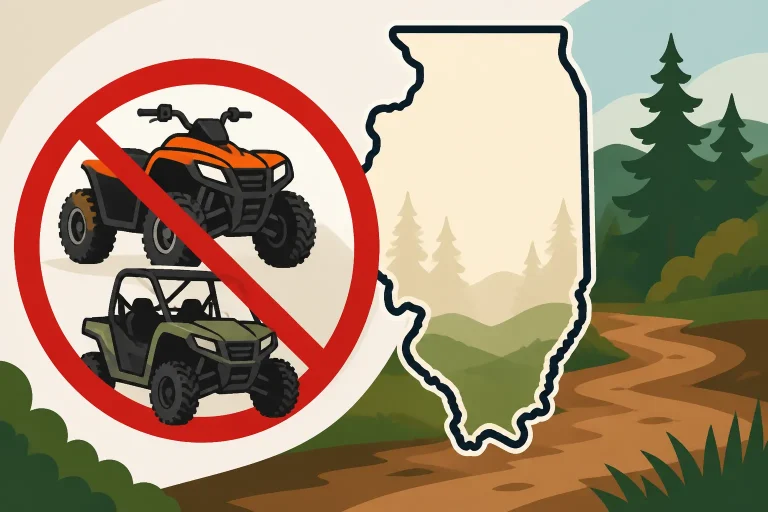
An annual Illinois OHV Usage Stamp sounds like a pass to ride public land, but it does not work that way everywhere. Some public OHV sites require a different access decal, and many public properties do not allow ATV or UTV riding at all. The key is to check the rules for the specific site before you haul your machine.
What the annual usage stamp does and does not cover
The Illinois Department of Natural Resources says an annual OHV Usage Stamp is generally required to operate an off-highway vehicle on public lands. But the stamp is not accepted or required at IDNR-managed or grant-assisted public OHV sites. Those locations require a separate OHV Public Access Decal instead.
That distinction matters because “public land” describes who manages or owns a property, not whether it is open to motorized riding. An annual stamp does not give you permission to ride on every public property, authorize riding wherever you choose within an open property, or replace a site’s own access requirements. The land must allow OHV use, and the applicable permit must match the site.
For a closer comparison of the two credentials, see Illinois Usage Stamp vs Access Decal and What the Stamp Covers and What the Decal Covers. The short version: a stamp is the general public-land requirement where it applies; a public access decal is required at designated IDNR-managed or grant-assisted OHV sites.
It also helps to separate two questions before a trip:
- Is OHV riding allowed at this location? Check the property’s rules and any designated trail or riding-area information.
- Which credential applies there? Confirm whether the location accepts the annual usage stamp or requires an OHV Public Access Decal.
A stamp can satisfy a legal requirement without making a closed or undesignated area available for riding. For more on that distinction, see The Usage Stamp Opens No Gates by Itself and Illinois Land You May Not Ride.
Which public land may require a stamp, decal, or neither
The right requirement depends on the property’s status and whether it actually provides an authorized place to ride. Use this table as a starting point, not as a substitute for checking the rules for the particular site.
| Public-land situation | What to expect | What to confirm before riding |
|---|---|---|
| Public land where OHV operation is allowed and the special-site decal exception does not apply | The annual OHV Usage Stamp may be the applicable public-land requirement | Whether riding is allowed in the specific area and where machines may operate |
| IDNR-managed or grant-assisted public OHV site | A separate OHV Public Access Decal is required instead of the annual stamp | The site’s current decal, entry, and riding rules |
| Public land with no designated OHV riding area | A stamp alone does not authorize riding | Whether any specific trail or area is open to OHVs |
| Private riding property | Public-land stamp rules may not be the only or applicable access requirement | The operator’s own permit, waiver, vehicle, and rider rules |
The Illinois Department of Natural Resources identifies Sahara Woods State Recreation Area as the primary IDNR-managed state property with a dedicated OHV trail system that permits public riding. At an IDNR-managed or grant-assisted OHV public site such as Sahara Woods, the annual stamp is not the credential to rely on; the separate OHV Public Access Decal is required. See Illinois Sahara Woods Permits for more about planning for that property.
Pyramid State Recreation Area is also named by the Illinois Department of Natural Resources as an example of an IDNR-managed public site where the annual stamp is not accepted or required and a separate decal applies. That does not mean every part of a public property is an OHV riding area. Confirm the designated riding area and current site rules before treating a location as a place to ride.
Other public properties may have trails for hiking, horseback riding, or other uses without opening them to ATVs and UTVs. A property’s public status, a trail map, or the presence of a road does not by itself establish that OHV use is permitted. The distinction is especially important when a route crosses multiple land types or management areas. See Illinois Public Land Not Designated for ATVs and Illinois Grant Site Rules for Riders when checking those situations.
If a site’s description is unclear, ask its manager directly whether the area is open to ATVs or UTVs and which credential applies. Avoid assuming that a stamp transfers to a decal, or that a decal required at one site is automatically the only thing you need at another. Ask about the exact property and the riding area you plan to use.
How to check the rules before you load up
A little site-specific checking can prevent a wasted drive or an unexpected problem at the entrance. Use this process before heading out:
- Identify the exact property and riding area. A county, state, or other public property may include areas with different uses or restrictions. Get the name of the specific trail system, not just the property name.
- Confirm that ATVs or UTVs are allowed there. Ask whether the riding area is open to your type of machine and whether it is currently available. A general public-land designation is not proof that OHV riding is allowed.
- Ask which permit applies. Find out whether the site accepts the annual OHV Usage Stamp or requires a separate OHV Public Access Decal. If a decal is needed, confirm how the site expects you to obtain it and whether it must be acquired before arrival.
- Check the rules for the whole trip. If your route includes more than one property or riding area, verify each one separately. A permit that works for one location may not meet the requirements at another.
- Confirm operating conditions. Ask about closures, access hours, vehicle restrictions, and any rider or passenger requirements that could affect your plans.
- Keep proof available. Carry or have ready whatever the site requires for the credential you purchased. Ask whether staff expect a physical display, purchase confirmation, or another form of proof.
The Illinois Department of Natural Resources requires the OHV public access decal or usage stamp to be displayed prominently on the forward half of the vehicle. Make sure you know which credential applies before placing a sticker on your machine. Illinois Public Access Decal Rules and Illinois Permit Placement on a Machine cover the decal side of that question.
Out-of-state riders should check reciprocity rather than assume that a home-state registration or sticker replaces Illinois requirements. The Illinois Department of Natural Resources says riders from states without a reciprocal agreement must purchase an Illinois public access sticker to ride on grant-assisted public OHV parks; confirm the current rule and fee with the department. A visiting rider may also need to meet the site’s separate entry rules. Illinois Rules for a Visiting Indiana Rider and Illinois Rules for an Out-of-State Machine can help identify questions to ask.
The Illinois Department of Natural Resources also says that particular public lands and state recreation areas it manages require direct supervision for operators under age 16 by a person over 18 who has a valid driver’s license. Check the rules for your destination, especially when a young rider is coming along. The department says Illinois law does not require OHV safety education certification to operate an ATV or UTV, and Illinois does not currently offer state-certified OHV safety education courses. That does not remove a site’s authority to set its own riding conditions, so confirm those separately.
Common mistakes that lead to a wrong permit
Treating a stamp as permission to ride anywhere
The most common misunderstanding is thinking that buying the annual stamp opens every public property to riding. It does not. The stamp is a requirement for public-land operation where the general rule applies; it does not turn an undesignated trail, closed area, or prohibited property into an authorized OHV route.
Check the land-use rules and the permit rules as separate things. For broader planning, Illinois Trails Closed to Machines explains why a public trail or area may not be available to motorized vehicles.
Using the stamp at a site that requires a decal
The opposite mistake is arriving at a designated OHV site with only the annual stamp. The Illinois Department of Natural Resources says the stamp is exempt and not accepted at IDNR-managed or grant-assisted OHV public sites where a separate Public Access Decal is required. Check the site’s current instructions before you travel, and do not assume that one credential can stand in for the other.
Assuming a public property has OHV trails
A state recreation area or other public property may have many permitted activities without having an authorized OHV trail. Sahara Woods is identified by the Illinois Department of Natural Resources as the primary IDNR-managed state property featuring a dedicated OHV trail system for public riding. That does not mean all public land in Illinois is open to machines or that every route within a riding property is open.
When a property’s information is vague, ask the manager for the designated OHV area and any map or route information riders should follow. If the answer does not clearly establish that your intended area is open to OHVs, do not treat the annual stamp as permission.
Checking only one part of a multi-site ride
A route that begins at an authorized riding area may pass near or through land with different rules. Confirm the status of each property and trail segment you intend to use, including any connector route. If one part requires a decal and another part has a different access rule, plan for both rather than relying on the credential that worked at your starting point.
The safest rule is simple: identify the exact riding area, confirm that your machine is allowed there, and ask which credential applies. The annual stamp is useful where the general public-land requirement applies, but it is not a universal public-land pass. At IDNR-managed and grant-assisted OHV public sites, check for the separate Public Access Decal; everywhere else, verify that riding is actually permitted before you go.
Sources
- Illinois Department of Natural Resources — Park – Illinois Department of Natural Resources (checked November 2, 2026)
Disclaimer
This article is for general informational purposes only and does not constitute professional advice. Laws, prices and regulations vary by location and change over time. Consult a qualified professional for guidance on your specific situation.