Your Hunting License Is Not a Riding Permit
A hunting license can make a hunt legal, but it does not automatically let you ride an ATV or UTV to your spot. In Illinois, hunting authorization and machine access are separate questions. Here’s how to tell what your license covers, what other permissions or stickers may apply, and what to check before you ride.
What a Hunting License Does—and Does Not—Authorize
An Illinois hunting license is permission to hunt under the applicable rules. It does not, by itself, give you permission to enter land, drive an off-highway machine on that land, or use a particular road or trail.
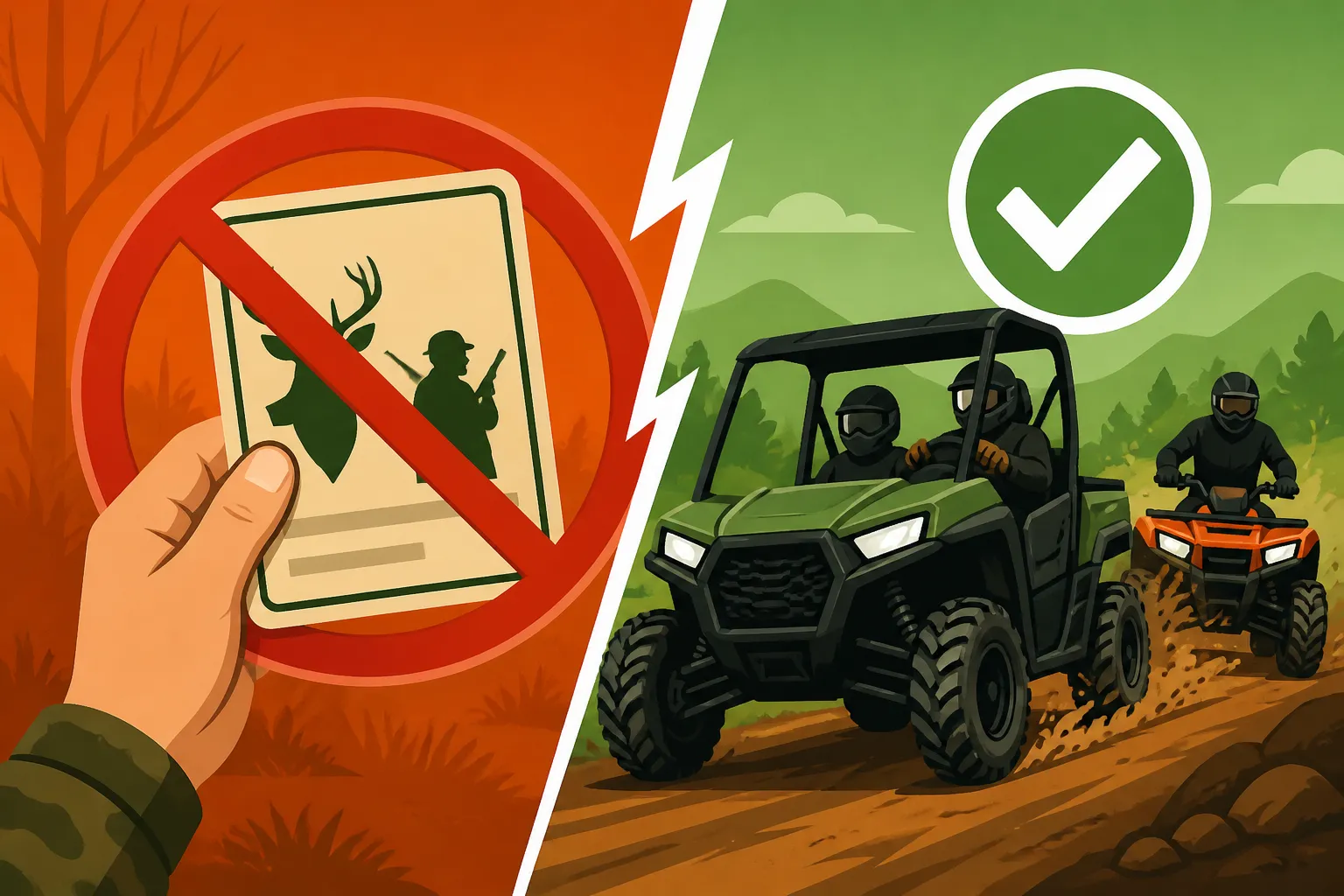
Think of hunting and riding as two separate checklists. First, confirm you are authorized to hunt the species, at the time and place you plan to hunt. Separately, confirm that your ATV or UTV is allowed on the property and on the route you intend to use. A machine may be prohibited even when hunting is permitted.
A hunting license also does not replace vehicle paperwork or site-specific requirements. Depending on where you ride, you may need an Illinois OHV usage stamp, an access decal, a park permit, or permission from the landowner or site manager. Each requirement has a different purpose, and one should not be assumed to cover another.
| Document or permission | What it generally addresses | What it does not automatically provide |
|---|---|---|
| Hunting license and any required hunting authorization | Whether you may hunt under the applicable rules | Permission to ride a machine or enter any property |
| Title or ownership records | Ownership or title status of the machine | Permission to use a trail or ride on a particular property |
| OHV usage stamp | A state usage requirement that may apply to operating an off-highway machine | Access to every public property or riding area |
| Public access decal | Access requirements for applicable grant-assisted riding sites | General permission to ride anywhere in Illinois |
| Landowner or site permission | Authorization to enter or use the property, subject to its rules | Exemption from other applicable riding or hunting requirements |
| Site permit or reservation | Permission to use a particular facility or riding area under its conditions | Permission to hunt there unless hunting is separately allowed |
For a closer look at how the state requirements differ, see What the Stamp Covers and What the Decal Covers and Illinois Stamp and Decal Compared. The key point is that a hunting license is not a substitute for either sticker, and neither sticker is a general pass to ride wherever you choose.
Even when a hunting arrangement includes access to land, ask what “access” means. It may allow you to walk in, use a designated parking area, or retrieve game by an approved route. It does not necessarily allow you to drive an ATV or UTV across the property. Get that detail from the person or agency managing the land rather than relying on the hunting license as proof.
What Determines Whether You Can Ride While Hunting
The answer depends on the land, the machine, the route, and the purpose of the trip. A hunting license does not make a closed road open to ATVs, turn a footpath into a motorized trail, or override a property’s vehicle restrictions.
Public land is not automatically open to machines
Some public properties have designated motorized routes or specific arrangements for hunting access. Others prohibit ATV and UTV riding, or allow vehicles only in limited areas. A public land boundary does not tell you which rule applies. Check the property’s current rules and map, and ask the managing agency if the route or access arrangement is unclear.
The distinction matters on state and federal land, wildlife areas, conservation areas, and other public properties. Land set aside for outdoor recreation or hunting is not necessarily an OHV riding area. Illinois Public Land Not Designated for ATVs explains why public ownership alone is not enough to establish that riding is allowed. Also check Illinois Trails Closed to Machines before treating a trail or access road as a machine route.
Do not assume that a road shown on a map is open to your machine. It could be closed to motorized traffic, limited to certain vehicles, or available only for a particular use. A gate, sign, seasonal closure, or current site notice may change what is allowed. When two sources appear to conflict, contact the property manager before unloading.
Hunting access may come with limits
A property may allow a hunter to use a machine for a specific purpose, such as reaching an approved parking area or accessing a designated route. That is not necessarily permission to ride recreationally, travel off-route, or use the machine throughout the property.
Ask direct questions before the hunt:
- Is an ATV or UTV allowed on this property for hunting access?
- Which roads, trails, or parking areas may I use?
- Are there dates or hours when machine access is closed?
- Does the permission cover game retrieval, or only travel to a hunting location?
- Are there limits on machine type, size, or number of vehicles?
- Do I need a separate permit, decal, or written authorization?
If access depends on an accommodation or a site-specific program, confirm the instructions with the land manager. Do not infer machine access from a hunting map, a past visit, or another hunter’s description. For more on this subject, see Illinois Hunting Access by Machine.
Private land requires permission for riding too
A landowner’s permission to hunt should not be treated as permission to ride unless the owner clearly includes machine use. Ask before crossing a field, using a farm lane, or parking an ATV or UTV on private property. The owner may allow hunting on foot but prohibit machines, or may allow a machine only on a named route.
A written message or permission form can help avoid misunderstandings about where you may go and what you may do. Illinois Landowner Permission Forms covers the value of keeping the terms clear. If you have permission to hunt but are unsure about riding, ask the landowner directly and get the riding conditions in writing when practical.
There is another important distinction: permission from a landowner does not automatically settle every state or local vehicle requirement. Confirm the rules that apply to the machine and the specific use. Likewise, having a state stamp or decal does not grant access to someone else’s property.
A riding-site sticker is not a hunting permit
Grant-assisted riding sites can have access requirements that are separate from hunting authorization. An access decal may be required for a qualifying site, but it does not, by itself, authorize hunting there. A site may prohibit hunting altogether or allow it only under separate rules.
For riders planning to hunt near a riding area, check both sets of rules: the site’s machine-access conditions and the hunting rules for that property. A stamp or decal is evidence of a particular riding requirement, not proof that hunting is allowed. See Illinois Decal Rules at a Grant Site for more on site-specific access.
What to Check Before You Load the Machine
Sorting out the requirements before the trip is easier than discovering a closure or missing permit at the trailhead. Use this sequence whether you are riding to a hunting location, using a machine on private land, or combining a hunt with a visit to a riding area.
-
Identify the exact property. Find the property name, owner, or managing agency. “Public land near my hunting spot” is not specific enough to confirm vehicle access. Property boundaries and nearby parcels can have different rules.
-
Find the rules for motorized use. Check the property’s official information, posted notices, maps, and current closure information. Confirm that your particular machine is allowed and that the route is open for the planned dates.
-
Ask whether hunting permission includes machine use. If permission comes from a landowner, club, outfitter, or site manager, confirm where you may ride and whether the permission is limited to hunting access. Ask about parking, retrieval, and any seasonal restrictions.
-
Confirm the documents and site requirements. Determine whether your trip calls for a usage stamp, public access decal, park permit, reservation, or other site authorization. These requirements depend on the use and location. Review Illinois Permit Questions Riders Ask if you need help distinguishing common permit questions.
-
Check the hunting rules separately. Confirm that your hunting authorization, season, species, method, and location are all covered. If you plan to carry or retrieve game with the machine, ask whether that activity is allowed on the property and along the route.
-
Keep useful records accessible. Bring the hunting paperwork and any required machine or site documentation. If you have written landowner permission, keep a copy available. At a grant-assisted site, review Carrying Papers at a Grant Site for practical advice on having relevant documents ready.
A call or message to the land manager can resolve details that a general map may not show. Be specific: name the property, describe your machine, explain whether you want to ride to a hunting location or use the property as a riding area, and ask which routes are permitted. If staff provide instructions, note the date and the person or office you contacted. Do not treat an unanswered question as permission.
Common Situations and a Before-You-Go Checklist
The same rule applies in different settings: hunting permission and riding permission must be checked separately. These examples show where people commonly make the wrong assumption.
You can hunt on private land but the machine stays outside
A landowner may give you permission to hunt but ask you to park outside the property and walk in. Follow that condition. Do not ride down a field edge or farm lane just because it looks like the easiest route. If you need machine access for mobility or equipment, discuss that before the hunt and agree on the route and limits.
A public property allows hunting, but you cannot find an OHV route
Do not assume a service road, field track, or access lane is open to ATVs or UTVs. Ask the managing agency whether machine access is allowed and, if so, where. If the property does not permit riding, a hunting license does not change that restriction. Choose another way to reach your hunting area or use a property that explicitly allows the planned machine use.
You are hunting near a grant-assisted riding site
A decal or site permit may be required to ride at the site, while hunting may be restricted or prohibited there. Confirm that both activities are allowed and whether the site has rules about firearms, hunting equipment, parking, or travel between areas. Do not assume a riding permit doubles as hunting authorization, or that a hunting license satisfies the site’s riding requirements.
You are visiting from another state
An out-of-state hunting license does not waive Illinois machine-access rules. Check Illinois requirements for the machine and the property you plan to use. Visitors should also verify whether any hunting authorization, site permit, or access decal is required for the specific trip. For questions about visitor access, see What a Visiting Rider Brings Besides an Illinois Decal.
Before leaving home, check these items:
- You know who manages the property and have checked its current rules.
- Machine use is allowed for your purpose, not merely hunting or walking access.
- You know the approved route and where you may park.
- You have any required hunting authorization and machine or site documents.
- You have permission for private land and understand its limits.
- You have checked for closures, seasonal restrictions, and site-specific conditions.
- You have a plan for retrieving game that does not depend on riding an unapproved route.
If one of those points is unclear, pause and ask the landowner or property manager. A valid hunting license is important, but it answers only the hunting question. Ride only when the separate access and vehicle requirements are clear.
Disclaimer
This article is for general informational purposes only and does not constitute professional advice. Laws, prices and regulations vary by location and change over time. Consult a qualified professional for guidance on your specific situation.