Where to Park Ten Trailers at a Trailhead
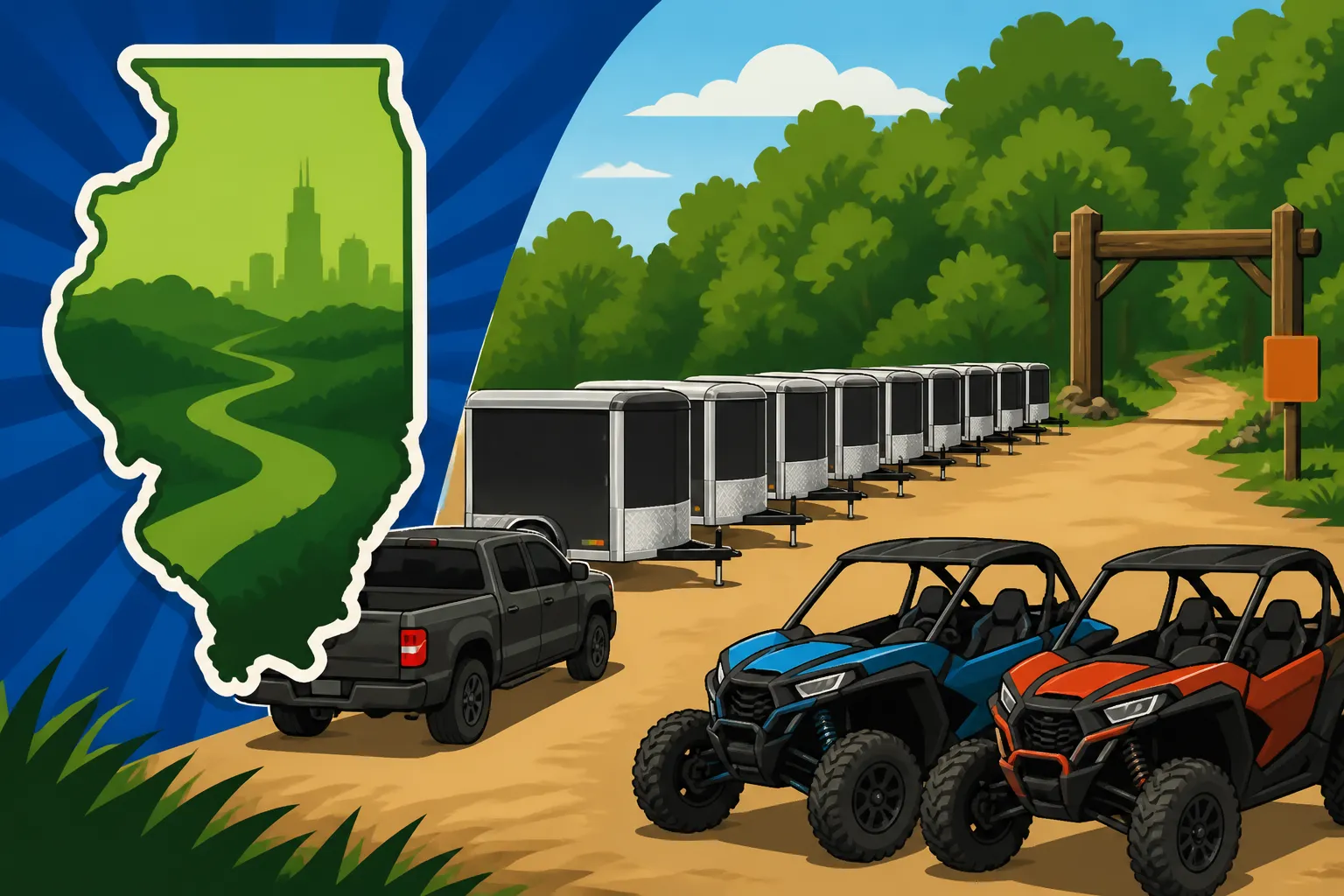
A ten-trailer ride can turn a quiet Illinois trailhead into a tight, confusing parking lot if everyone arrives at once. Long rigs need room to turn, unload, and leave without blocking gates, roads, or emergency access. This guide explains how to check a site, plan trailer spaces, coordinate arrivals, and handle overflow before your group makes the drive.
Start with the trailhead, not the trailer count
Ten trailers do not simply require ten marked spaces. The group also needs room to maneuver, park tow vehicles, unload machines, and keep access lanes clear. A site that works for a few pickups may be a poor fit for a convoy, even if the parking area looks spacious in a photo.
Before choosing a destination, treat parking as part of the ride plan. Ask the site operator what the lot can handle, how parking is organized, and whether the group needs to arrive in stages. That conversation can save you from reaching a crowded gate with nowhere safe to turn around.
Confirm the site’s parking rules directly
Start with the people who manage the riding area. A county park district, private park, club, or state-site operator may set its own rules for trailers, overnight parking, unloading, and group arrivals. Do not assume that a large open area is available for parking just because it appears on a map.
When you contact the site, explain the details that affect space: how many trailers are coming, their approximate length, whether vehicles will remain attached, and how many machines will be unloaded. Ask whether there is a designated trailer lot, whether parking is first-come, and whether a group can reserve or coordinate spaces. If the answer is uncertain, ask what the operator recommends for a busy day.
This matters at destinations across Illinois, whether you are heading toward Sahara Woods near Harrisburg, a club-run area near Marion, or a private riding area closer to Marseilles. The name of a town or riding area does not tell you how its current parking layout works. Check the site’s own guidance before you commit the whole group to one entrance.
For a broader look at the kinds of places available, see Illinois ATV Trails: Where You Can Actually Ride and Illinois Grant-Assisted Riding Areas. If your destination is Sahara Woods, review Reserving a Riding Day at a State OHV Park and Illinois Daily Caps and Sell-Outs as part of the same planning process. A permit or reservation does not automatically mean that a particular trailer layout is available, so confirm both.
Think in vehicle footprints, not painted lines
A trailer takes up more than its body length. It needs space to swing during a turn, and the tow vehicle may need to remain attached until the driver is positioned. Once a machine is unloaded, people may be moving between the trailer, the tow vehicle, and the trail access point. Ten trailers can therefore occupy much more of a lot than ten parking stalls suggest.
A simple planning exercise helps. Ask each driver for the approximate combined length of the tow vehicle and trailer, and whether they can back confidently in a confined area. You do not need to create a complicated engineering diagram. The point is to identify the unusually long rigs, the drivers who may need extra maneuvering room, and any trailers that can be detached only if the site permits it.
A compact enclosed trailer and a long toy hauler should not be treated as interchangeable. If a narrow lane or tight corner separates the entrance from the parking area, one oversized rig can slow the entire group. Tell the site operator about the longest combination, not just the average one.
Check the approach as carefully as the lot
The final stretch to a rural trailhead may include narrow roads, soft shoulders, steep approaches, low branches, gates, or a turn that is awkward for a long trailer. A parking area can be generous while the entrance remains difficult to navigate. Ask whether there are any restrictions or recommended approaches for large vehicles.
Use a mapping tool to review the route and identify the last sensible place to regroup, but do not rely on a screen view as proof that a turn is trailer-friendly. Tools such as onX Offroad can help you compare routes and mark meeting points; still, confirm access and directions with the site. A displayed road or track is not permission to drive on it, and maps may not show temporary closures or local restrictions.
If a convoy is approaching from different directions, choose a legal, spacious meeting place away from the trailhead. A gas station or other suitable public lot may work if the owner allows it and the group does not block customers. Do not use a road shoulder, private driveway, field entrance, or fire lane as an improvised staging area.
Build a parking plan for ten trailers
Once the site confirms that your group can be accommodated, decide how the vehicles will arrive, enter, unload, and exit. A plan does not need to be rigid. It should make the first few minutes orderly enough that drivers are not improvising in a crowded entrance.
Assign arrival groups and a parking lead
Avoid having ten tow vehicles reach a narrow entrance together. Divide the convoy into small arrival groups and give each group a clear time window. The exact spacing depends on the site’s instructions, the distance between vehicles, and how quickly the first drivers can park. The goal is to prevent a line of trailers from blocking a public road while the lead vehicle searches for a spot.
Choose one person to communicate with the site and one person to help direct the group, if the operator allows it. The parking lead should know the agreed layout, where to pause, and which areas must stay clear. They should not wave vehicles into places they have not confirmed are available.
Send every driver the same practical information before departure: the entrance to use, the meeting location, the site’s check-in process, the expected arrival order, and a phone contact for the group. A group text is useful for updates, but the plan should not depend on every driver having reliable cell service. In southern Illinois especially, it is sensible to agree on the sequence before leaving town rather than trying to coordinate every turn from the trailhead.
For ride-day logistics beyond parking, Illinois Group Ride Planning can help you think through group size, communication, and shared responsibilities. If you are unfamiliar with the area, Illinois Trail Conditions Before You Tow is another useful topic to check before loading up.
Keep the entrance, lanes, and turnaround usable
A good parking arrangement keeps traffic moving in a predictable direction. Follow the operator’s directions about one-way flow, unloading zones, and where vehicles may be left. Do not create your own shortcut across grass, a field edge, or an area that looks unused. That ground may be reserved for emergency access, drainage, staff vehicles, or other visitors.
Leave clear space around gates and access roads. Emergency vehicles, maintenance equipment, and other riders may need to pass even when your group is unloading. If a driver has to stop to read a message or ask for directions, have them pull into an approved waiting area rather than stopping across the entrance.
Think about the exit before the first trailer parks. If vehicles are positioned so tightly that everyone must reverse at once, departure can become more stressful than arrival. Ask whether the site prefers a particular parking direction or whether trailers should remain attached. A layout that lets each driver leave without moving several other rigs is usually easier to manage, provided the site approves it.
Separate unloading from long-term parking when permitted
Some sites may have a practical place for unloading before vehicles move to a longer-term parking area. Others may expect riders to unload where they park. Never assume you can use a trail entrance, access road, or shoulder as an unloading lane; get the operator’s direction first.
If unloading and parking are separate, make the handoff orderly. One person can help keep the path clear while each driver unloads, secures equipment, and moves as directed. If unloading happens in the main lot, leave enough room for neighboring visitors to access their vehicles and machines. Avoid opening ramps where they block a driving lane or extend into another group’s space.
Before leaving a parked vehicle, confirm that ramps, tie-downs, tools, fuel containers, and loose gear are secured. A dropped strap or open ramp can create a hazard for the next driver trying to maneuver through the lot. Keep personal belongings out of shared lanes, and do not leave a trailer unattended in a spot the operator has not approved.
| Parking question | What to confirm before the trip | Why it matters |
|---|---|---|
| Can the site accommodate ten trailers? | Ask the operator and describe the longest vehicle-and-trailer combination | A count of vehicles does not show the space needed to turn and unload |
| Where should the group meet? | Choose an approved, spacious location away from the entrance | Prevents a queue from forming on a public road |
| How should trailers be positioned? | Follow the site’s layout and direction of travel | Reduces backing conflicts and blocked lanes |
| Can vehicles be left attached? | Ask whether detaching or repositioning is allowed | Parking rules and space can differ by site |
| What happens if the lot is full? | Agree on a legal backup plan before departure | Avoids roadside staging or unauthorized parking |
| Who is responsible for the group? | Name a site contact and a parking lead | Gives drivers a clear person to call for instructions |
Prepare for busy days and changing conditions
Even a solid plan can be affected by weather, events, closures, or other riders arriving before your group. Build a little flexibility into the trip rather than treating ten reserved spots as guaranteed unless the operator has explicitly confirmed that arrangement.
Have a real overflow plan
Before the trip, ask what the site wants you to do if the lot is full or unsuitable for a large group. The answer may be to wait at a designated location, arrive later, use another approved parking area, or split the group across separate arrival times. Follow the operator’s answer rather than improvising.
Do not let a driver park on a road shoulder simply because the rest of the group is inside. A trailer can restrict visibility, obstruct access, or create a hazard for passing traffic. Likewise, avoid blocking a neighboring business, private gate, farm entrance, or residential driveway while waiting for space.
If the site cannot confirm a suitable arrangement, consider reducing the number of vehicles. That might mean carpooling where practical, using fewer tow vehicles, or choosing a different date or destination. For riders bringing machines to an established site, Illinois Trailheads With Trailer Parking and Illinois Riding Areas That Take Reservations can help narrow the search, but the operator should still confirm what is available for your group.
Treat weather and ground conditions as parking information
Rain can change a gravel or grass lot quickly. A space that looks firm in dry weather may be difficult for a heavy tow vehicle after a wet night. Conversely, dry conditions can mean dust and reduced visibility as several rigs arrive and move around.
Ask whether the site has parking restrictions after heavy rain and whether trailers should stay on a hard surface. Do not pull onto grass or soft ground to make room for the next person unless staff directs you to do so. Spinning tires can damage the area, and a stuck trailer can block everyone behind it.
Weather also affects unloading and securing equipment. Give drivers time to handle wet ramps, muddy footwear, and loose straps safely. Avoid rushing someone through a maneuver because the rest of the group is waiting. If conditions make the entrance or lot questionable, pause at the agreed meeting point and contact the site before continuing.
Keep access permits and check-in separate from parking assumptions
Parking permission and riding access are separate questions. Depending on the location, riders may need site-specific permits, a usage stamp, an access decal, a waiver, or other check-in steps. Ask what applies to the destination and what each rider or machine must bring. Do not assume that having a place to park means the group is cleared to ride.
Illinois riders can review Illinois OHV Permits: Two Stickers Explained and What the Stamp Covers and What the Decal Covers to understand why stickers may serve different purposes. For a grant-assisted riding area, check Illinois Grant Site Rules for Riders before departure. Carrying the right paperwork and completing the required process can prevent a frustrating delay after the trailers are already parked.
If a site uses advance registration or has a vehicle cap, plan that step separately from parking coordination. A booking confirmation may help with entry, but it does not necessarily reserve a trailer space unless the site says so. Keep confirmations accessible, and make sure the group knows who will present them at check-in.
Make arrival and departure easier for everyone
A ten-trailer day feels manageable when drivers know where to go and what to do next. It feels chaotic when people stop in the entrance, unload wherever they find room, and wait for someone else to solve the layout. A few simple habits can protect the site and make the day more enjoyable.
Use a short arrival briefing
Before the first vehicle reaches the entrance, send a concise update with the agreed meeting point, arrival order, site contact, and any changes. If a lead driver needs to check in before the rest of the group enters, explain that in advance. Nobody should have to guess whether to follow, wait, or pull into a space.
Keep phones and navigation tasks out of the tightest part of the approach. If a driver needs to confirm a location, they should stop only where stopping is safe and permitted. The person leading the convoy should not assume every vehicle can see or hear them, particularly if traffic separates the group.
onX Offroad can be useful for sharing a general route or meeting point with riders who use the app, but make sure everyone also has written directions and the site’s official address or entry instructions. Ask riders to download or save what they need before reaching an area where reception may be limited. Do not rely on a map pin alone if the operator has provided a more specific entrance.
Protect other visitors’ space
Your group is not the only one using the trailhead. Leave room for smaller vehicles, riders arriving after you, park staff, and people who are not part of the ride. Keep music, engines, and conversations at a reasonable level, especially near homes or campsites.
Do not spread gear across neighboring spaces or use a second spot as a workshop without permission. Keep children and pets close while trailers are moving. A person walking behind a reversing trailer may be difficult for the driver to see, so establish a clear rule that nobody crosses behind a vehicle while it is maneuvering.
At departure, check the area for straps, trash, spilled fluids, and equipment left behind. Make sure ramps are raised and secured before moving. If the group is leaving together, have drivers pull out in the sequence the parking lead established rather than allowing several vehicles to reverse at once.
Review the plan after the ride
A quick debrief can make the next trip smoother. Note what worked: perhaps staggered arrivals prevented a queue, or a particular vehicle needed more turning room than expected. Record any site instructions that the operator gave you, but confirm them again before a future visit because layouts, rules, and conditions can change.
If parking felt unsafe or the group had to improvise, treat that as useful information rather than a minor inconvenience. A different meeting location, fewer tow vehicles, an earlier arrival window, or another riding area may be the better choice next time. A convenient trail destination is only convenient if the whole convoy can reach it, unload safely, and leave without blocking access.
For route planning, onX Offroad may help you keep your group’s chosen approach and meeting point organized, while the site operator remains the authority on where you may park and ride. Confirm the details directly, arrive with a shared plan, and give each driver enough space and time to maneuver. That is the difference between ten trailers arriving as a team and ten separate parking problems.
Disclaimer
This article is for general informational purposes only and does not constitute professional advice. Laws, prices and regulations vary by location and change over time. Consult a qualified professional for guidance on your specific situation.