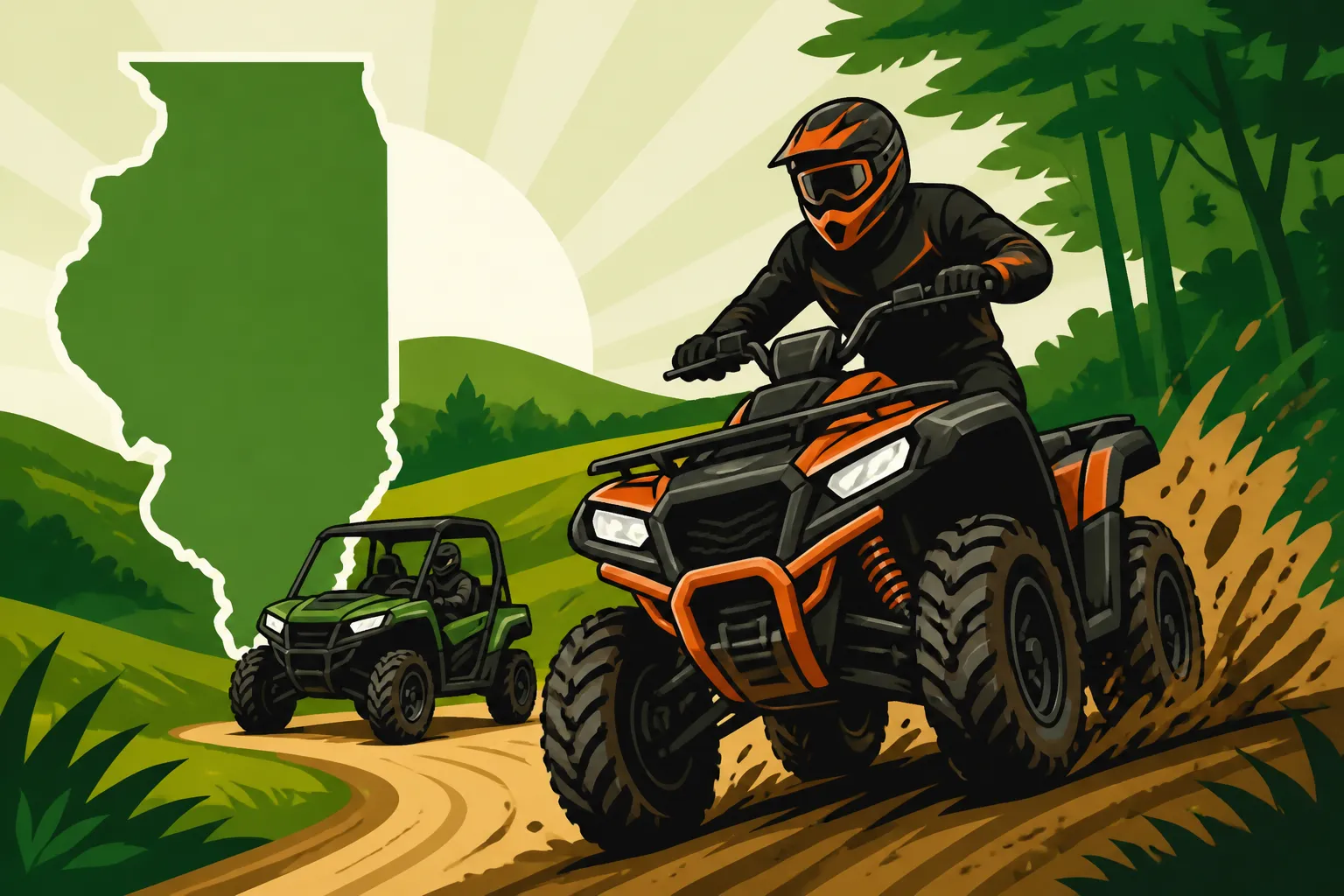
Illinois ATV Trails: Where You Can Actually Ride
Illinois riders often discover the hard part is not finding dirt roads; it is finding a place where an ATV or UTV is actually allowed. A public forest, farm lane, or trail on a map is not automatically open to off-highway vehicles. This guide explains where to look, what to check before towing, and how to avoid arriving at a closed or unsuitable riding area.
Where Illinois ATV and UTV riding is actually allowed
Start with a designated riding area
In Illinois, the safest starting point is a riding area that specifically accepts off-highway vehicles. That might be a state OHV park, a grant-assisted site, or a private park. Each has its own access rules, hours, permitted vehicle types, trail conditions, and procedures for checking in. “It looks like a trail” is not enough to establish that motorized riding is allowed.
This distinction matters because Illinois has plenty of public land that is not open for recreational ATV use. A trail may be intended for hiking, horseback riding, hunting access, or maintenance vehicles. A road may be open to some traffic but not to an unregistered or unequipped off-highway machine. Before you plan a route, confirm the land manager’s rules for the specific property and the specific type of vehicle you intend to bring.
A useful way to organize your search is to separate places into three groups: dedicated OHV areas, private parks that sell or arrange access, and public land where motorized riding is not designated. The guide to [Illinois Grant-Assisted Riding Areas] can help you understand the first group. For an overview of properties that do not necessarily follow the same access model, see [Illinois Private Off-Road Parks].
A map pin is not permission
Mapping apps can be handy for getting oriented, planning a drive, and saving a route for an area you are already allowed to ride. For example, a rider might use onX Offroad to keep a planned route organized or see where a trail system sits in relation to a campground. But an app map should be treated as a planning aid, not proof that a road or path is open to ATVs.
This is especially important in rural Illinois, where a line on a map might cross private property, a closed access road, a levee, a utility corridor, or land managed for another purpose. A route that looks continuous on a screen can end at a locked gate or lead onto property where you do not have permission to ride. Do not assume that a visible track, user-submitted route, or satellite image overrides a posted sign or the land manager’s rules.
Use maps to ask better questions, not to skip the questions. Confirm the property name, who manages it, whether the route is open to your machine, and whether you need a reservation, permit, decal, waiver, or check-in. If you use onX Offroad or another mapping tool, compare what it shows with the riding area’s official information before leaving home.
Illinois riding areas to consider first
Sahara Woods State Fish and Wildlife Area
Sahara Woods, near Harrisburg in southern Illinois, is the state’s best-known dedicated OHV destination. It is often described as Illinois’s only state OHV park, which makes it an obvious first place to investigate if you want an established riding area rather than a route assembled from scattered roads. The property is associated with reclaimed mine ground, so the landscape and riding experience can feel quite different from a flat, familiar farm track.
Do not treat “state park” as a promise that you can simply show up and unload. Check the operating schedule, reservation process, daily capacity, vehicle requirements, permit instructions, and any closure notices before you tow down. A long drive to southern Illinois is frustrating enough without finding out at the entrance that registration is full, the site is closed, or your machine does not meet the rules.
Sahara Woods has its own procedures for permits and entry, and those details can affect the whole day. Review [Sahara Woods: Illinois's Only State OHV Park] and [Illinois Sahara Woods Permits] before planning around it. If you are considering a weekend or holiday, build in time to book, read the waiver requirements, and check what you need to show at the gate. Do not assume a general Illinois permit replaces a site-specific reservation or entry requirement.
Grant-assisted and club-run areas in the south
Southern Illinois has several riding options beyond Sahara Woods, including properties operated by counties, clubs, or private organizations. Mill Creek Park near Marshall, Heartland Lodge near Nebo, and Little Egypt Off Road near Marion are examples riders may encounter while researching an outing. Their operators, trail layouts, access processes, and machine rules are not interchangeable, so verify the details for the exact site you plan to visit.
A county-operated location may have a different check-in process from a club-run park. A lodge-based riding area may combine trails with lodging or other visitor services, while a club property may have specific operating days and membership or day-use procedures. Even two nearby locations can differ in whether they accept side-by-sides, allow passengers, have camping, require advance registration, or close trails after rain.
For a group trip, name the actual destination in your planning messages rather than saying “we’re riding in southern Illinois.” That helps everyone check the right rules and arrive at the same entrance. Explore the site-specific information for [Little Egypt Off Road in Illinois], [Mill Creek Park Is Run by Clark County], and [Heartland Lodge Runs a Riding Area at Nebo]. Confirm the current operator’s instructions directly before you leave, especially if you are arranging a visit around a particular weekend.
Private parks and other regional choices
Private riding parks can be a practical option when you want a managed property with a defined trail system, an entry process, or amenities such as camping. The Cliffs near Marseilles is one example riders may find while searching in northern Illinois. Other private properties are farther south or closer to the state’s central regions. Their terrain and services vary, so do not choose based on a name or a social media photo alone.
A private park may set its own vehicle restrictions, age requirements, helmet rules, noise limits, passenger policies, waiver terms, and operating schedule. A machine that is legal to own or operate elsewhere is not automatically acceptable on a particular park’s trails. A UTV may be too wide for some routes, a modified machine may fail a property’s requirements, or a child may not meet the park’s minimum age or supervision rules.
Before booking, make a short call or review the park’s own visitor information. Ask whether your exact machine type is accepted, whether passengers are allowed, what paperwork or permits you need, and whether the trails suit your group’s experience level. If camping is part of the plan, ask separately about campsite booking, quiet hours, pets, fires, and generator rules. The general overview of [Illinois Private Off-Road Parks] is a useful starting point, but the property’s own rules should decide your plan.
| Riding option | What makes it useful | What to confirm before you go |
|---|---|---|
| Sahara Woods | A designated state OHV destination in southern Illinois | Booking, capacity, schedule, permits, machine requirements, and closures |
| Grant-assisted or club-run area | A managed riding site that may serve a particular region or riding style | Access decal rules, operator instructions, open days, vehicle limits, and check-in |
| Private riding park | A defined property with its own visitor rules and possible amenities | Fees, waivers, age rules, trail suitability, camping, and machine restrictions |
| General public land | May be useful for other recreation or access purposes | Whether motorized OHV riding is specifically designated and allowed |
| Private land with permission | Can offer a personal riding option when the landowner agrees | Written permission, boundaries, other land users, and local restrictions |
Public land is not automatically an ATV trail
Shawnee National Forest and other public properties
Riders sometimes assume that a large forest must have a network of ATV trails. That assumption can lead to a costly mistake. Shawnee National Forest is known for hiking, camping, scenic areas, and other recreation, but that does not mean cross-country ATV or UTV riding is allowed. Check the forest’s designated motorized routes and restrictions rather than interpreting a forest road, hiking trail, or open-looking track as an OHV route.
The same caution applies to state parks, conservation areas, nature preserves, wildlife areas, and public land managed by a county or local agency. A property may allow cars on certain roads, permit access for hunting, or maintain service roads without opening those routes to recreational off-highway vehicles. A hunting license, public-land access, or an OHV sticker does not turn a closed route into an approved trail.
When a property’s status is unclear, ask the managing agency about the exact road or trail, not just the property in general. Say what you drive, where you hope to ride, and whether you are asking about recreational use or access for a specific permitted activity. For a broader explanation, read [Illinois Public Land Not Designated for ATVs] and [Why Shawnee National Forest Bans Illinois OHVs].
Private fields, farm lanes, and permission
A gravel lane that cuts across farmland can look like a tempting route, particularly when it appears on a map or runs alongside a field. But visibility does not equal access. A farm lane may belong to the landowner, serve equipment and livestock, or connect to a public road while still being private. Riding there without permission can damage crops, disturb animals, create safety risks, and jeopardize a landowner’s willingness to allow future access.
If you have a relationship with a landowner, ask clearly before riding. Explain who will be coming, what machines you will use, where you hope to ride, and when you expect to be there. Agree on boundaries, gates, speed, passengers, and whether other family members or guests can join. A friendly verbal conversation is better than assuming, but written permission is especially useful when access is temporary or several riders are involved.
Do not treat a hunting arrangement as general ATV permission. Permission to retrieve equipment, reach a hunting location, or travel along one specified route may not authorize recreational riding. Keep the permission limited to what the landowner actually approved. More guidance is available in [Illinois Private Land Permission Rules] and [Illinois Farm Land Riding Permission].
Roads, crossings, and apparently open routes
An ATV or UTV riding area is not the same thing as a public street route. Illinois street use has separate rules, and whether a particular road allows a non-highway vehicle can depend on local ordinances and the road’s jurisdiction. A paved road, a quiet township lane, or a farm-to-market route is not automatically a legal connector between trail systems.
Even within an approved riding area, follow the marked routes and crossing instructions. Do not leave a designated route to reach a nearby road, business, or attractive-looking field unless the operator explicitly allows it. If your trip involves a public-road segment, investigate that segment separately; trail permission does not establish street legality. The guide [Illinois ATV Road Rules: Local Ordinances Decide] explains why checking the precise road and governing jurisdiction matters.
For trail planning, treat any road connection as a separate legal question. Check whether the route is open to your vehicle, whether local permission or a town permit is required, and whether the machine must meet street equipment and insurance rules. If you cannot confirm those details, keep the ride within the designated property rather than improvising a connection.
Permits, decals, and entry requirements
Understand the difference between state stickers
Illinois OHV rules can involve more than one sticker, and the names are easy to mix up. A usage stamp and an access decal are associated with different access requirements. The correct one may depend on where you plan to ride and what kind of site you are visiting. Do not assume that buying a sticker of any kind gives access to every public or private riding area in the state.
A grant-assisted riding site may require an access decal, while other public riding circumstances may involve a usage stamp. The relationship between the two is important: requirements can differ by site, and an access decal may affect whether a separate stamp is required for that use. Check the current state instructions and the specific property’s rules rather than relying on a friend’s old sticker or a memory from a previous season.
Before you buy, identify each destination on your itinerary and make a list of its requirements. The guides [Illinois Usage Stamp vs Access Decal] and [Illinois Public Access Decal Rules] explain the distinction in more detail. If you have a question about whether a particular sticker covers a particular ride, ask the site operator or the relevant state office using the exact site name and machine type.
Check in before the day of the ride
A permit or decal may be only one part of the process. A park can also require advance registration, a site-specific permit, a waiver, a wristband, a vehicle sticker, or an in-person inspection. Some places manage daily capacity, which means having the right annual sticker does not necessarily guarantee that you will be admitted on the date you choose.
For a family or group, one person should keep a shared checklist. Record each rider’s paperwork, the machine’s identifying information if needed, any booking confirmation, and the site’s entry instructions. Make sure the driver who will be towing or checking in can access the documents. If a confirmation is on a phone, consider saving it for offline access or printing a copy, particularly if reception may be unreliable near the entrance.
Do not wait until the parking lot to discover that a waiver needs to be completed by a parent, that a machine needs a specific sticker placement, or that a vehicle is not permitted on the site. Review the instructions before loading the trailer. [Illinois OHV Permits: Two Stickers Explained] and [Illinois Waivers Signed Before You Ride] are useful references when you are sorting out the paperwork.
Choose a riding area that fits your machine and group
Match the trail to the vehicle
A trail system that welcomes ATVs may not be suitable for every ATV, and a place that accepts UTVs may still restrict their width, passenger arrangement, or modifications. Before you go, check whether the operator accepts your exact type of machine, including a side-by-side, dirt bike, youth quad, or modified vehicle. Ask about trail width, designated routes, and any limits on passengers or equipment.
Think about the machine’s real dimensions rather than relying on a model name. A UTV with accessories, wider tires, a roof, or other additions may have a different practical footprint than a stock machine. If you are unsure whether your vehicle fits, share its dimensions with the park and ask directly. A mismatch can mean a difficult turn-around at the gate or, worse, being forced onto a trail that is not appropriate for the machine.
Trail difficulty is not just about steep hills. Mud, loose rock, ruts, tight trees, blind corners, and changing ground conditions can make a route challenging. Ask the operator which trails suit beginners and whether routes are separated by vehicle type or difficulty. The overview [Illinois Trails That Allow Side-by-Sides] can help you narrow down places to investigate, but confirm specific restrictions with the site before loading up.
Plan for children and less-experienced riders
A ride that works for experienced adults may be overwhelming for a child or a first-time rider. Ask about minimum ages, supervision rules, passenger policies, and what routes are appropriate for beginners. Do not use a child’s confidence at home as the only measure of readiness for a crowded trail system with unfamiliar terrain and other machines moving nearby.
Choose an outing where the group can ride at a manageable pace and regroup without pressure. Explain trail signals, safe following distance, where to stop, and what to do if someone becomes separated. Agree on a meeting point before leaving the staging area. If the site has separate beginner routes, stay on them until the rider has had time to learn how the machine handles on that terrain.
A family should also check whether each child is allowed to operate the machine they will be using. Manufacturer age guidance, park rules, and state requirements may all matter. For ideas about finding a more suitable outing, see [Illinois Trails for Kids] and [Illinois Rules for a Teen Rider]. If the answer about a child’s eligibility is unclear, ask the park directly before you book or travel.
Be realistic about weather and trail conditions
Illinois weather can turn a familiar route into a very different ride. Heavy rain may create deep ruts, slick clay, standing water, or closures designed to protect the trail. Hot, humid conditions can make a long ride exhausting, while cooler weather can bring mud, wet leaves, or reduced daylight. A trail that was easy on a dry visit may demand more skill and patience after a storm.
Check for trail notices close to departure, not only when you first make the plan. Ask whether the park has closed specific loops or changed its operating status after rain. If a trail is closed, do not ride around the barrier or assume that a short detour is harmless. Closures often protect the route from lasting damage, and staff may have a safety reason for keeping riders out.
Build flexibility into your day. Bring suitable clothing, water, basic recovery and repair supplies, and a plan for turning back if conditions change. If you are using onX Offroad to keep a route organized, remember that an offline map can help with orientation but does not show every temporary closure or replace the operator’s instructions. For more planning guidance, read [Illinois Trail Conditions Before You Tow].
Plan the trip before you put the machine on the trailer
Check access, hours, and reservations
A successful ride often depends on details that do not seem exciting until they go wrong. Confirm the site’s address and entrance, opening days, check-in procedure, reservation requirements, and any daily limit. Search for the operator’s latest notices and contact the site if a detail could change your decision to make the drive. A location pin may lead to the wrong entrance, especially at a large property or a site with separate visitor and service access.
If you are traveling from Chicago, Springfield, Peoria, St. Louis, or another distant starting point, treat the drive as part of the outing. Confirm that the park will be open for your intended arrival time and ask what happens if you arrive late. If the site uses advance registration, complete it before you hitch the trailer. Keep the address, confirmation, and check-in instructions accessible to the person navigating.
Camping requires another layer of planning. A riding area may not provide camping, may have limited sites, or may require you to reserve through a separate operator. Check whether the campground is on the riding property, whether you can ride directly from it, and whether its rules allow your trailer, generator, pets, or campfire. [Illinois OHV Camping With Trail Access] can help you explore the general idea, but confirm details with the campground and riding site separately.
Prepare the machine and the trailer
Before leaving, inspect the machine for basic problems that are harder to fix at a trailhead: low tires, loose fasteners, weak battery connections, fluid leaks, damaged lights, or a winch that has not been tested. Carry the tools and recovery equipment that make sense for your machine and riding conditions. For a side-by-side, confirm that the trailer has enough space and capacity, and secure the machine according to the trailer and tie-down manufacturers’ instructions.
Take clear photographs of the machine and its identifying information before the trip. That can help you distinguish your vehicle in a crowded staging area and make it easier to document its condition. Pack protective gear for everyone, not just the primary driver. If passengers are permitted, make sure they have appropriate helmets and understand where to sit and how to remain secure.
Do a final walk-around after loading and again before pulling away. Check the tie-downs, ramps, hitch connection, safety chains, lights, and any doors or gates. It is much easier to catch a loose strap in your driveway than on a rural highway. Keep papers that may be needed for the ride together with your other travel documents, and verify whether the riding area asks for proof of ownership or insurance.
Follow local etiquette and leave room for other riders
Trail etiquette is more than being friendly. It helps prevent collisions, keeps dust and noise from becoming a problem, and makes managed riding areas more likely to remain open. Follow posted speed limits, slow down near staging areas, yield as directed, and avoid tearing up the trail by spinning tires when traction disappears. If you meet a rider on a narrow route, stop somewhere safe and follow the site’s passing rules.
Stay on the marked routes. Riding around mud, a closed section, or a damaged bridge can widen the trail and create new problems for staff and volunteers. Do not leave litter, dump oil or fuel, or assume that a maintenance road is open because it has tire tracks. At a campground, respect quiet hours and the rules for generators, pets, fires, and alcohol. A good day of riding should not become someone else’s safety problem or a reason for stricter access rules.
In a group, appoint a lead rider and a sweep rider, agree on regrouping points, and make sure everyone knows the route plan. Keep enough space to see what the rider ahead is doing, especially around dust, blind turns, and changing terrain. Let faster riders pass only where the trail and the park’s rules make it safe. For more on behavior that helps protect access, see [Illinois Trail Etiquette Locals Expect].
Common planning mistakes that spoil an Illinois ride
Treating an old post as a current operating notice
A trail report, forum comment, or social media post can be useful background, but it may describe a different season, a temporary event, or a route that has since closed. An old photo does not establish that the trail remains open. The operator may have changed its booking process, vehicle limits, schedule, or maintenance plan since the post was written.
Use informal reports to generate questions. If someone says a route is good for beginners, ask the park whether that description still applies and whether it fits your machine. If a post mentions a campsite or a direct trail connection, verify that the facility still offers it and that riders can use it. This small step can prevent a wasted drive and avoid putting your group on a route that is no longer permitted.
A map application can also display outdated or user-submitted information. onX Offroad may help you keep a route or property location organized, but it should not be your sole source for current closures, permits, or land access. Check the land manager’s or park operator’s latest instructions before relying on any route. When two sources conflict, contact the site and follow the official direction.
Assuming one permit covers every site
A common source of confusion is having a valid sticker but still missing a separate site requirement. State-level stamps and decals, park permits, reservations, waivers, and day-use procedures serve different purposes. A sticker may address one access rule without buying admission, reserving a place, or authorizing use of every trail in Illinois.
Make a site-by-site list rather than asking only, “Do I have my Illinois sticker?” Write down the exact permit or decal required, where to obtain it, whether it is tied to a particular machine, and what must be completed before arrival. If you are riding more than one property on a trip, repeat the check for each one. Do not assume a sticker displayed on one machine can be moved to a different machine or shared among vehicles.
If you have questions, use the site’s full name when contacting the operator or state office. Explain whether you have an ATV, UTV, dirt bike, rental machine, or visitor vehicle, and describe exactly where you intend to ride. [Illinois Stamp and Decal Rules] and [Illinois Permit Questions Riders Ask] can help you identify the right questions to ask.
Arriving without a fallback plan
Even a carefully planned trip can be affected by weather, a closure, a sold-out booking, or a mechanical problem. A backup plan does not need to mean driving to a second park without checking first. It can be as simple as knowing the nearest fuel stop, having an alternate place to stay, or deciding ahead of time that you will reschedule rather than ride somewhere unauthorized.
Do not improvise on public land if your planned park is closed. A nearby forest road or field may look like an easy substitute, but it may not be open to OHVs. Instead, call the operator, check whether another designated riding area is open and accepting your vehicle, or use the day for a non-riding activity. This is safer than turning a disappointing closure into a trespass or citation.
A small amount of preparation makes the whole outing calmer. Share the destination and check-in details with everyone in the group, keep emergency contacts available, and agree on what happens if the group is separated. Most importantly, treat the land manager’s rules as part of the ride itself. The goal is not just to find dirt; it is to ride somewhere you are welcome, properly prepared, and able to return to.
Disclaimer
This article is for general informational purposes only and does not constitute professional advice. Laws, prices and regulations vary by location and change over time. Consult a qualified professional for guidance on your specific situation.