Twenty-Five, Fifty and Twenty
Navigating the maze of rules and regulations for making your ATV or UTV street legal in Illinois can feel like a full-time job, and one of the most confusing pieces of the puzzle often revolves around insurance requirements. Many riders want to enjoy their machines on local roads but get stuck trying to understand the seemingly cryptic numbers thrown at them by insurers. This guide is here to demystify the "Twenty-Five, Fifty and Twenty" rule, explaining exactly what it means for you and your machine if you plan to hit Illinois streets.
Understanding "Twenty-Five, Fifty and Twenty"
When you start looking into getting your ATV or UTV insured for street use in Illinois, you'll inevitably hear the phrase "Twenty-Five, Fifty and Twenty." These aren't just arbitrary numbers; they are the bedrock of Illinois's minimum liability insurance requirements for any motorized vehicle operating on public roads, and that includes your side-by-side or quad if you're taking it to the pavement where allowed. It's a standard format that insurance companies use nationwide, but it can certainly feel like industry jargon if you're not familiar with it.
The frustration is real when you're just trying to do the right thing and comply with the law. You've probably already spent hours researching [Can You Drive a UTV on the Road in Illinois?] and figuring out if your local municipality even permits it. Adding complex insurance lingo on top of that can make anyone want to throw their hands up. But don't worry, we're going to break it down into plain English. Essentially, these numbers represent the minimum liability coverage you must carry to protect others on the road in case you're at fault in an accident. Without this specific coverage, you're not just risking a ticket; you're risking your personal finances and peace of mind. Remember, [Illinois Requires Insurance for Street Use] for any machine operating on public roads, and these are the numbers that define that requirement.
Breaking Down the Numbers
Let's get into the specifics of what each number in "Twenty-Five, Fifty and Twenty" actually means for your policy. These figures directly correspond to the maximum amount your insurance company will pay out for specific types of damages if you are found responsible for an accident on an Illinois road. It's crucial to understand these limits because anything beyond them could come out of your pocket.
First up, the "Twenty-Five" refers to $25,000 for bodily injury liability per person. This means that if you're involved in an accident where someone else is injured and you are at fault, your insurance will pay up to $25,000 to cover the medical expenses, lost wages, and pain and suffering for each individual who is hurt. Imagine you're riding your UTV on a village street, perhaps equipped with some great accessories from SuperATV to make it street-ready, and you misjudge a turn, clipping another vehicle. If the driver of that vehicle is injured and incurs $15,000 in medical bills, your policy would cover that. If their passenger also sustains injuries, your policy would cover up to $25,000 for their costs as well, up to the next limit.
Next, the "Fifty" stands for $50,000 for total bodily injury liability per accident. This is the absolute maximum your insurance company will pay out for all bodily injuries resulting from a single accident, regardless of how many people are injured. So, in our previous scenario, if the driver had $30,000 in injuries and the passenger had $25,000, that's a total of $55,000. Your policy would only pay out $50,000, leaving you personally responsible for the remaining $5,000. This is why understanding these limits is so vital – accidents can quickly exceed minimum coverage, especially with rising medical costs. It's a sobering thought, but one that every responsible rider needs to consider.
Finally, the "Twenty" refers to $20,000 for property damage liability per accident. This is the maximum amount your insurance will pay to repair or replace property that you damage in an accident, typically another vehicle, but it could also include things like fences, mailboxes, or even buildings. Let's say, unfortunately, your UTV collides with a new pickup truck, causing $22,000 worth of damage. Your policy would cover $20,000 of that, and you'd be on the hook for the remaining $2,000. This coverage is for damage you cause to others' property, not damage to your own machine. For that, you'd need additional coverage beyond basic liability, which we'll touch on shortly. These minimums are outlined in depth in resources like [Illinois Insurance Minimums for Street Use], providing a foundational understanding of what's expected of you as an Illinois rider.
Beyond the Minimum: Why More Coverage Might Be Wise
While "Twenty-Five, Fifty and Twenty" represents the legal minimum in Illinois, it's often prudent to consider carrying more than just the bare minimum liability coverage for your street-legal ATV or UTV. The reality is that minimums are designed to be just that – minimal. In today's world, where medical costs can skyrocket after even a moderate accident and vehicle repair costs continue to climb, these minimums might not offer sufficient protection, leaving your personal assets vulnerable.
Think about it: if you're involved in a serious accident where multiple people are severely injured, or a high-value vehicle is totaled, the $50,000 bodily injury limit or $20,000 property damage limit could easily be exceeded. When that happens, you, the at-fault driver, become personally responsible for the difference. This means your savings, your home, or even your future earnings could be on the line. No one wants to think about these worst-case scenarios, but being prepared is part of responsible ownership, especially when taking your machine onto public roads. Many riders, even those using performance parts from SuperATV, recognize that the thrill of the ride needs to be balanced with sound financial protection.
Beyond increasing your liability limits, you might also want to explore additional types of coverage. For instance, uninsured/underinsured motorist coverage is a smart addition. This protects you if you're hit by a driver who either doesn't have insurance or doesn't have enough insurance to cover your damages and medical bills. Given the number of uninsured drivers out there, this coverage can be a lifesaver. Another key consideration is comprehensive and collision coverage, which protects your own ATV or UTV. Collision coverage helps pay for repairs to your machine if it's damaged in an accident, regardless of who is at fault. Comprehensive coverage, on the other hand, covers damages from non-collision events like theft, vandalism, fire, or hitting an animal. While these aren't legally required for street use, they offer peace of mind, especially if your machine is a significant investment. Exploring options like [Illinois Comprehensive Coverage for a Quad] can help you understand these protective layers.
When and Where This Coverage Applies
It’s crucial to understand that this "Twenty-Five, Fifty and Twenty" insurance requirement isn't a blanket rule for every time your tires touch dirt. This specific minimum liability coverage is only required when your ATV or UTV is being operated on public roads and highways in Illinois where such use is permitted by local ordinance. This means if you're exclusively riding on private land, dedicated off-road parks, or grant-assisted riding areas like Sahara Woods, these specific street-legal insurance minimums don't apply.
The distinction is vital. Many riders own ATVs and UTVs solely for recreational trail riding or farm work. In those scenarios, while carrying some form of insurance (like an off-road policy or an addition to your homeowner's insurance) is always a good idea for protecting your investment and liability, it's not the same as the state-mandated liability for street use. The moment you transition from a private trail onto a public road, even just to get to another trail or to access a local business, the rules change. It’s a point of frequent confusion for owners, who might assume their off-road policy covers everything. Always double-check your policy with your agent to ensure you're covered for the specific type of riding you do, especially if you plan to utilize the street-legal option. We've seen many riders get caught off guard, so understanding the nuances is paramount. For a deeper dive into where you can legally drive, you can always refer to resources like [Illinois UTV Street Legal Rules by Town] or [Can You Drive a UTV on the Road in Illinois?].
Local Ordinances and State Requirements
The ability to even ride your ATV or UTV on public roads in Illinois is a complex patchwork, primarily governed by local ordinances rather than a sweeping statewide law. While the state of Illinois sets the insurance minimums for any vehicle on its roads, it doesn't give a blanket "yes" or "no" to UTVs on streets. Instead, it delegates that authority to individual cities, villages, townships, and counties. This means what's perfectly legal in one town, like Byron, where they have a specific UTV permit program, might be strictly prohibited in the next town over.
This decentralized approach can be incredibly frustrating for riders. You can't just assume that because your neighbor in a different county can ride their side-by-side to the corner store, you can too. Each local jurisdiction must pass its own ordinance to allow ATVs or UTVs on its public roads. Once such an ordinance is passed, then the state's minimum insurance requirements, the "Twenty-Five, Fifty and Twenty," kick in. It's like a two-step process: first, the local government has to say "yes" to UTVs on their roads, and second, if they do, you then have to meet the state's equipment and insurance mandates. Without both pieces, you're not legal. Many riders find themselves poring over local government websites or calling village halls to confirm the rules, as discussed in [Illinois Municipalities That Pass Ordinances]. It's a vital step that often gets overlooked, but it's the foundation of legal street riding.
Proving Your Coverage on the Road
So, you've done your homework, your local town allows UTVs on its streets, and you've secured a policy that meets the "Twenty-Five, Fifty and Twenty" minimums (or more!). That's a huge step. But the job isn't quite done. Just like with any other motor vehicle, you need to be able to prove you have that coverage if you're stopped by law enforcement. A conservation officer, sheriff's deputy, or village police officer has the authority to ask for proof of insurance, and if you can't provide it, you could face penalties even if you are, in fact, insured.
The most common way to prove your coverage is by carrying your insurance card. This can be a physical card that your insurer mails to you, or many insurance companies now offer digital proof of insurance that you can display on your smartphone. Whichever method you choose, make sure it's easily accessible while you're riding. Fumbling through bags or trying to pull up an email when you're on the side of the road isn't ideal. Consider keeping a laminated copy in a waterproof compartment on your UTV, perhaps even in a storage bag from a brand like SuperATV, or ensuring your phone is charged and readily available if you rely on digital proof. It's a small detail, but it can save you a lot of hassle and potential fines. Being prepared and having [Proof of Coverage in the Glovebox] is a simple but critical part of riding legally and responsibly on Illinois streets.
Equipping Your UTV for Illinois Streets (Beyond Insurance)
Securing the right insurance, specifically the "Twenty-Five, Fifty and Twenty" liability coverage, is a critical step for making your ATV or UTV street legal in Illinois. However, insurance alone won't get you there. Illinois state law also mandates a specific list of equipment that your machine must possess to be deemed street-worthy, even if your local municipality permits road use. This is where many riders realize their factory-stock machine, perfect for the trails, might need some significant upgrades to comply with the road rules. It’s not just about safety; it’s about meeting statutory requirements to avoid fines and ensure your machine is visible and controllable in a mixed-traffic environment.
The good news is that there are many aftermarket solutions available to help you meet these requirements. Companies like SuperATV specialize in accessories and kits designed to help UTV owners customize their machines for various uses, including street legality. They offer everything from full turn signal kits to DOT-approved windshields, making the conversion process much more straightforward than trying to source individual components. Understanding the [Illinois Non-Highway Vehicle Equipment List] is your starting point for budgeting and planning these essential modifications. Don't assume anything; check each item off the list carefully.
Essential Equipment Checklist
To truly be street legal in Illinois, your ATV or UTV needs more than just a valid insurance card. It also needs to be equipped with specific features designed to make it safe and visible for operation alongside cars and trucks. Here's a breakdown of the essential equipment you'll need to consider, ensuring your machine adheres to the letter of the law:
- Rearview Mirror: This might seem obvious for road use, but many off-road machines only come with side mirrors, or no mirrors at all. Illinois law requires at least one rearview mirror, typically mounted to allow the operator to see at least 200 feet behind the vehicle. Look for durable, adjustable mirrors that can withstand the rigors of both on and off-road use.
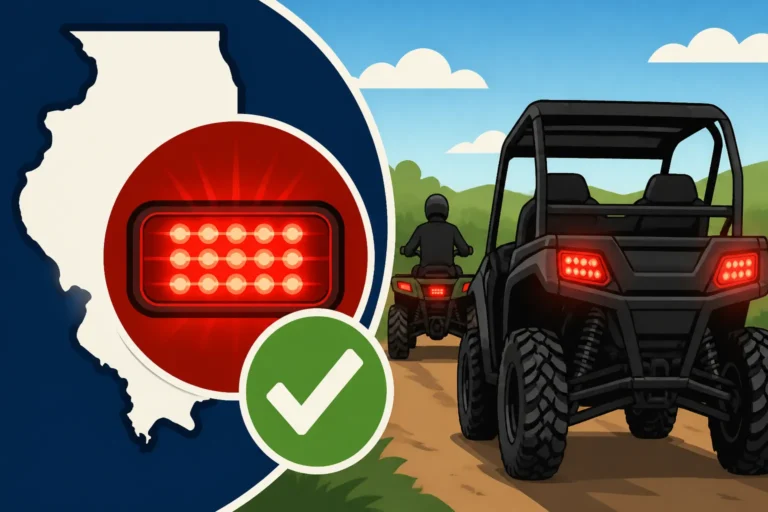
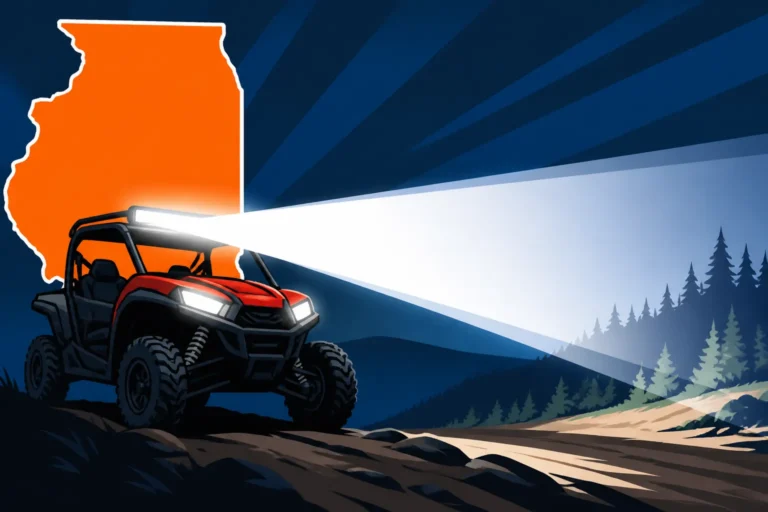
- Headlights, Tail Lights, and Brake Lights: Your machine absolutely must have working headlights, tail lights, and brake lights. The headlights need to illuminate objects at least 500 feet ahead, and the tail lamp must be visible from 100 feet to the rear. Brake lights are crucial for signaling your intentions to traffic behind you. If your machine's factory lights don't meet these intensity requirements, or if you only have a single tail light, upgrades are necessary.
- Turn Signals: This is often one of the biggest additions for UTVs. While some ATVs are smaller and hand signals might suffice in certain situations, UTVs almost universally need working turn signals for clear communication on the road. Many aftermarket kits, including those from SuperATV, integrate seamlessly with your existing wiring to provide front and rear turn signals, often with an audible flasher.
- Slow-Moving Vehicle Emblem: This distinctive orange triangle with a red border is required on any vehicle traveling slower than the normal speed of traffic. If your UTV has a maximum speed of 35 mph (often the local speed limit threshold for UTV access), this emblem is a must-have for visibility, especially on rural roads. It needs to be securely mounted to the rear of your machine.
- Horn: A working horn is essential for warning pedestrians or other drivers of your presence. A simple electric horn is usually sufficient to meet this requirement.
- Windshield (for UTVs): While not explicitly on every state's non-highway vehicle equipment list, many local ordinances or common sense dictates a windshield for UTVs on streets to protect against debris. Companies like SuperATV offer a range of windshields, from full glass to flip-up polycarbonate, providing protection and sometimes even a wiper option.
Remember, this isn't an exhaustive list for every local ordinance, but these are the primary state-level requirements that fall under the [Illinois Non-Highway Vehicle Equipment List]. Always check your specific local ordinance, as some towns might have additional requirements, but these core items are non-negotiable for operating on Illinois public roads.
The Importance of Compliance
The equipment checklist isn't just a suggestion; it's a legal mandate that carries consequences if ignored. Operating your ATV or UTV on Illinois public roads without the proper equipment, even if you have insurance, can lead to citations, fines, and potentially having your machine impounded. Law enforcement officers are trained to look for these specific safety features, and a missing mirror or non-functional brake light is an easy catch. The purpose of these laws is not to inconvenience you but to ensure safety for everyone on the road, including yourself.
Consider the potential costs: a ticket for an equipment violation might be less than for driving uninsured, but accumulating multiple citations can quickly add up, as detailed in [Illinois Ticket Costs for Street Riding]. Beyond the financial penalties, there's the inconvenience and stress of dealing with law enforcement, potential court appearances, and the time lost if your machine is towed. More importantly, operating without essential safety equipment like proper lighting or turn signals significantly increases your risk of being involved in an accident. You might be a highly skilled off-road driver, but the dynamics of road traffic are different, and visibility and communication with other drivers are paramount. Investing in the right street legal kit from a reputable source like SuperATV and ensuring everything is properly installed and functioning is not just about avoiding tickets; it's about protecting yourself and others. It demonstrates responsible ownership and contributes to a safer environment for everyone sharing the road.
Getting Your UTV Insured: Practical Steps
Once you've navigated the local ordinances and equipped your ATV or UTV with all the necessary street-legal gear, the final critical step is securing the right insurance. This is where your understanding of "Twenty-Five, Fifty and Twenty" truly comes into play. It can feel a bit daunting to call an insurance agent and explain that you want to insure your "off-road vehicle" for "on-road use," but with a clear understanding of what you need, the process becomes much smoother. Don't be shy; insurance agents are accustomed to a wide variety of vehicle types and usage scenarios.
The key is to be upfront and detailed about your intentions. Explain that you're seeking coverage for a non-highway vehicle that will be operating on public roads within specific municipalities that permit it. Be prepared with all the essential information about your machine. This typically includes the full Vehicle Identification Number (VIN), the make, model, and year of your ATV or UTV, and a clear description of any modifications you've made to make it street legal (e.g., turn signal kits, rearview mirrors, windshields from SuperATV). The more information you can provide, the more accurately your agent can quote a policy that meets Illinois's minimum liability requirements, and potentially offers additional protections you might want. Comparing quotes from several different insurance providers can also help you find the best rates and coverage options. For a general idea of costs, consider exploring resources like [Illinois ATV Insurance Cost Per Year].
Working with Your Insurance Agent
When you're ready to get your policy, approaching your insurance agent with clear and precise information is key. Don't just ask for "ATV insurance" or "UTV insurance," as many standard off-road policies don't automatically include the liability coverage required for street use. Specifically state that you need a policy that provides liability coverage meeting Illinois's minimum "Twenty-Five, Fifty and Twenty" requirements for operation on public roads. This clarifies your intent immediately and helps the agent identify the correct type of policy for you.
Beyond the minimum liability, this is also your opportunity to discuss additional coverage options that might be beneficial. Think about whether you want comprehensive coverage (for things like theft, fire, or vandalism) and collision coverage (for damage to your own machine in an an accident). These are often highly recommended, especially if your UTV is a significant investment or you've added valuable aftermarket parts. You'll also want to discuss your deductible choices – the amount you pay out-of-pocket before your insurance kicks in after a claim. A higher deductible typically means lower monthly premiums, but you'll need to be comfortable paying that amount should an incident occur. It's a balance between upfront costs and financial exposure in a claim. Understanding options like [Illinois Insurance After a Claim] and [Illinois Insurance Deductible Choices] can empower you to make informed decisions with your agent.
Factors Affecting Your Premium
The cost of your ATV or UTV insurance premium for street legal use in Illinois will depend on several factors, much like car insurance. Understanding these can help you anticipate costs and potentially find ways to manage them.
Firstly, the type of machine plays a big role. A powerful sport quad or a high-performance, four-seat side-by-side will generally cost more to insure than a smaller, less powerful utility ATV. The horsepower, displacement, and overall value of your machine are all taken into account. Your rider history is also critical; a clean driving record with no accidents or violations will typically result in lower premiums. Conversely, past tickets or claims, even in a car, can increase your rates. The location where you primarily store and ride your machine can also influence costs, with urban areas sometimes having higher rates due to increased traffic density and theft risk.
Lastly, modifications to your machine, especially performance-enhancing ones or highly customized builds, can affect your premium. While essential street legal components like a SuperATV turn signal kit are necessary for compliance, extensive modifications that significantly increase the machine's value or perceived risk might lead to higher insurance costs. Always disclose all modifications to your insurer to ensure proper coverage. Even simple things like whether the machine is stored in a locked garage versus left outside can impact rates. By understanding these variables, you can have a more informed conversation with your insurance agent and tailor a policy that fits both your legal requirements and your budget.
Disclaimer
This article is for general informational purposes only and does not constitute professional advice. Laws, prices and regulations vary by location and change over time. Consult a qualified professional for guidance on your specific situation.