Illinois Requires a 500-Foot Headlight
It’s a common scenario: you’ve got a perfectly capable ATV or UTV sitting in your garage, and you’d love nothing more than to use it for a quick run to the corner store, visit a neighbor, or even commute short distances. However, the open road in Illinois often feels like a legal minefield for off-road vehicles. This guide is here to cut through the confusion and specifically address one of the most critical safety components for street-legal riding: the headlights, and the strict 500-foot visibility rule that accompanies them.
The Foundation of Street Legality in Illinois
Riding an ATV or UTV on public roads in Illinois isn't a simple "yes" or "no" answer, which is often the most frustrating part for owners. Many assume that because their machine can go on the road, it should be allowed. However, the state starts with a general prohibition, then allows local governments to create specific exceptions. This patchwork of rules makes understanding the requirements, especially for equipment like headlights, absolutely essential before you ever put a tire on the pavement.
The General Ban on Off-Road Vehicles on Public Roads
Let’s be crystal clear right from the start: Illinois state law generally bans off-highway vehicles (OHVs), which include ATVs and UTVs, from operating on public streets and highways. This isn't just a suggestion; it's the default legal position. The idea behind this ban is primarily safety. These machines are designed for off-road terrain, with different handling characteristics, braking distances, and visibility profiles than traditional street-legal vehicles. The state aims to protect both OHV riders and other motorists by keeping these vehicles off high-speed, high-traffic routes. If you simply assume your machine is fine on the road, you could quickly find yourself facing a ticket or, worse, involved in an accident.
How Local Jurisdictions Create Exceptions for UTVs
Here's where it gets interesting, and often confusing. While the state bans OHVs from roads generally, it has given cities, villages, townships, and counties the authority to pass their own ordinances allowing UTVs on specific public roads within their jurisdiction. This means your ability to ride on the street depends entirely on where you are. One town might have embraced UTVs as a practical mode of local transportation, while the very next town over might strictly enforce the statewide ban. These local ordinances are usually quite specific, often detailing which roads are permitted, what times of day riding is allowed, and a whole host of equipment requirements that go above and beyond what your machine might have stock. It’s never safe to assume that if one town allows it, all do. You absolutely must check the specific rules for every locale you intend to ride in. You might find a town like Byron, Illinois, has a specific UTV permit process, while a neighboring rural township has completely different rules, or none at all. [Illinois UTV Street Legal Rules by Town] can be incredibly helpful here.
What "Non-Highway Vehicle" Means in Illinois Law
To understand the equipment requirements, it helps to understand how Illinois law categorizes these machines. ATVs and UTVs, when not specifically modified and approved for traditional highway use, fall under the umbrella of "non-highway vehicles." This legal definition is crucial because it sets them apart from cars and trucks and dictates the specific safety equipment they must carry if they are to be operated legally on roads where local ordinances permit it. The term "non-highway vehicle" acknowledges their primary design purpose while allowing for limited, locally sanctioned road use under specific conditions. It means that while they might share some features with cars, they are not treated identically, and their equipment requirements, like the critical headlight visibility, reflect their unique design and the potential risks associated with road operation. The [Illinois Non-Highway Vehicle Equipment List] is a great resource to review all these requirements.
Illinois Headlight Requirements for Road Use
When it comes to making your ATV or UTV street legal in Illinois, adequate lighting is non-negotiable, and the headlight is at the forefront of this requirement. It's not just about having a light; it's about having a light that meets a very specific standard for visibility. This standard is designed to ensure that you can see where you're going and, just as importantly, that other drivers can see you, especially when visibility is low.
Understanding the 500-Foot Visibility Rule
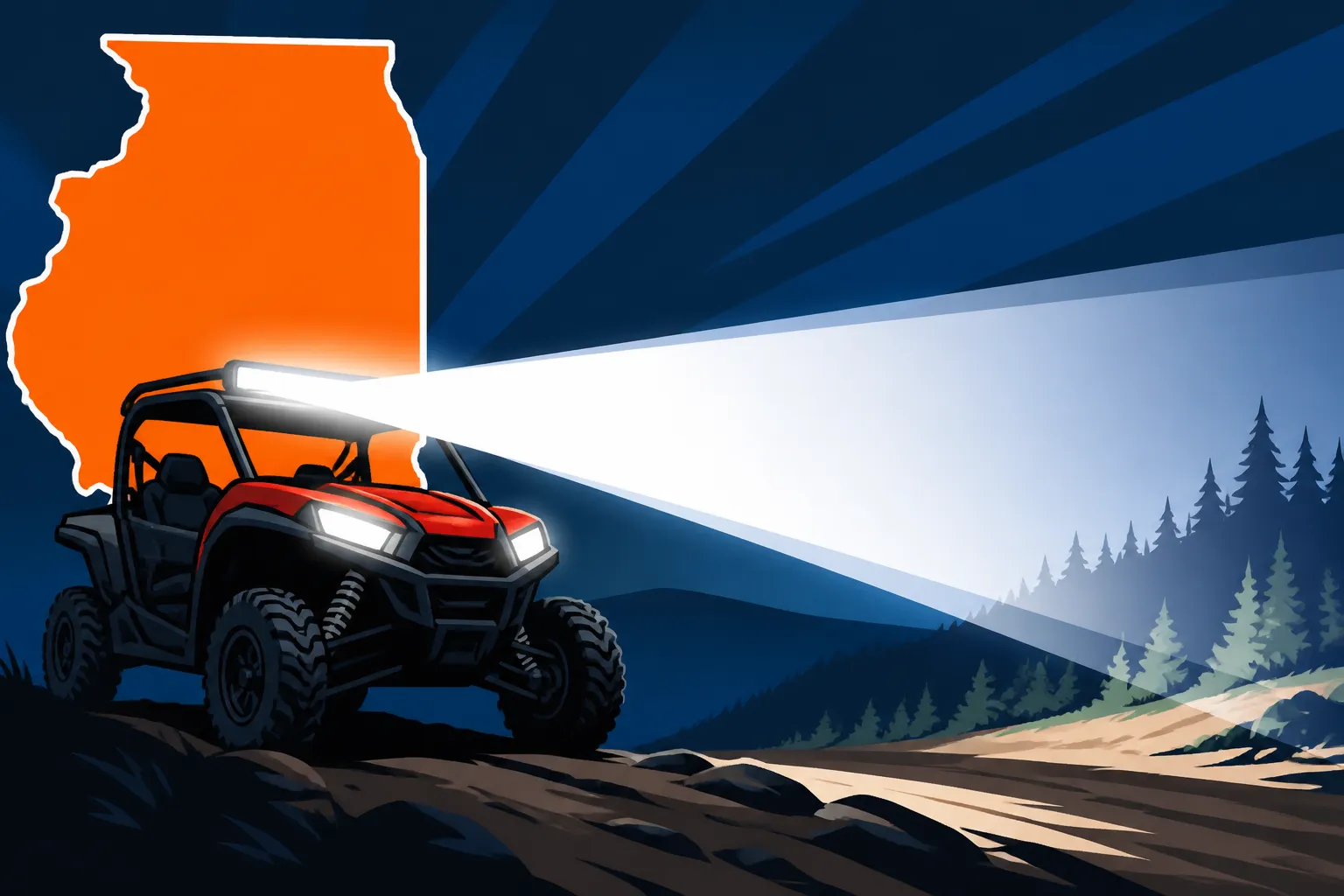
The Illinois Vehicle Code specifically mandates that any non-highway vehicle operated on public roads must have at least one headlight (and often two are standard on most machines) that is capable of projecting a beam of light for a minimum distance of 500 feet. This isn't some arbitrary number; it's a critical safety measure. Imagine driving on a country road at dusk or in light rain. Being able to see obstacles, road hazards, or even deer from 500 feet away gives you crucial reaction time. For oncoming traffic, your bright headlight makes your presence known from a significant distance, reducing the risk of a head-on collision or misjudgment. It's about ensuring ample warning for everyone on the road. Without a headlight meeting this standard, you're not just risking a ticket; you're significantly compromising safety for yourself and others. This rule is a fundamental part of [Illinois Headlight Requirements for an ATV].
Why Your Stock Headlights Might Not Be Enough
Many ATV and UTV owners are surprised to learn that their factory-installed headlights, while perfectly adequate for trail riding or navigating a field, might not meet the 500-foot visibility standard for street use. Manufacturers design stock lighting for the vehicle's intended primary purpose, which is typically off-road. This often means they prioritize wide, flood-style beams for close-range visibility on trails rather than a focused, long-distance beam needed for road safety.
Consider a scenario: you've just bought a brand new side-by-side, excited about using it to get around your small town. You assume the lights are sufficient. But as soon as night falls and you hit a darker stretch of road, you realize your stock lights only illuminate about 150-200 feet ahead. That's a huge gap from the required 500 feet. Not only would you be in violation of the law, but you'd also be operating unsafely. The light might be bright to you at close range, but it might not project a strong enough beam far enough down the road to meet the legal requirement. This is where aftermarket upgrades often come into play, as many stock systems simply aren't engineered with this specific road visibility standard in mind.
Practical Considerations for Headlight Performance
Meeting the 500-foot headlight requirement involves more than just swapping out a bulb. Several factors influence how well your headlights perform. The type of bulb (halogen, LED, HID), the design of the reflector or projector housing, and even the cleanliness and condition of your headlight lenses all play a role. For instance, a dirty, scratched, or yellowed plastic lens can significantly reduce light output and projection, even if you have a powerful bulb.
When you're looking to upgrade, consider the beam pattern. For road use, you generally want a headlight that provides a good balance of foreground illumination and long-range projection without excessive glare for oncoming drivers. Some aftermarket LED light bars, while incredibly bright, might not be street-legal due to their beam pattern being too broad or causing too much glare. It's crucial to look for lighting solutions specifically designed for road applications, which often means they have a cutoff beam to prevent blinding others. Installing auxiliary lights or replacing stock units with more powerful options from reputable brands like SuperATV can help you achieve compliance, but always verify their road-legal status and proper aiming before hitting the streets. Regular maintenance, like cleaning your headlight lenses, is also a small but impactful step in ensuring optimal visibility.
Beyond Headlights: Other Essential Lighting Equipment
While the headlight is critical, it's just one piece of the puzzle for legal road operation in Illinois. Your ATV or UTV needs a comprehensive lighting package to ensure visibility from all angles, especially in low-light conditions or when communicating your intentions to other drivers. Overlooking these other lighting requirements can be just as problematic as having inadequate headlights.
Tail Lamps and Brake Lights: Visibility from Behind
Just as important as seeing what's in front of you is ensuring that vehicles behind you can see you. Illinois law requires that non-highway vehicles operating on public roads be equipped with a tail lamp (or lamps) that emits a red light visible from at least 100 feet to the rear. This tail lamp must be illuminated whenever the headlight is on. Additionally, brake lights are mandatory. These must activate when the brakes are applied, emitting a red or amber light to signal to following drivers that you are slowing down or stopping. [Illinois Requires a 100-Foot Tail Lamp] goes into more detail. Imagine a situation on a busy county road: a car approaching from behind needs clear visual cues to maintain a safe following distance and react if you slow down. Without effective tail and brake lights, you're a significant rear-end collision risk. Many stock ATVs and UTVs come with these, but ensuring they are bright, clean, and fully functional is paramount for road use.
Turn Signals: Communicating Your Intentions
Unlike off-road trails where hand signals might suffice, public roads demand clear, standardized communication. Illinois law for street-legal UTVs requires working turn signals, both front and rear, that are visible to other drivers. These signals allow you to indicate your intention to turn left or right, change lanes, or merge, preventing dangerous assumptions by other motorists. Think about pulling out of a driveway onto a two-lane road; a clear, blinking signal lets oncoming and following traffic know your next move. Without them, you'd be forced to make unpredictable maneuvers or resort to hand signals, which can be difficult to see and interpret, especially in traffic or at night. Many ATVs do not come with turn signals from the factory, making this a common aftermarket upgrade for those aiming for street legality. When choosing turn signals, ensure they are bright enough to be seen in daylight and meet any specific illumination or flash rate requirements. [Illinois Requires Turn Signals] is a must-read for anyone considering road use.
Reflectors for Added Safety
Beyond active lighting, passive visibility is also a legal requirement. Illinois mandates that non-highway vehicles have red reflectors on the rear and, in some cases, amber reflectors on the sides, particularly if the vehicle is wider. These reflectors serve as a crucial backup, making your machine visible even if your active lights fail or are turned off when parked on a road shoulder. They catch and return light from other vehicles' headlights, providing a silhouette of your machine in low-light conditions. While they don't replace headlights or tail lights, they significantly enhance your overall visibility, especially from the rear. It's a small but vital safety feature that often gets overlooked during the conversion to street legality. Checking that your reflectors are clean, intact, and properly positioned is a quick and easy step to boost safety.
Additional Safety Gear for Street-Legal ATVs and UTVs
Achieving street legality in Illinois extends beyond just proper lighting. There are several other crucial pieces of equipment and administrative requirements designed to ensure your safety and the safety of others on shared roadways. Failing to address any of these can lead to fines, citations, or even the impoundment of your machine.
The Mandate for a Rearview Mirror
Picture yourself driving down a street in a UTV. You need to know what's happening behind you for safe lane changes, turns, and general awareness of traffic. That's why Illinois law requires a working rearview mirror on any non-highway vehicle operated on public roads. This isn't just a suggestion; it's a legal necessity. A rearview mirror allows you to observe traffic approaching from the rear without having to turn your head completely, which can be risky, especially while maintaining control of the machine. Most UTVs come with at least one rearview mirror, but many ATVs do not, making this another common aftermarket addition. Ensure your mirror provides an unobstructed view of the road behind you and is securely mounted to withstand the vibrations and bumps of riding. [Illinois Requires a Rearview Mirror] elaborates on this vital component.
Slow-Moving Vehicle Emblem Rules
For vehicles that typically travel at lower speeds than the flow of traffic, an additional warning is necessary. Illinois requires that any non-highway vehicle operating on a public road carry a "slow-moving vehicle" (SMV) emblem. This is a distinctive fluorescent orange triangle with a dark red reflective border, typically mounted prominently on the rear of the machine. Its purpose is to clearly signal to other motorists that your vehicle is likely traveling at 25 miles per hour or less, giving them ample time to reduce speed and react safely.
Consider a scenario where you're on a rural road with a 55 mph speed limit. Without an SMV emblem, a driver approaching from behind might not realize you're moving much slower until they're very close, creating a dangerous situation. The bright orange and reflective properties of the emblem make it highly visible both day and night, significantly reducing the risk of a rear-end collision. Make sure your SMV emblem is clean, in good condition, and mounted correctly—typically vertically, point-up, and between 2 and 6 feet above the ground on the machine's furthest rear point.
Insurance and Licensing for Street Use
Beyond the physical equipment, there are administrative requirements that simply cannot be skipped. If you're going to operate your ATV or UTV on public roads in Illinois, you generally need to carry liability insurance. Just like with a car, this insurance protects you financially in case you're at fault in an accident causing injury or property damage to others. The minimum coverage requirements for street-legal operation are the same as for cars and trucks in Illinois. While trail riding insurance might be optional, street use makes it mandatory.
Furthermore, the operator of the street-legal machine must possess a valid driver's license. This isn't a special "OHV license"; it's a standard Class D driver's license that demonstrates you have met the state's requirements for operating a motor vehicle. Operating without a valid license or adequate insurance on public roads can lead to severe penalties, including fines, license suspension, and potential impoundment of your vehicle. Always have proof of insurance and your driver's license with you when riding on public streets. [Illinois Requires Insurance for Street Use] provides important details on this.
Navigating Local Ordinances and Enforcement
Understanding the general state requirements for equipment is one thing, but actually riding on Illinois roads requires a deep dive into the specific rules governing your intended riding area. Because street legality is granted at the local level, navigating the patchwork of ordinances and understanding how they're enforced is just as crucial as having the right headlights.
Researching Your Local UTV Ordinances
This is perhaps the most critical step before you even think about putting your UTV on a local street. Illinois law allows municipalities, townships, and counties to pass ordinances permitting UTV use on their roads, but it doesn't require them to. This means that just because a neighboring town allows it doesn't mean your town does. You need to actively research the specific rules for each jurisdiction you plan to ride in.
How do you do this? Start by checking your city or village's official website. Many municipalities will have their ordinances posted online. Look for sections related to "non-highway vehicles," "utility terrain vehicles," or "off-highway vehicles." If you can't find it online, a call to the village or city clerk's office is your next best bet. They can direct you to the relevant code or tell you if an ordinance exists. For unincorporated areas, you'll need to check county or township ordinances.
These ordinances often specify not just if you can ride, but where (e.g., only on roads with speed limits 35 mph or less), when (e.g., daylight hours only), and how (e.g., requiring specific permits, inspections, or equipment beyond state minimums). Some towns might require an annual permit, like the one in Byron mentioned earlier, which often involves an inspection to ensure all required equipment is present and functional. If you ride in multiple towns, you might need to comply with multiple sets of rules.
What to Expect from Law Enforcement
Even if you've done your homework and believe your machine is fully compliant, encounters with law enforcement can still occur. Officers are tasked with enforcing both state laws and local ordinances, and the specifics of OHV regulations can sometimes be complex, even for them. If you're pulled over, the most important thing is to remain courteous and cooperative. Have all your documentation readily available: your driver's license, proof of insurance, and any local permits or registrations.
A conservation officer, a county sheriff, or a municipal police officer can stop you to check for compliance. They will typically look for the mandatory equipment we've discussed – functional headlights (meeting the 500-foot rule), tail lights, brake lights, turn signals, a rearview mirror, and the SMV emblem. They might also check your tires, width restrictions, and ensure you're not riding on prohibited roads or during prohibited hours. If your local ordinance requires a permit sticker, they'll look for that too. Being prepared and having all your paperwork in order can make these encounters much smoother.
Penalties for Non-Compliance
The consequences of non-compliance can range from a simple warning to significant fines, court costs, and even the impoundment of your machine. Riding on a prohibited road, operating without required equipment, or failing to have proper insurance or a valid license can all lead to citations. The cost of a ticket can vary widely depending on the specific violation and the local jurisdiction. For example, [Illinois Penalties for Illegal Street Riding] can be quite substantial.
Beyond the immediate financial hit, repeated violations could lead to more serious consequences, including suspension of your driver's license. If your machine is impounded, you'll face towing and storage fees on top of any fines, which can quickly add up. The best way to avoid these headaches is through proactive preparation: thoroughly research local ordinances, ensure your machine is equipped to the letter of the law, and always carry all necessary documentation. It's a small investment of time and effort to ensure your recreational riding doesn't turn into a legal and financial burden.
Upgrading Your Machine for Illinois Road Compliance
For many ATV and UTV owners, getting their machine ready for street legal use in Illinois means more than just a quick check; it often requires strategic upgrades. While some machines may have adequate lighting and mirrors from the factory, others will definitely need some additions or replacements to meet the state's stringent requirements, especially the 500-foot headlight visibility rule.
Aftermarket Lighting Solutions
If your stock headlights aren't cutting it for the 500-foot visibility rule, or if your machine lacks essential lighting like turn signals, the aftermarket is your friend. There's a vast array of lighting solutions available designed to boost visibility and bring your vehicle into compliance.
For headlights, you might consider upgrading to brighter LED bulbs, or even entirely new LED headlight assemblies. These often offer superior light output, a clearer beam pattern, and consume less power than traditional halogen bulbs. When choosing new headlights or auxiliary driving lights, look for products that specifically state they are suitable for road use and provide a focused beam for distance. Many brands offer complete headlight kits that meet or exceed visibility requirements.
For turn signals, if your ATV or UTV doesn't have them, you'll need to install a complete kit. These kits typically include front and rear LED lights, a flasher relay, and a switch that can be mounted on your handlebars or dash. Similarly, if your stock tail lights aren't bright enough or lack integrated brake light functionality, aftermarket LED tail light assemblies are a popular choice. Remember, the goal isn't just to have lights, but to have lights that clearly communicate your presence and intentions to other drivers from the legally required distances.
Sourcing Compliant Accessories
When you're upgrading your ATV or UTV for street legality, it's not enough to just buy any part. You need to source accessories that are specifically designed for road use and comply with Illinois regulations. This means looking for products from reputable manufacturers who understand vehicle lighting standards. For instance, when considering the critical 500-foot headlight requirement, a company like SuperATV offers a range of lighting options, including LED light bars and headlight kits, that can provide significantly improved illumination. While some light bars are designed for off-road use only, many manufacturers also produce DOT-compliant (Department of Transportation) lights that meet road-legal specifications. Always check product descriptions and specifications to ensure they meet the specific needs for distance, beam pattern, and color.
Beyond lighting, you'll also need to source a compliant rearview mirror if your machine doesn't have one, or an SMV emblem. These are usually readily available from ATV/UTV accessory retailers, farm supply stores, or online. The key is to avoid cheap, non-certified parts that might look good but fail to meet the legal requirements or perform reliably. Investing in quality, compliant accessories from trusted brands ensures your safety and helps you avoid issues with law enforcement.
| Required Equipment | Illinois Standard | Common Upgrade Need | Where to Source |
|---|---|---|---|
| Headlights | Visible 500 ft | Often needed | Aftermarket retailers, specialty lighting |
| Tail Lamp | Red, visible 100 ft rear | Sometimes needed | Aftermarket retailers, specialty lighting |
| Brake Lights | Red/Amber, visible rear | Sometimes needed | Aftermarket retailers, specialty lighting |
| Turn Signals | Front & Rear, visible | Often needed | Turn signal kits from accessory brands |
| Rearview Mirror | unobstructed view to rear | Often needed | ATV/UTV accessory retailers |
| SMV Emblem | Fluorescent orange triangle | Always needed | Farm supply stores, accessory retailers |
| Horn | Audible 200 ft | Sometimes needed | Aftermarket horns, accessory brands |
The Importance of Professional Installation
While many ATV and UTV owners are perfectly capable of tackling DIY projects, some of the electrical and safety-critical installations for street legality are best left to professionals, especially if you're not experienced. Improper wiring of lights can lead to electrical shorts, battery drain, or even fire hazards. Incorrectly aimed headlights, even powerful ones, can blind oncoming drivers, creating a new set of dangers and legal issues.
A qualified mechanic specializing in powersports vehicles can ensure that all your new equipment is installed correctly, wired safely, and properly adjusted to meet all legal requirements. They can also advise you on the best products for your specific machine and local ordinances. For example, if you're adding a complete turn signal kit, a professional will know how to integrate it seamlessly into your existing electrical system without causing conflicts. While there's an upfront cost for professional installation, it provides peace of mind that your machine is not only legally compliant but also safe and reliable for road use. It's an investment in your safety and in avoiding potential legal troubles down the road.
Disclaimer
This article is for general informational purposes only and does not constitute professional advice. Laws, prices and regulations vary by location and change over time. Consult a qualified professional for guidance on your specific situation.