The Farm Exemption From Street Insurance Rules
Navigating the rules for ATVs and UTVs in Illinois can feel like trying to find your way through a corn maze blindfolded, especially when you use your machine for serious farm work. One of the biggest head-scratchers for many rural residents is whether they need to carry traditional street legal insurance when they're just zipping down the road from one field to another or heading to the grain bin. This guide is here to clear up that confusion, specifically diving into the farm use exemption from those often-misunderstood street insurance rules in Illinois.
The General Rule: Why OHVs Need Insurance for Street Use in Illinois
Before we talk about any exemptions, it's super important to understand the baseline. In Illinois, the law generally views ATVs and UTVs as off-highway vehicles (OHVs), meaning they're meant for dirt, trails, and private land. Taking them onto public roads carries a whole different set of considerations, and usually, that includes insurance.
What "Street Legal" Really Means for an Illinois UTV
Let's be real: Illinois doesn't make it easy to just jump on your UTV and head down to the corner store. The state law starts with a pretty firm "no" to OHVs on public roads. However, Illinois does provide a framework where local units of government—like villages, cities, and counties—can pass ordinances to allow UTVs on their specific roads. This is why you might see UTVs legally cruising down streets in one small town, but not in the next. It all hinges on whether that local government has taken the specific steps to open their roads. If your UTV is going to be used on these approved public roads, it needs to meet a whole list of equipment requirements, from headlights and taillights to turn signals and mirrors. This equipment often mirrors what a car needs for safety and visibility, and many owners turn to aftermarket solutions, perhaps from a reputable provider like SuperATV, to get their machine up to snuff.
Even with all the right gear and a local ordinance, that UTV isn't truly "street legal" in the same way your car is. It's street legal within specific, defined boundaries and under specific conditions. And generally, that includes having the right insurance. It's a patchwork quilt of rules, and it's vital to check with your specific municipality before you ever take your UTV onto a public street for recreational or non-farm purposes.
The Mandatory Insurance Minimums for Public Roads
If your UTV does qualify for street use under a local ordinance, then you're almost certainly going to run into mandatory liability insurance requirements. Just like with cars, Illinois has minimums you need to meet to protect other drivers and their property in case you cause an accident. We're talking about the "25/50/20" rule:
- $25,000 for bodily injury to one person in an accident.
- $50,000 for bodily injury to more than one person in an accident.
- $20,000 for damage to property in an accident.
This coverage is incredibly important. Imagine you're driving your UTV on a village street, and you accidentally collide with another car. Without this insurance, you'd be personally responsible for those damages, which could be financially devastating. These are the stakes when operating any motor vehicle on public roads, and your UTV is no exception if it's operating outside of specific exemptions. You can learn more about [Illinois Insurance Minimums for Street Use].
Decoding the Farm Use Exemption for ATVs and UTVs
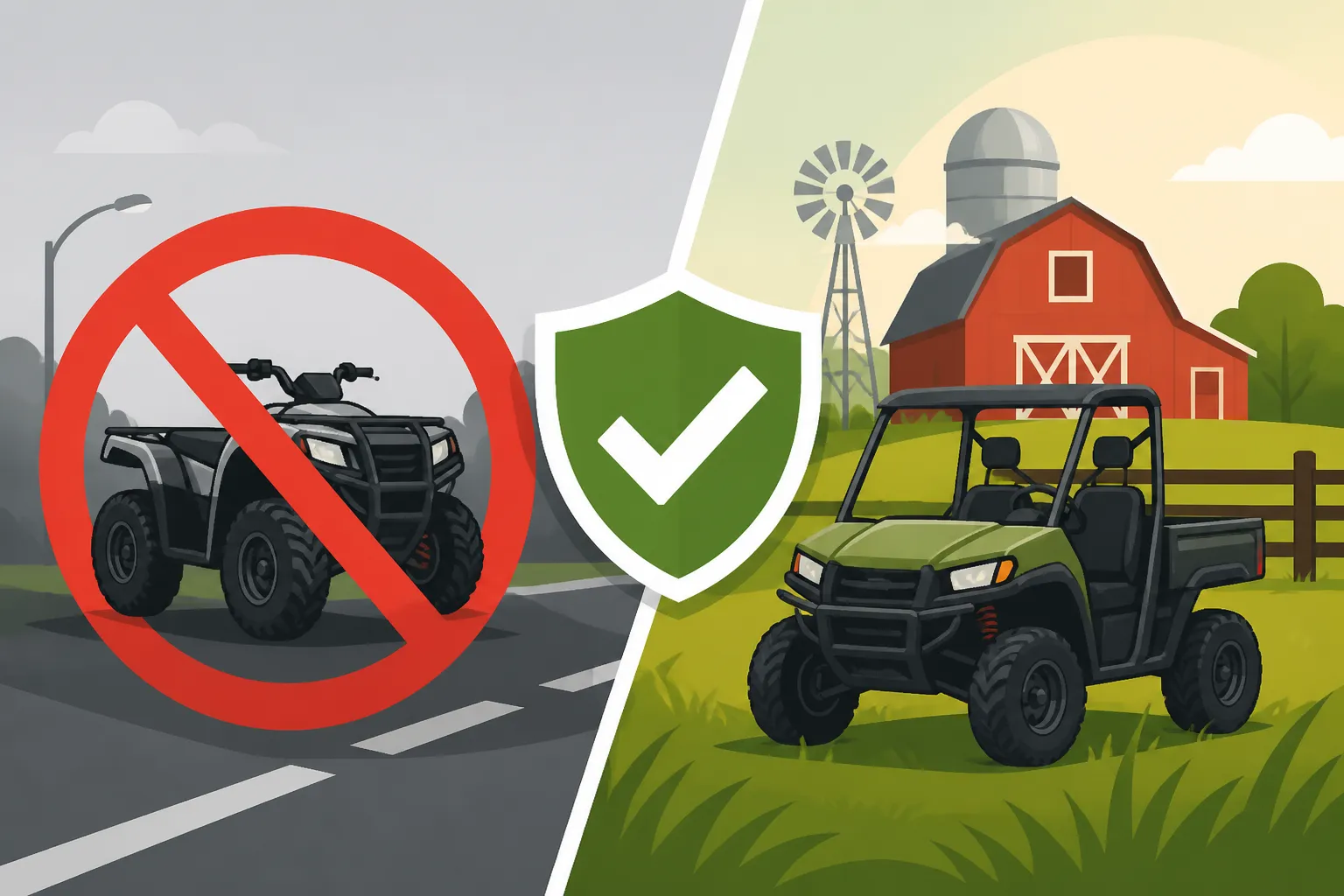
Now, let's get to the good news for our hardworking farm friends. Illinois does offer an exemption for ATVs and UTVs used exclusively for agricultural purposes, meaning you don't have to carry those specific street legal liability insurance minimums when operating on public roads for farm work. This exemption is a lifesaver for farmers who rely on their machines daily to manage their operations.
Who Qualifies as a "Farm Machine" in Illinois?
This isn't a blanket exemption for anyone who lives in a rural area. To qualify, your ATV or UTV must be used exclusively for agricultural purposes. What does that mean in practice? It means your machine is primarily used for tasks directly related to farming, livestock production, or other agricultural operations. Think about it:
- Hauling tools, feed, or supplies between fields.
- Checking fences and livestock.
- Transporting equipment for planting or harvesting.
- Moving small implements like sprayers or spreaders.
- Supervising crops or checking irrigation systems.
This exemption is really designed for the utility aspect of your OHV on the farm, making it easier to do the essential work of agriculture without adding undue regulatory burden. It's about getting from point A to point B to get work done, not for a joyride. If your machine is mostly for recreation, even if it's on your farm, this exemption doesn't apply. Illinois recognizes the unique needs of its agricultural community, which is why there's a specific [Illinois Farm and Livestock Exemption] for these machines. This also ties into rules like [Illinois Machines Used Only on a Farm], which might influence other aspects of ownership.
What the Exemption Actually Exempts You From
It's crucial to understand the scope of this exemption. It only exempts farm-use ATVs and UTVs from the mandatory liability insurance requirements when used on public roads for agricultural purposes. That's it. It doesn't mean you can operate recklessly, or that you're exempt from all other rules of the road.
Specifically, it removes the legal obligation to carry those 25/50/20 liability insurance minimums that a recreational UTV would need if it were allowed on a village street. The state understands that these machines are tools for a specific trade, and imposing the same insurance burden as a commuter vehicle might be excessive for their limited, functional road use. It's a recognition of the machine's primary function and the context of its use on public ways. However, this is not a free pass on all fronts, and other safety considerations remain paramount.
When the Exemption Does Not Apply
This is where many people get tripped up, and it's essential to be crystal clear. The farm use exemption has very strict boundaries. If your use falls outside these boundaries, even for a moment, the exemption likely vanishes, and you could be held liable without insurance if an incident occurs.
Here are scenarios where the exemption generally does not apply:
- Recreational Use: Taking your UTV down the road to visit a neighbor for a social call, or heading to a local event, is not farm use. Even if you're a farmer, if the purpose of the trip isn't directly related to your agricultural operation, the exemption isn't in play.
- Commuting to a Non-Farm Job: Using your ATV or UTV to get to a job that isn't agricultural (e.g., driving to town for a part-time job at a hardware store) is not covered by the exemption.
- Non-Farm Business Use: If you're using your machine for a landscaping business that isn't part of your farm's agricultural production, the exemption won't apply.
- "Quick Errands" That Aren't Farm-Specific: Want to run into town for a snack or a soda? If it's not directly related to getting farm supplies or performing a farm task, you're outside the exemption. For instance, if you're taking your UTV to the gas station to fill it up for farm use, that might be a gray area that officers could interpret differently. However, if you're just driving to get yourself a coffee, it’s not farm use.
- Lending to a Friend for Non-Farm Use: If you let a friend borrow your "farm machine" and they use it recreationally on public roads, even if you typically use it for farm work, that specific trip isn't exempt.
The key takeaway is "exclusively for agricultural purposes." Any deviation from that core function on public roads puts you outside the insurance exemption, and potentially at risk.
Navigating Public Roads as a Farm ATV/UTV Operator
So, you're using your ATV or UTV exclusively for farm work, and you need to briefly operate it on a public road. Great, the insurance exemption helps, but it doesn't mean it's a free-for-all. There are still important rules and safety considerations to keep in mind.
Equipment Still Required for Farm Machines on Public Roads
Even without the street insurance requirement, safety and visibility are non-negotiable, especially on public roads. You're still sharing the road with cars, trucks, and other farm equipment, and you need to be seen and understood. While a local ordinance might dictate specific equipment for general street-legal UTVs, for farm machinery, the focus shifts to being a "slow-moving vehicle" and ensuring basic visibility.
You should definitely equip your machine with:
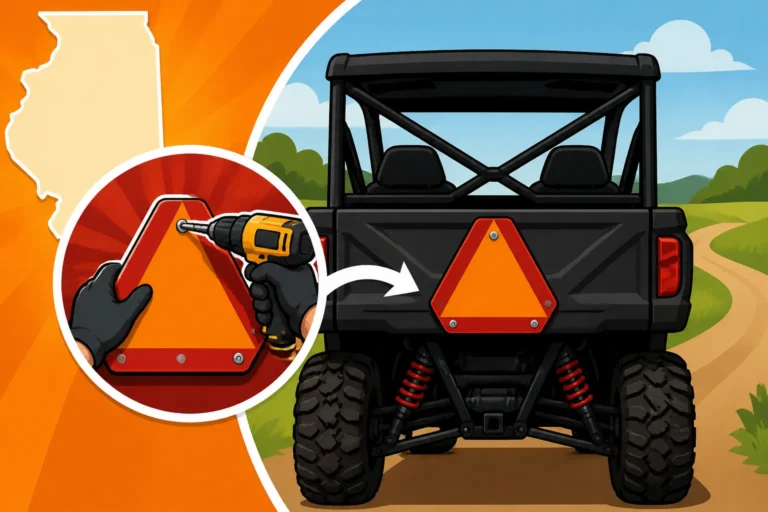
- A Slow-Moving Vehicle Emblem: This bright orange and red triangle is universally recognized as indicating a vehicle traveling 25 mph or less. It's critical for preventing rear-end collisions, especially on rural roads where speeds can be higher. Illinois has specific rules for this, and it’s a must-have for farm use on public roads. [Illinois Requires a Slow-Moving Vehicle Emblem].
- Lights: At a minimum, you'll need working headlights and taillights, especially if there's any chance you'll be on the road at dusk, dawn, or in low visibility conditions. These are fundamental safety features.
- Brakes: Your brakes need to be in excellent working order. This sounds obvious, but a farm machine works hard, and maintenance can sometimes slide.
- Mirrors: While not always explicitly required for farm implements in the same way as a "street legal" UTV, a rearview mirror significantly enhances your awareness of traffic behind you, which is crucial for safety.
Considering the general [Illinois Non-Highway Vehicle Equipment List] for any road interaction is a good practice, even if not every item is strictly mandated for farm machines under this specific exemption. Many farmers find that adding a light bar or extra reflective tape from a company like SuperATV enhances their visibility even further, going above and beyond minimum requirements.
Crossing Roads vs. Traveling Down Roads
There's a subtle but important distinction between briefly crossing a public road to get to another field, and traveling a significant distance down a public road.
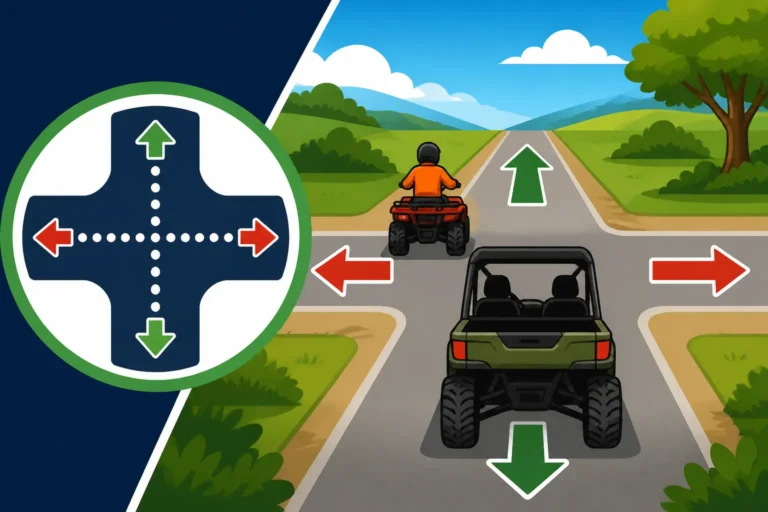
- Crossing: Often, local enforcement is more lenient if you're simply making a quick, direct crossing of a road to access adjacent property. This is generally understood as part of farm operations. The key is to do so safely, yielding to all traffic, and making your intentions clear.
- Traveling: If you're going to travel a quarter-mile, a half-mile, or more down a public road, you need to be extra cautious. While the farm exemption from insurance applies, you're still expected to adhere to traffic laws, respect speed limits (which your machine likely can't exceed anyway), and operate safely. Local ordinances, while often focused on "street legal" UTVs, might still have general implications for any non-traditional vehicle operating on their roads. Understanding [Illinois Crossing Rules at Intersections] is fundamental for safe operation.
Always prioritize safety. Even if you're technically exempt from certain rules, avoiding an accident is the real goal.
The Importance of Personal Liability Coverage (Even Without the Exemption)
Here's some straight talk from an old blogger: even though the state says you don't need that specific street liability insurance for farm use, it's incredibly wise to ensure you have some form of personal liability coverage. Why?
- Accidents Happen: The exemption covers the legal requirement for street liability insurance. It doesn't absolve you of financial responsibility if you cause an accident. If you injure someone or damage property, and you don't have personal liability coverage (perhaps through your farm insurance policy or an umbrella policy), you could still face significant personal financial loss.
- Beyond the Road: What if an accident occurs on your private farm property, but it's still a serious incident? Or what if there's a dispute about whether your use truly qualified as "agricultural" at the time of an accident on a public road? General liability coverage can offer peace of mind.
- Protecting Your Assets: You've invested in your farm, your land, and your machines. Protecting those assets from potential lawsuits is just good business sense.
Talk to your farm insurance agent. Explain exactly how you use your ATV or UTV, especially on and near public roads. They can help you determine what coverage makes sense for your specific situation. This is a bit like [Illinois Insurance for Trail Use] – even when not required, it's often a smart choice.
Common Pitfalls and Best Practices for Farm OHV Operators
Operating a farm ATV or UTV on public roads, even with the exemption, requires vigilance and common sense. Avoiding common mistakes can save you a lot of headaches, and potentially, a lot of money.
Proving "Farm Use" If Pulled Over
This is a big one. An Illinois conservation officer or local sheriff’s deputy sees you on a public road on your UTV. They might not immediately know you're headed to check on the back forty. You need to be able to demonstrate that your use is, in fact, agricultural.
- Be Prepared to Explain: Calmly explain your destination and purpose. "I'm heading to the north field to check the fence line," or "I'm taking these tools over to fix the sprayer."
- Visible Cues: Is your UTV equipped like a farm machine? Are you hauling tools, feed, or agricultural products? Is there mud on the tires from the field? Are you wearing work clothes? These visual cues can help reinforce your claim. If you've outfitted your UTV with a dump bed or a winch from SuperATV for farm tasks, it immediately looks less like a recreational machine.
- No Recreational Items: Avoid having coolers, camping gear, or other clearly recreational items on your machine when operating on public roads under the farm exemption. That just complicates the narrative.
- Proof of Ownership/Employment: While not always necessary, having basic farm identification, a farm address, or even being able to articulate details about your operation can help.
Remember, the officer has discretion. Your ability to clearly and politely explain your legitimate farm purpose is key.
Local Ordinances and Their Impact
We talked about how local municipalities can pass ordinances for UTV use on their roads. Even with the state farm exemption for insurance, a local ordinance could potentially have other requirements for any UTV on their roads, regardless of use.
- Check Local Rules: Before routinely using public roads in a specific village or county for farm work, it's always a good idea to check if they have any specific rules for farm implements or non-traditional vehicles on their roads. While the state exemption takes precedence for insurance, local rules often cover things like operating hours, specific road designations, or even speed limits that might affect you. Understanding [Illinois Municipalities That Pass Ordinances] can save you from a surprise ticket.
- Safety First: No local ordinance can ever override the need for safe operation. Always drive defensively and be aware of your surroundings.
Why You Might Still Want Comprehensive Insurance
Even if you're fully covered by the farm exemption for liability, think about the value of your machine itself. ATVs and UTVs are significant investments, often costing many thousands of dollars. What if something happens to it that isn't related to liability?
- Theft: Sadly, farm equipment can be a target for thieves. If your UTV is stolen from your barn or field, comprehensive insurance can help you replace it. This is why many owners get [Illinois Theft Coverage in a Shed] or other secure storage options.
- Fire: A mechanical issue, an electrical short, or even a stray ember can lead to a fire. Comprehensive coverage can protect you.
- Damage (Non-Collision): What if a tree falls on it, or it gets damaged by severe weather? Comprehensive coverage can often step in where liability doesn't.
- Collision (Your Fault): If you hit a deer, or accidentally back into a fence on your own property, collision coverage (often paired with comprehensive) can help repair your machine.
While the farm exemption is great for specific liability rules, it doesn't protect your machine. Consider discussing comprehensive and collision options with your insurance provider to fully protect your investment.
Farm vs. Recreational OHV Road Use in Illinois: A Quick Look
Here's a simplified comparison to help you quickly grasp the differences when considering public road use:
| Feature | Recreational UTV (on approved local roads) | Farm-Use ATV/UTV (exclusively for agricultural purposes) |
|---|---|---|
| Primary Use | Personal enjoyment, commuting, general errands | Agricultural work (hauling, checking fields, livestock, etc.) |
| Local Ordinance | Required for any street access | Not directly required for crossing or brief travel for farm work |
| Mandatory Street Insurance | Required (25/50/20 liability minimums) | EXEMPT for agricultural purposes only |
| Equipment Requirements | Extensive (headlights, taillights, turn signals, mirrors, brake lights, SMV emblem often) | Basic (SMV emblem strongly recommended/required, lights, brakes; mirrors wise) |
| Driver's License | Required | Generally required for road use |
| Usage Stamp/Decal | Usage Stamp if on DNR trails, Access Decal if on grant-assisted sites (not for street use) | Usage Stamp if on DNR trails, Access Decal if on grant-assisted sites (not for farm road use) |
| Proof of Use | Permit/registration documentation from local municipality | Be prepared to explain and demonstrate agricultural purpose if stopped |
| Recommended Coverage | Mandatory liability, plus comprehensive/collision for protection | Personal/farm liability, plus comprehensive/collision for protection |
Disclaimer
This article is for general informational purposes only and does not constitute professional advice. Laws, prices and regulations vary by location and change over time. Consult a qualified professional for guidance on your specific situation.