Illinois Trails That Allow Side-by-Sides
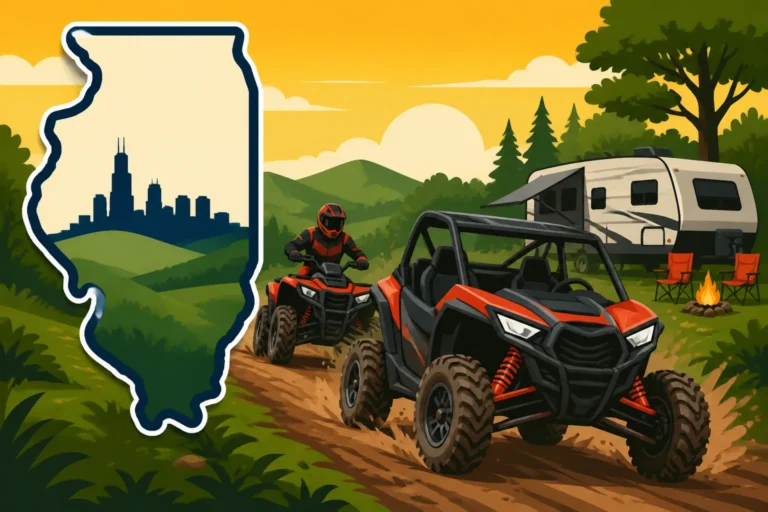
A side-by-side can make an Illinois trail day feel easy—until you discover the route is too narrow, the park does not allow your machine, or the land is not open to motorized riding at all. Illinois has fewer public OHV options than many riders expect. This guide explains where to start, what to confirm before towing, and how to avoid a wasted trip.
Where to look for Illinois side-by-side trails
Illinois riding opportunities tend to fall into three categories: designated public or grant-assisted OHV sites, private off-road parks, and land where you have specific permission to ride. A route that appears on a map is not automatically a legal trail, and a road that fits your UTV is not necessarily open to it.
For many riders, the most practical first step is to search for a managed riding area rather than a general trail network. A park operator can tell you whether side-by-sides are admitted, what size or equipment restrictions apply, and whether reservations or permits are needed. Start with [Illinois Trails That Allow Side-by-Sides] and compare the options with [Illinois Private Off-Road Parks].
Sahara Woods and designated OHV areas
Sahara Woods, near Harrisburg in southern Illinois, is a designated state OHV riding area and one of the best-known places to investigate for a planned off-road outing. Its trails occupy reclaimed mine land, so the terrain can feel very different from a smooth forest road. Riders may encounter uneven ground, changing trail conditions, and routes that call for careful attention to the machine’s capabilities.
Do not assume that every side-by-side will be accepted simply because the site allows OHV riding. Before setting out, check the park’s rules for permitted vehicle types, factory specifications, width, required equipment, registration or permit steps, and operating hours. If your UTV has been modified, ask specifically whether those changes could affect entry. A machine that is legal on private property may still fail a site’s admission requirements.
Sahara Woods has its own booking and admission process, so check what must be arranged before you load the trailer. The park may have capacity limits or rules that make advance planning especially important on a popular weekend. The details in [Illinois Sahara Woods Permits] and [Reserving a Riding Day at a State OHV Park] can help you understand the planning questions to ask.
Private parks and managed riding areas
Private off-road parks can offer a more structured experience than trying to piece together a route across public land. Operators may maintain trails, set their own admission rules, and offer facilities or services suited to a day of riding. Examples to research include The Cliffs near Marseilles, Little Egypt Off Road near Marion, Mill Creek Park near Marshall, and the riding area associated with Heartland Lodge near Nebo.
Treat each property as its own operation. A park may admit ATVs but limit side-by-sides, set a maximum vehicle width, require a particular kind of safety equipment, or use different rules for passengers and children. Some facilities may also have separate requirements for waivers, reservations, noise, spark arrestors, camping, and pets. Call or check the operator’s own information before making a long drive, especially if your machine is unusually wide, has a lifted suspension, or carries several passengers.
The difference between a public grant-assisted site and a privately managed park matters, too. Admission at one location does not automatically provide access elsewhere, and an Illinois sticker or stamp is not a universal trail pass. For background, see [What a Grant-Assisted Riding Site Actually Is] and [Illinois Grant-Assisted Riding Areas].
Private land is not a trail system
A field road, farm lane, strip mine road, or path across timber ground may look inviting, but appearance does not establish riding permission. You need authorization from the landowner or the person responsible for managing the property. Hunting access, a nearby trailhead, or a public road bordering the property does not give you permission to ride across it.
This is particularly easy to get wrong when using a navigation app. An app can help you understand where you are and plan a route, but it cannot grant permission or determine every local restriction. If you use onX Offroad to inspect the surrounding area, treat the map as a planning aid, then confirm the land status and riding rules with the site operator or landowner. The same caution applies to any marked line that appears to connect two legal riding areas.
Compare riding options before you hook up the trailer
A little research can save hours of driving and the frustration of arriving at a gate with the wrong machine, missing paperwork, or no reservation. Use the table below as a starting point, not as a guarantee that a particular site is open to every UTV.
| Riding option | What it may offer | What to confirm before leaving |
|---|---|---|
| Sahara Woods | A designated OHV area in southern Illinois | Side-by-side admission, vehicle specifications, permits, booking, hours, and capacity |
| Private off-road park | Managed trails and park-specific services | UTV access, width limits, admission, waivers, age rules, and operating schedule |
| Grant-assisted riding area | Access to a site supported through a public program | Whether the site is currently open and which access decal or other requirements apply |
| Private property with permission | Riding on land authorized by its owner or manager | The exact boundaries, approved routes, dates, conditions, and any restrictions |
| Public road or forest road | A route that may be open to certain motor vehicles | Whether the road is legally open to your vehicle and whether local rules permit use |
Check vehicle access, width, and equipment
“Side-by-side allowed” can still leave important questions unanswered. Ask whether the park admits your type of UTV, whether it has a width limit, and whether passengers are permitted in the seats you plan to use. If your machine has a roof, windshield, aftermarket tires, lift, snorkel, or other changes, mention them when you call. Staff may be able to tell you whether the modification affects compliance with site rules.
Bring the machine’s basic details with you when checking. Make a note of the make, model, year, width, passenger capacity, and any non-factory changes. A quick conversation with that information is much more useful than asking only, “Can I bring a UTV?” If the operator gives you a specific answer about a modification or dimension, keep a note of it so you can double-check before departure.
The rules for trails and the rules for public-road use are different. A side-by-side being accepted inside a private park does not make it street legal, and public-road access may depend on local ordinances and equipment requirements. For street-use questions, see [Illinois UTV Street Legal Rules by Town].
Check access requirements and permits
Some Illinois riding sites have access requirements beyond the park’s admission fee. In particular, learn whether a location is a grant-assisted site and whether an access decal is required for your machine. The decal requirement is not a blanket pass for all public land, and it does not give you permission to ride wherever you find a trail.
It is also important not to confuse the access decal with a usage stamp. The two stickers have different purposes, and what applies can depend on where you ride and the site’s status. Review [Illinois Public Access Decal Rules] and [Illinois Usage Stamp vs Access Decal] before assuming that one purchase covers every riding requirement.
Ask whether the permit or decal must be displayed on each machine, whether a confirmation must be printed or shown at check-in, and whether riders need separate wristbands or waivers. If you are taking more than one UTV, confirm the requirement for each one rather than assuming a single purchase covers the whole trailer. [One Access Decal Covers Every Grant-Assisted Site] explains why the decal can matter across qualifying sites, while the site operator remains the best place to confirm its rules.
Use maps as a planning tool, not permission
Trail maps are useful for estimating drive time, looking for nearby services, and understanding how a riding area is laid out. They are less reliable as proof that a route is open to your machine today. Roads may be private, trails may be closed, and seasonal conditions can change what is safe or permitted.
A route-planning tool such as onX Offroad can help you review terrain and organize a trip, but check its information against the park’s own map and current instructions. Do not follow a mapped line off a designated route because it appears to offer a shortcut. If you are unsure whether a segment is open, ask the operator before riding it.
Download or save the information you need before leaving home. Cell service can be limited in parts of southern Illinois, and a gate or trailhead may not be a convenient place to sort out a missing reservation email. [Illinois ATV Trail Map Downloads] and [Illinois Trail Conditions Before You Tow] are useful topics to review while planning.
Plan a side-by-side ride that goes smoothly
The best riding day is usually decided before the first trail. Checking the rules, preparing the machine, and talking through the plan with everyone in your group can prevent the kind of small mistake that turns a fun weekend into a stressful one.
Call the park with specific questions
Before you book or leave home, contact the site directly. Ask questions that match your machine and your group rather than relying on a general list of rules. For example:
- Are side-by-sides allowed on the trails you operate?
- Is there a maximum vehicle width, length, or passenger capacity?
- Are modified or non-stock machines subject to additional checks?
- Is advance registration required, and can the site reach capacity?
- What permits, decals, waivers, or proof of ownership should we bring?
- Are there rules for children, passengers, helmets, or supervision?
- Are camping, fuel, wash facilities, and trailer parking available?
- Are trails closed or restricted after heavy rain?
A direct answer is especially valuable when your vehicle is close to a size limit or has been modified. Keep the contact information and any instructions with your trip notes. If you are going with a group, share the rules before anyone starts loading; it is much easier to address a machine that may not qualify while it is still at home.
Match the route to your passengers and experience
A wide side-by-side can feel stable and comfortable, but that does not mean every trail is appropriate for it. Tight turns, narrow wooded sections, steep ground, soft mud, and exposed obstacles can make a route challenging even for an experienced driver. A family outing with younger passengers calls for a different plan than a day focused on technical terrain.
Start with the park’s trail descriptions and ask which routes suit a larger machine or a less-experienced driver. Agree on a simple group plan: who leads, who follows, where you will regroup, and what to do if someone stops or gets separated. If the park uses one-way routes or marked difficulty levels, make sure every driver understands the signs before heading out.
For navigation, onX Offroad may help you review route options ahead of time, but stay within the riding area’s marked boundaries and follow posted signs. A digital map is no replacement for park instructions, and it should not encourage the group to explore an unmarked spur. If conditions have changed since you checked the map, follow the operator’s current direction.
Prepare for weather, mud, and mechanical trouble
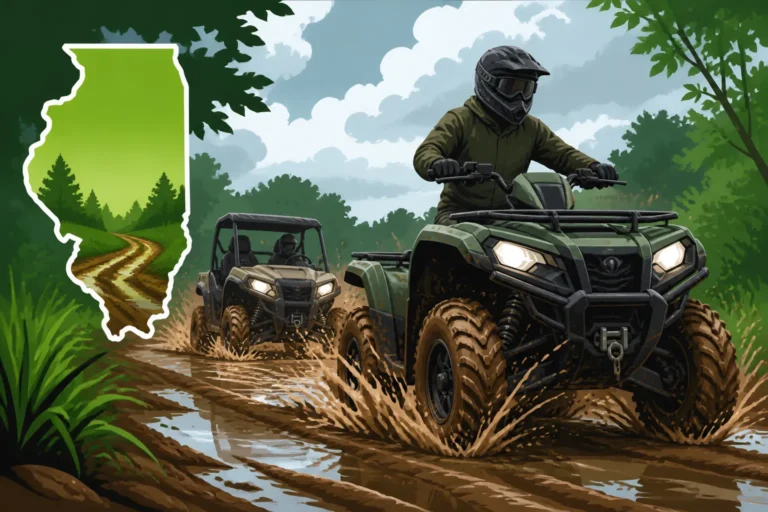
Illinois conditions can shift from dry and dusty to slick and muddy, and reclaimed ground or clay can behave differently after rain. Check the forecast, then ask the riding area about recent conditions rather than assuming that a trail shown as easy will feel the same after a storm. Heavy rain can make routes unsafe or lead to temporary closures.
Before towing, inspect tires, brakes, steering, lights, seat belts, and recovery points. Check fluid levels and pack basic recovery and repair items suited to your machine. A winch, tow strap, first-aid supplies, water, and a charged phone can be useful, but they do not make it safe to attempt a route beyond your experience or the vehicle’s limits. Bring a paper or offline map if you expect weak signal.
Finally, plan for the trip home. Mud packed into the radiator, underbody, or suspension can create problems if it is ignored. Allow time for a basic cleanup and post-ride check before storing the machine. Good preparation is not about expecting the worst; it is about avoiding an exhausting tow-home surprise after an otherwise great day.
Ride legally and leave room for a return visit
Finding a place to ride is only part of the job. Staying on authorized routes, respecting other users, and following a park’s procedures help protect access for the next weekend and the next group of riders.
Stay on marked routes and respect closures
Do not leave a designated trail to avoid a muddy patch, pass another group, or reach a scenic-looking area. Riding off-route can damage vegetation and soil, disturb wildlife, and create conflict with landowners or site managers. A closure sign should be treated as a real boundary, even if the trail beyond it looks passable.
When another vehicle approaches, slow down and give the other driver room. On narrow trails, avoid rushing into blind corners or climbing a hill before you can see what is coming down. Follow posted speed limits and the park’s passing rules, and keep a safe gap so dust, mud, or sudden braking does not catch out the vehicle behind you. [Illinois Trail Etiquette Locals Expect] covers the small habits that make a shared trail more pleasant.
Carry the paperwork the site expects
Before unloading, check that you have the required proof of registration or ownership, permits, decals, reservation details, and completed waivers. Requirements vary by location, so do not assume the documents accepted at one park will satisfy another. If a site asks for a confirmation on your phone, save it where you can find it without a strong signal; if it requires a printed document, bring the printout.
Keep important items accessible but secure. If several drivers are sharing a trailer, tell each person what they need to show at check-in and which machine the paperwork applies to. This simple step helps avoid a last-minute scramble when the group is waiting at the gate. The guidance in [Illinois Proof of Ownership on the Trail] can help you think through what to carry.
Recheck details before every trip
A riding area that worked for your group last season may have different operating conditions on your next visit. Recheck admission rules, trail status, weather, reservations, and any permit requirements before every trip, particularly when you are traveling a long distance. If you use onX Offroad, review your planned route again, but verify access with the park or land manager.
When in doubt, ask the site manager what applies to your vehicle and planned ride. That is often faster than trying to interpret a map symbol or an old social-media post at the trailhead. A few targeted questions can help you choose a suitable Illinois side-by-side trail, arrive prepared, and spend more of your day riding rather than sorting out a preventable problem.
Disclaimer
This article is for general informational purposes only and does not constitute professional advice. Laws, prices and regulations vary by location and change over time. Consult a qualified professional for guidance on your specific situation.