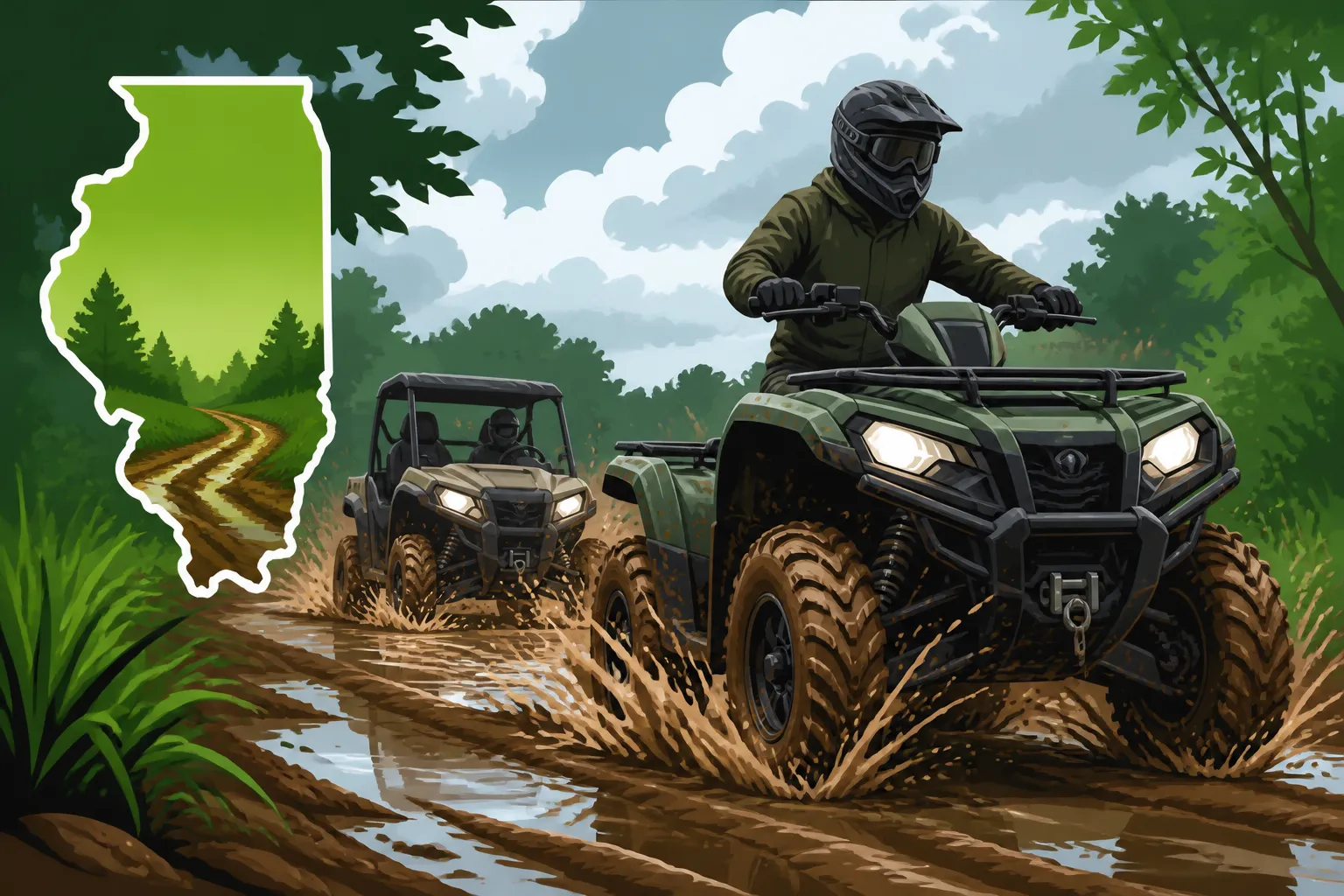
Illinois Trail Riding After Heavy Rain
Heavy rain can turn an Illinois riding day into a long recovery job: clay packs into tires, water hides ruts, and a trail that looked passable from the parking area may be soft farther in. This guide explains how to judge conditions, check access, protect your machine, and decide when postponing is the smarter call.
Why Heavy Rain Changes Illinois Trail Conditions
Clay, mud, and hidden damage
Rain doesn’t affect every Illinois riding area the same way. A sandy or gravelly stretch may drain relatively quickly, while clay-rich ground can stay slick and soft long after the rain stops. In southern Illinois, a trail may look firm on top but still give way under a tire. Near reclaimed mine ground, changing elevations and exposed soil can create a mix of firm ridges and muddy low spots.
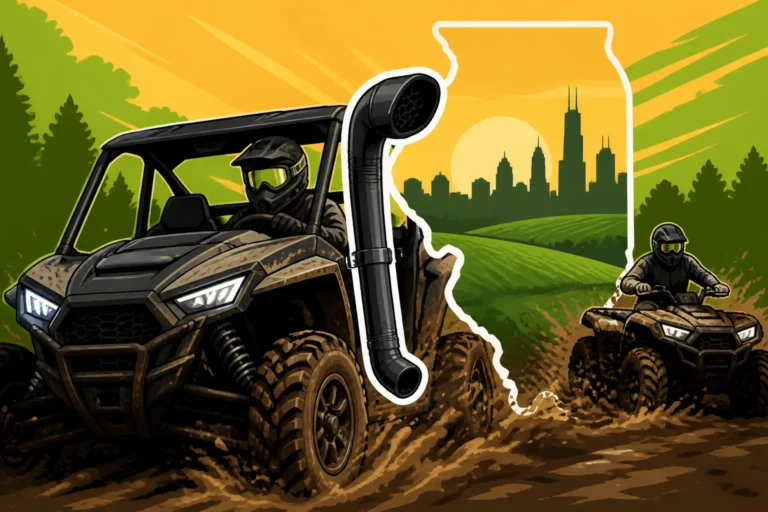
That combination is what makes post-rain riding unpredictable. Your front tires may track normally through a damp stretch, then slide sideways on a clay slope or drop into a rut filled with opaque water. A puddle can conceal a rock, branch, deep hole, or washed-out edge. On a side-by-side, the vehicle’s weight can deepen ruts quickly; on a quad, a sudden loss of traction can be enough to put you off balance.
The trouble can continue after you get home. Mud packed around brakes, suspension, and the radiator can affect how the machine runs and cools. Fine clay can dry into stubborn layers, while wet debris may hide a damaged boot, loose fastener, or bent component. A post-ride inspection matters even when the day seemed uneventful.
Why one park may be rideable while another is not
Trail conditions depend on more than how many inches of rain fell nearby. Soil, slope, shade, drainage, trail design, traffic, and the timing of the rain all matter. A wooded route can hold moisture longer than an exposed ridge. A low crossing can remain flooded after nearby trails have dried. A heavily used route may be rutted already, making additional traffic more damaging.
Conditions can also vary within a single riding area. A parking lot may be firm while a low trail section is saturated. A route that drains well in one direction may be difficult to climb in the other. Don’t assume a report from one trail, one neighboring town, or one parking area describes the whole property.
That’s especially important when you’re planning a long drive to ride. Places such as Sahara Woods, Little Egypt Off Road, Mill Creek Park, and Heartland Lodge each have their own land, trail layout, operating practices, and ways of communicating updates. Check directly with the riding area before towing down. For broader context on locations, see [Illinois Trail Conditions Before You Tow] and [Illinois Trail Closures After Rain].
When mud becomes a safety and access problem
Mud is not automatically a reason to avoid every ride. The bigger question is whether conditions make it hard to control the machine, stay on the route, or avoid damaging the trail. Deep ruts can catch a tire or pull a vehicle toward a soft shoulder. Slick side slopes can make it difficult to stop or turn. Water covering a crossing makes it impossible to judge its depth or surface.
There’s also a difference between a trail being wet and a trail being closed. A property may close specific routes, limit vehicle types, or shut down riding altogether to protect riders and the land. Do not treat an open gate, an old social media post, or a map line as permission to ride. Follow the site’s current instructions and stay off closed routes.
| What you see | What it may mean | Safer response |
|---|---|---|
| Shallow water with a visible, firm bottom | The route may be wet but still passable | Proceed only if the site allows it and you can maintain control |
| Opaque water over a rut or crossing | Depth and obstacles are hard to judge | Do not enter; find an approved alternative or turn back |
| Tires sinking or spinning in place | The ground may be too soft for safe travel | Stop before digging deeper and follow the site’s recovery rules |
| Fresh, deep ruts across a route | Repeated traffic may be damaging the trail | Avoid the area and report the condition to staff |
| A posted closure or barricade | The route is not open for riding | Turn around; do not go around or move the barrier |
How to Decide Whether to Ride
Check the riding area, not just the forecast
A weather app can tell you what happened in the region, but it can’t tell you whether a particular loop has standing water or whether the operator has closed it. Before loading, contact the riding area or check its official updates. Ask specific questions: Is the property open after the rain? Are all trails available? Are there restrictions for UTVs or larger machines? Has the site posted any closure or reroute information?
If you’re considering Sahara Woods or another managed site, confirm its operating status and entry requirements directly. A permit or reservation does not necessarily mean every route will be open in poor conditions. Review [Illinois Trail Etiquette Locals Expect] as well, especially the expectation to respect closures and avoid damaging a route for the next group.
Navigation apps can help you understand where you are and plan a route, but a mapped line should never be treated as proof that a trail is open. onX Offroad can be useful for preparing a route and keeping track of your location, particularly when cell service is weak. Before leaving home, save any maps or information you’ll need offline, then verify access rules and conditions with the property itself.
Use a simple go, wait, or turn-back decision
Before you unload, consider the condition of the access road, staging area, and first section of trail. If the lot is already deeply rutted, vehicles are struggling to get out, or staff are directing riders away from routes, take that information seriously. Don’t let the cost or effort of towing make the decision for you. A disappointing drive home is better than a damaged machine, an injury, or a recovery that puts others at risk.
A practical decision check looks like this:
- Confirm the site is open. Check for current closures or restrictions with the riding area.
- Check the machine and rider readiness. Make sure tires, brakes, lights, recovery gear, and protective equipment are in good shape.
- Assess the first safe section. If the surface is already beyond your comfort level, don’t continue deeper into the property.
- Set a turn-back point. Agree with your group that anyone can call off a route without being pressured to keep going.
- Reassess as conditions change. Rain can return, water can rise, and a route can become harder after several machines pass through.
If you’re unsure whether a route is suitable, ask the site manager rather than relying on another rider’s guess. You can also review [Illinois Trail Difficulty Ratings] and [Illinois OHV Camping With Trail Access] when planning a trip where weather could affect your schedule.
Know when postponing is the right answer
Postponing makes sense when the riding area is closed, water hides the route, the trail is visibly washing out, or you can’t keep the machine under control. It’s also wise to wait if the only way forward seems to be spinning the tires, riding outside the marked route, or pushing through a flooded crossing.
There’s no prize for finishing a loop in bad conditions. A group can split up, get separated, or turn a minor stuck vehicle into a larger recovery problem. If someone in your party is new to muddy riding, has limited experience on slopes, or is operating a machine that feels too heavy or powerful for them, choose a lower-risk day. [Best Illinois ATV Trails for Beginners] can help with planning a more appropriate ride, though conditions still need to be checked before departure.
Riding More Carefully If the Site Is Open
Start slowly and stay on marked routes
If the operator confirms that riding is allowed, begin with a cautious pace. Test traction in a safe, open area before entering narrower or steeper trails. Keep enough room between machines to avoid sudden stops and reduce the chance that one rider’s wheel spray or roost blinds someone behind them.
Stay on marked routes, including when a muddy section looks unpleasant. Cutting around a puddle can widen a trail, damage vegetation, or lead you onto land where riding is not allowed. If a route is too soft or slick, turn back using the approved trail rather than making a new path. Never ride around a barricade or enter a closed section because another machine has left tracks there.
In a group, agree on simple signals and keep track of the rider behind you. If someone stops, make sure the rest of the group knows before continuing. Apps such as onX Offroad can help a group monitor its position, but don’t let a screen distract you from the trail or replace direct communication. Save the route before you head into an area where service may be unreliable.
Match your riding to the surface
Smooth, controlled inputs usually work better than sudden throttle, braking, or steering changes on slick ground. Avoid aggressive acceleration that spins the tires and digs a trench. If you feel the machine losing traction, ease off and reassess rather than trying to power through blindly. On a slope, keep your movements deliberate and avoid stopping where the vehicle could slide or become difficult to restart.
Do not enter water if you cannot see the bottom or judge the depth. Even a familiar crossing can change after heavy rain. Water may cover a washed-out section, a submerged branch, or a deeper channel. Turning around is often the safest option, even if the crossing looked manageable on your last visit.
For route planning, onX Offroad may help you keep your bearings and retrace a known path, but the trail’s current condition and the operator’s directions take priority. Treat mapped routes as navigation aids, not as guarantees that every line is open or safe after rain.
Keep the group and other riders in mind
Wet conditions increase the chance that one rider will slow down unexpectedly or need help. Give other machines space, especially on narrow trails, hills, and blind corners. Don’t stop in a place where approaching riders cannot see you. If you need to pull over, choose a safe spot that does not block the route or force others off the trail.
Agree on a regrouping point before starting, and make sure each rider knows what to do if the group gets separated. Keep a phone protected from water, but don’t count on having service everywhere. A downloaded map in onX Offroad can be a useful backup for orientation, alongside a charged phone and a clear plan for contacting the group.
If a rider becomes stuck, pause before attempting a recovery. Check that everyone is clear of the tires, winch line, and moving parts. Follow the riding area’s recovery guidance, and don’t use a recovery method that exceeds your equipment or experience. If the machine is in a hazardous position, contact site staff rather than making a risky pull.
After the Ride and Before Your Next Trip
Clean and inspect the machine
Rinse mud from the undercarriage, suspension, wheels, and brakes while it is still damp enough to remove. Avoid directing high-pressure water at seals, electrical connections, bearings, or other sensitive areas. Follow the owner’s manual for cleaning and maintenance guidance, especially if the machine has been in deep water.
Once it’s clean, inspect the tires, brakes, steering, suspension, lights, and visible wiring. Look for sticks or packed mud around moving parts. Check for fresh scrapes, bent components, loose hardware, or damaged boots. If the machine was submerged, began overheating, or sounds different than usual, stop using it and have it checked before another ride.
Mud can hide problems that become obvious only after it dries. Give the machine time to drain, and check again before storing it. For more planning help across the season, see [Illinois Riding Season Considerations] and [Illinois Mud and What It Does to a Machine].
Leave the trail better than you found it
Don’t ride repeatedly through a soft section just to see whether it improves. Each pass can deepen ruts and make the route harder to maintain. If you see a closure, washout, or hazard, let the property know and give a clear description of where it is. A location saved in onX Offroad may help you explain the spot, but report it through the riding area’s preferred channel.
Clean mud from your machine and gear before traveling home, particularly if you’ve visited more than one property. This helps keep packed soil and debris from being carried onto other trails or into your garage. Follow the riding area’s rules for washing, parking, and waste disposal.
A good post-rain ride is not necessarily the longest one. Sometimes it means choosing a firm route, turning around early, or deciding that the trail needs another day to drain. Checking conditions, respecting closures, and leaving soft ground alone helps keep Illinois riding areas safer and more enjoyable for everyone.
Disclaimer
This article is for general informational purposes only and does not constitute professional advice. Laws, prices and regulations vary by location and change over time. Consult a qualified professional for guidance on your specific situation.