Illinois Spark Arrestor Requirements
A spark arrestor can be a small part with a big effect on whether your ATV or UTV is accepted at a riding site. In Illinois, the key is to check the rules for the specific property or event rather than assume a permit or decal settles the equipment question. Here’s how to check, what to inspect, and what to do before towing.
What Illinois riders should know about spark arrestors
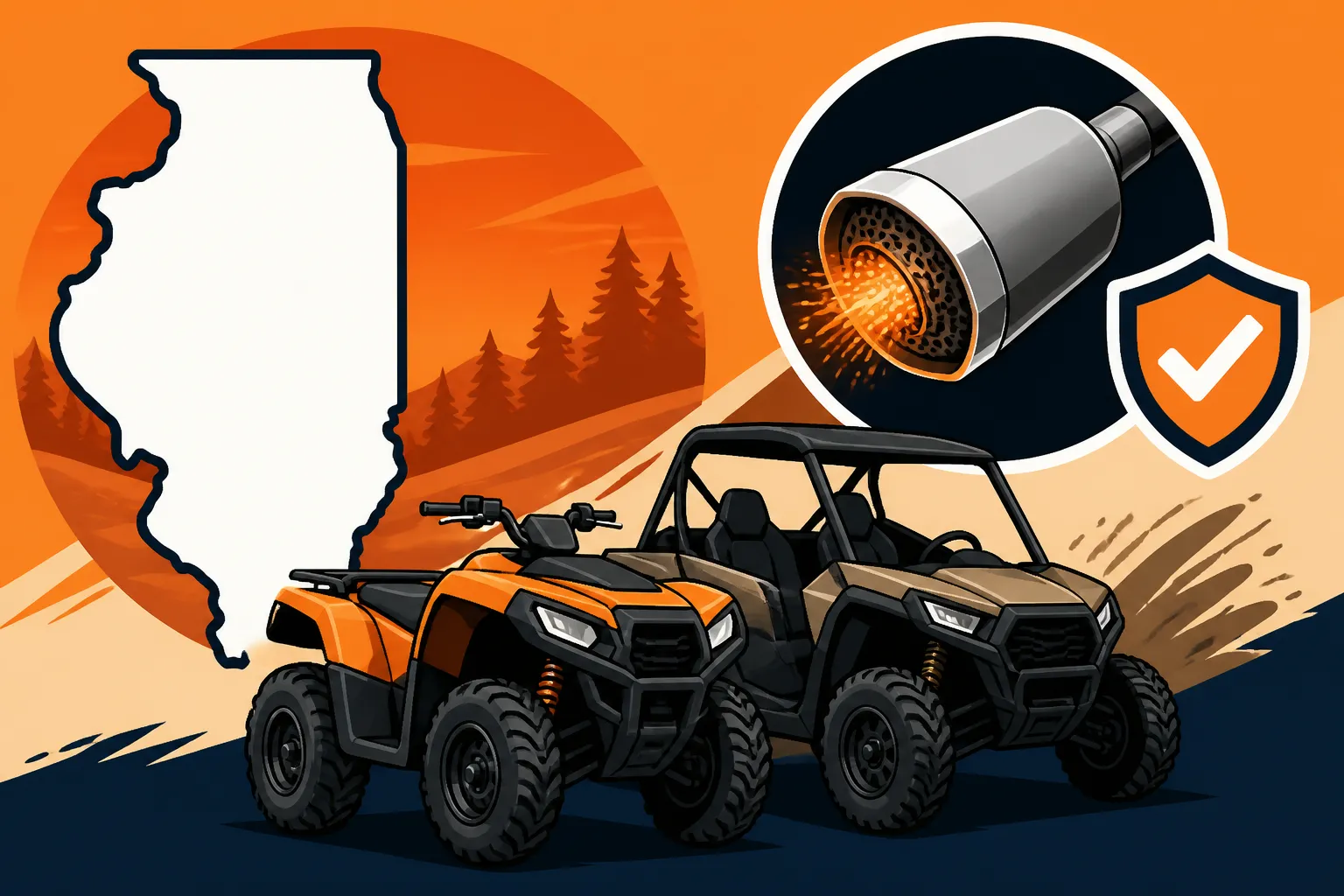
A spark arrestor is a device in an exhaust system designed to keep hot particles from escaping. It is not the same thing as a muffler. A muffler reduces exhaust noise; a spark arrestor is intended to reduce the risk of igniting dry leaves, grass, or other combustible material. Some exhaust assemblies combine both functions, but one does not automatically prove the other is present.
For riding in Illinois, treat spark-arrestor requirements as a site-specific equipment issue. A rule may come from the riding-area operator, land manager, event organizer, or the terms attached to access. The rule can apply even when your machine has the permit or decal needed for that location. Likewise, having a spark arrestor does not grant permission to ride somewhere that is closed to OHVs.
That distinction matters because Illinois riding access involves different kinds of land and programs. A riding area’s equipment checks are separate from the state’s permit system. Review Illinois Grant Site Rules for Riders and Illinois Private Park Waivers and Rules before you travel. Those rules may cover required equipment, inspection procedures, noise, fire precautions, or the conditions under which a machine can be turned away.
| Question | What to check |
|---|---|
| Is a spark arrestor required? | Ask the specific park, land manager, or event organizer |
| Does a permit or decal prove compliance? | No. A permit and an equipment requirement are separate |
| Will the machine be inspected? | Confirm whether staff check the exhaust or require documentation |
| Does a modified exhaust qualify? | Confirm that the installed setup meets the site’s stated rule |
| Is the riding area open? | Check current access and fire-related restrictions before hauling |
A registration, out-of-state permit, or Illinois access decal generally answers an access or administrative question—not whether a particular exhaust setup meets a property’s equipment standards. Visiting riders should not assume that a machine accepted at a park in another state will automatically pass inspection in Illinois. Ask the Illinois site directly, especially if the machine has an aftermarket exhaust or removable insert.
Also check the rules for the specific activity. A private riding park may set its own entry conditions, while an organized ride may add requirements for participants. If an area is closed or a route is not designated for motorized use, a compliant exhaust does not change that. Illinois Land You May Not Ride explains why confirming the land’s access status is just as important as checking equipment.
How to confirm the rule before you ride
The most reliable answer comes from the place where you intend to ride. Look for current rider rules on the site’s official information, then contact the operator if the wording is missing or unclear. Do this before you load the machine: a site may refuse entry if its equipment rules are not met, and finding that out at the gate can waste a full trip.
When you ask, describe the machine and exhaust setup rather than asking only, “Do you require a spark arrestor?” For example, say whether the machine is an ATV, dirt bike, or side-by-side; whether its exhaust is stock or aftermarket; and whether it has a removable insert or screen. If you have a part number, manual, or product documentation, keep it available.
Ask specific questions:
- Is a spark arrestor required for this machine or riding area?
- Does the site require a particular approval, marking, or type of device?
- Does the rule apply to every route, or only particular areas or conditions?
- Will staff inspect the exhaust at entry?
- Is a visible label enough, or should you bring manufacturer documentation?
- Are there separate noise limits or restrictions on modified exhausts?
- Can fire conditions trigger extra restrictions or a temporary closure?
A vague “it should be fine” can leave room for trouble at check-in. If the answer affects whether you can ride, request a clear explanation of the requirement. Keep the response with your trip details, particularly if a staff member has confirmed that a specific configuration is acceptable. Do not treat a phone or email answer as an exemption from posted rules; follow any instructions the operator gives you at the site.
The same approach applies to private parks and organized rides. Rules can change, and separate operators may have different standards. Illinois Machines That Must Meet Specs is relevant when a site requires machines to conform to equipment specifications. If a park also tests for excessive sound, review Illinois Sound Limits at a Park. A spark arrestor does not make an overly loud machine acceptable, and a quiet muffler does not establish that a spark arrestor is installed.
If you are planning a trip around a permit or reservation, check access, booking, and machine rules together. Illinois Trail Conditions Before You Tow can help with trip planning, but confirm the current requirements with the actual riding area. This is especially useful for visitors: an out-of-state registration or permit may not replace an Illinois site’s separate entry rules.
Inspecting, choosing, and maintaining the device
Start with the machine’s owner’s manual and the exhaust manufacturer’s instructions. A device that is correct for one engine or exhaust may not fit another. A screen or insert that looks similar is not necessarily approved for your particular system, and installing a generic part can affect exhaust flow or machine operation. If the exhaust has been modified, ask the manufacturer or a qualified repair shop which arrestor is compatible.
Inspect the setup before each trip, and again after riding in mud, dust, or debris. Follow the manufacturer’s maintenance schedule rather than assuming a device never needs service. Depending on its design, a spark arrestor can become blocked or damaged, reducing performance or making it ineffective.
Check for:
- A missing, loose, or incorrectly installed insert, screen, or end cap
- Cracks, holes, dents, or other damage to the device or exhaust
- Heavy carbon buildup, packed mud, or debris that could obstruct the outlet
- Missing retaining hardware, seals, or other parts called for by the manufacturer
- Evidence that someone removed or altered the assembly
- An exhaust change that no longer matches the documentation for the arrestor
Do not drill, cut, or remove components to improve sound or performance without understanding the consequences. Modifying the exhaust can make a previously compliant setup fail a site’s inspection, increase noise, or create a maintenance or safety problem. If you are unsure whether a part is intact or properly installed, have a qualified mechanic inspect it before riding.
When a replacement is needed, match it to the exact make, model, year, and exhaust system. Retail listings, including Amazon, can help you find parts, but a listing alone does not establish that the item meets a riding area’s rule or is approved for your setup. Check the manufacturer’s specifications and the site’s requirements before buying. Keep the packaging, product information, or installation instructions if they help identify the part.
A spark arrestor should not be confused with a flame-control device for a machine that is otherwise unsafe to operate. Do not ride if the exhaust is loose, visibly damaged, leaking, or improperly mounted. A machine that is not running correctly needs repair, not a quick workaround before reaching the gate.
A practical pre-ride checklist
Use this checklist when preparing for a ride in Illinois, especially if you are visiting a new site or riding a modified machine.
- Confirm the land is open to your machine. Check that the area permits the type of riding you plan to do. A stamp, decal, reservation, or event entry does not open land that is closed to motorized use.
- Read the site’s current equipment rules. Look for spark-arrestor requirements, exhaust specifications, sound limits, and inspection procedures.
- Contact the operator if anything is unclear. Describe your machine and exhaust setup, and ask what documentation or markings are accepted.
- Inspect the device. Confirm it is installed as designed, secure, undamaged, and maintained according to the manufacturer’s instructions.
- Bring useful documentation. Keep your owner’s manual or product information accessible if the site asks you to identify the device.
- Check for temporary restrictions. Dry conditions or other fire concerns may lead a property to restrict access or riding activities. Confirm the site’s current status before leaving.
- Keep access and equipment paperwork separate. Carry the permits, decals, or reservation confirmation the site requires, but do not assume those documents prove exhaust compliance.
If a staff member says the machine does not meet the rules, ask which requirement it fails and whether there is an accepted way to verify or correct it. Do not argue that another park approved the same machine; each operator may enforce its own conditions. If the problem cannot be resolved safely and properly, do not ride that day.
The practical takeaway is simple: verify the spark-arrestor rule with the specific Illinois riding area, maintain the device as designed, and treat permits as separate from equipment approval. That small check before loading can prevent an avoidable turn-away and help reduce fire risk where you ride.
Disclaimer
This article is for general informational purposes only and does not constitute professional advice. Laws, prices and regulations vary by location and change over time. Consult a qualified professional for guidance on your specific situation.