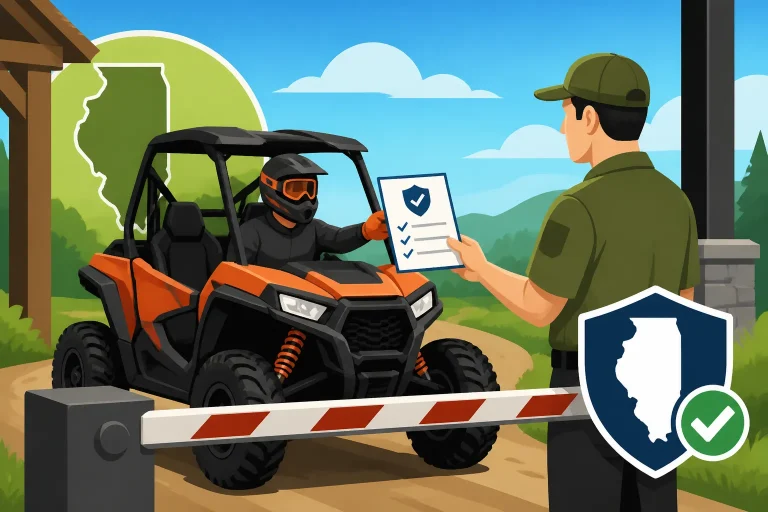
Illinois Online Safety Courses
Illinois riders looking for an online ATV or UTV safety course often want to know whether it is required, recognized, or enough to get on a trail. Illinois has no statewide safety-course requirement for ordinary off-highway riding, but a course can still help. The key is to separate voluntary training from permits, age rules, and the requirements of a particular riding area.
Are online ATV safety courses required in Illinois?
Illinois does not have a statewide safety-course requirement that every ATV or UTV rider must meet before riding off-highway. That does not make training pointless, and it does not mean every place you ride will have identical rules. A riding park, event organizer, insurer, or another state may set its own requirements or recommend a course.
For a general overview of the state’s approach, see Illinois Has No Statewide Safety Course. That distinction matters when you are deciding whether to pay for a course or expect its certificate to qualify you for something specific. A voluntary certificate is not automatically a state permit or legal authorization to ride.
What an online course can do
A useful course can introduce basic operating practices, including how to prepare a machine, choose protective gear, ride within your skill level, and respond to common trail hazards. It can also give newer riders and parents a structured way to discuss safe decisions before anyone starts the engine.
Online learning has practical limits. A screen-based course cannot teach you to judge traction by feel, control a machine on uneven ground, or practice emergency maneuvers. Treat it as a classroom component, not a substitute for supervised practice on a suitable machine and in a controlled setting.
When a course may still be useful
Training can be valuable even when Illinois does not require a certificate. It may help if:
- You or your child is new to ATVs or UTVs.
- A family is setting consistent rules before a first ride.
- A park, event, insurer, or out-of-state destination asks about training.
- You want a refresher after a long break from riding.
- You are moving from a small youth machine to a larger or heavier one.
If you are riding with a young person, review the state’s age and supervision rules separately. A course completion certificate does not cancel an age restriction or replace required adult supervision. Illinois Rules for Young Riders and Illinois Supervision at a Riding Park cover issues that training alone cannot resolve.
How to choose an online course
The best course depends on why you need it. Someone seeking a general introduction may want a clear, well-organized safety course. Someone preparing for a specific park or event needs to confirm that the organizer accepts the course before enrolling. A certificate that looks official is not proof that a particular site recognizes it.
| What you need | What to check before enrolling | What the course does not automatically provide |
|---|---|---|
| General safety education | Whether it covers the type of machine you will ride and the basics you want to learn | Practical riding ability |
| A certificate for a park or event | Whether the site accepts that provider, course, and certificate format | Permission to ride if other site rules are unmet |
| Training for a child | Whether the material is age-appropriate and an adult can review it with the child | An exception to age or supervision rules |
| Preparation for riding in another state | Whether the destination state or riding area recognizes the course | Reciprocity for permits, registration, or trail access |
| An insurer’s training condition | Whether the insurer accepts the specific course and what documentation it needs | A guaranteed discount or change to coverage |
Confirm acceptance with the organization that asks for it
Before registering, ask the park or organization what it means by “safety course.” It may accept a course from a named provider, require a particular certificate, or have its own orientation at check-in. It might not accept an online certificate at all. If the rule is unclear, get the answer directly from the organization and keep a record of it.
For state-operated or grant-assisted sites, do not assume that a general certificate replaces the required access documents. Illinois riding access can involve more than one sticker or permit, and training is a separate issue. Illinois OHV Permits: Two Stickers Explained explains the difference between the state usage stamp and public access decal.
Check what the certificate actually says
Before paying or providing personal information, look for the course provider, the machine type covered, the topics included, how completion is recorded, and whether you can download or print proof. If the certificate is intended for a park, event, or insurer, compare its wording and provider with that organization’s requirements.
Be cautious of claims that a certificate makes a machine street legal, grants access to public land, or satisfies every state’s rules. These are separate matters. Illinois street use, for example, has its own local and equipment rules; a safety course does not grant permission to use a road. See Can You Drive a UTV on the Road in Illinois? for the separate street-use question.
What an online course can and cannot replace
A safety course is education. It does not function as a vehicle title, usage stamp, access decal, riding-area permit, or local road authorization. It also cannot make a machine eligible for a trail if that machine does not meet the site’s requirements.
Before riding, identify the rules that apply to your actual trip. The answer may depend on whether you are riding on private land, a private park, a grant-assisted public site, or a road opened to certain vehicles by a local ordinance. A course certificate does not grant landowner permission or open a closed route.
Course versus permit and access documents
Illinois riders can encounter different requirements for different purposes. A state usage stamp and public access decal relate to off-highway riding access; a day permit at a particular park may be separate. The details vary by location and activity, so check the relevant site’s current instructions before loading the machine.
An out-of-state course certificate also does not automatically count as Illinois riding permission. Likewise, Illinois training does not automatically satisfy another state’s course or access requirements. For broader permit and visitor questions, see Illinois Permit Questions Riders Ask and Illinois Rules for an Out-of-State Machine.
Course versus age and supervision rules
Parents should not treat online completion as proof that a child is ready to ride alone or can use any size machine. The rider’s age, the machine, the riding location, and the applicable rules all matter. A course can support a family’s safety planning, but it does not change legal age limits or a park’s own requirements.
It is also worth checking the riding area’s rules for operators and passengers. A UTV passenger, for example, is not necessarily covered by the same assumptions as the operator, and private parks may set their own minimum-age or supervision policies. Review Illinois License Rules for Young Operators and the site’s posted rules before you go.
Course versus hands-on practice
Online lessons can explain concepts, but safe riding requires practice. Start in a controlled, open area where riding is permitted. Use a machine suited to the rider, follow the manufacturer’s instructions, and build skills gradually rather than beginning on steep, muddy, or crowded trails.
A practical progression is to learn the controls while stationary, practice starting and stopping, and then work on turns and speed control on forgiving ground. Riders should know how to shut off the machine, how to communicate with others, and what to do if a machine stalls or someone is hurt. A parent or experienced supervisor should remain present when a young or inexperienced rider practices.
A practical checklist before you enroll or ride
Use this sequence to avoid paying for a course that does not meet your purpose, or assuming that a certificate settles questions it does not address.
- Name the reason for taking the course. Decide whether you want general safety education, a certificate requested by a specific organization, or preparation for riding somewhere outside Illinois.
- Ask the organization what it accepts. Confirm the provider, course format, certificate details, and any age-specific requirements before enrolling.
- Check the course content. Look for material that matches the vehicle and rider, and prefer instruction that addresses protective gear, pre-ride checks, terrain, passengers, and emergency decisions.
- Save proof of completion. Keep the certificate or confirmation where you can retrieve it, but do not present it as a permit unless the organization specifically says it serves that purpose.
- Check the riding location’s current rules. Verify permits, access documents, machine restrictions, hours, and local conditions directly with the site.
- Review age and supervision rules separately. A course does not override them. Confirm both state requirements and the riding area’s own policies.
- Arrange hands-on practice. Start in a permitted, low-risk area and match the machine to the rider’s size and experience.
If you are comparing courses, contact the provider and the organization that may require the certificate. Ask whether the course is online only, whether there is a practical component, what proof you receive, and whether the certificate remains valid for the intended use. Requirements can differ, so an answer from a course seller is not a substitute for confirmation from the park or agency that controls access.
For a broader overview of options and where training might fit into a ride plan, see Illinois Safety Course Options. If the question is specifically about a park certificate rather than general education, Safety Certificates at an Illinois Riding Park may help you identify what to verify with the site.
The safest way to think about online ATV and UTV courses in Illinois is straightforward: take one to build knowledge, but do not rely on it to settle permits, access, age, supervision, or street-use questions. Confirm the requirements for the rider, machine, and destination independently, then pair online learning with appropriate hands-on practice.
Disclaimer
This article is for general informational purposes only and does not constitute professional advice. Laws, prices and regulations vary by location and change over time. Consult a qualified professional for guidance on your specific situation.