Illinois Hunting Season and Trail Access
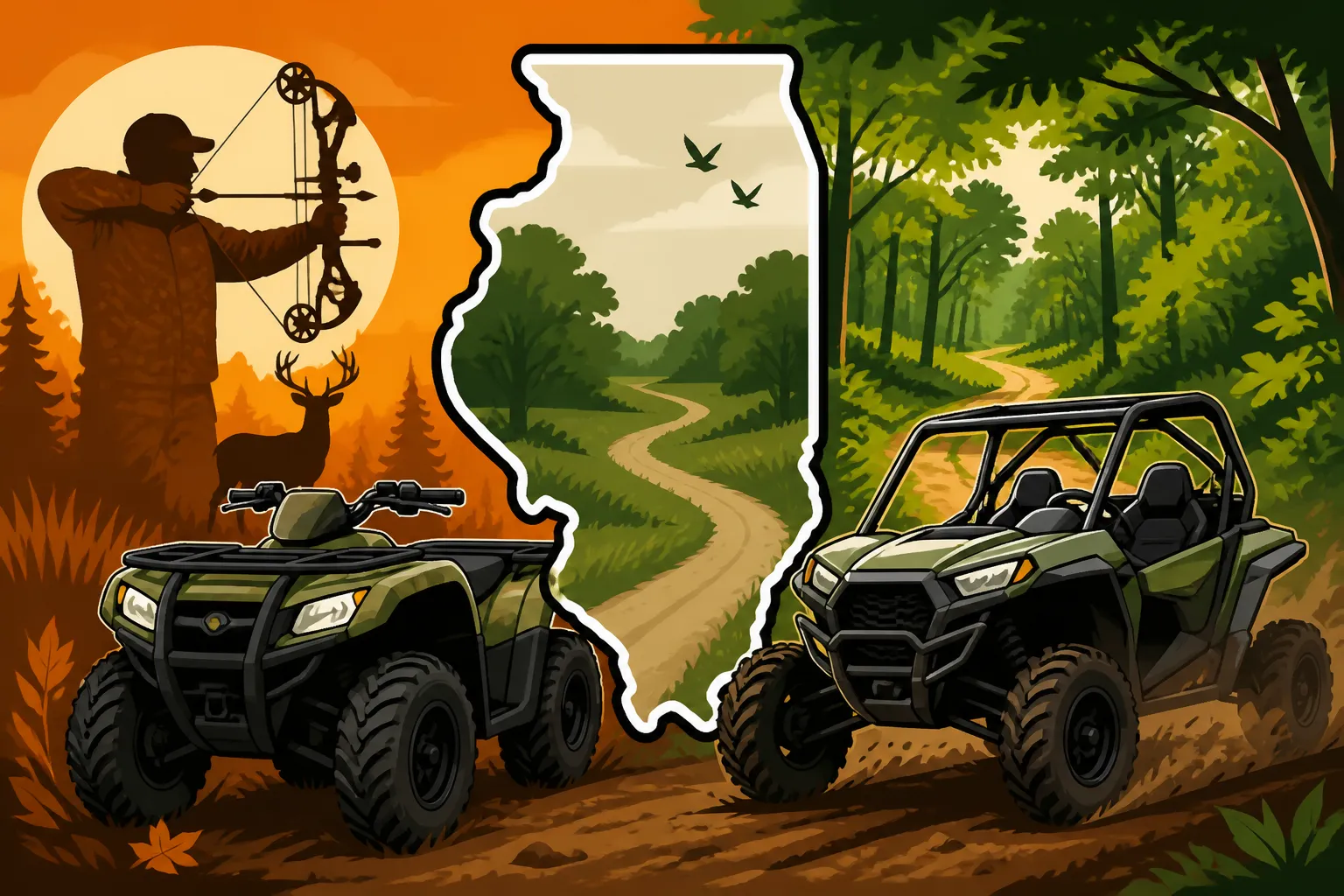
When hunting season arrives, an ATV or UTV can seem like the easiest way to reach a stand, retrieve gear, or travel near a trail. But being allowed to hunt somewhere does not automatically mean you can ride there. This guide explains how to check Illinois trail access, avoid closed areas, and plan around seasonal restrictions before unloading your machine.
Hunting Access and ATV Access Are Different
A hunting permission is not riding permission
A hunting license, hunting permit, or permission to hunt on a particular property does not automatically authorize ATV or UTV use. Riding access depends on the landowner’s rules, the site’s regulations, and whether a road or trail is specifically open to off-highway vehicles. A place where you may walk to a hunting spot can still be closed to motorized travel.
That distinction matters on both public and private land. A hunter may have permission to enter a property on foot but not to drive across it. A public area may allow hunting while limiting motorized vehicles to certain roads, designated routes, or authorized uses. Before you bring a machine, confirm that riding is allowed for your particular purpose and on the route you intend to use.
If you are hunting and riding on the same trip, check both sets of rules separately. [Illinois Hunting Access by Machine] explains why access for hunting does not necessarily open a route to motor vehicles, while [Your Hunting License Is Not a Riding Permit] covers the common assumption that a hunting license is enough to authorize a ride.
Separate the machine’s legal paperwork from permission to ride
Even when a route is open, your machine may need the right paperwork or stickers for the site. Illinois has different requirements for an off-highway usage stamp and a public access decal, and they do not serve the same purpose. A required stamp or decal does not grant permission to ride on every trail or tract of public land.
For example, a decal may be required at a grant-assisted riding site, but that does not make unrelated public land available for riding. Likewise, an annual usage stamp does not open a closed forest road or authorize travel across a field. The rules depend on the location and the type of access it provides. [What the Stamp Covers and What the Decal Covers] and [What a Grant-Assisted Riding Site Actually Is] explain the difference between those requirements.
Before leaving home, confirm three things: that the route is open to your type of machine, that you have any required site-specific permit or sticker, and that you have permission for the activity you plan to do. Treating these as separate checks helps prevent the frustrating—and potentially expensive—surprise of reaching a gate and finding out your paperwork does not match the site.
How Hunting Season Can Affect Trail Availability
Expect temporary changes, not one statewide rule
There is no single rule that makes every Illinois trail open or closed throughout hunting season. Conditions can vary by property, managing agency, local ordinance, and the kind of hunting activity taking place. A site may keep a designated route open, limit access to certain roads, temporarily close part of its property, or impose conditions that change during the season.
That means last month’s experience is not a reliable guarantee for your next ride. A route you used in early fall may have different access conditions during a busy hunting period. Signs can be added at entrances, gates may be closed, and site-specific notices may change what is permitted. Check the managing agency’s current rules before you tow, rather than relying only on a trail map, an old social media post, or a friend’s memory.
Seasonal hunting activity also creates practical concerns even where riding is allowed. Hunters may be walking in low light, setting up near access roads, or carrying equipment through areas where visibility is limited. Slow down, stay on the permitted route, and avoid making assumptions about what is around a blind corner or beyond a tree line.
Check the rules for the exact type of land
Illinois public land is not one uniform category. A state park, conservation area, national forest, county-managed property, and designated off-highway riding area can all have different rules. Some public properties are not open to ATV or UTV riding at all, even if hunting or other recreation is allowed there. Review [Illinois Public Land Not Designated for ATVs] and [Illinois Land You May Not Ride] before treating public ownership as permission to ride.
The Shawnee National Forest is a useful example of why the distinction matters: being able to visit or hunt in a large public landscape does not mean you may ride cross-country or use every road as an OHV trail. Check what motorized routes are actually designated and open. If a route is not clearly authorized, do not assume that a map line, worn track, or vehicle-sized opening makes it legal.
Rules can differ even between nearby properties. One county site may allow a certain kind of vehicle on a designated route, while a neighboring area may prohibit it. For state-managed recreation areas, review [Illinois State Park Riding Rules] and [Illinois Conservation Area Riding Rules] for the relevant property rather than trying to apply a rule you heard about another site.
| Where you plan to ride | What to verify before you go |
|---|---|
| State park or conservation area | Whether motorized riding is allowed at all, which routes are designated, and whether seasonal restrictions apply |
| National forest or other federal land | Which roads or trails are open to your vehicle type and whether cross-country travel is prohibited |
| Grant-assisted riding site | Required decal, site rules, open dates, and any hunting-season notices |
| Private riding park | Permission, operating schedule, admission or reservation process, and machine-specific rules |
| Private hunting property | Explicit permission to ride, approved routes, timing, and where the machine may be parked |
| Farm or other private land | Landowner approval and any limits on fields, lanes, woods, or access roads |
Riding on Private Land During Hunting Season
Get specific permission from the landowner
If you have permission to hunt on private land, ask separately whether you may bring an ATV or UTV. Make the request specific: explain what machine you plan to use, when you want to ride, which route you hope to take, where you will park, and whether you need to cross a field or use a farm lane. “Can I hunt here?” is not the same question as “Can I drive my machine to this location?”
Specific permission protects the relationship as well as the ride. A landowner may be comfortable with a machine on a gravel lane but not across a crop field, through timber, or near a hunting setup. They may also want you to avoid certain hours or areas when other hunters are present. Keep the agreement clear, and do not extend it to a neighbor’s property or a different route without asking.
If the property is shared among family members, leased to hunters, or managed by a club, confirm who has authority to grant motorized access. One person’s approval may not cover the whole property. For more detail, see [Illinois Private Land Permission Rules] and [Illinois Farm Land Riding Permission].
Protect the property and avoid interfering with hunting
A wet field, soft shoulder, or narrow wooded trail can be damaged quickly by repeated machine traffic. Hunting season often overlaps with muddy conditions, fallen leaves, and reduced visibility, all of which can make a route more vulnerable. Ask whether the ground is firm enough before riding, and be prepared to postpone the trip if the landowner says conditions are too wet.
Be especially cautious about riding near tree stands, blinds, baiting or feeding areas, parked vehicles, and likely walking routes. Do not assume that an empty parking area means nobody is hunting nearby. If you see another person, stop at a safe distance, make your presence known calmly, and wait for clear direction rather than continuing toward them.
Respect boundaries even when a mapped route appears to connect to another parcel. A public road, farm lane, or trail shown on a digital map may not carry public riding rights. [Illinois Timber Land Access] is a useful reminder to verify what a landowner actually permits instead of treating access as implied.
Planning a Safe and Legal Ride Around Hunting Activity
Check maps, notices, and site rules before towing
Build your route plan from the site’s own rules first. Look for official notices about closures, hunting-season conditions, motorized access, and designated routes. If anything is unclear, contact the property manager or site office before you load the machine. A quick call can save a long tow to a locked gate—or help you avoid entering an area where riders are not welcome.
Mapping tools such as onX Offroad can help you study routes and orient yourself, but a map is a planning aid, not permission to ride. Use it to prepare questions and identify where a route may meet a boundary or access road. Then confirm the route’s legal status with the land manager or landowner. onX Offroad may also help you keep track of your planned route in areas where cell service is unreliable, but do not rely on a digital map alone to establish property access.
Bring an offline map or another way to navigate if your route crosses rural areas with weak reception. Save the site’s contact details and any confirmation or permit information before you leave. If a trail is closed or conditions differ from what you expected, turn around rather than trying an unmarked alternative.
Make visibility and communication part of the plan
Hunting-season rides call for extra care around people who may be on foot and less visible than other vehicles. Travel slowly near trail crossings, parking areas, gates, and wooded stretches. Use the equipment required for your machine and route, and avoid riding in a way that could surprise someone who is focused on hunting.
Before the trip, agree on a meeting point and a communication plan with your group. Tell someone who is not riding where you will be and when you expect to return. If the group separates, do not improvise a route through closed land to catch up. Stop at a safe place, use your agreed communication method, and regroup on an authorized route.
If hunting activity makes a trail feel crowded or unsafe, choose another legal riding area or reschedule. Illinois has designated and private riding options, but their rules and availability differ. Check ahead for seasonal access and site requirements, especially when traveling to a park that is far from home. [Illinois Trail Conditions Before You Tow] offers additional planning considerations for avoiding wasted trips.
Use a simple pre-ride checklist
Before riding during hunting season, make sure you can answer each of these questions:
- Is the exact property open to ATV or UTV riding?
- Is the specific route designated or otherwise authorized for my machine?
- Are there seasonal closures, hunting restrictions, or temporary notices?
- Do I have the landowner’s permission if the property is private?
- Does the site require a stamp, decal, reservation, or other permit?
- Have I checked the route and property boundaries rather than relying on an old track?
- Can I ride without disturbing hunters, damaging land, or entering a closed area?
- Do I have a backup plan if the route is closed or conditions are unsafe?
If you cannot confirm the route is open, do not ride it. A hunting license, an access sticker, a familiar trail, or a line on a map does not replace permission from the responsible land manager. Checking before you go keeps the day predictable and helps preserve access for both riders and hunters.
Disclaimer
This article is for general informational purposes only and does not constitute professional advice. Laws, prices and regulations vary by location and change over time. Consult a qualified professional for guidance on your specific situation.