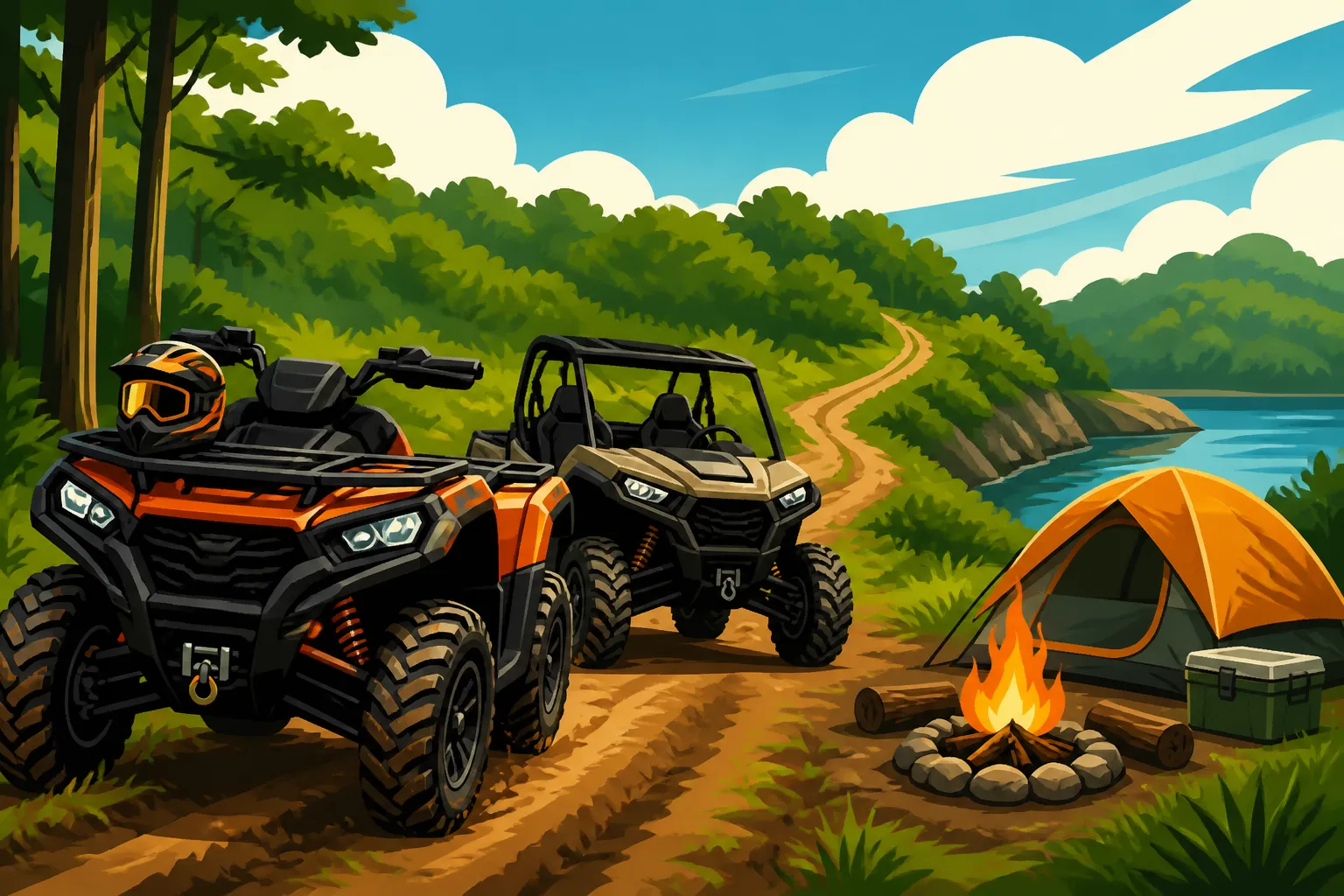
Illinois OHV Camping With Trail Access
Planning an Illinois riding weekend can get complicated fast: a campground may be close to a trail but not connected to it, while a riding park may have limited camping or require separate reservations. This guide explains how to pair legal OHV riding with a practical place to stay, what to confirm before towing, and how to plan for Illinois trail conditions.
Understand what trail access means in Illinois
A nearby campground is not automatically connected to a trail
“Camping with trail access” can describe several very different arrangements. A campground might sit inside a riding property, border a trailhead, or simply be a short drive from a park. Those are not interchangeable. If you’re picturing pulling your side-by-side out of the campsite and riding straight onto a trail, ask specifically whether the campground connects to an authorized riding route.
Some facilities allow machines only on designated roads between a campsite and a trail entrance. Others require you to trailer your ATV or UTV from the campground to the riding area. A lodging property may welcome riders but still prohibit machines on its internal roads, grass, or non-designated paths. A map showing two places close together does not establish permission to ride between them.
Before booking, ask the campground or riding-area operator to describe the route in plain language. Find out whether it is an authorized OHV trail, a public road, private property, or a route that requires a separate permit. If the answer is vague, plan as though you’ll need to trailer. That small clarification can prevent a frustrating arrival-day surprise.
Most Illinois riding happens at designated areas
Illinois does not offer a continuous statewide network of public ATV and UTV trails where riders can freely travel between towns, campgrounds, and public lands. Riding opportunities are concentrated at designated parks, club-run properties, and other areas that specifically allow OHVs. Some are privately operated; others have their own admission, permit, waiver, or operating rules.
That distinction matters when you’re choosing a place to stay. A campground near a public forest or conservation area is not necessarily a campground with OHV trail access. For instance, the presence of forest roads does not mean cross-country riding is allowed, and an ordinary hiking trail is not an ATV trail. The rules for Shawnee National Forest are especially important to understand: [Why Shawnee National Forest Bans Illinois OHVs].
Think of your trip as two separate reservations to coordinate: a place to sleep and a place where your machine may legally ride. Sometimes those are part of one operation. Often they are not. Start with a riding property that suits your machines and experience, then identify lodging that fits its rules and travel distance.
Separate riding, camping, and road use
A legal riding permit does not automatically authorize travel on nearby streets or roads. Similarly, an Illinois usage stamp or access decal is not a general pass to ride wherever you see a dirt track. Each requirement has a specific purpose, and the land manager’s rules still apply.
Before loading up, make sure you know which sticker or permit your trip requires, and whether your destination is a grant-assisted riding site, a private park, or another type of property. The distinction between an annual stamp and an access decal catches plenty of riders off guard: [Illinois OHV Permits: Two Stickers Explained]. For a plain-language comparison of what each covers, see [What the Stamp Covers and What the Decal Covers].
Also check the rules for your machine and every person riding it. A site may have requirements for helmets, age, supervision, passengers, equipment, waivers, or proof of ownership. Treat “we have the right sticker” as the start of your preparation, not the end.
Match a riding area with a place to stay
Start with the riding property, not the campground
Choose the riding area first, especially if the group includes a mix of machines, riding abilities, or ages. Confirm that the property accepts your vehicle type and that it has the terrain you want. A beginner-friendly road or loop can make the first day much more enjoyable than arriving at a property where the available routes are too technical for your least experienced rider.
Then ask the property operator about camping. Get clear answers to these questions: Is camping offered on the property? Are sites intended for tents, RVs, or both? Can you reserve a site, or is it first come, first served? Are electrical hookups, water, showers, toilets, or dump facilities available? Are generators permitted, and are there quiet hours? Policies and amenities differ, so don’t assume one park’s setup matches another’s.
If the riding area does not offer camping, ask staff which nearby communities or campgrounds riders commonly use. That can help you narrow the search, but confirm the details with the campground itself. A recommendation that a campground is “nearby” may still mean driving the machines on a trailer every morning and evening.
Compare on-site camping, nearby campgrounds, and cabins
There are three common ways to build an Illinois riding weekend around overnight stays. On-site camping is usually the simplest for access if the operator allows it, but it may have fewer amenities or limited availability. A nearby public or private campground may offer more facilities, but you might need to trailer to the trailhead. A cabin or lodge can be a comfortable choice for a group that doesn’t want to bring camping equipment, though it may have separate rules about parking, trailers, and machine storage.
| Overnight option | Main advantage | What to confirm before booking |
|---|---|---|
| Camping at the riding property | May reduce daily travel between camp and riding | Site availability, machine routes, hookups, quiet hours, and separate riding fees |
| Campground nearby | May offer more amenities or space for a larger group | Actual driving distance, trailer parking, machine rules, and whether riding from camp is allowed |
| Cabin or lodge | A comfortable option for riders who prefer indoor lodging | Trailer parking, machine storage, occupancy, pet rules, and distance to the riding entrance |
| Dispersed or public-land camping | Can sound appealing for a self-contained trip | Whether camping is allowed there and whether OHV use is separately authorized |
Don’t book based on a map pin alone. Ask for the campground’s actual address, the riding area’s entrance location, and the expected route between them. A property may have several entrances, and the closest one on a map may not be the public check-in point.
For broader trip ideas, compare options in [Illinois OHV Camping With Trail Access] and [Illinois Riding Areas With RV Sites]. If you prefer a roof over your head, [Illinois Trails With Cabins Nearby] can help you think through that alternative.
Look at riding regions before choosing a weekend
Southern Illinois tends to be the first region riders explore when they’re looking for a dedicated OHV weekend. The area around Marion, Harrisburg, and Nebo offers several named riding destinations and a different trip feel from northern Illinois. For example, Little Egypt Off Road is a club-run riding area near Marion, while Heartland Lodge operates a riding area near Nebo. Their rules, terrain, lodging arrangements, and access procedures are separate; don’t assume that a nearby lodging business is part of the riding operation.
In central Illinois, Mill Creek Park near Marshall is another property riders may consider when planning a trip. The Cliffs near Marseilles is a northern Illinois riding option. These names can help you build a shortlist, but they are not interchangeable recommendations: verify the current machine types accepted, hours, booking process, camping availability, and trail conditions directly with each operator.
Start with the trip’s main priority. If your group wants a full weekend at one riding property, look for the closest legal camping arrangement. If you want a more comfortable base with restaurants or groceries nearby, lodging in a nearby town may suit you better, provided you’re comfortable trailering to the park. Regional overviews such as [Illinois Southern Riding Areas] and [Illinois Northern Riding Areas] can help you compare where to focus your search.
Research campsites and trails before you tow
Verify the riding area’s status and rules
Use official property information as the final word on whether a site is open, what types of machines it accepts, and how to arrange entry. A trail map or community post can be useful for orientation, but it may not reflect closures, changed access rules, or a property’s current operating procedures.
Ask whether the area is a public site, a private park, or a club-run property. Find out whether it requires a reservation, a waiver, a day-use permit, a membership, or other check-in steps. If the site has a cap on daily riders or vehicles, ask how the operator handles full dates and whether arriving without a booking is realistic. That question matters most on holiday weekends and during popular riding periods.
Confirm where you must check in and whether your machines must be inspected. Some properties may limit vehicle width, require equipment to meet specified standards, or restrict modified machines. A machine that is too wide, too loud, or otherwise outside the property’s rules can turn a long drive into a disappointing trip. For a general look at designated Illinois opportunities, see [Illinois Grant-Assisted Riding Areas].
Use maps for planning, not permission
Digital maps can help you estimate distances, understand the shape of a riding area, and find services along the drive. Tools such as onX Offroad may help you organize route research and mark useful locations, but a mapped line is not proof that you have permission to ride it. Confirm access with the land manager and use the property’s own maps and instructions when they are available.
That distinction is especially useful when a campground, forest road, private lane, and riding trail appear close together. A route that looks continuous on a screen may cross land where motorized travel is prohibited. If there’s a questionable gap between your campground and the trail system, ask the operator whether riders are permitted to travel through it—or simply plan to haul the machines.
Download or save the information you’ll need before leaving home. Cell reception can vary in rural areas, and a phone map that depends on a strong connection may be less useful at a trailhead. Keep the campground address, riding-area entrance, reservation details, and emergency contacts somewhere you can access offline. A paper map is also a sensible backup when your group is riding in unfamiliar terrain.
Confirm access and permits for every rider and machine
One person in the group may be responsible for reservations, but every rider should understand the requirements that apply to them. Ask whether the permit is attached to the machine or the individual, whether each vehicle needs its own sticker, and whether riders from outside Illinois have a separate access requirement. These details can affect the total cost and the time needed at check-in.
If you’re visiting from another state, don’t assume that an out-of-state registration or sticker automatically satisfies Illinois rules. Check the instructions for the specific property and the state access requirements that apply to your trip. The visitor-specific overview [Illinois Rules for a Visiting Rider] is a useful starting point, while [Illinois Public Access Decal Rules] explains a separate issue that can matter at designated access sites.
Keep digital or paper proof of reservations and permits with your other trip documents. If a property asks riders to show a confirmation, waiver, or proof of ownership, you’ll want it handy rather than searching through email at the gate. Before departure, compare the names on your reservation with the people and machines actually traveling.
Plan the campsite and trailer logistics
Choose a site that works for your whole setup
A tent site can be a poor fit if you arrive with a long truck, a large trailer, and several machines. Before reserving, ask whether the campsite has enough room for your tow vehicle and trailer, whether parking is separate, and whether you may unload machines at the site. If the campground uses narrow loops, low branches, soft ground, or tight turns, a large rig may take more maneuvering than you expect.
Think through the order you’ll need to use the space. You may need room to back in, unload, secure machines, and still open doors or access camping gear. If the site is on a slope, ask whether the operator can identify flatter options for trailers. A quick conversation can prevent a late arrival from turning into a long, awkward backing exercise in the dark.
For a larger group, work out in advance whether you’re reserving neighboring sites or sharing one. Confirm occupancy limits, extra-vehicle rules, fire restrictions, and whether visitors are allowed. Don’t assume that booking one campsite automatically provides parking or space for every rider in the group.
Decide whether to trailer every day
If your campground is not connected to the riding area by an authorized route, you’ll likely be trailering machines between the two. That means checking the driving distance, the park’s parking arrangements, and the amount of time your group is willing to spend loading and unloading. A short drive can still feel like a chore if you’re moving several machines twice a day.
Before you leave home, secure machines properly and inspect the trailer. Check the coupler, safety chains, tires, lights, tie-downs, and loading ramps. Pack straps where they’re easy to reach rather than burying them under tents and coolers. At the campground, leave enough room to park the trailer without blocking roads, other campsites, or emergency access.
A trailer-free plan is appealing, but it only works when the operator confirms a permitted connection between the campsite and the riding area. Do not substitute an informal track, a field edge, or a road shoulder for an authorized route. If in doubt, haul the machine.
Prepare for weather, mud, and repairs
Illinois conditions can change quickly enough to affect a weekend plan. Rain may make some trails muddy or lead to closures, while hot, humid weather can make a long day in riding gear exhausting. Ask the operator how it communicates closures and whether it updates trail conditions before guests arrive. Make a backup plan that doesn’t depend on riding every scheduled hour.
Carry basic tools and supplies appropriate for your machines and riding style. A tire repair kit, compact inflator, gloves, flashlight, tow strap, and first-aid supplies can be helpful, but they don’t replace a plan for getting an injured rider or disabled machine back to the staging area. Make sure the group knows where to meet if riders become separated and who has the property’s emergency contact information.
After a muddy ride, inspect the machine before packing it for the trip home. Mud packed around a radiator, brakes, suspension, or frame can cause problems later. If the park has a wash station, confirm its location and any rules for using it. If not, bring what you need to keep mud from being tracked through the campground or packed into your trailer.
Make a realistic riding and camping schedule
Book around operating days and arrival windows
A weekend plan can fall apart if your arrival time doesn’t match the riding property’s check-in process. Confirm opening and closing times, the latest time you can enter, when waivers must be completed, and whether riders can leave and return during the day. If you’re arriving after a long drive from Chicago, Rockford, or St. Louis, be realistic about how much riding you’ll fit in on the first day.
Ask whether the property requires advance booking and how far ahead you should arrange a popular date. A campground reservation and a riding reservation may have different booking systems. Keep confirmation numbers together, and check that the dates line up. A campsite booked for Friday night does not guarantee entry to a riding park on Friday afternoon.
Allow extra time for unloading, registration, safety checks, and getting everyone oriented. If children or inexperienced riders are coming, build in time for helmet checks, instructions, and a slow first ride. Rushing straight from the highway to a challenging trail is a poor way to start a trip.
Choose an itinerary that fits your group
A first-time group often has more fun with one main riding session and a relaxed evening than with an overpacked schedule. Plan shorter loops at the beginning of the day, then decide whether everyone wants to continue. Riders who are tired, overheated, or uncomfortable are less likely to make good decisions on the trail.
For a two-night weekend, a workable outline might look like this:
- Arrive during daylight, set up camp, and confirm the next day’s check-in details.
- Ride a manageable route on the first full day, with regular water and rest breaks.
- Give the group time to clean equipment and enjoy the campsite without racing the sunset.
- On the final day, choose a shorter ride that leaves time to pack and secure machines before the drive home.
If your group wants multiple full days, ask whether the riding property and campground both support that schedule. Be especially careful not to schedule your campsite checkout before you have time to load machines, clean up, and meet any park departure requirements.
Coordinate expectations in a mixed-experience group
A group ride is only as enjoyable as its pace and communication. Before the weekend, identify who has ridden before, who is new, and whether everyone has a machine suitable for the planned terrain. Agree on a lead rider and a sweep rider, and decide what the group will do at trail forks or if someone needs to stop.
Parents should check site rules for young operators, supervision, passengers, and required safety equipment. Don’t assume a child’s ability on family property translates to readiness for an unfamiliar public or private trail. Review the park’s age requirements before booking, then select routes and ride lengths that fit the least experienced person in the group.
Set a few simple expectations before engines start: stay on marked routes, leave space between machines, slow down near people and campsites, and stop somewhere safe if the group gets separated. Good communication reduces the pressure to keep up and makes it easier to turn around when conditions or energy levels change.
Keep the campsite comfortable and respectful
Follow campground rules as carefully as trail rules
A riding weekend doesn’t suspend ordinary campground expectations. Observe speed limits, quiet hours, fire rules, pet policies, and designated parking areas. A machine that is welcome on a marked trail may still be prohibited from being driven through a campground after hours. Ask how the property expects riders to move between the site, parking area, and check-in point.
Keep noise and dust in mind, especially when campsites are close together. Avoid unnecessary engine revving, late-night loading, and riding around camp for convenience. If the park limits generator hours or has restrictions during dry conditions, plan around them instead of trying to negotiate at the last minute.
Secure valuables, keys, fuel containers, and riding equipment when you leave camp. If you’re staying in a cabin or lodge, ask where machines and trailers may be parked, and whether muddy gear can be stored outdoors. These details are easier to sort out before arrival than after a property manager asks you to move a loaded trailer.
Pack for the campsite as well as the trail
It’s easy to focus on helmets, riding clothes, tools, and machine parts, then realize you’re short on ordinary camping supplies. Make a separate campsite list that includes bedding, lighting, rain gear, drinking water, food storage, chargers, and weather-appropriate clothing. If you’ll be staying in a cabin, confirm which linens or kitchen items are provided rather than assuming the setup.
Keep a clean set of clothes available for the drive home. A sealed tote or bag can keep dry clothing separate from muddy riding gear. Pack trash bags for dirty boots and wet layers, and bring a towel or mat to reduce mud inside a tent, vehicle, or cabin.
Plan meals around the facilities you actually have. A tent site without hookups calls for a different food plan than an RV site with power. Find out whether fuel, groceries, and repair supplies are available nearby; rural riding areas may not have a convenience store around the corner. Save the address of the nearest practical stop before you get to the trailhead.
Protect the land and leave the site ready for the next group
Stay on designated trails and avoid cutting across fields, wooded areas, or closed sections. Shortcuts can damage vegetation, widen muddy routes, and create access problems for everyone. When a trail is closed, treat the closure as a firm boundary rather than a suggestion.
Keep garbage, food scraps, and wastewater under control at camp. Use the property’s disposal facilities, and don’t wash oil, fuel, or other contaminants into soil or drainage areas. If your group brings pets, follow leash and cleanup rules and make sure they’re comfortable around loud machines.
Before leaving, check the campsite for small items that are easy to miss: straps, gloves, drink containers, tent stakes, and trash. Walk around the trailer and inspect tie-downs before pulling out. Leaving a clean campsite is part of being welcome back, particularly at small operations where riders and staff share the same space.
Use this final checklist before departure
Confirm the details that can derail the weekend
A few calls or messages before you leave can save a long drive and a disappointing arrival. Confirm the riding property’s operating status, entry procedure, machine eligibility, and permit requirements. Then confirm the campground’s site type, parking arrangement, check-in time, and rules for trailers and machines.
If you have a question about riding between two places, ask the people responsible for the land. Don’t rely on a route that happens to appear on a map, a friend’s memory of a prior visit, or a trail that looks established. A legal connection needs clear authorization.
Keep a list of what each operator confirms. If a campground says riders may use an internal road, ask where that road begins and ends and whether it is open for the dates of your stay. Specific answers are more useful than a general “riders are welcome.”
Save useful information offline
Before leaving home, save addresses, reservation confirmations, permits, waiver instructions, and contact details on your phone. Keep copies accessible if the phone battery dies or reception drops. A paper copy of the campground address and the riding-area entrance can be helpful when several people are navigating separate vehicles.
If you use onX Offroad to review the area, save the map information you need before the trip and treat it as a planning aid—not a substitute for a property’s official route guidance. Mark the campground, trail entrance, fuel stops, and likely meeting points. Make sure everyone in the group knows which map or navigation method to use.
Share the itinerary with someone who is not riding. Include where the group expects to camp, which riding property it plans to visit, and when you expect to return. This is simple preparation that can matter if plans change or a rider needs help.
Final pre-trip checklist
- Confirm that the riding property is open on your planned dates.
- Verify that each machine type in your group is allowed.
- Ask whether advance reservations, permits, waivers, or inspections are required.
- Confirm whether camping is on-site or at a separate property.
- Get clear permission before riding between the campground and trail area.
- Check trailer parking, unloading arrangements, and campsite dimensions.
- Review rules for children, passengers, helmets, pets, fires, and quiet hours.
- Save maps, addresses, confirmations, and emergency contacts offline.
- Check the weather and trail-condition update before you depart.
- Pack basic repair supplies, first aid, water, and a plan for a disabled machine.
The best Illinois OHV camping weekend is usually the one where the access details are settled before the truck is loaded. Choose the riding property first, confirm exactly where you can camp, and treat every trail connection as something to verify rather than assume. That leaves more time for the part you came for: a safe ride, a comfortable night, and an easier trip home.
Disclaimer
This article is for general informational purposes only and does not constitute professional advice. Laws, prices and regulations vary by location and change over time. Consult a qualified professional for guidance on your specific situation.