Illinois Crossings of State Highways
It's incredibly frustrating when you're out enjoying your ATV or UTV, navigating county roads or village streets that are perfectly legal, only to be faced with a major state highway that seems to create an impassable barrier. You see the path continue on the other side, or perhaps there's a gas station or a friend's house just a stone's throw away, but that ribbon of state-maintained asphalt feels like an impenetrable wall. This guide is going to clear up all that confusion about how (and if) you can legally cross Illinois state highways on your off-road machine, helping you understand the strict rules and how to stay safe and legal.
The Blanket Ban: Why State Highways Are Tricky for ATVs and UTVs
Let's cut right to the chase: Illinois state law generally treats ATVs and UTVs like fish out of water on state highways. These aren't just minor roads; they're the arteries of our state, designed for high-speed, conventional vehicle traffic. Trying to mix a machine built for trails or farm fields with cars and trucks zipping along at 55 or 65 miles per hour is a recipe for disaster. The law recognizes this inherent danger, which is why the default stance is a resounding "no" for ATVs and UTVs on these particular roads.
The Core Illinois Law
The Illinois Vehicle Code lays out very clearly that off-highway vehicles (OHVs), which include ATVs and UTVs, are generally prohibited from operating on highways, roads, or streets of this state. While local municipalities and counties have some leeway to create ordinances for their specific roads, the state law acts as the overarching authority for state routes. This means that even if your local village allows you to ride your UTV on its streets, that permission doesn't magically extend to crossing a major state highway that dissects the village. It's a critical distinction many riders unfortunately overlook.
The rationale behind this blanket prohibition isn't about making your life harder; it's purely about safety. ATVs and UTVs have different handling characteristics, braking distances, and top speeds compared to cars and trucks. Their profile makes them less visible, especially in busy traffic, and a sudden stop or swerve from a conventional vehicle could have catastrophic consequences for an off-road rider. The state wants to avoid these severe mismatches in vehicle performance and driver expectations.
What Exactly Is a State Highway?
When we talk about "state highways" in Illinois, we're generally referring to roads that are part of the state highway system and are maintained by the Illinois Department of Transportation (IDOT). These are typically marked with the familiar shield-shaped route signs, often displaying "IL" followed by a number, or U.S. highway route signs. These include major two-lane roads, multi-lane divided highways, and everything in between that falls under IDOT's jurisdiction. They are distinct from county roads, which are maintained by the county highway departments, or township and municipal roads, which fall under local control.
It's crucial to be able to identify these roads because the rules are different. You might be riding legally on a county road designated by a local ordinance, but as soon as that road intersects with or becomes a state highway, the rules change drastically. A good habit is to consult a detailed map or use a GPS app that differentiates between road types if you're planning a route that might involve crossing different jurisdictions. Understanding [Illinois Roads Under Two Jurisdictions] is key here, as overlapping authority can create confusion if you don't know who is responsible for what.
The Danger of Interstates and Tollways
While state highways present challenges, interstates and tollways are an entirely different beast, and the law here is absolute: ATVs and UTVs are strictly, unequivocally banned from these roadways. There are no exceptions, no crossings allowed, no "what if" scenarios. These are high-speed, limited-access arteries where traffic flows at extremely fast paces, and even conventional vehicles face severe risks during breakdowns or accidents.
Imagine trying to navigate a UTV, even one equipped with all the street-legal bells and whistles, onto a bustling Interstate 57 or a Chicago tollway. The speed differential alone would make it incredibly perilous. These roads are designed for vehicles traveling at 70 mph or more, and an ATV or UTV simply cannot safely keep up with that flow, nor is it designed to handle the turbulence from passing semi-trucks. The state takes this ban very seriously, and for good reason. [Illinois Closes Tollways and Interstates to Every Machine] because the risk of a fatal accident is astronomically high. There's simply no scenario where operating an off-road machine on an interstate or tollway is safe or legal.
The Critical Exception: Crossing State Highways Legally
While the general rule is a firm "no," Illinois law does offer a very narrow and specific exception that allows ATVs and UTVs to cross state highways. This isn't permission to ride on them for any distance, but rather to traverse them at a designated point to continue your journey on the other side. However, this exception comes with strict conditions that must be met to ensure safety and legality.
Crossing Only at an Intersection
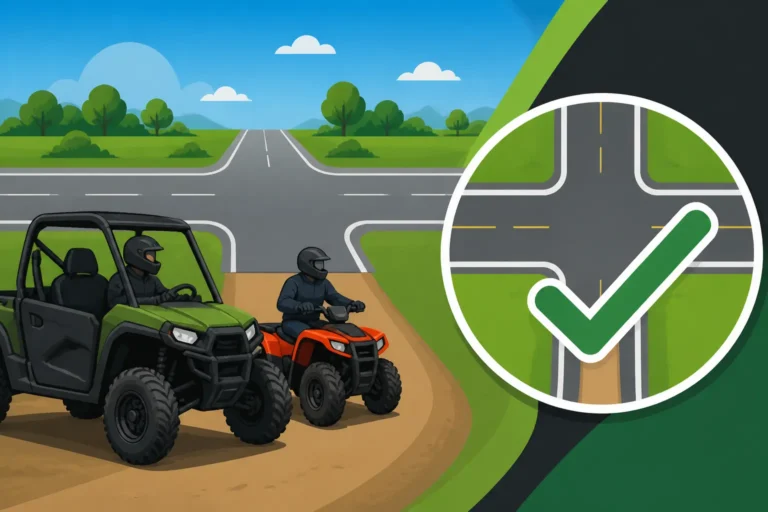
The golden rule for crossing a state highway in Illinois is this: you may only do so at an intersection and you must cross at an angle of approximately 90 degrees to the highway. This means you can't ride down the shoulder, make a wide turn onto the highway, drive a short distance, and then turn off. You must approach the intersection, stop, ensure it's safe, and proceed directly across to the road on the opposite side. The moment you deviate from this straight-across path, you're in violation of the law.
The logic behind this rule is straightforward: minimize exposure to high-speed traffic. By crossing directly and perpendicular to the flow of traffic, you spend the absolute shortest amount of time on the state highway itself. It also makes your intentions clearer to other drivers. This isn't a suggestion; it's a mandatory requirement. You need to treat these crossings with the utmost respect and caution, as if your life depends on it – because it very well might. [State Highways May Be Crossed Only at an Intersection] to keep you and other motorists safe.
Local Ordinance Prerequisite
Here's another crucial layer of complexity: even if you're at an intersection that would allow for a 90-degree crossing, you still can't just go for it unless the local jurisdiction on both sides of the state highway has passed an ordinance permitting the use of ATVs or UTVs on their roads. In simpler terms, if the village or county road you're on leading up to the state highway doesn't permit UTVs, you can't legally be there to even attempt a crossing. And if the road on the other side doesn't permit them, you'd be immediately illegal upon reaching it.
This means you need to do your homework. Before you ever plan a route that involves a state highway crossing, you must verify that the specific city, village, or county has adopted an ordinance allowing UTVs or ATVs on the connecting roads. Without this local permission, the state's crossing exception is moot. You can't just assume; you need to check local government websites or call their offices. Understanding [Illinois Municipalities That Pass Ordinances] and what they entail is paramount to planning any street-legal ride.
Equipment Requirements for Crossing
Just because you're allowed to cross doesn't mean you can do it with a bare-bones trail machine. Illinois law specifies certain equipment requirements for any off-highway vehicle operating on roads open to the public, even for a brief crossing. These are vital for your visibility and safety when interacting with faster-moving traffic. Your machine must be equipped with:
- Headlights: Visible from at least 500 feet, illuminating the road ahead.
- Tail Lamps: Emitting a red light visible from at least 100 feet.
- Brake Lights: Clearly indicating when you're slowing or stopping.
- Turn Signals: Functional front and rear signals to indicate your intentions.
- Rearview Mirror: Essential for seeing approaching traffic.
- Slow-Moving Vehicle (SMV) Emblem: A reflective orange and red triangle mounted on the rear, indicating that your vehicle travels at 25 mph or less.
Many ATVs and UTVs come from the factory without all of these features, or with features that don't meet the precise legal specifications for road use. You might need to invest in aftermarket accessories. Companies like SuperATV offer a range of products, from full turn signal kits to DOT-approved mirrors and brighter LED lighting, that can help bring your machine up to snuff. These upgrades are not just about compliance; they are about genuinely enhancing your safety on a high-risk crossing. Meeting the [Illinois Non-Highway Vehicle Equipment List] is non-negotiable for anyone venturing near public roads. The [Illinois Requires a Slow-Moving Vehicle Emblem] is particularly important as it warns other drivers of your lower speed potential well in advance.
Practicalities and Precautions for a Safe Crossing
Even when you've done all your homework, verified the local ordinances, and equipped your machine properly, actually executing a state highway crossing still demands extreme caution and a well-thought-out approach. This isn't a casual maneuver; it requires your full attention and adherence to best practices for safety.
Situational Awareness and Visibility
When you approach a state highway intersection, your "spidey senses" need to be on high alert. You should assume that no one sees you until you've made eye contact or confirmed their awareness. Look left, look right, look left again, and then check over your shoulder before you even think about entering the intersection. Pay close attention to traffic speed and volume. On a quiet Sunday morning, a crossing might feel straightforward, but during rush hour, it could be downright suicidal. Always choose the safest moment.
Beyond just looking, you need to make yourself as visible as possible. This means having your headlights on, even in broad daylight. Consider adding a safety flag or brighter colors to your machine and riding gear. Aftermarket LED light bars or auxiliary lights, often available from brands like SuperATV, can significantly increase your presence, especially if you're approaching an intersection with visual obstructions. Remember, the faster the traffic on the state highway, the less time drivers have to react to a slower-moving vehicle like yours. Every second counts.
Crossing Strategy: Speed and Directness
Once you've assessed the traffic and determined it's safe to proceed, the crossing itself should be executed quickly and directly. Don't dawdle. Accelerate smoothly and consistently across the shortest possible path – that 90-degree angle we talked about earlier. Avoid any sudden swerves or hesitation. Think of it like a quick, decisive sprint across a finish line. Your goal is to be off the state highway and onto the connecting road as efficiently as possible.
This direct approach minimizes the time you are exposed to potentially fast-moving traffic. It’s not a moment for sightseeing or admiring the scenery. Your focus should be entirely on getting from point A (the approach road) to point B (the connecting road on the other side) without incident. Prepare your machine for this brief burst of acceleration. If you're on a machine that takes a while to get up to speed, you'll need an even larger gap in traffic.
Understanding "Local" Limits
While state highways generally have higher speed limits, the local roads that feed into and out of them, and which are part of the UTV/ATV ordinances, often have much lower limits – typically 35 mph or less. This is important for your crossing strategy. You shouldn't be attempting to "match" the state highway speed. Instead, you'll be approaching the crossing at the speed limit of the local road, which means you'll be entering the state highway's path at a much slower pace than through traffic.
This speed differential is precisely why such extreme caution is required. The state law specifically limits [Only Streets Posted 35 mph or Lower Qualify] for UTV access, reinforcing that these machines are not meant for high-speed road travel. You need to be confident that your machine can accelerate across the necessary distance quickly enough to clear the highway without impeding or surprising oncoming traffic. Always respect the posted speed limits on the local roads leading to and from the crossing, and never exceed your machine's safe operating limits for acceleration.
Consequences of Illegal Crossings and Misconceptions
Despite the clear rules and inherent dangers, many riders still attempt illegal crossings or operate under false assumptions. It’s crucial to understand that bypassing the regulations comes with significant risks, both legal and financial, that far outweigh any perceived convenience. Ignoring the rules isn't just a minor infraction; it can have severe and lasting consequences.
Penalties and Enforcement
Illinois law enforcement, including local police, county sheriffs, and Illinois Conservation Police officers, take violations of ATV/UTV road rules seriously. Attempting an illegal crossing of a state highway can lead to a significant ticket, hefty fines, and potentially even impoundment of your machine. These aren't minor parking tickets; they can be costly and inconvenient, creating a major headache that completely ruins your day (and potentially your riding season).
The penalties for [Illinois Penalties for Illegal Street Riding] are designed to deter dangerous behavior. A single citation can easily cost you hundreds of dollars in fines and court fees. Furthermore, repeat offenses or particularly egregious violations could lead to more severe legal repercussions, including charges for reckless endangerment depending on the circumstances. It's simply not worth the risk when the rules for legal crossing, though strict, are clearly laid out. Always assume you are being observed, especially around high-traffic areas and state routes.
Insurance Implications
Beyond the legal penalties, an illegal crossing can have devastating effects on your insurance coverage if you're involved in an accident. Most ATV/UTV insurance policies have clauses that specify legal operation. If you're riding in an area where your machine is not permitted, or you're operating it in violation of state or local laws (like attempting an illegal state highway crossing), your insurance company could deny your claim.
Imagine totaling your expensive UTV or causing damage to another vehicle or person, only to find out your policy won't cover it because you were operating illegally. This could leave you on the hook for tens of thousands of dollars in repair costs, medical bills, and liability. The purpose of carrying [Illinois Insurance Minimums for Street Use] for street-legal UTVs is to protect you financially, but that protection vanishes if you disregard the law. Always ensure your actions fall within the parameters of your policy and state regulations.
Common Misconceptions
Many riders cling to certain misconceptions that lead them astray. One common one is, "It's just a quick hop across; no one will notice." This thinking is flawed. Even a momentary illegal act on a public road is still illegal and still dangerous. Law enforcement doesn't need to see you riding for miles; witnessing a quick illegal crossing is enough for a citation. Furthermore, the risk of collision doesn't care how long you're on the road; it's about the speed and volume of traffic at that precise moment.
Another misconception is, "I'm only going a hundred feet, it's basically an extension of the intersection." This isn't how the law works. Any travel along the state highway, even a short distance, is typically prohibited. The 90-degree crossing rule is very specific for a reason. [Illinois Rules Riders Get Wrong] often lead to costly mistakes. Don't rely on anecdotal evidence or what you've seen others do. Always consult the official ordinances and state laws to ensure your understanding is accurate and up-to-date. Your safety and legal standing depend on it.
| Feature | Legal State Highway Crossing | Illegal State Highway Operation |
|---|---|---|
| Location | Only at marked intersections | Anywhere on the highway, shoulders, interstates, tollways |
| Maneuver | Direct 90-degree traverse across intersection | Riding along the highway, U-turns, non-direct crossings |
| Local Ordinances | Required on connecting roads on both sides of highway | Not considered; assuming permission exists |
| Equipment | Full street-legal equipment (lights, mirror, SMV, etc.) | Stock trail machine or incomplete equipment |
| Traffic Awareness | High vigilance, waiting for clear gap, full observation | Impatient, rushing, assuming visibility |
| Speed | Controlled acceleration from local road speed, direct across | Trying to match highway speed or dawdling |
| Penalties | None (if rules followed) | Fines, impoundment, court costs, potential charges |
| Insurance Coverage | Typically valid if all rules followed | Potentially voided, leaving rider responsible for costs |
| Safety Risk | Minimized by strict adherence to rules | Dramatically increased, high risk of severe accident |
Disclaimer
This article is for general informational purposes only and does not constitute professional advice. Laws, prices and regulations vary by location and change over time. Consult a qualified professional for guidance on your specific situation.