Illinois Riding Areas Reachable Without a Truck
A weekend ride can get complicated before you even reach the trail: your vehicle may not be rated to tow a loaded trailer, or you may not own a truck at all. Illinois still offers several ways to plan a ride, but the best option depends on whether you can safely tow, rent a machine, or travel with someone who can haul yours.
What “reachable without a truck” really means
Not owning a truck does not necessarily rule out an Illinois riding weekend. A suitable car, SUV, or minivan may be able to tow a small trailer, but the vehicle’s rated capacity, the trailer’s weight, and the loaded machine all matter. If towing is not practical, look into rental availability or travel with a riding partner who can transport the machine.
There is an important distinction between reaching a riding area and being allowed to ride there. A quad or side-by-side that arrives on a trailer generally cannot simply be driven from a nearby hotel, gas station, or public road to the trailhead. Street use depends on Illinois law and local ordinances, and a machine’s off-road permits do not automatically make it road legal. For the basics, see Illinois ATV Trails: Where You Can Actually Ride and check the rules for the specific site before planning your route.
Start with your transportation option
Think of transportation as a choice between three plans: tow your own machine with a properly rated vehicle, rent a machine near the riding area if rentals are available, or coordinate with another rider who has room to haul yours. Each option has different costs and practical tradeoffs, so settle this question before booking lodging or driving several hours.
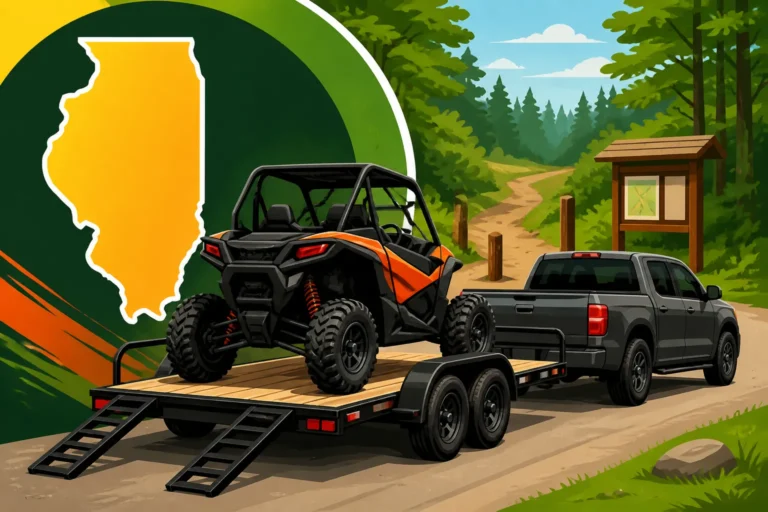
A crossover may look capable, but its appearance does not tell you how much it can safely tow. Check the vehicle manual and the trailer’s loaded weight, including the quad, fuel, tie-downs, spare equipment, and anything else carried on the trailer. Also consider tongue weight, hitch equipment, braking requirements, and whether the trailer itself fits the vehicle’s limits. If the numbers are close or unclear, ask a qualified towing professional rather than guessing.
Renting may remove the trailer problem, but it is not a guaranteed fallback. Some riding areas may not rent machines, and rental availability, age requirements, insurance terms, equipment rules, and booking procedures can differ. Use Illinois Riding Areas That Rent Machines as a starting point, then contact the area directly to confirm what is actually available for your dates.
Compare the practical options
| Plan | What you need | Main advantage | What to check first |
|---|---|---|---|
| Tow your own machine | A suitable tow vehicle, correctly sized trailer, and secure tie-downs | You ride a machine you know | Vehicle and trailer ratings, parking, permits, and route |
| Rent at or near the riding area | A confirmed rental reservation and any required documents | You avoid hauling a machine | Availability, eligibility, rules, included equipment, and pickup location |
| Travel with another rider | Space on a trailer and an agreement about loading and transport | You may avoid buying or renting towing equipment | Trailer capacity, schedule, insurance, and who is responsible for loading |
| Choose a closer destination | A manageable drive and a feasible way to transport the machine | Less time and fuel spent getting there | Whether the site is open, suitable for your machine, and accepting riders |
The cheapest-looking plan is not always the easiest. A rental can involve advance coordination, while borrowing trailer space means matching another person’s schedule and making sure the machine fits. A shorter drive may save time but still be a poor choice if the area does not allow your vehicle type or the trailer parking is unsuitable.
Plan the trailhead, not just the destination
Before you leave, confirm where riders check in, where trailers can be parked, and whether the entrance requires an advance reservation or other paperwork. A navigation app may route you to a general property entrance rather than the riding check-in point, which is a frustrating surprise when you are towing. The guide to Illinois Trailheads With Trailer Parking can help you think through this part of the trip.
A map app such as onX Offroad can help you review the general approach and keep your route organized, but do not treat a displayed road or track as permission to ride it. Confirm that the route is public and legal for your vehicle, and follow the riding area’s current directions. If cell service may be limited, prepare directions before leaving and carry a backup way to find the entrance.
Illinois riding areas to consider
Illinois has a mix of public and private riding destinations, from purpose-built OHV areas to club-run and privately operated parks. These places are worth investigating when you do not own a truck, but their location alone does not tell you whether they offer rentals, have parking that suits your trailer, or can accommodate your particular machine.
Use each area’s official information to confirm access, dates, reservations, fees, machine requirements, and any permits or decals. For a broader overview of destinations, start with Illinois Private Off-Road Parks, then narrow the choices by your transportation plan.
Southern Illinois destinations
Sahara Woods near Harrisburg is a well-known state OHV destination to investigate if your trip is headed to the southern part of the state. It is not a reason to assume that every machine can ride there or that a permit will be available at the gate. Check the site’s reservation process, permitted machine types, entry requirements, and trailer arrangements before setting out. For booking details, read Booking a Sahara Woods Permit Through ExploreMoreIL.
Near Marion, Little Egypt Off Road is another southern Illinois option to research. Because club-run and private areas can have their own schedules and rules, confirm operating days, admission arrangements, trail suitability, and whether rentals are offered before you make plans. If you are searching for a destination in that part of the state, Illinois Riding Near Marion may help you compare nearby possibilities.
Heartland Lodge, near Nebo, and Mill Creek Park near Marshall are additional names riders may encounter when researching Illinois riding areas. Treat them as places to investigate, not as interchangeable destinations: locations differ in terrain, access, operating arrangements, and machine rules. Verify the details directly with the operator or managing organization, especially if your trip depends on renting equipment or leaving a trailer parked for the day.
Northern and central Illinois destinations
The Cliffs near Marseilles may be worth considering for riders traveling from northern Illinois, while central Illinois riders might compare destinations around Springfield or Peoria. A closer park can reduce highway time and simplify coordination with a friend who has a trailer, but distance alone does not make a destination the right fit.
Look beyond the name on a map. Confirm that the area permits your type of vehicle, that the trail conditions match your experience, and that the site will be open when you plan to go. If a location is privately operated, its rules may include requirements that do not apply at another park. Guides to Illinois Riding Near Chicago, Illinois Riding Near Springfield, and Illinois Riding Near Peoria can help you build a shortlist by region.
When comparing northern and southern choices, include the full trip rather than just the drive to the park. Consider where you can stay, whether you can bring a trailer to the lodging, how far the lodging is from the trailhead, and whether the route between them involves roads where your off-road machine cannot legally travel. A plan that looks easy on a map can become awkward if the machine is stranded at the park and your room is miles away.
How to choose the right plan
The right destination is the one that works with your machine, transport, schedule, and riding experience—not simply the one with the most appealing trail photos. Make a short list, then confirm the practical details with each area before paying for reservations or lodging.
If you can tow with a car or SUV
First check your owner’s manual for towing limits and any restrictions related to passenger load, steep grades, or trailer brakes. Then calculate the loaded trailer weight rather than using the trailer’s empty weight. Add the machine, fuel, tie-downs, spare tire, tools, and other cargo. Keep the trailer properly balanced and use equipment appropriate for the load.
Before departure, inspect the tires, lights, hitch connection, safety chains, and tie-downs. Plan a route that is comfortable for your vehicle and trailer, and allow extra time for stops. If you are unfamiliar with towing, practice in a quiet area before making a long trip. A packed highway or narrow rural entrance is not the best place to discover that backing up a trailer is harder than expected.
Finally, confirm that your destination has somewhere suitable to park the trailer and vehicle. A trailhead can be open to riders but still have limited parking or a specific check-in location. Ask about arrival instructions and whether you need to unload in a designated area. The advice in Illinois Trailheads With Trailer Parking is useful to consider even when you are visiting a different site.
If you need to rent or share transport
If rental is your best option, ask specific questions before booking: Is the machine available for your dates? Which kinds of riders may operate it? What identification or documents are required? Is protective equipment provided, required, or something you should bring? What happens if weather or trail conditions affect the ride? Get the answers directly from the rental provider rather than assuming the rules are the same everywhere.
If you plan to share a trailer, settle the details well ahead of the ride. Confirm the trailer has room for your machine and that the tow vehicle can handle the total loaded weight. Agree on who supplies straps, who pays for fuel or parking, and what time the group will leave. It is also sensible to discuss what happens if one rider needs to head home early or a machine develops a problem.
When comparing destinations, onX Offroad can be one tool for organizing route research and checking the area around a trailhead. Use it alongside the riding site’s own directions and rules, not instead of them. Before departure, save or note the exact entrance and check-in location so you are not navigating to a broad property address while managing a trailer.
A pre-trip checklist for a no-truck ride
A little preparation can prevent the classic bad start: arriving after a long drive only to find the machine cannot enter, the reservation is missing, or the trailer has nowhere to go. Work through these checks before committing to the trip.
Confirm the site and machine requirements
Contact the riding area or review its official information to verify that it is open for your planned visit and accepts your machine type. Ask whether your machine must meet particular size, equipment, sound, or safety requirements. Confirm whether riders need an Illinois usage stamp, an access decal, a site permit, or more than one requirement. [Illinois OHV Permits: Two Stickers Explained] can help clarify why those requirements should not be assumed to be interchangeable.
Check whether the area requires advance reservations, waivers, proof of ownership, or other paperwork. If you are bringing a child, passenger, or borrowed machine, ask what additional rules apply. Keep confirmations accessible offline or printed in case your phone has poor reception at the entrance.
Also check the status of the exact trail or facility you intend to use. Rain, maintenance, seasonal operations, or special events can affect access. A destination’s general listing is not a guarantee that every trail or feature will be open on the day you arrive.
Make the drive workable
Set the vehicle and trailer up before ride day, not in a dark driveway minutes before departure. Check tire condition and pressure, lights, hitch, chains, and secure tie-down points. Pack basic tools, water, food, a first-aid kit, and any riding gear you need. If the route crosses areas with weak cell coverage, have directions available offline and tell someone where you are going.
Use onX Offroad or another mapping tool to prepare your approach, but check road restrictions and destination instructions independently. It can be helpful to identify a fuel stop and a safe place to pull over, especially when towing. Do not rely on an off-road map line as authorization to enter private property or ride an unapproved route.
Finally, make a simple backup plan. Know what you will do if a rental is unavailable, the park is closed, or your towing setup develops a problem. A nearby alternative is only useful if it accepts your machine and you can meet its requirements, so verify the backup before the trip rather than while sitting in a parking lot.
The most reliable way to ride without owning a truck is to build the outing around a confirmed transport plan. Choose the area, verify its rules, arrange the machine or trailer, and make sure the route from parking to the riding area is legal and practical. That extra planning can turn a stressful haul into a much smoother day on the trails.
Disclaimer
This article is for general informational purposes only and does not constitute professional advice. Laws, prices and regulations vary by location and change over time. Consult a qualified professional for guidance on your specific situation.