Illinois Riding Near Chicago
Finding an ATV or UTV trail near Chicago can be harder than it looks: maps show plenty of roads, but that does not mean riding is allowed on them. This guide explains the practical options within a reasonable drive, how private riding parks differ from public trails, and what to check before loading up and heading out.
What riding near Chicago really looks like
Expect to use a managed riding park
The Chicago area is not surrounded by a dense network of public ATV trails. For many riders in northeastern Illinois, the most straightforward nearby option is a private or managed off-road park, where the operator sets the rules, riding hours, vehicle requirements, and entry process. That is different from simply finding an unpaved road and assuming it is open to off-highway vehicles.
The Cliffs Insane Terrain near Marseilles is one of the better-known riding destinations within reach of the Chicago region. It is a private park, so its admission process and rules are not the same as those for a public trail. Before making the drive, check directly with the park for current hours, reservations, vehicle eligibility, closures, and any required paperwork. Conditions and operating details can change, and a long drive is a frustrating time to discover that your machine or planned arrival does not fit the day’s requirements.
A private park can be a good match if you want a full day of riding without having to piece together permission from multiple landowners or local governments. It is still important to choose the right setting for your group. A family bringing a young rider, for example, should confirm age and supervision rules and ask whether there are easier routes. A group with wide side-by-sides should make sure the trails and park rules suit those machines before setting out.
Treat nearby road access as a separate question
A gravel lane, farm road, forest road, or rural township road is not automatically an ATV trail. Illinois road use is governed by state rules and, in some situations, local ordinances. Even where a local government allows certain non-highway vehicles on designated streets, that does not create general permission to ride on every road in the area. Do not use a road as a connector unless you have confirmed that the route is legally open to your vehicle.
The same caution applies to public land. A park, conservation area, or forest may welcome hikers, cyclists, anglers, and campers while still prohibiting motorized trail riding. Riding off a designated route can create safety risks, damage property, and lead to enforcement. Check the rules for the specific property rather than relying on a general map label or an online post. For a broader overview of the difference between open riding areas and places that merely look rideable, see [Illinois ATV Trails: Where You Can Actually Ride].
The practical takeaway is simple: plan around a confirmed riding site, not around a vague map pin. If a route includes public roads, private land, or multiple parcels, check permission and legal access for each part. A route that seems connected on a phone screen may not be connected in a way you are allowed to ride.
Nearby options and how to compare them
Consider the drive as part of the ride plan
For Chicago-area riders, “nearby” often means making a day trip rather than rolling straight from home onto a trail. Marseilles is a common direction to investigate for a private park experience, while other Illinois riding areas can require a longer drive south or west. The right choice depends on more than mileage: think about the time it takes to tow, the amount of riding available, the kind of terrain your group wants, and whether the park can accommodate your machine.
A quick comparison can help narrow the search:
| Option | Best fit | What to verify before leaving |
|---|---|---|
| A managed park near Marseilles | A day trip from much of the Chicago region | Hours, entry process, reservations, vehicle rules, trail conditions |
| A farther Illinois riding park | Riders willing to travel for a different setting or more riding time | Open dates, terrain, fees, camping, fuel and food nearby |
| A grant-assisted riding area | Riders seeking a site supported through Illinois’s OHV access program | Required decals or stamps, site rules, operating status |
| A road or unpaved route | Only when local access is expressly allowed | Ordinances, jurisdiction, permitted vehicle types, required equipment |
That table is a starting point, not a list of guaranteed open facilities. Call or check the operator’s official information before traveling, especially if you are planning around a holiday, a wet-weather weekend, or a group outing. A site can be open in general while particular trails are closed or unsuitable after rain.
If you are willing to drive farther, explore the state’s regional choices rather than assuming the closest facility is the only one worth considering. [Illinois Northern Riding Areas] can help you compare options in the northern part of the state, while [Illinois Private Off-Road Parks] is useful when you are open to privately operated properties.
Match the terrain to your machine and riding group
A park can look ideal in photos but still be a poor fit for your group. A new rider may want forgiving routes and clear signage, while an experienced rider may be looking for more challenging terrain. A side-by-side driver needs to confirm trail width and machine restrictions; a dirt-bike rider should check whether the park has suitable routes for that vehicle type. Do not assume every facility allows every kind of off-highway vehicle.
Think about the group’s experience honestly. If someone is riding for the first time, a long day of difficult mud or steep, technical terrain can become stressful quickly. Start with an area that offers room to learn and agree in advance that the group can split up or turn back. More experienced riders may enjoy a demanding route, but the outing still needs a plan for regrouping and communicating if the group gets separated.
For help narrowing down beginner-friendly possibilities, see [Best Illinois ATV Trails for Beginners]. If you are riding a side-by-side, [Illinois Trails That Allow Side-by-Sides] is another useful planning topic. Confirm the specific park’s current vehicle rules directly; a general description of a trail or region does not replace the operator’s requirements.
How to plan the trip from Chicago
Check access, operating details, and conditions first
Start by confirming that the riding area is open on the day you plan to visit. Check its official channels for operating hours, reservation requirements, arrival instructions, closures, and vehicle limits. If anything is unclear, contact the operator. A short call can settle questions that a search result or an old social media post cannot answer reliably.
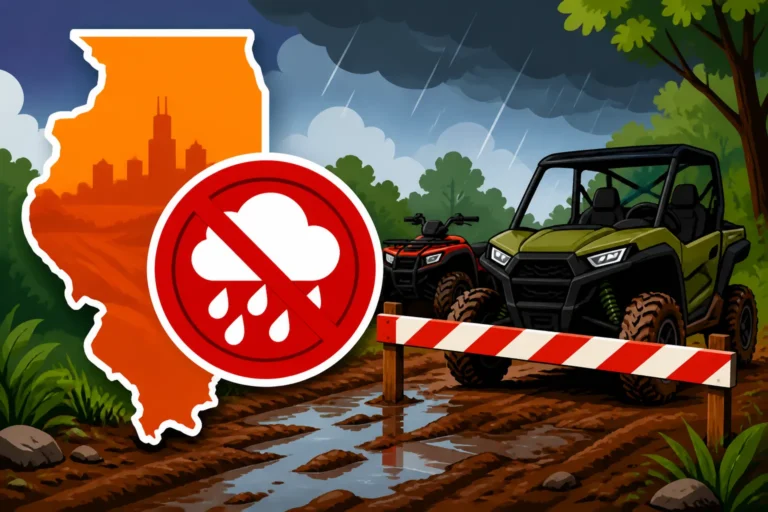
Then check recent trail conditions. Rain can turn clay into slick, heavy mud, make some routes difficult for less experienced riders, or prompt temporary closures. Dry conditions can also affect dust, visibility, and fire-related restrictions. A park may remain open while certain sections are unavailable, so ask about the conditions that matter to your machine and skill level. [Illinois Trail Conditions Before You Tow] is a helpful companion when you are weighing whether to make the trip.
Map tools can help with the drive and with organizing a route, but they are not proof that a trail is legal or open. onX Offroad can be one way to review mapped routes and prepare questions before leaving, but confirm access with the land manager or park operator. If the map shows a route crossing private property, a road, or land with unclear status, stop and verify rather than treating the line on the screen as permission.
A useful pre-trip check is to write down the park’s address, check-in instructions, reservation or permit details, and a backup plan if weather affects riding. Download or save the information before you leave. Cell service can be unreliable around trail areas, and a phone that cannot load a page at the gate is not much help.
Prepare your machine and everyone riding it
Before loading, inspect the ATV or UTV for basic readiness. Check tires, brakes, steering, lights where applicable, fluid levels, and the condition of straps and tie-down points. Pack gear suited to the forecast and terrain, including helmets and protective clothing. If you have not ridden for a while, a quick check at home is much easier than trying to troubleshoot a problem in a parking area after a long tow.
Make sure the machine meets the park’s requirements. Some operators may set limits or checks related to vehicle specifications, sound, safety equipment, or modifications. A heavily modified machine is not automatically acceptable just because it runs well at home. Ask about unusual features before you travel, particularly if your UTV is wide, has a lift, or has modifications that could affect fit or noise.
Plan for the people as carefully as the machines. Confirm who is driving, who is riding as a passenger, and whether children meet the park’s age and supervision rules. Bring water, food, a first-aid kit, and a way to communicate within the group. If someone has limited experience, agree on a simple pace and regrouping points instead of expecting them to keep up on every route.
Permits, stickers, and park rules
Do not confuse an Illinois decal with admission
Illinois has different requirements for off-highway vehicles depending on where and how they are used. A usage stamp, a public access decal, a park admission permit, and a private park’s own entry requirements are not interchangeable. Whether a particular sticker is required depends on the riding site and the applicable rules. Confirm what applies to the specific location before you head out.
This distinction matters for riders planning from Chicago because a familiar state sticker does not necessarily buy admission to a private park, reserve a riding day, or cover every requirement at a public site. Likewise, purchasing a park permit should not be treated as permission to ride elsewhere. Check the operator’s instructions and state requirements separately. [Illinois OHV Permits: Two Stickers Explained] and [Illinois Public Access Decal Rules] explain the different roles these credentials can play.
If you are visiting a grant-assisted riding site, check whether a public access decal is required and how it must be displayed. If you are going to a private park, ask what the park itself requires. For an overview of sites supported through Illinois’s OHV grant program, see [Illinois Grant-Assisted Riding Areas]. Keep proof of purchase or confirmation accessible, but do not assume that proof replaces a required sticker or other credential.
Read the rules for the exact place you plan to ride
Every riding property can have its own practical rules. These may cover check-in, waivers, passengers, age restrictions, speed, trail direction, camping, pets, alcohol, sound, or where vehicles can be unloaded. A friend’s description of a visit last season may be useful context, but it should not be your final source for today’s requirements.
Read the rules before arriving, and make sure every rider understands them. For example, if a park requires a waiver, find out who must sign it and whether a parent or guardian needs to complete paperwork for a minor. If there are separate rules for passengers or particular vehicle types, check those in advance. Sorting this out at the entrance can delay your group or leave a rider unable to participate.
Carry the information you may need at the site: confirmation details, relevant ownership documents if requested, and any required decals or permits. Keep items secure and easy to reach rather than buried beneath riding gear. Questions about documents and site expectations are covered in [Carrying Papers at a Grant Site], but always follow the specific park’s instructions.
A practical checklist for a better riding day
Use this sequence before you leave
A good Chicago-area riding day begins with the destination, not the trailer. Choose a confirmed riding area, check its current operating information, and make sure the terrain and rules match your group. Then verify the route and travel time, keeping in mind that towing can make a drive slower and more tiring than a normal car trip.
Use this order to reduce last-minute surprises:
- Choose the riding area. Confirm it is a legal place for your vehicle type and intended activity.
- Check the operator’s information. Verify open dates, hours, reservations, entry instructions, closures, and vehicle restrictions.
- Confirm required permits or decals. Determine which state credentials and site-specific permits apply.
- Review weather and trail conditions. Ask whether rain, mud, or other conditions have changed what is open or rideable.
- Inspect the machine and trailer. Check safety equipment, tires, brakes, tie-downs, and anything else likely to cause trouble on the drive.
- Plan for the group. Review age, passenger, supervision, and experience considerations.
- Save your information offline. Keep the address, confirmation, and key rules available if cell service drops.
A map app can help organize the drive, and onX Offroad may help you review mapped routes during planning. Use those tools as aids rather than as substitutes for permission or current site information. If a trail line appears to cross land you have not confirmed is open, treat that as a question to resolve before riding.
Keep a backup plan and set realistic expectations
A backup plan is especially useful when your outing depends on weather, reservations, or a long tow. Identify another confirmed activity or a different riding date rather than assuming you can improvise a legal trail nearby. If the park is closed or the trails are unsuitable, riding an unverified road or crossing private land is not a safe workaround.
Set expectations for the day before the group unloads. Decide how often to regroup, what to do if someone gets separated, and when the group will stop for water or rest. Riders with different experience levels may enjoy the day more if they agree to take easier routes together and give confident riders a chance to explore only where park rules and communication allow.
Finally, leave room for the return trip. Mud, fatigue, and loading can add time, and a tired driver hauling a trailer needs a little margin. A successful ride is not measured by squeezing in every trail; it is getting everyone home safely after a day at a place where riding is actually permitted.
Disclaimer
This article is for general informational purposes only and does not constitute professional advice. Laws, prices and regulations vary by location and change over time. Consult a qualified professional for guidance on your specific situation.