Sahara Woods Sits 5 Miles West of Harrisburg
Sahara Woods is a convenient destination for riders looking for an off-road day near Harrisburg, but being only a short drive away does not mean you can simply arrive and ride. You still need to check that the site is open, understand its permit and decal requirements, and plan for the trail conditions. This guide covers how to prepare for a visit and avoid common day-trip surprises.
Where Sahara Woods is and what to expect
Getting oriented near Harrisburg
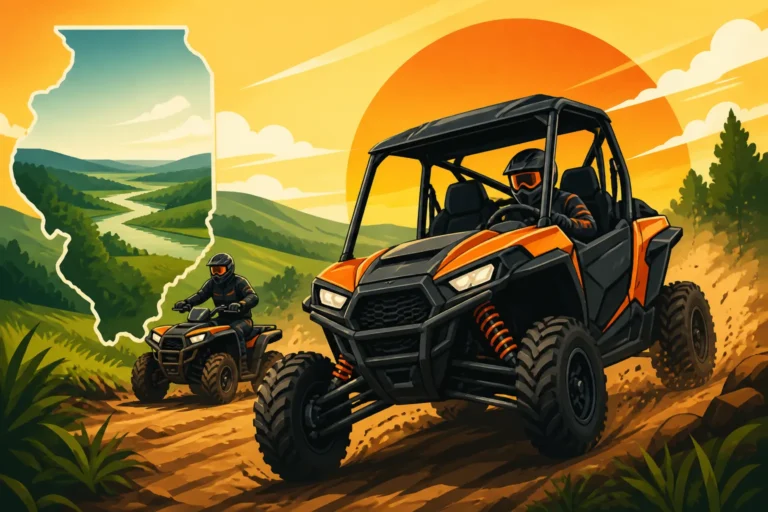
Sahara Woods sits about five miles west of Harrisburg in southern Illinois. That puts it within easy reach of town for many local riders, while still making it a destination worth planning for if you are towing a machine from elsewhere in the state. Before leaving, confirm the route and destination details using current park information rather than relying only on a general map pin.
A short drive from Harrisburg can make the trip feel spontaneous, especially if you live nearby. But a riding area is not the same as a public road or a neighborhood park: the access point, hours, registration process, and rideable boundaries all matter. Give yourself time to locate the correct entrance and complete any required check-in before unloading.
The location also makes Harrisburg a useful place to organize practical details before or after a ride, such as fuel, food, and supplies. Do not count on every service being available beside the trailhead, though. If your group needs fuel for a machine, drinking water, snacks, or a specific repair item, bring it with you or confirm where you can get it before driving out.
Understanding the riding area before you go
Sahara Woods is known as an Illinois state OHV riding destination, not a general-purpose trail system where every path in the surrounding region is automatically open to machines. Stay within the routes and areas designated for riding. Nearby woods, roads, fields, and public land do not become legal OHV routes just because they appear close on a map.
That distinction is easy to miss when a map shows a network of tracks or unpaved lines. A line may be a service road, a private route, or a path that is not open to motorized use. A tool such as onX Offroad can help you prepare and understand the wider area, but use it as a planning aid—not as a substitute for the site’s rules and posted boundaries.
If it is your first visit, start by reading Sahara Woods' 30 Miles in Illinois and Illinois ATV Trails: Where You Can Actually Ride. Those topics can help set expectations about the area and the difference between a designated OHV site and land that merely looks rideable. The park’s official directions and instructions should guide your final decisions.
Plan permits and site access before the drive
Check what your machine and riders need
A trip can be derailed at the gate if the group has assumed that one sticker, stamp, or permit covers everything. Illinois has requirements connected to off-highway vehicle use and access to certain grant-assisted riding sites, and Sahara Woods may also have its own reservation, permit, waiver, or check-in steps. Confirm the requirements that apply to your visit and each machine before setting out.
The practical approach is to identify the purpose of each document or decal rather than treating them as interchangeable. One requirement may relate to general OHV use, while another may relate to riding at a particular public-access or grant-assisted area. For an explanation of how those requirements differ, see [Illinois OHV Permits: Two Stickers Explained] and [Illinois Usage Stamp vs Access Decal].
Ask the same questions for every rider and machine in your group. A parent bringing a youth quad, someone borrowing a friend’s machine, or a group arriving with both ATVs and side-by-sides may need to check different details. Do not assume that a permit purchased for one machine transfers to another; review [Illinois Permit for a Second Machine] if you are bringing more than one.
Reserve and verify the visit details
Check the park’s official information close to your intended ride date. Hours, access instructions, reservation procedures, and operating conditions can affect whether the trip works as planned. A holiday or popular weekend can be especially frustrating if you tow several hours only to discover that the day’s arrangements are different from what you expected.
For a straightforward visit, keep the confirmation details together before departure. Save a copy on your phone and, if practical, keep a paper copy as a backup. Confirm what riders need to show at check-in, whether a waiver must be completed in advance, and whether each machine needs its own identification or sticker. The specific process can change, so avoid relying on an old screenshot or an unverified social-media post.
If you are choosing between a short visit and a longer riding weekend, compare the permit options and rules rather than assuming a multi-day option is always available or worthwhile. [Reserving a Riding Day at a State OHV Park] and [Illinois Sahara Woods Permits] are useful related topics. For a more focused look at advance planning, see [Booking Before You Drive Down].
Prepare your machine, trailer, and group
Do a practical pre-ride machine check
A machine that starts in the driveway can still cause trouble once it has been strapped down, unloaded, and ridden away from the parking area. Before the trip, check the basics: tires, wheels, brakes, throttle return, steering, lights if required by the park or conditions, fluid levels, and any visible leaks. Bring the machine’s documents and any proof of ownership the site may ask to see.
The closer you get to a ride day, the more tempting it is to skip small checks. That is often when a soft tire, weak battery, loose tie-down, or damaged strap turns into a delay. If your machine has recently been repaired or modified, test it near home rather than discovering a problem at the trailhead. Follow the park’s machine requirements; a vehicle that does not meet site rules may not be allowed to ride.
Use [Illinois Machines That Must Meet Specs] and [Machines Checked Against Factory Specifications at the Gate] as prompts to verify requirements before loading. If you are using a phone-based map such as onX Offroad, download or prepare what you need before you reach an area with poor reception. A map app can be helpful for orientation, but it should not encourage you to leave authorized routes.
Pack for the drive and the riding day
A good day-trip kit is more than a helmet and a tank of fuel. Pack water, food, a basic first-aid kit, suitable clothing, eye protection, gloves, and tools appropriate to your machine. Add a tire repair option and a method of contacting your group if riders become separated. In southern Illinois, weather and ground conditions can shift the feel of a ride quickly, so bring layers and gear that can handle dust, mud, or changing temperatures.
Trailer preparation deserves the same attention as the machine. Check the trailer tires, lights, hitch, safety chains, and tie-down points before leaving. Secure each vehicle so it cannot shift during braking or on rough roads. If you are transporting more than one machine, make sure the loading arrangement leaves enough room to unload safely without moving another vehicle into traffic or unstable ground.
Create a simple group plan before anyone sets off on a trail. Decide where to regroup, what to do if a machine breaks down, and how children or less experienced riders should stay with the group. If your party has different experience levels, agree on a pace that the newest rider can manage. A ride is more enjoyable when no one feels pressured to keep up or embarrassed to ask for a slower route.
Ride within the site’s rules and your ability
Match the day to your riding experience
A first visit is a good time to learn the area gradually rather than trying to cover as much ground as possible. Begin with routes that suit the least experienced rider in your group, and take time to understand how the trail is marked and where the boundaries lie. A rider who is comfortable on a familiar farm lane may still feel out of their depth on unfamiliar, uneven terrain.
Do not use another rider’s pace as your measure of what is safe. A group can include different machines, skill levels, and comfort with mud, hills, or tight turns. Agree that anyone can request a break or turn back without being teased. This matters especially when adults are riding with children or teens, whose experience and machine size may differ from those of the adults.
Before the day, review Best Illinois ATV Trails for Beginners and [Illinois Trail Difficulty Ratings]. The point is not to assume that every route will match a particular description, but to think ahead about skill, machine capability, and group expectations. If the site provides current route guidance or signs, follow those over a general description found elsewhere.
Respect boundaries, other riders, and changing conditions
Stay on designated routes and obey signs, closures, speed limits, and staff directions. Riding beyond a marked boundary can damage land, create conflict with property owners, and put the rider at risk of a citation or being removed from the site. A visible track on a phone map is not permission to use it.
Give other riders space, especially in areas where visibility is limited. Slow down before blind turns, avoid stopping in a spot where another rider cannot see you, and make sure the trail is clear before restarting. Dust can reduce visibility, while mud and loose ground can affect stopping distance and steering. Adjust your pace to conditions instead of trying to maintain the speed you had on the previous section.
Rain, recent maintenance, or seasonal conditions may affect which routes are open and how difficult they feel. Check for closures and warnings before unloading, and do not assume that a familiar area has the same conditions every time. [Illinois Trail Closures After Rain] and [Illinois Trail Etiquette Locals Expect] offer useful reminders for safer, more considerate riding.
Build a reliable day-trip plan
Use maps as a planning tool, not an access guarantee
A navigation app can help you estimate the drive, locate Harrisburg, and keep your group oriented around the destination. onX Offroad may also be useful for preparing a broader map view, particularly if you want to understand the surrounding area before arriving. Make sure you know which information comes from the app and which information comes from the park’s own current instructions.
Before the trip, review your route and save the details you may need without depending on a strong mobile signal. Identify the site entrance, your expected parking or unloading area, and a backup meeting point that does not interfere with traffic or trail access. If your group uses separate vehicles, share the destination and arrival plan with everyone in advance.
Do not treat a mapped road or trail as public access unless the site or responsible authority confirms that it is open to riders. This is especially important in a rural area, where a short distance on a map can cross private property, a closed route, or land with different rules. Use maps to ask better questions—not to replace permission, posted signs, or official directions.
Have a backup plan for delays or a change of plans
Leave enough time for check-in, unloading, and a safety briefing before you expect to start riding. If a trailer issue, a missing document, or a long line delays your group, a rushed departure can lead to mistakes. Make sure someone knows your general itinerary and when you expect to be back, particularly if you are traveling without another group.
Agree on what happens if weather, a closure, a machine problem, or a full reservation changes the plan. That might mean postponing the ride, switching to a different activity, or stopping in Harrisburg rather than searching for an unauthorized place to ride. A backup plan is not pessimistic; it saves the group from making a poor decision after investing time and fuel in the drive.
| Before you leave | What to confirm | Why it matters |
|---|---|---|
| Site access | Current operating information, entrance, and check-in steps | Prevents arriving at the wrong place or at the wrong time |
| Permits and decals | Requirements for the site, each rider, and each machine | Avoids treating separate documents as interchangeable |
| Machine | Basic condition, required equipment, and proof of ownership | Reduces breakdown risk and gate delays |
| Trailer | Tires, lights, hitch, chains, and tie-downs | Helps make the drive and unloading safer |
| Group plan | Meeting point, riding pace, and emergency approach | Keeps riders together and makes regrouping easier |
| Map and directions | Confirmed route and saved navigation details | Helps if reception is weak or the group gets separated |
For related planning questions, [What a Visiting Rider Brings Besides an Illinois Decal] can help visitors think through documents and gear, while Illinois Trail Conditions Before You Tow is a useful reminder to check conditions before committing to the drive. Keep the final checklist simple enough that everyone in the group can follow it.
Disclaimer
This article is for general informational purposes only and does not constitute professional advice. Laws, prices and regulations vary by location and change over time. Consult a qualified professional for guidance on your specific situation.