Proof of Coverage in the Glovebox
Cruising the open roads of Illinois on your ATV or UTV can be an incredible experience, offering freedom and adventure, but many riders get caught off guard by the need to prove they're properly insured. You might think your personal vehicle insurance covers everything, or that off-road machines don't need the same paperwork as a car, only to find yourself facing a hefty ticket or, worse, a devastating financial blow after an accident. This guide is here to walk you through exactly why carrying proof of insurance in your machine's "glovebox"—or its off-road equivalent—is absolutely critical when you venture onto Illinois' approved public roads, and how to make sure you're always prepared.
The Mandate: Why Proof of Coverage Matters on Illinois Roads
It's a common misconception that because ATVs and UTVs are primarily designed for off-road use, the rules of the road don't fully apply to them. However, once you choose to operate your machine on any public road in Illinois where it's legally permitted, it essentially takes on the responsibilities of a regular vehicle in the eyes of the law. This isn't just a suggestion; it's a legal requirement designed to protect everyone on the road.
Understanding Illinois' Street-Legal Insurance Requirements
If you're one of the many Illinois riders who has gone through the process of making your ATV or UTV street-legal, perhaps by adding turn signals, mirrors, or other essential equipment, then you've also entered the world of mandatory vehicle insurance. The state of Illinois, like most others, requires that any motor vehicle operating on its public roads carry a specific amount of liability insurance. This isn't about protecting your machine from damage; it's about providing financial protection to others if you're at fault in an accident. Without this coverage, you could be personally responsible for substantial medical bills, property damage, and legal fees.
These requirements extend to your street-legal ATV or UTV just as they would to your car or truck. It's not enough to simply have the physical modifications; you must have an active insurance policy that explicitly covers your off-road machine for road use. Many standard ATV/UTV policies are designed only for off-road, private property, or trail park use, so it's crucial to confirm with your insurance provider that your policy includes coverage for on-road operation. You can learn more about the specific requirements by checking out [Illinois Requires Insurance for Street Use] and [Illinois Insurance Minimums for Street Use].
The Consequences of Riding Uninsured or Without Proof
Imagine you're enjoying a beautiful afternoon ride on a county road, legally allowed to be there, when a minor fender bender occurs. Perhaps you clip a mailbox, or another vehicle swerves, and you end up in a ditch. In these moments, the absence of proper insurance, or even just the proof of it, can turn a simple incident into a serious legal and financial headache. If you're pulled over for a routine traffic stop or involved in an accident and cannot produce valid proof of insurance, you could face significant penalties.
These penalties often include hefty fines that can quickly add up, and in some cases, your machine could even be impounded. Beyond the immediate legal repercussions, consider the financial fallout if you cause an accident without liability insurance. You could be sued for property damage to another vehicle, medical expenses for injured parties, and even lost wages if someone can't work due to their injuries. These costs can easily run into tens or even hundreds of thousands of dollars, completely derailing your financial stability. For riders navigating permitted areas, understanding [Illinois ATV Road Rules: Local Ordinances Decide] is also key to avoiding unexpected encounters with law enforcement. The goal isn't just to avoid a ticket, but to ensure you're protected from the unexpected.
What Counts as "Proof" and Where to Keep It
So, you've got the right insurance policy for your street-legal machine—that's a huge step! But having the policy isn't enough if you can't prove it when asked. Just like with your daily driver, you need to have accessible documentation showing current coverage.
Acceptable Forms of Insurance Documentation
When a law enforcement officer asks for proof of insurance in Illinois, they're typically looking for something official that clearly states your name, the vehicle's details (make, model, VIN), the policy number, and the coverage dates. The most common and widely accepted forms include:
- Your physical insurance card: This is the gold standard. Most insurance companies will mail you a small card for each insured vehicle. It's compact, easy to hand over, and universally recognized.
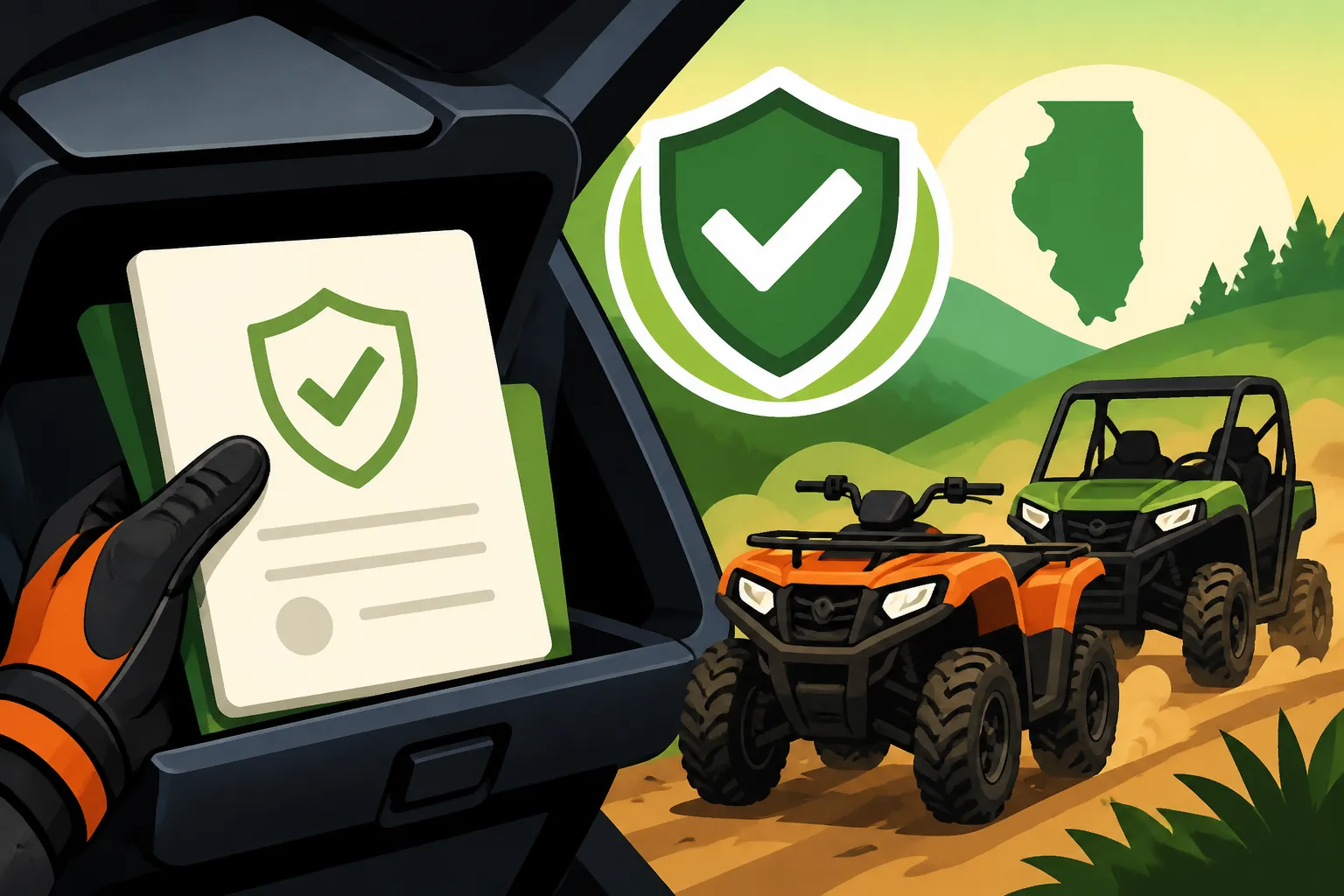
- A digital insurance card on your smartphone: Illinois law allows for electronic proof of insurance. Many insurance providers have apps that display your card, or you can often access a digital version through their website. Just make sure your phone is charged and accessible!
- Your policy declaration page: This is usually a longer document that provides a detailed breakdown of your coverage. While it's certainly proof, it's not as convenient as a small card for quick checks.
- A temporary insurance binder: If you've just purchased a new policy or updated an existing one, your agent might provide a temporary binder, which serves as valid proof until your official cards arrive.
What definitely won't work is simply telling the officer you have insurance. They need to see it in writing, whether physical or digital. This is why having it ready is so important.
The "Glovebox" or Equivalent Concept for Off-Roaders
Now, let's be real: many ATVs and UTVs don't come equipped with a traditional, secure glovebox like a car. This creates a unique challenge for riders who need to carry essential documents safely and accessibly. The key is to think about "glovebox" as a concept rather than a literal compartment. You need a secure, weatherproof spot on your machine where your insurance proof—and perhaps your driver's license, if you're riding a UTV on the street as per [Do You Need a License for a UTV in Illinois?]—can be stored without getting lost, wet, or damaged.
Here are some practical solutions:
- Waterproof storage bag: A heavy-duty, zip-lock style bag or a dedicated waterproof document pouch is an excellent choice. You can often secure these within an existing storage bin, under the seat, or in a secured cargo box.
- Front or rear storage compartments: Many UTVs, and some larger ATVs, have built-in storage areas. Ensure these are lockable or very secure to prevent documents from bouncing out on rough terrain. If not waterproof, add that extra layer of protection with a bag.
- Aftermarket storage solutions: The market is full of accessories designed to add storage to your off-road machine. Products from reputable brands like SuperATV, for instance, offer rugged storage boxes, door bags, and under-seat bags that are designed to withstand the elements and keep your gear, including important papers, safe and dry. These can be a lifesaver for creating that essential "glovebox" space.
- On your person: For some, keeping a digital copy on a fully charged phone or a laminated physical card in a wallet or jacket pocket might be the most reliable option, especially if your machine offers minimal secure storage. However, consider the risks of losing your phone or having your wallet damaged during a ride.
The most important thing is that the proof is readily available and protected from the elements. A soggy, illegible insurance card isn't going to do you much good when a conservation officer or local police officer asks for it.
Here’s a quick comparison of common storage options for your proof of coverage:
| Storage Location | Pros | Cons | Ideal For |
|---|---|---|---|
| Waterproof Pouch | Inexpensive, highly portable, protects from elements | Can be misplaced if not secured, limited capacity | Minimalists, attaching to handlebars/seat |
| Built-in Compartment | Secure, readily accessible, blends in | May not be fully waterproof, limited space, not always lockable | UTVs, larger ATVs with factory storage |
| Aftermarket Storage Box | Durable, often waterproof, lockable, more capacity | Requires installation, adds bulk, can be an investment | Serious trail riders, carrying multiple items |
| Personal Wallet/Pocket | Always on you, quick access | Risk of loss/damage, not ideal for physical cards in rough terrain | Digital proof, emergency backup |
Navigating the Nuances: Exemptions, Out-of-State, and Farm Use
While the general rule for street-legal machines is clear—you need proof of insurance—there are always specific situations and exceptions that can create confusion. It's crucial to understand these nuances to avoid inadvertently breaking the law or leaving yourself unprotected.
When You Might Be Exempt (and Why You Still Need to Be Smart)
Illinois law does offer certain exemptions where a traditional motor vehicle insurance policy might not be explicitly required for an ATV or UTV. The most common of these is for machines used exclusively for agricultural purposes on private land, or for crossing public roads between fields. For example, a farmer moving their utility vehicle from one field to another directly across a township road might fall under a specific exemption. You can read more about [The Farm Exemption From Street Insurance Rules] for a deeper dive. Similarly, if you only ever ride your ATV or UTV on private property, like your own sprawling backyard or a dedicated private riding park, then the state's public road insurance requirements don't apply.
However, even if an exemption might apply in a very specific scenario, it's always smart to exercise caution. The lines can get blurry. What if that "field crossing" becomes a quick run to the hardware store for a part? Or what if you're on your own property but accidentally veer onto an easement or public access point? The moment your tires touch a public thoroughfare outside of a clearly defined, limited exemption, the rules change. Many riders choose to carry at least basic liability insurance even for machines primarily used on private land, simply for the peace of mind and protection against unforeseen circumstances. It's about being smart and proactive, rather than reactive when something goes wrong.
Out-of-State Riders: What to Know About Illinois Rules
Illinois is a popular destination for off-road enthusiasts from neighboring states like Indiana, Missouri, and Wisconsin. If you're visiting Illinois with your ATV or UTV and plan to ride it on any public roads that are legally open to such machines, you generally need to comply with Illinois' insurance requirements. Fortunately, if your home state requires motor vehicle liability insurance and you have a valid policy, Illinois will typically recognize that coverage.
The key, however, remains the same: you must have proof of that coverage readily available. Don't assume that because your Indiana insurance is valid back home, you don't need to carry the card when riding in Illinois. Always ensure you have your physical or digital insurance card with you, showing that your machine is covered by liability insurance that meets or exceeds Illinois' minimums. Understanding [Illinois Rules for an Out-of-State Machine] is vital for visitors to ensure a smooth, penalty-free ride. A law enforcement officer won't know you're insured unless you can show them the proof.
The Importance of More Than Minimum Coverage
While Illinois sets specific minimum liability insurance requirements, these are truly the bare minimums designed to prevent you from being completely uninsured. Many experienced riders and financial advisors will tell you that relying solely on minimum coverage can be a risky gamble. Imagine a scenario: you're involved in an accident, and the damages to property and medical expenses for an injured party far exceed your policy's minimum coverage limits. Who pays the difference? You do.
This could mean your savings, your home, or future earnings are at risk. For instance, if your policy only covers a certain amount for property damage and you total someone's expensive truck, you could be on the hook for thousands out of pocket. For personal injury, medical bills from even a moderate accident can quickly soar. This is why many riders opt for higher liability limits and often consider adding comprehensive and collision coverage, even if not legally required for road use. While comprehensive and collision protect your own machine, higher liability limits protect your assets from claims made by others. It's a small investment that can provide immense peace of mind.
Practical Steps for Ensuring You're Covered
Navigating insurance can feel like a chore, but it's a critical part of being a responsible and protected rider. Taking proactive steps can save you a world of trouble and expense down the line.
Getting the Right Policy for Your Street-Legal Machine
The first and most important step is to make sure your insurance policy actually covers your specific usage. Don't just assume your existing auto policy or a generic ATV policy will do the trick for street-legal riding.
- Talk to an expert: The best advice you can get will come from an experienced insurance agent who understands the nuances of ATV and UTV coverage, especially for street use. Explain exactly how and where you plan to ride your machine – on trails, on private land, and on public roads. They can help you determine the appropriate coverage amounts and ensure your policy meets Illinois' specific requirements for road operation. They can also clarify what [Illinois Insurance for Trail Use] covers versus what's needed for the street.
- Explicit street coverage: Verify that your policy explicitly states coverage for on-road use. Some policies have exclusions for public road operation, and you don't want to find that out after an incident.
- Confirm liability limits: Discuss the various liability limits with your agent. While you need to meet the minimums (often expressed as numbers like [Twenty-Five, Fifty and Twenty] referring to thousands of dollars), consider increasing these limits to better protect your personal assets. It's often a relatively small increase in premium for a significantly larger safety net.
- Review your declaration page: Once you have a policy, carefully read the declaration page. This document outlines your coverage, limits, and the vehicles covered. Make sure your ATV or UTV is listed with the correct VIN and that "on-road" or "street legal" coverage is noted.
Regular Checks and Updates to Your Proof
Getting the policy is just the beginning. You need to maintain vigilance to ensure your proof of coverage is always current and accessible.
- Before every ride: Make it a habit to do a quick check before you head out, especially if you're hitting public roads. Is your physical card in its waterproof pouch? Is your phone charged with the digital card easily accessible? This small habit can prevent a big headache.
- Renewals and policy changes: Insurance policies renew periodically. When yours does, make sure you receive an updated insurance card and replace any old ones in your machine. Similarly, if you make any changes to your policy (e.g., changing coverage limits, adding or removing a machine), ensure you get updated proof of insurance.
- Digital vs. physical: While digital proof is convenient, consider having a physical backup, especially for longer rides or areas with spotty cell service. Batteries die, and signals drop. A laminated card in a secure compartment means you're never caught off guard.
- Keep copies: It's a good idea to keep copies of your insurance information in multiple places—a digital copy in your email or cloud storage, a physical copy at home, and the one in your machine. This way, if something is lost or damaged on the trail, you have easy access to replacements.
By diligently managing your insurance coverage and ensuring you always have proof in your "glovebox," you're not just complying with Illinois law. You're giving yourself peace of mind, protecting your finances, and ensuring your off-road adventures can continue safely for years to come.
Disclaimer
This article is for general informational purposes only and does not constitute professional advice. Laws, prices and regulations vary by location and change over time. Consult a qualified professional for guidance on your specific situation.