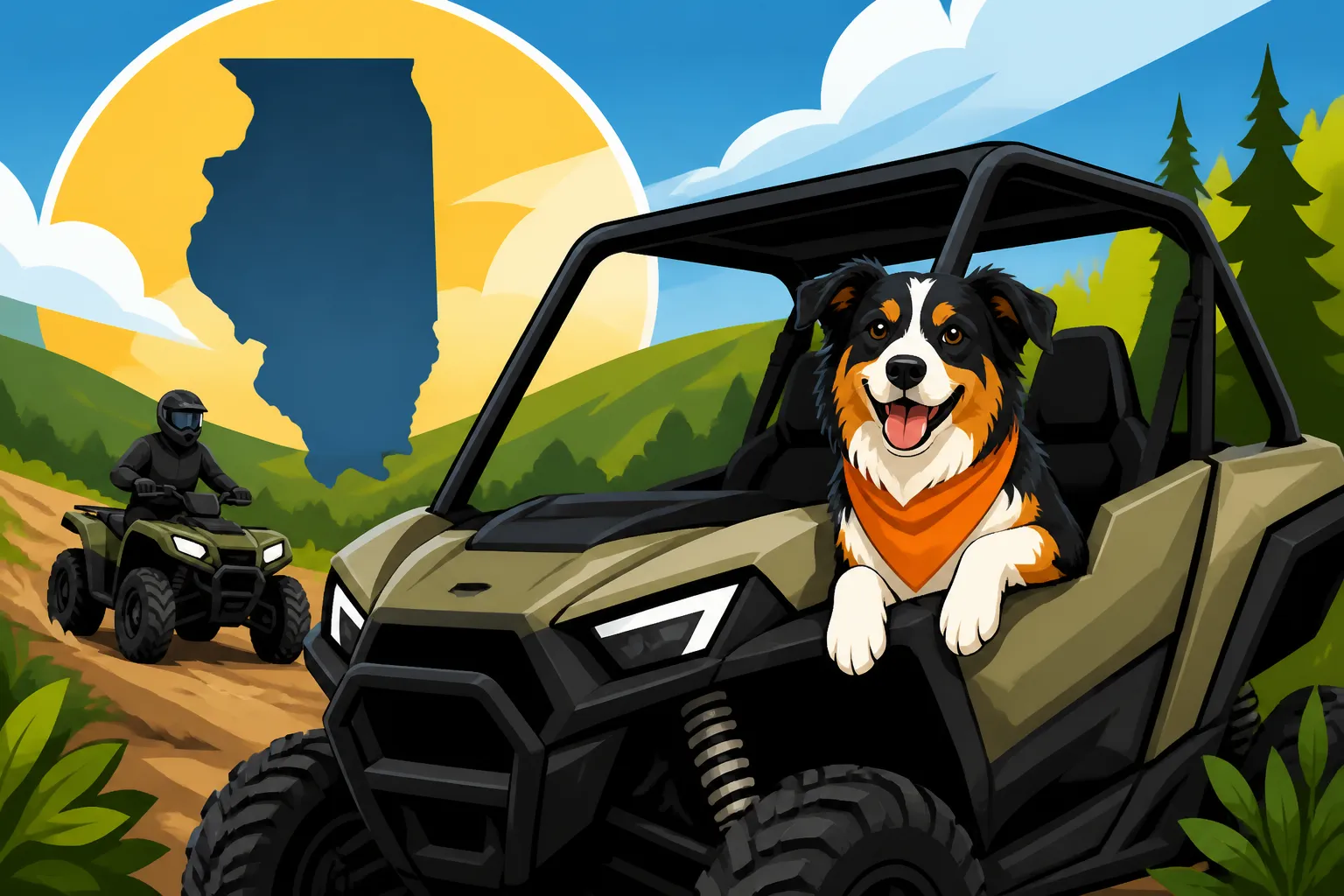
Bringing a Dog to an Illinois Riding Park
Taking a dog to an Illinois riding park can work, but “dogs are allowed” does not mean every part of the property is safe or open to them. At Sahara Woods and other Illinois Department of Natural Resources properties, dogs must stay leashed, and pedestrians are prohibited on designated OHV trails. Here’s how to plan a visit without confusing park access with trail access.
Where dogs are allowed at an Illinois riding park
The first distinction is between being on park property and being on an active riding trail. According to the Illinois Department of Natural Resources, dogs are permitted at Sahara Woods State Recreation Area and other IDNR state properties as long as they remain leashed at all times. The same agency prohibits pedestrians and unauthorized users directly on designated off-highway vehicle trails.
Those rules can both apply at the same site. Your dog may be allowed in areas where people can walk, while the marked OHV trail itself remains off-limits for walking. A leash does not turn a riding trail into a dog-walking route, and permission to bring a dog onto the property is not permission to take the dog everywhere on it.
Sahara Woods State Recreation Area is the primary IDNR-managed state property with a dedicated OHV trail system that permits public riding. Before bringing a dog, plan around the distinction between the riding area and places where a leashed visitor can be present. For broader site context, see Illinois Grant-Assisted Riding Areas and What a Grant-Assisted Riding Site Actually Is.
| Location or situation | What to expect | Practical approach |
|---|---|---|
| IDNR property, away from designated OHV trails | Dogs are permitted if leashed, according to IDNR | Keep the leash attached and stay in areas where pedestrians are allowed |
| Designated OHV trail | Pedestrians and unauthorized users are prohibited, according to IDNR | Do not walk a dog onto the trail |
| Privately operated riding park | The IDNR state-property rule does not establish that park’s policy | Ask the operator about dogs, permitted areas, and leash requirements before leaving home |
| Busy riding area or trail entrance | Riders may be entering or leaving on machines | Keep the dog well away from machine traffic and use only an allowed pedestrian area |
A private park can set its own access rules, so don’t assume that a policy at Sahara Woods applies elsewhere. Some operators may restrict dogs, limit them to certain areas, or have other requirements. Check directly with the park before making plans; a listing or a previous visit may not reflect the rules currently in force.
This distinction matters particularly at parks with camping or shared-use areas. A campground, parking area, or picnic space may have different rules from a trail. Even if the park allows dogs in one part of the property, that does not establish that they can accompany riders on the OHV route. For planning a stay, Illinois OHV Camping With Trail Access can help you think through the difference between lodging and riding access.
Keep your dog away from active riding routes
The clearest rule for IDNR properties is not to walk a dog directly on a designated OHV trail. The IDNR says pedestrians are prohibited there. A dog walking on the route with a person is still part of a pedestrian visit, and a leash does not change the trail restriction.
There’s also a practical safety reason to avoid riding routes. A dog may not recognize an approaching ATV or UTV as a hazard, and a moving machine can arrive with little warning, especially around turns or uneven ground. Engine noise, dust, and groups of riders may also make a dog pull, freeze, or try to bolt. Keeping your dog in a permitted area away from machine traffic reduces the chance of a sudden encounter.
Before the ride, identify where you can wait with your dog without blocking the trail, entrance, or other visitors. If the available dog-friendly area is too close to machines or there is no suitable place to stay, consider leaving the dog at home rather than improvising at the gate.
A few practical habits make it easier to keep a visit calm:
- Keep the leash attached whenever your dog is outside your vehicle, and hold it rather than relying on the dog to stay close.
- Choose a place well away from trail entrances and the path machines use to reach the riding area.
- Do not let the leash stretch across a walkway, parking space, or access route.
- Give other visitors room to pass, especially if they are pushing a stroller, handling riding equipment, or approaching on a machine.
- Leave if the dog becomes distressed, difficult to control, or uncomfortable with the sound and activity.
These are sensible precautions, not substitutes for the park’s actual rules. A sign, staff instruction, or site-specific policy takes priority. If you are unsure whether a particular area is open to pedestrians, ask park staff instead of testing the boundary.
Trail users should also follow the site’s general conduct expectations. Illinois Trail Etiquette Locals Expect offers useful context for sharing riding areas considerately, while Illinois Grant Site Rules for Riders can help with the broader rules that apply at grant-assisted sites.
Check private-park policies before you travel
Illinois Department of Natural Resources guidance applies to IDNR state properties. It does not set the dog policy for every private riding park or club-run site. If your destination is not an IDNR property, contact the operator before you load the machine or set off with your dog.
Ask whether dogs are allowed on the property, whether they must remain leashed, and which areas are open to them. It’s also worth asking whether dogs can be in camping or parking areas and whether there are restrictions near trails. Don’t treat a general “pet-friendly” description as confirmation that dogs are permitted beside active riding routes.
When you call or message the operator, explain how you intend to use the site: riding while another person stays with the dog, camping overnight, or bringing the dog along as a passenger. Those are different situations, and a policy that allows pets at a campground may not permit them in the riding area.
If you are visiting a state site, begin with the official property information and check for current notices or signs when you arrive. For Sahara Woods, the relevant baseline is straightforward: dogs must be leashed on IDNR property, and pedestrians cannot use designated OHV trails. If a sign or staff member gives a more specific direction for an area, follow it.
What to confirm before leaving
A quick check with the site can prevent a long drive that ends with the dog unable to stay. Confirm:
- Whether dogs are allowed at the specific property, not just at parks in the same region.
- Whether the dog must be leashed everywhere or only in certain areas.
- Which places are open to pedestrians and which are designated OHV trails.
- Whether the dog can stay with a person in a permitted area while others ride.
- Whether the site has any additional dog-related restrictions or instructions.
If you plan to ride at Sahara Woods, remember that a riding permit and permission to bring a dog are separate questions. Review Illinois Sahara Woods Permits for the riding-side planning details, and verify the dog rules with the property before you go. Similarly, Illinois OHV Permits: Two Stickers Explained explains that riding access documents and site access are distinct issues; neither should be treated as permission to take a dog onto a restricted trail.
Plan for the dog, not just the ride
A riding day can be uncomfortable for a dog even when the park allows leashed pets. If the dog is expected to wait while other people ride, think through how long it will be alone, whether a responsible person can stay nearby, and whether the chosen area is calm enough. Do not leave a dog tied up unattended beside a riding route or in a place where visitors and machines must pass.
Bring a secure leash, water, a bowl, and bags for waste. Keep the dog’s supplies separate from riding gear so you can reach them without unloading everything. If you need a backup leash or a waste-bag carrier, a local pet shop or Amazon may be convenient, but the important part is having equipment that fits your dog and keeping it under control.
Check the weather and the site layout before deciding to bring the dog. Shade and water may not be available where you plan to wait, and a parked vehicle is not a safe substitute for a supervised, comfortable space. If the dog cannot be kept cool, hydrated, and away from machine traffic, leaving it at home is the safer choice.
Think about sound and temperament, too. A dog that is relaxed around familiar vehicles may react differently to many unfamiliar engines, dust, and movement. If your dog pulls hard, is frightened by noise, or is not reliable on a leash, a busy riding property may not be a good outing. You can still enjoy the ride without asking the dog to cope with an environment that is stressful or hard to manage.
If someone in your group will stay with the dog, agree on a meeting place that is clearly outside the marked OHV route. Don’t use a trail entrance or crossing point as a waiting spot. Keep the leash short enough to prevent the dog from reaching the riding path, while leaving enough room for the person to control it comfortably. If staff direct you to move, do so promptly.
A simple arrival routine
When you arrive, pause before unloading the dog or starting the ride.
- Read posted signs and check in with staff if the dog policy or pedestrian areas are unclear.
- Locate the designated OHV trails and stay off them with the dog.
- Choose a permitted waiting area that does not obstruct riders or other visitors.
- Keep the dog leashed and supervised throughout the visit.
- Reassess the plan if the dog becomes anxious or the area proves busier than expected.
For a longer trip, check site conditions and operating information as well as pet rules. Illinois Trail Conditions Before You Tow can help with the riding side of the outing, but it does not replace a direct check about bringing a dog.
The simplest plan is to treat the dog’s permission and the machine’s riding permission as separate. Confirm that the property allows dogs, keep the dog leashed where required, and stay off designated OHV trails. At an IDNR property, the agency expressly permits leashed dogs on the property while prohibiting pedestrians on designated trails. At a private site, ask the operator what applies before you go.
Sources
- Illinois Department of Natural Resources — Off-Highway Vehicle Safety Education (checked November 2, 2026)
- Illinois Department of Natural Resources — Off Road Trail at Sahara Woods SRA (checked November 2, 2026)
Disclaimer
This article is for general informational purposes only and does not constitute professional advice. Laws, prices and regulations vary by location and change over time. Consult a qualified professional for guidance on your specific situation.