Illinois Safety Course Options
Illinois riders often hear conflicting advice about safety certificates: one person says a course is required, while another says it is optional. The practical answer depends on where and how you ride. Illinois does not have a statewide ATV safety-course requirement for every off-road ride, but a park or event may set its own rules. Here’s how to choose training and confirm what counts.
Is an ATV safety course required in Illinois?
For ordinary off-road riding, Illinois does not require every ATV or UTV operator to complete a statewide safety course before riding. A course can still be useful, and a particular riding area, rental provider, event organizer, or insurer may have its own conditions. Check the rules for the place you plan to ride rather than assuming a certificate is either universally required or universally accepted.
That distinction matters because Illinois riding involves several separate kinds of requirements. A safety course is training. A permit, stamp, or access decal is authorization or proof related to a particular riding area or program. A street-use license and equipment rules apply to a different situation from riding on an off-road trail. One document does not automatically replace another.
For a clear overview of the state’s general course requirement, see Illinois Has No Statewide Safety Course. The absence of a statewide requirement is not a reason to skip checking a park’s own rules. Private parks can set entry conditions, while grant-assisted sites and state OHV areas may have their own procedures for riders and machines. Start with the specific site’s current instructions, especially if you are bringing a child, renting a machine, or attending an organized ride.
| Situation | Is a course automatically required statewide? | What to check |
|---|---|---|
| Riding off-road on a site that does not require training | No general statewide course requirement applies to every off-road ride | Site rules, age limits, supervision, permits, and machine requirements |
| Riding at a private park | Not automatically, but the park may set its own entry conditions | Whether it requires a certificate, accepts online training, or provides instruction |
| Renting an ATV or UTV | No general course requirement applies to every rental | Rental company training, age limits, waiver, and operator rules |
| Joining an event or group ride | The event may impose conditions beyond general state rules | Organizer requirements, site rules, and any rider briefing |
| Using a machine on streets where local riding is allowed | A safety certificate is not a substitute for street-use requirements | Local ordinance, operator eligibility, license, equipment, and insurance rules |
A certificate may be a condition of entry even when state law does not make it a universal requirement. Before paying for a course, ask the park or organizer exactly what it accepts. A course that is useful for learning may not meet a site’s specific policy, and a certificate that satisfies one park may not carry over to another.
If your plan includes riding on a public road, check that separately. Illinois street access for an ATV or UTV depends on local rules and other requirements; a safety course by itself does not make a machine street-legal. Can You Drive a UTV on the Road in Illinois? explains why checking the relevant local ordinance is essential.
Safety course options for Illinois riders
There is no single course that every Illinois rider must take, so the best option depends on the rider’s experience, age, machine, and destination. Common choices include online learning, hands-on instruction, and a park’s own orientation or safety briefing. Each has a different purpose.
Online learning
An online course can introduce safe operating habits without requiring a rider to bring a machine to a training site. Topics may include protective gear, starting and stopping, turning, terrain awareness, passenger limits, and avoiding unsafe riding choices. The format can work well for a beginner preparing for a first outing or a parent who wants to review fundamentals with a child.
Online instruction has limits. It cannot show whether a rider can control a particular machine, and completing a module does not guarantee that a park will accept its certificate. Before enrolling, check the course provider’s description and ask the destination whether it recognizes that course. If the course is meant to satisfy a park rule, get confirmation before treating the certificate as proof of eligibility.
A useful online course should do more than present a quiz. Look for clear instruction about machine fit, riding posture, speed control, braking, scanning ahead, trail etiquette, and what to do if a rider loses control or encounters another machine. A family can also use an online course as a discussion starter, then practice basic controls in a safe, permitted area before attempting a trail.
Hands-on instruction
A hands-on class gives a rider the opportunity to practice under supervision. Depending on the provider, it may cover pre-ride checks, starting and stopping, turning, braking, body position, and how to handle common terrain. This can be especially valuable for a new operator who has never ridden, or for a person moving from a small ATV to a heavier or more powerful machine.
Ask what the class includes before registering. Does it provide the machine, or must the rider bring one? Is the course designed for the type of ATV or UTV the rider will use? Are there age restrictions? Does it include supervised practice, or is it mainly a classroom session? If a park requires proof of training, ask whether it accepts the provider’s certificate and whether the training must be completed by each operator.
Hands-on instruction does not remove the need to learn the controls of the machine you actually ride. Models can differ in braking, shifting, steering response, weight, and passenger layout. Read the owner’s manual and practice gradually, even if the rider has completed a general course.
Park and rental orientations
Some riding sites or rental businesses may provide an orientation, safety briefing, or operating instructions. These can explain local trail rules, restricted areas, check-in procedures, and hazards specific to that property. Treat the briefing as important even if you have ridden elsewhere; familiarity with one trail system does not mean you know another site’s rules.
An orientation is not necessarily a formal safety course or certificate. Ask whether the briefing is mandatory, whether it is provided at check-in, and whether it replaces any training requirement. A rental company may also require its own instruction or set age and operator conditions. Those terms can differ from one provider to another, so confirm them directly before booking.
For a broader look at private-property requirements, see Illinois Private Park Waivers and Rules. If you are visiting a public or grant-assisted site, also review Illinois Grant Site Rules for Riders. Both kinds of site may have requirements that are separate from taking a general safety course.
Choosing the right course for you or your child
Choose training based on the rider’s actual needs rather than on the shortest route to a certificate. A confident adult who has years of experience may want a refresher on a new machine or unfamiliar terrain. A child who has never operated an ATV may need close adult supervision and instruction suited to their size and ability. A UTV driver should learn how that machine handles, especially when carrying passengers or traveling on uneven ground.
Before selecting a course, answer these questions:
- Where will you ride? Ask the site whether training is required and what certificates it accepts.
- Who will operate the machine? Check whether the course is appropriate for the rider’s age and experience.
- What machine will they use? Look for instruction relevant to an ATV, UTV, or other specific vehicle rather than assuming one course covers every type equally.
- Is there practical riding time? If the operator is new, consider whether supervised practice is more useful than an online-only lesson.
- What proof will you receive? Confirm whether the provider issues a certificate and whether the destination recognizes it.
- What else does the site require? Check permits, waivers, protective equipment, machine specifications, and any age or supervision rules.
For a child, course completion should not be treated as permission to ride any machine without limits. A young operator needs a vehicle appropriate to their size and ability, a suitable riding environment, and supervision that matches the risks. Review Illinois Rules for Young Riders and Illinois Supervision at a Riding Park before planning a family outing. Also check the manufacturer’s age guidance for the particular machine and any stricter park policy. Training helps, but it does not make an oversized or unsuitable machine safe for a child.
A course is also not a substitute for helmet use or basic preparation. Riders should understand the machine’s controls, wear protective gear suited to the activity, and avoid riding beyond their ability. Before setting out, review the rules for passengers, speed, trail direction, and closed areas. If the destination requires a waiver or other check-in documents, complete those steps as directed.
Confirming what a certificate does and does not cover
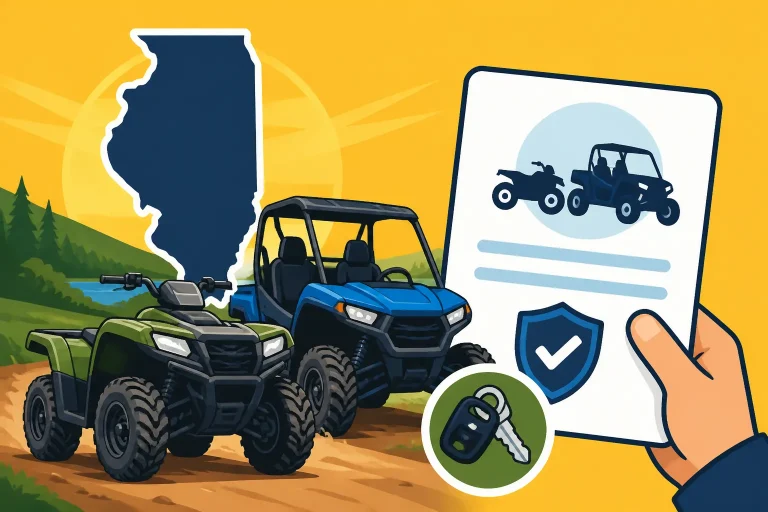
The most common mistake is assuming that a safety certificate answers every access question. It does not. A certificate may show that someone completed a course, but it does not automatically provide permission to ride on a particular property, authorize street use, satisfy a permit requirement, or prove that a machine meets site specifications.
Use this check before leaving home:
- Ask the site directly: Is a safety course required for this rider, and which providers or certificates are accepted?
- Clarify who needs training: Does the requirement apply to every operator, only minors, or a particular type of machine?
- Check timing and proof: Must the certificate be completed before arrival, and should the rider bring a printed or digital copy?
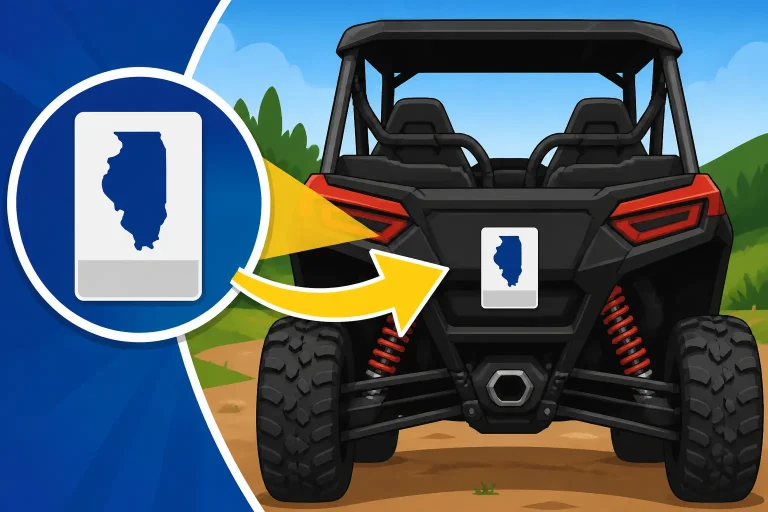
- Review separate access rules: Confirm the required permit, decal, waiver, machine sticker, or check-in steps for that destination.
- Keep street use separate: If any part of the route involves a public road, verify local authorization and the relevant operator, equipment, and insurance requirements.
Illinois access paperwork can be easy to confuse because different stickers serve different purposes. A course certificate is not an OHV permit, and an access decal is not proof of training. For help telling the paperwork apart, see Illinois OHV Permits: Two Stickers Explained and What the Stamp Covers and What the Decal Covers. If you are riding with children, Illinois Rules for Young Riders can help you identify additional questions to settle before a trip.
If no course is required, training can still be a sound choice. It can give a beginner a structured introduction, help a parent teach safer habits, and reduce the chance that a rider learns essential controls in the middle of a busy trail. If a course is required, verify the provider and certificate requirements before enrolling. In either case, pair training with the owner’s manual, responsible supervision, proper protective gear, and a site-specific rules check.
Disclaimer
This article is for general informational purposes only and does not constitute professional advice. Laws, prices and regulations vary by location and change over time. Consult a qualified professional for guidance on your specific situation.