Taking an Illinois Machine to Ride in Another State
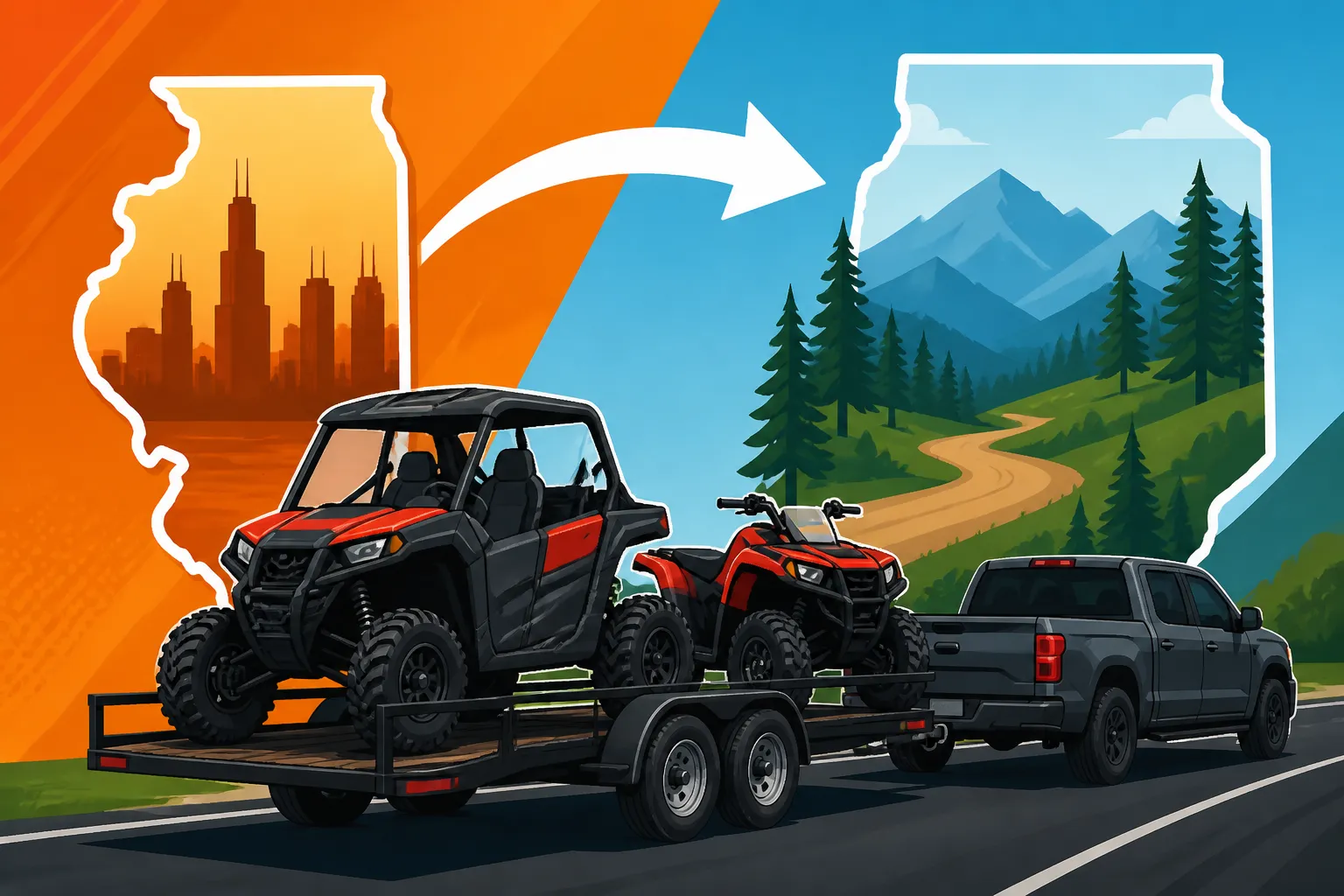
Taking an Illinois ATV or UTV to another state can involve more than loading it onto a trailer. The Illinois title, usage stamp, and access decal do not automatically give you permission to ride elsewhere. Before you travel, check the destination state’s rules, the specific riding area’s requirements, and any separate rules for road use.
Why Illinois permits may not carry over
A permit or sticker generally applies within the system that issued it. Illinois’s usage stamp and access decal address Illinois requirements; they are not nationwide riding permits. An Illinois title can help document ownership, but it does not by itself authorize riding on another state’s trails or public land. For a clearer explanation of the Illinois stickers, see Illinois Usage Stamp vs Access Decal and Illinois OHV Permits: Two Stickers Explained.
The key question is whether the destination recognizes an Illinois credential as equivalent to its own requirement. That recognition, sometimes called reciprocity, is not something to assume. A destination may treat an Illinois machine as properly documented for one purpose but still require a local trail pass, vehicle registration, visitor permit, or other credential for another.
Requirements can differ based on:
- The machine: An ATV, dirt bike, and side-by-side may fall into different categories.
- The rider: A state may have separate requirements for residents, visitors, adults, and young operators.
- The land: State-managed trails, federal land, county areas, and private parks can each set different rules.
- The activity: Riding on a designated trail is not the same as operating on a public road.
- The credential: A title, registration, trail permit, and proof of ownership serve different purposes.
For example, a state may allow a visitor to ride with a valid home-state registration in one location, while a particular park still requires a daily pass. Another location may require its own sticker even if the machine is titled in Illinois. A private riding park may have entry rules that do not depend on state reciprocity at all.
Keep the distinction between ownership paperwork and permission to ride in mind. A title or bill of sale can help show that the machine belongs to you. It does not establish that the machine is allowed on a particular trail, and it does not replace a permit or registration required by the destination. Illinois title documents are explained in Illinois ATV Title Certificates Explained, while Illinois Proof of Ownership on the Trail covers the separate question of what paperwork to carry.
A useful way to think about it is:
| Document or requirement | What it may help establish | What it does not automatically establish |
|---|---|---|
| Illinois title | Ownership record for the machine | Permission to ride outside Illinois |
| Illinois usage stamp or access decal | Compliance with applicable Illinois requirements | Acceptance by another state or riding area |
| Destination-state registration or permit | Compliance with the issuing state’s or site’s rules | Permission to use every trail or road |
| Bill of sale or other ownership record | Evidence of a purchase or transfer | Registration, insurance, or trail access |
| Road-use documents and equipment | Compliance with applicable street rules | Access to off-road trails |
The destination’s official requirements matter more than the sticker already on the machine. If you are crossing a state line for a specific park or trail system, check that site’s rules as well as the broader state requirements. A state agency’s general page may not cover a county trail, private park, or locally managed riding area.
Check the state, land manager, and riding area
Do not stop after searching for “ATV laws” in the destination state. First identify exactly where you plan to ride. The state’s general rules may not answer whether the specific trail accepts an Illinois credential, requires a visitor permit, or limits certain machine types.
Use this order:
- Name the exact riding area. Find the official site or land manager for the trail, park, forest, or riding area. If you are visiting a private park, use that park’s own rules.
- Check the machine category. Confirm that the rules cover your type of machine, such as an ATV or side-by-side, and note any size or equipment restrictions.
- Look for visitor or nonresident rules. Search for wording about out-of-state machines, reciprocity, temporary permits, nonresident permits, or proof of registration.
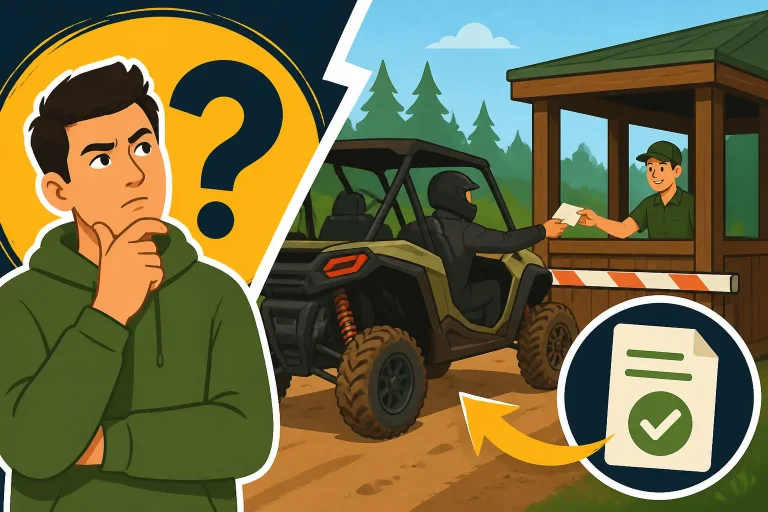
- Check the access rules. Verify whether the site has a day pass, annual permit, reservation, registration sticker, waiver, or check-in requirement.
- Confirm what documents to carry. Ask whether staff may require a title, registration, bill of sale, identification, or proof of insurance.
- Check how requirements are enforced. Find out whether permits must be bought before arrival, displayed on the machine, or shown at a gate.
- Verify the information before departure. If the written instructions do not answer your situation, contact the agency or park office directly.
When the rules are unclear, ask a specific question rather than asking only whether the area “accepts Illinois permits.” For example: “My machine is titled in Illinois and I plan to ride as a visitor. Do I need your state registration or a trail permit, and what ownership paperwork should I bring?” Give the staff the machine type and the location you plan to use. Requirements may differ between two sites run by different agencies in the same state.
Keep a record of the answer. Save the relevant official page, email, or permit confirmation on your phone, and consider carrying a printed copy if the riding area has limited cell service. A saved screenshot can be useful at the gate, but it does not replace a required sticker, permit, or document.
Be careful with forum posts and old trip reports. They can help you identify questions to ask, but they may describe a different machine, a different land manager, or rules that have since changed. Use the current official information for the state or riding area. If the trip includes multiple parks, verify each one separately instead of assuming the first permit covers the rest.
A simple comparison can keep the requirements straight:
| Question | State or agency to check |
|---|---|
| Does an Illinois credential count as registration? | Destination state motor-vehicle or natural-resources agency |
| Is a separate trail sticker or pass required? | Specific trail system or land manager |
| Can this machine use the trail? | Riding area’s vehicle eligibility rules |
| What ownership proof is accepted? | State agency or site staff |
| Can the machine be used on nearby streets? | State and local road authorities |
| Is a waiver or reservation required? | Specific park or riding area |
This is especially important if you plan to ride on public land. Not all public land is open to motorized use, and a permit does not make a closed area legal to ride. Check that the exact route is designated for your machine. Illinois riders familiar with state-specific access rules can use Illinois Rules for an Out-of-State Machine as a reminder that rules can depend on both the vehicle and where it is used, but the destination’s own rules control once you cross the border.
Keep trail riding, street use, and transport separate
A machine that is allowed on a trail is not automatically legal on a public road. Likewise, a machine that can be driven on certain roads under local rules may still need a separate trail permit to enter an off-road riding area. Treat these as different questions, and check each before you travel.
Trail or off-road riding
For a planned off-road ride, check whether the specific route is open to your type of machine and whether the site requires its own permit. Some places may also set operating conditions, equipment rules, age requirements, or check-in procedures. A credential that covers access to one area may not cover another, even if both are in the same state.
Make sure you understand where the permit must be displayed and whether every machine needs its own. If you are taking more than one vehicle, do not assume one permit or one registration covers the whole group. Ask whether passengers or riders need separate passes, too.
Riding on public roads
Street use is a separate issue involving state law and, in some cases, local ordinances. The destination may restrict which roads an ATV or UTV can use, require specific equipment, or prohibit street operation altogether. A machine’s Illinois title, Illinois decals, and trail pass do not prove it meets another state’s road-use rules.
If a route to the trailhead includes public roads, do not assume a short connection is allowed. Check the rules for the road authority involved and determine whether the machine is permitted on that road, what equipment is required, and whether the rider needs a particular license or insurance. If the route crosses a town or county boundary, local rules may change along the way.
Towing and hauling
Transporting the machine on a trailer is different from riding it on the road. Before leaving, check that the trailer, tow vehicle, and load are ready for the trip. Secure the machine at suitable tie-down points, confirm that the load cannot shift, and make sure the trailer lights and connections work.
Keep the machine’s paperwork accessible without leaving it loose in the trailer. If your route crosses a border or you are using a rental or borrowed machine, confirm that you have the owner’s permission and any documents needed to explain why you are transporting it. Illinois Title and Proof of Address and Illinois Title Paperwork Checklist may help Illinois owners organize their home-state records, but check the destination’s requirements for what it will accept.
If you plan to ride somewhere that requires a permit in advance, buy or reserve it before you tow. Some riding areas limit daily entry or require a waiver, and arriving without the required confirmation can leave you unable to ride. Bring the confirmation in a form you can access without a reliable signal.
Prepare your paperwork and verify before departure
A short paperwork check before loading can prevent a long drive from ending at a gate. Start with the destination’s list, then gather documents that establish ownership, identify the machine, and satisfy any permit or access requirements. Do not assume that carrying every Illinois document will substitute for a destination permit; carry the items the destination specifically requires.
A practical pre-trip checklist:
- Ownership: Bring the title or another ownership document if the destination asks for it. If the machine was recently bought and the title is not yet available, ask what alternative proof is accepted. A bill of sale may help explain the purchase, but do not assume it replaces a required title or registration.
- Machine identification: Make sure the vehicle identification or serial number is legible and matches the paperwork. Take a photo of the number and documents for your records, but keep any originals required by the destination available.
- Permit or registration: Obtain the destination’s required permit before travel if advance purchase is available or required. Confirm whether it must be attached to the machine or simply shown at check-in.
- Rider information: Check whether riders need identification, a license, a safety credential, a signed waiver, or adult supervision.
- Insurance: Confirm whether insurance is required for the planned activity or road use. Requirements can differ, so ask the destination rather than relying on your Illinois use case.
- Site-specific rules: Review hours, reservations, machine restrictions, noise or equipment standards, and any rules about passengers or groups.
- Contact information: Save the office number and the official rules page. If the site closes or changes access conditions, you may need to verify before setting out.
If you are borrowing a machine, get clear permission from its owner and ask whether the destination requires the owner’s paperwork or a written authorization. If you are renting, ask the rental provider which permits are included and which you must buy yourself. Do not assume an Illinois stamp or decal travels with a rented machine as a substitute for a destination credential.
Keep documents together in a secure folder or waterproof pouch. A basic pouch from a local store or Amazon can help protect paper copies from rain and mud, but avoid putting irreplaceable originals somewhere they could be lost on the trail. Store digital copies separately from the phone you use for navigation, and make sure you can access them offline.
Before leaving, run through one final sequence:
- Confirm the exact riding area and its current access status.
- Verify the destination’s rules for Illinois visitors and your machine type.
- Buy or reserve any required permit, pass, or entry time.
- Check separate road-use requirements if your plan includes public streets.
- Match the machine’s identification number to its ownership paperwork.
- Pack required documents, permit confirmations, and contact details.
- Recheck the official information shortly before departure.
If a rule remains ambiguous, ask the agency or site manager for a direct answer and keep a written record. This is more reliable than relying on an Illinois sticker, an old forum post, or a general assumption about reciprocity. The safest plan is to treat Illinois documents as proof of Illinois status and confirm separately what the destination requires.
Disclaimer
This article is for general informational purposes only and does not constitute professional advice. Laws, prices and regulations vary by location and change over time. Consult a qualified professional for guidance on your specific situation.