Keeping a Landowner’s Written Permission on You
Written permission is a simple way to reduce confusion when you ride an ATV or UTV on someone else’s Illinois property. It can help clarify who may ride, where they may go, and how long access lasts. It is not a substitute for following the law or the property owner’s conditions, but a clear record can prevent avoidable disputes.
Why carry written permission on private land
A landowner’s verbal invitation may feel straightforward, but details can get muddled. One person may understand “the back field” to include a lane or wooded area that the owner meant to keep off limits. A neighbor or caretaker may see unfamiliar machines and reasonably question whether the riders have permission. A written note gives everyone a practical way to check what was agreed.
Illinois riders should treat permission as specific to the property and the activity. Being allowed to walk, hunt, or retrieve an animal does not automatically mean you may ride a quad or side-by-side. Likewise, permission to ride one section of a farm does not necessarily extend to adjoining fields, a neighboring parcel, or a road. For more on the distinction, see Illinois Private Land Permission Rules and Illinois Farm Land Riding Permission.
Written permission can help establish that the owner authorized access, but it does not grant unlimited rights. The landowner can set conditions, restrict areas, limit the dates, or withdraw permission. It also does not make a machine legal to operate on a public road or open a riding area that is closed to motorized use.
| What written permission can clarify | Why it matters |
|---|---|
| The property covered | Helps distinguish the approved parcel from neighboring land |
| Who may ride | Avoids assuming that permission for one person covers a group |
| Which machines are allowed | Clarifies whether permission covers an ATV, UTV, or both |
| Where and when riding is allowed | Helps prevent accidental use of restricted areas or dates |
| Conditions for access | Records limits on speed, passengers, routes, or gates |
| Who to contact | Gives riders a way to check if plans or conditions change |
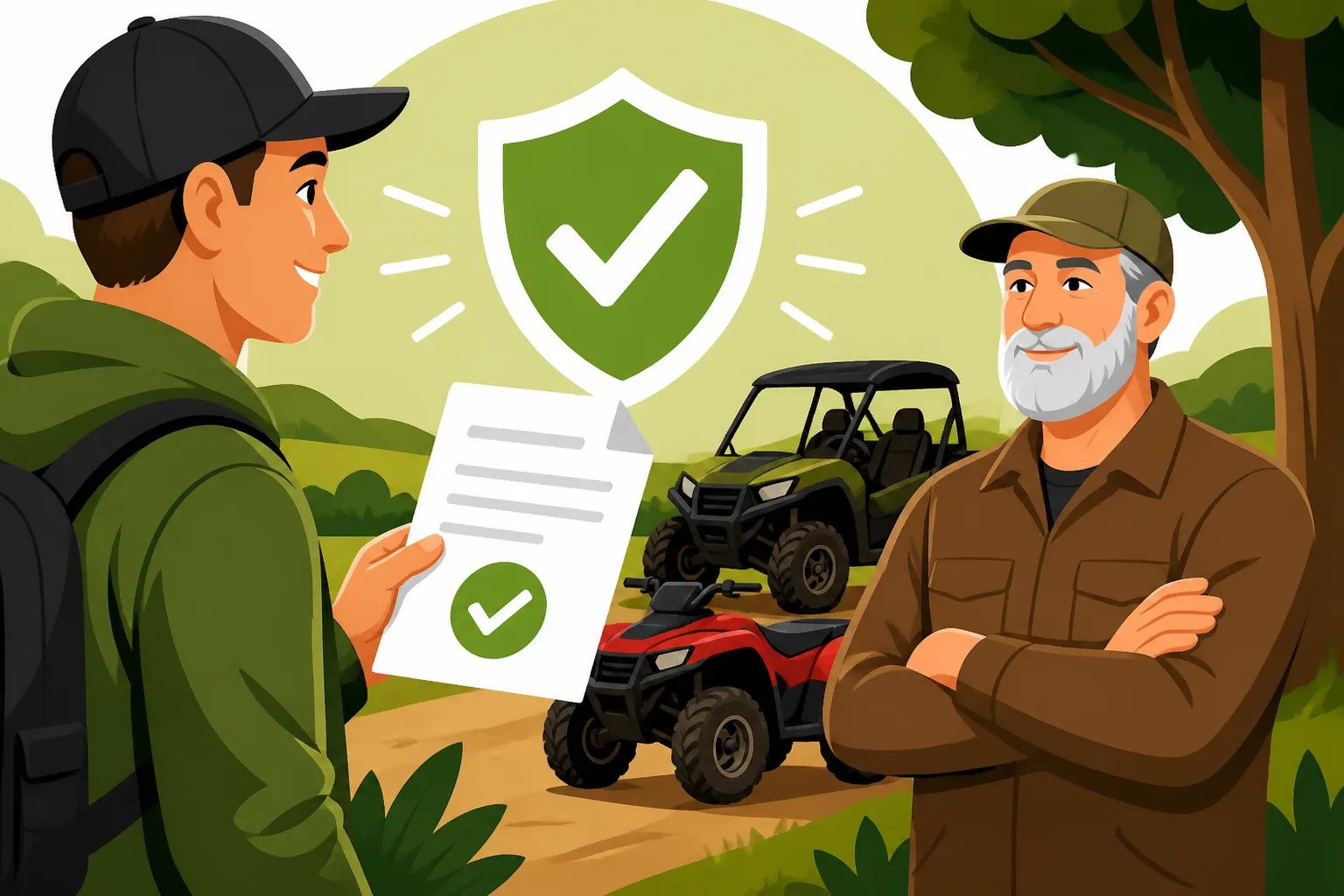
Keep the permission with you while riding, rather than leaving it in a truck parked at another entrance. If someone asks why you are on the property, you can explain calmly and show the record. A document may not resolve every disagreement, but it can make it easier to confirm the owner’s instructions.
Permission is especially useful when a property is large, has multiple entrances, or is used by more than one family or business. It is also helpful when riders are guests who do not know the landowner personally. Do not assume that a familiar path, an open gate, or the absence of a “No Trespassing” sign means riding is authorized. If you are unsure, ask before entering. Illinois’s general rules are covered in Illinois Trespass Law for Riders.
What to put in a permission note
A useful permission note does not need legal language. Its job is to record the agreement clearly enough that the owner and rider understand the same boundaries. A vague note saying “OK to ride” may not answer the questions that matter if the land is shared or access is limited.
Ask the person granting permission to identify the property and the permitted activity. If the property has several fields, trails, or access points, a simple map or clear description can help. Avoid relying on a property boundary guess based only on a fence, tree line, or worn track.
A practical note should include:
- The landowner or authorized representative’s name and contact information. Confirm that the person giving permission has authority to do so. A tenant, caretaker, or employee may not have permission to authorize recreational riding.
- The property description. Use an address, parcel description, farm name, or a clear written description of the approved area. Attach a map if boundaries are difficult to explain.
- The rider names. List each person who is allowed to ride, or clearly state whether the permission covers a defined group. Do not assume that one rider can bring additional guests.
- The machines covered. State whether the permission applies to ATVs, UTVs, or particular machines. If the owner has set size or equipment limits, include them.
- The dates or time period. Specify the intended riding day or season, and ask what happens if weather delays the visit. Open-ended permission can be misunderstood.
- The approved routes and restricted areas. Note where riders may travel, along with any buildings, livestock areas, crops, wetlands, gates, or other places to avoid.
- Conditions for riding. Include instructions about speed, passengers, noise, helmets, alcohol, firearms, pets, parking, or gates if the owner has set them.
- The owner’s acknowledgment. A signature or a clear written message from the person authorizing access helps document the arrangement. Keep the original message or a copy.
The note should describe permission, not try to transfer responsibility or promise that the owner will accept every possible risk. Do not add terms the owner has not agreed to. If either party wants a formal liability release or contract, that is a separate matter and may merit legal advice.
For a template or more detail about what to record, see Illinois Landowner Permission Forms. Treat any form as a starting point, not proof that the person signing it controls every part of the land. If the property is leased or managed by a business, ask who can authorize recreational vehicle access.
A written message can be useful when a formal paper note is impractical. Keep the full exchange, including the date, the sender’s contact details, and any map or instructions. A cropped screenshot that shows only “Sure, go ahead” may omit the property, date, and conditions that make the permission understandable. If the owner changes the plan by phone, follow up with a message confirming the new instructions.
How to carry and use the permission
Keep a copy somewhere accessible while riding. A paper copy in a sealed document pouch is a dependable option when phones lose signal or batteries run low. A clear photograph or saved message on a phone can provide a backup. If you buy a waterproof document pouch from a retailer such as Amazon, check that it closes securely and can be reached without unpacking the machine.
Before leaving, confirm that the copy is legible and includes all relevant pages, maps, and conditions. If several riders are traveling separately, each should have the permission or a copy of it. One rider carrying the only copy may not help if the group splits up or arrives through different entrances.
When asked about access, remain polite and answer directly. Show the permission if appropriate, explain the approved area, and contact the landowner if there is uncertainty. Do not use the document as a reason to argue with a neighbor or official. If someone identifies a boundary or access problem, stop and resolve it before continuing.
A useful routine is to review the permission at the trailhead:
- Confirm that the date is still valid and the owner has not changed the arrangement.
- Match the property description to the location where you are parked.
- Review any no-go zones and route limits with everyone in the group.
- Make sure each rider understands the conditions, including passenger and gate rules.
- Save the owner’s number so you can check a change rather than guessing.
Written permission should not be treated as a permit for public land. A landowner’s approval covers only the access they are authorized to grant. It does not replace any requirements that apply to a designated riding site, nor does it give permission to use a public trail or cross someone else’s property. Similarly, an Illinois usage stamp or access decal does not itself grant permission to enter private property. See Illinois OHV Usage Stamp Explained and Illinois Public Land Not Designated for ATVs for the difference between riding credentials and permission to access land.
If an officer, conservation officer, or other person asks about your presence, the details will depend on the setting and the reason for the contact. Carrying permission can help explain the arrangement, but it does not mean every other document or rule is satisfied. What a Conservation Officer Can Ask to See offers more context on documents and questions that may come up.
Important limits and common mistakes
A permission note is only as reliable as the agreement behind it. If the signer lacks authority, the property description is unclear, or the note has expired, carrying it may not resolve the issue. Before riding, confirm that the person authorizing access controls the relevant land and that no lease, business policy, or other restriction prevents the use.
Do not assume that permission to ride privately includes permission to travel along a public road, across a neighbor’s parcel, or through a public area. Each place has its own rules. A private route may end at a public road, but that does not make the road part of the private property or automatically authorize street riding. Check the route and applicable local rules before using any public roadway.
Other frequent mistakes include:
- Bringing extra riders without asking. Permission for the named rider may not cover guests, passengers, or a whole group.
- Treating an old note as permanent approval. The owner may have changed the conditions or withdrawn access.
- Riding outside the described area. A permission note does not make a nearby parcel part of the approved property.
- Ignoring a gate, sign, or direct instruction. Stop and clarify rather than assuming the written note overrides a newer restriction.
- Assuming permission covers damage or unsafe conduct. Follow the owner’s rules and ride responsibly; the note is not a guarantee against liability.
- Using permission from one owner for land controlled by another. Confirm parcel boundaries, especially where farms or wooded properties meet.
Permission can also change while you are on the property. If the owner asks the group to leave or stop using a route, comply and arrange any follow-up afterward. A copy of an earlier note is not a license to disregard a clear change in instructions.
If you damage a fence, crop, gate, or other property, tell the owner promptly and discuss what happened. Do not conceal damage or leave a gate in a different position from the way you found it. Following the owner’s directions is part of being a welcome guest, even when the note does not spell out every detail.
For concerns about trespass, remember that a written note is evidence of an arrangement, not automatic immunity from a complaint or citation. Its value depends on whether the permission was genuine, current, and applicable to the place and activity involved. If a dispute arises, stop riding and seek appropriate legal guidance rather than trying to settle a contested boundary on the trail. Related information is available in Illinois Trespass Penalties for Riders.
A few minutes spent confirming the property, riders, dates, and boundaries can prevent a confusing situation later. Carry the permission, keep a backup, and treat the landowner’s conditions as part of the ride plan. When anything is unclear, ask before unloading.
Disclaimer
This article is for general informational purposes only and does not constitute professional advice. Laws, prices and regulations vary by location and change over time. Consult a qualified professional for guidance on your specific situation.