Illinois Townships and Their Authority
It's incredibly frustrating, isn't it? One minute you're legally cruising your UTV down a county road, and the next you're worried about venturing onto a township road, completely unsure if you're breaking a rule you didn't even know existed. Illinois has this patchwork of regulations for ATVs and UTVs on public roads, and understanding the role of townships in that equation can feel like deciphering an ancient scroll. This guide will shine a light on the specific authority Illinois townships hold over their roads when it comes to off-highway vehicles, helping you navigate these often-confusing local rules with confidence.
The Foundation: Illinois's Stance on Off-Road Vehicles on Public Roads
When you first bring home that shiny new side-by-side or a rugged ATV, the dream is often to explore beyond your property line. But in Illinois, hitting public roads isn't as simple as turning the key. There's a fundamental state-level rule that sets the stage for everything else.
The Baseline: A General Ban on Street Use
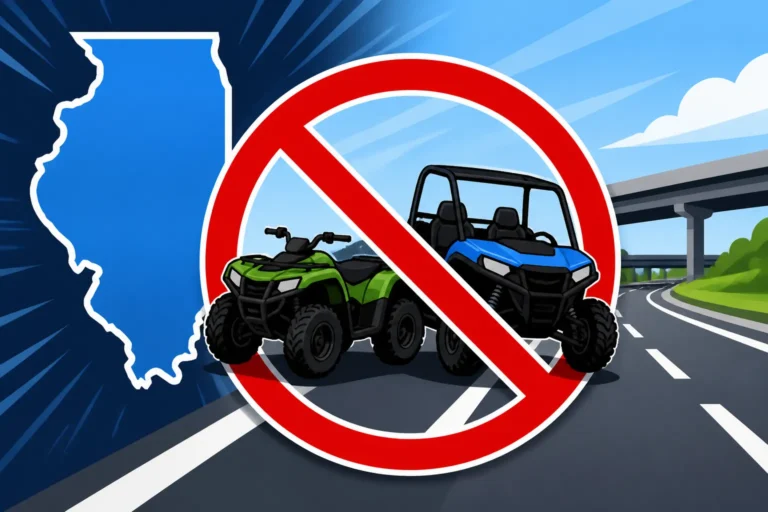
Let's be blunt: the default position in Illinois is that ATVs and UTVs are not permitted on public roads. This isn't just some suggestion; it's the law. These machines are designed for off-road environments – tearing through trails, working on farms, or navigating private land. They simply weren't built with the same safety features and operating characteristics as traditional street-legal vehicles like cars or motorcycles. This means that if you pull out of your driveway and onto any public road without explicit permission, you're likely in violation.
This statewide ban serves a crucial purpose: safety. Think about the differences: no turn signals on many ATVs, limited rearview visibility, different braking characteristics, and often, much less protection for occupants in a collision. The state prioritizes the safety of all road users by generally keeping these powerful, specialized machines off the paved or graveled public thoroughfares where cars and trucks travel. It's why [Illinois Law Starts by Banning Street Riding], establishing the initial prohibition before any exceptions are carved out. This is why you can't just hop on your quad and run to the corner store, no matter how short the distance might be.
The Power of Local Decision-Making
However, the story doesn't end with a blanket ban. Illinois law wisely understands that different communities have different needs and rural landscapes. That's where local governments come in. The state has enacted legislation that grants specific authority to counties, townships, and municipalities to opt-in and create their own ordinances or resolutions allowing ATVs and UTVs on certain public roads within their jurisdiction. This local control is why you'll hear friends in one town talk about legally riding their UTVs to the gas station, while folks just ten miles down the road are scratching their heads because their village bans it completely.
This delegation of authority is a double-edged sword for riders. On one hand, it opens up possibilities for legal street use where it makes sense for the community. On the other hand, it creates a highly localized, often confusing, patchwork of rules. A county might pass a resolution allowing UTVs on its roads, but a township within that county might choose not to, or vice-versa. Suddenly, a simple ride requires you to know not just the county rules, but the specific township rules, and possibly any city ordinances if you plan to enter a populated area. This is the very essence of why you need to understand specific local laws, a point often brought up when discussing [The Illinois Law Behind Every Local UTV Ordinance].
Deciphering Township Authority and Road Networks
To ride legally in Illinois, you really have to become a local regulations expert. Knowing your specific jurisdiction is paramount, and townships often present a unique layer of complexity.
What Exactly is a Township Road?
In Illinois, townships are often smaller units of local government, particularly prevalent in rural and agricultural areas. They are distinct from counties or incorporated municipalities (cities and villages). Their primary responsibilities often include local road maintenance, property assessment, and general assistance. A "township road" is exactly what it sounds like: a road that falls under the jurisdiction and maintenance of a specific township. These roads are typically low-traffic, often gravel or unimproved, and primarily serve local residents, farmers, and property owners.
Imagine a network of winding gravel lanes connecting farms, rural homes, and small parcels of land. These are often township roads. They might not have streetlights, painted lines, or even a formal name beyond a route number or local designation. They differ significantly from a busy county highway (which might be paved and carry more traffic) or a state route (like an Illinois Route 13 or 34, which is maintained by the Illinois Department of Transportation). Understanding this distinction is crucial because the rules that apply to a county highway won't automatically apply to a township road, and vice-versa. This is why a county-level UTV resolution doesn't automatically mean every township within that county is open for business.
The Role of the Township Board and Road Commissioner
So, who decides if you can ride your ATV or UTV on these township roads? It's primarily the Township Board, often in close consultation with the Township Road Commissioner. The Road Commissioner is an elected official whose main job is to oversee the maintenance, repair, and construction of township roads. They're the ones who know every pothole, every culvert, and every curve on those local routes. When the topic of allowing off-road vehicles on township roads comes up, their input is incredibly valuable, if not critical.
The Road Commissioner's perspective often centers on practicalities: "Can these roads safely handle the added traffic? What about dust control on gravel roads? How will this impact our maintenance budget if the roads see more wear and tear?" They'll consider safety for other vehicles, potential conflicts with farm machinery, and the overall impact on the community. It's why [Why the Township Road Commissioner Has a Say] is such a critical piece of the puzzle. Their recommendations can heavily influence whether the Township Board ultimately votes to adopt an ordinance, what conditions they might impose (like speed limits or seasonal restrictions), and which specific roads are deemed appropriate for OHV use. This means you might find a township road that seems perfect for riding, but if the Road Commissioner has concerns about its safety or integrity, the board might decide against opening it up.
The Path to Legal UTV/ATV Access on Township Roads
Getting an Illinois township to allow ATVs and UTVs on its roads isn't as simple as posting a question on a community Facebook page. It involves a formal, often public, process that requires careful consideration and adherence to legal procedures.
From Public Interest to Formal Ordinance
For a township to legally permit ATVs or UTVs on its roads, the Township Board must pass a formal ordinance. This isn't a casual agreement or an informal decision; it's a legally binding document that defines the specific terms and conditions for such use. The process typically begins with residents expressing interest or concern. This might be through petitions, phone calls to board members, or speaking at public meetings. If enough interest is garnered, the Township Board might begin discussions.
These discussions are rarely quick. They often involve assessing the pros and cons, considering input from the Road Commissioner, and evaluating the potential impact on public safety, road maintenance, and community peace. Before any vote, townships are usually required to hold public hearings. This is a crucial step where residents, both in favor and opposed, can voice their opinions, concerns, and suggestions. These hearings provide valuable feedback that can shape the final ordinance. Finally, after all input is considered and the ordinance is drafted, the Township Board will hold a formal vote. It's a structured process, not unlike [How a Village Board Votes to Allow UTVs], even though the specific governing body and road types differ. Remember, if the board doesn't pass a formal ordinance, then the statewide ban remains in effect for those township roads.
Key Elements of a Valid Township Ordinance
When a township does decide to open its roads, their ordinance isn't just a simple "yes" or "no." It's a detailed document that lays out the rules of engagement. For an ordinance to be effective and legal, it generally must specify several key elements. First, it will explicitly list which township roads are open to ATV and UTV traffic. This might be all roads, or only specific ones deemed safe and appropriate. It's rarely a blanket permission for every stretch of gravel.
Second, the ordinance will typically outline operational requirements. This includes things like speed limits (often lower than for cars), hours of operation (sometimes restricted to daylight hours), and age restrictions for drivers. Most importantly, it will detail the necessary equipment. This is where state-level minimums, like those found in the [Illinois Non-Highway Vehicle Equipment List], often come into play, but townships can add their own requirements. For example, while state law mandates headlights and taillights, a township might specify that a horn, specific mirrors, or even a bright safety flag are required. Riders often look to aftermarket suppliers like SuperATV for these types of upgrades, ensuring their machines meet both state and any specific local township requirements for street-legal operation. These additions, such as a sturdy set of mirrors or a reliable turn signal kit, can be the difference between a legal ride and a frustrating ticket.
Navigating and Complying on Township Roads
Once a township has an ordinance in place, the responsibility shifts to you, the rider, to understand and adhere to its specifics. Riding legally on township roads requires more than just knowing an ordinance exists; it demands active compliance and awareness.
Knowing Your Permitted Routes
This is perhaps the single most critical piece of information you need: which specific roads are you allowed to ride on? Never assume that just because a township has an ordinance, all of its roads are open to ATVs and UTVs. Many ordinances will explicitly list the permitted roads, often excluding high-traffic areas, roads near schools, or those deemed unsafe for off-highway vehicle travel. The last thing you want is to be halfway down a beautiful, winding gravel road only to realize you're actually violating the local ordinance.
To confirm the permitted routes, your best bet is to contact the township clerk's office directly. They should be able to provide you with a copy of the official ordinance or a map detailing the approved roads. Some progressive townships might even have this information, including downloadable maps or lists, posted on their official websites. This proactive research is vital. It's similar to the advice you'd follow for any jurisdiction, as highlighted in [Illinois Ordinance Lookups Before You Ride]. Don't rely on hearsay or what a friend of a friend said; get the official word before you roll out.
Essential Equipment and Safe Operating Practices
Even on township roads where UTVs are permitted, you're not entirely free to operate as you would on a private trail. Illinois state law mandates certain equipment for any non-highway vehicle operated on public roads, and townships can add to these. Expect to need functional headlights and taillights, brake lights, a rearview mirror, and often a slow-moving vehicle (SMV) emblem mounted prominently on the rear. Some ordinances might even require turn signals, a horn, or specific types of tires or seating arrangements.
Beyond the physical equipment, safe operating practices are non-negotiable. This means adhering strictly to posted speed limits (which may be lower for OHVs than for cars), obeying all traffic signs, and being extra vigilant for other vehicles, pedestrians, and especially farm equipment. Remember, many township roads are active routes for agricultural machinery, which can be slow-moving, wide, and have limited visibility. Installing accessories like enhanced LED lighting or additional mirrors from a company like SuperATV can significantly improve your visibility and awareness, making your ride safer for everyone. But no amount of aftermarket gear can replace careful, responsible driving.
Understanding Enforcement and Penalties
Make no mistake: even on quiet township roads, the rules are enforced. Local sheriff's deputies, state police, and sometimes even township constables can issue citations for non-compliance. These penalties can range from significant fines to having your machine impounded. If you're caught riding on a road not designated for OHV use, or if your machine lacks the required equipment, you're looking at a violation.
The consequences for illegal street riding can be steep. A simple joyride could quickly turn into a costly legal headache, complete with court costs and potential increases in your insurance premiums. It's not worth the risk. Always carry proof of your vehicle's title, any required permits, and proof of insurance (if required by the ordinance) when riding. Ignorance of the law is never an excuse in the eyes of law enforcement, and [Illinois Penalties for Illegal Street Riding] are a real deterrent that you want to avoid at all costs. Checking that all your required lighting is functional, your mirrors are properly adjusted, and your SMV emblem is clean and visible before every ride can save you a lot of trouble.
Overcoming Challenges and Fostering Community Harmony
While the ability to ride ATVs and UTVs on township roads can be a huge convenience and boost to recreation, it's not without its challenges. These often involve balancing the interests of riders with the concerns of other residents and the practicalities of maintaining rural infrastructure.
Addressing Community Concerns and Maintaining Roads
When townships consider allowing OHVs on their roads, they often face a mixed bag of public opinion. For every rider eager for legal access, there might be a resident concerned about increased dust, excessive noise, or perceived safety risks. Imagine living on a quiet gravel road and suddenly having several UTVs roaring past your house at all hours. These concerns are legitimate, and they are frequently brought up during public hearings. [Neighbors Who Complain to a Board] are a very real factor that township boards must weigh.
Road maintenance is another significant challenge. Township roads, especially those that are graveled or unpaved, can degrade quickly under heavy or inappropriate use. ATVs and UTVs, with their knobby tires and sometimes aggressive driving styles, can contribute to washboarding, potholes, and overall road wear. The Township Road Commissioner, as discussed, is keenly aware of these issues. Increasing traffic, even from OHVs, can mean increased costs for grading, gravel replacement, and dust suppression. This is why you might see ordinances include specific speed limits or even seasonal restrictions, aimed at mitigating issues like [Dust on a Gravel Township Road] during dry periods or preventing damage during thaw cycles.
The Intricacies of Intersecting Jurisdictions
One of the most complex aspects of riding on township roads in Illinois is dealing with intersecting jurisdictions. Your ride might be perfectly legal on a particular township road, but what happens when that road crosses a county highway or, even trickier, a state route? The answer is often: "the rules change." Each unit of government (township, county, municipality, state) has its own authority over its roads, and their ordinances and regulations apply only to their roads.
This means you could be on a township road where UTVs are allowed, but to cross a county highway, you might need to comply with specific county-level rules for crossings, or perhaps the county doesn't allow any OHV street use at all. The problem becomes even more pronounced with state highways. Illinois law is clear: [State Highways May Be Crossed Only at an Intersection], and riding on a state highway (like an IL Route) is generally prohibited, even if the surrounding local roads allow OHVs. This often means you can't just drive down the state highway for a mile to get to the next township road. These "junction points" are where riders often get into trouble due to a lack of understanding about which rules apply where. It underscores why [Roads Two Governments Share Need Two Ordinances] if those roads are shared or connect in a way that implies continuous travel. Similarly, understanding [Illinois Crossing Rules at Intersections] is critical, as these rules are typically state-level and apply regardless of the local ordinance you're coming from. Navigating these transitions safely and legally requires constant vigilance and knowledge of local mapping. Many riders consider beefing up their machine's protection, perhaps with heavy-duty skid plates or A-arm guards from SuperATV, knowing that rural township and connecting roads can sometimes be rough and unforgiving, but no product can substitute for knowing the nuanced rules of each jurisdiction.
| Feature / Jurisdiction | Village/Municipality | County | Township |
|---|---|---|---|
| Governing Body | Village Board/City Council | County Board | Township Board / Road Commissioner |
| Typical Road Types | Paved streets, residential roads | County highways, main rural routes | Low-traffic gravel roads, local access |
| Ordinance Process | Formal vote, public hearings | Resolution, public hearings | Formal ordinance, board vote |
| Common Motivations | Resident convenience, tourism | Agricultural access, rural connectivity | Local access, specific community needs |
| Equipment Rules | Must meet state minimums, can add more | Must meet state minimums, can add more | Must meet state minimums, can add more |
| Permits/Fees | Often require annual permits and fees | Less common for permits, more about specific road use | Varies, some may have permit systems |
| Example Roads | Main Street, subdivision streets | Route 1, County Road 500N | Maple Lane, Farm Road 200E |
Disclaimer
This article is for general informational purposes only and does not constitute professional advice. Laws, prices and regulations vary by location and change over time. Consult a qualified professional for guidance on your specific situation.