Safety Certificates at an Illinois Riding Park
A safety certificate can seem like one more document to bring before an Illinois ride, but the rules depend on where you plan to ride and who is operating the machine. Illinois does not have a statewide safety-course requirement that automatically applies at every riding park. Here’s how to check whether a particular site requires training, what to carry, and what a certificate does not replace.
What a safety certificate means at a riding park
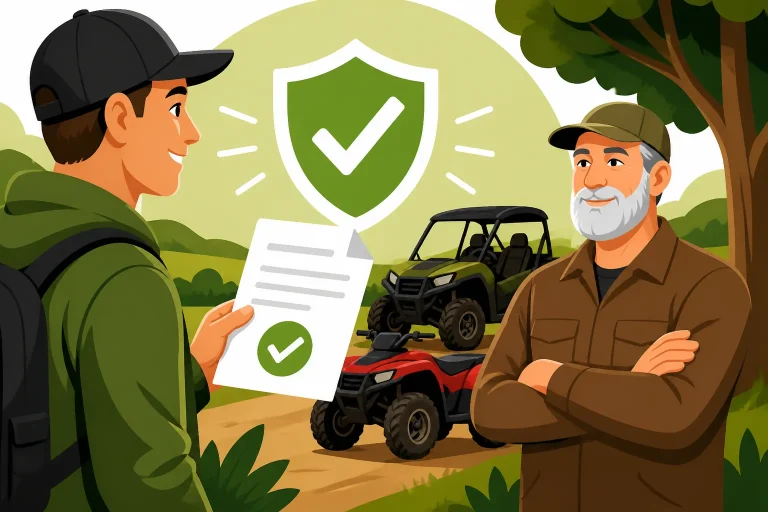
A safety certificate usually means proof that a rider completed a designated safety course. It may be issued after an online or in-person class, and a park might ask to see it before allowing someone to ride. But the phrase does not point to one universal Illinois document that every ATV or UTV rider must have.
That distinction matters because parks can have their own admission and operating rules. One site may ask for training proof for young riders; another may rely on age restrictions, supervision rules, a waiver, or an orientation at the gate. A private park can set its own conditions for entry, while a public or grant-assisted site may have rules tied to its management and access program.
The certificate also is not the same thing as a permit to use a site. A course may teach safe operation, but it does not by itself authorize riding on land where machines are not allowed. It does not replace a required permit, an access decal, a waiver, proof of age, or any other documentation the site asks for.
Illinois has no blanket statewide safety-course requirement for off-highway vehicle riders, but that does not mean a course can never be required. Site policies can be more specific than statewide rules. For a broader look at the state-level distinction, see Illinois Has No Statewide Safety Course. To compare possible training routes, see Illinois Safety Course Options and Illinois Online Safety Courses.
Before relying on a certificate, find out what the park means by the term. It might mean an ATV safety course completion card, a certificate from a particular provider, or documentation of an orientation. If the requirement is unclear, ask the site to confirm which course it accepts and whether it applies to every rider or only certain age groups.
State rules and park rules are different
A common source of confusion is treating “Illinois requires it” and “this park requires it” as interchangeable statements. They are not. A rule that applies at one facility may be a site condition rather than a statewide law. Likewise, a certificate accepted at one park may not satisfy another park’s policy.
The type of riding area can help you identify whom to ask, but it does not remove the need to check current rules. Private operators generally set their own admission requirements. Public and grant-assisted areas can have their own operating rules as well. Start with the official website or office for the exact site, rather than assuming that a rule from a nearby park applies.
For a grant-assisted riding area, remember that access paperwork and training are separate questions. An access decal may be required for eligible sites, but it is not a safety certificate. The reverse is also true: a course certificate does not serve as an access decal. Review Illinois Grant Site Rules for Riders and Illinois Public Access Decal Rules when planning to use a site that requires the decal.
A quick comparison helps keep the paperwork straight:
| Requirement | What it generally addresses | What it does not replace |
|---|---|---|
| Safety certificate | Completion of a course or other training accepted by a site | Riding permission, site permit, access decal, or waiver |
| Site permit or admission | Permission to enter or ride at a particular facility | Training proof if the site separately requires it |
| Access decal | Access conditions for applicable grant-assisted sites | A course certificate or a private park’s admission rules |
| Waiver | Acknowledgment of risks and site conditions | Proof of training or permission to ride elsewhere |
| License or age documentation | Whether an operator meets a site or legal condition | Any separate course or entry requirement |
The table is a guide to the different purposes, not a list of documents required at every Illinois park. The specific combination depends on the site, the machine, and the rider. Some locations may require only a few of these items; others may have additional rules.
Age is another reason not to generalize. State requirements, manufacturer guidance, and a park’s minimum age or supervision policy can all matter, and they are not necessarily the same thing. Check the relevant site policy for each child or teen who will ride or operate a machine. The topics in Illinois Private Park Age Minimums and Illinois Rules for Young Riders can help frame the questions to ask, but the park’s current rules are the ones to confirm for that visit.
How to confirm whether a park requires a certificate
Do this before booking or loading the machines. A quick check can prevent a frustrating surprise at check-in, especially when a rule applies to a particular age group or only to the person operating a vehicle.
- Identify the exact riding area. Use the facility’s full name and location. A park, nearby trail system, campground, and public riding area may have different operators and rules.
- Look for current rider requirements. Check the site’s official rules, registration information, frequently asked questions, or waiver instructions. Do not rely only on an old social post or a third-party listing.
- Search for training and age terms. Look for wording such as safety certificate, course completion, youth operator, minimum age, supervision, or training. A general statement that the site is family-friendly is not a substitute for a specific rule.
- Ask the site if anything is ambiguous. Use the contact method provided by the operator. Ask what certificate is accepted, which riders need it, whether an online course qualifies, and whether the proof must be shown at check-in.
- Confirm how to present proof. Ask whether a printed document, a digital copy, or another form of verification is accepted. Keep the answer with the rest of the trip information.
- Recheck shortly before you leave. Operating policies can change. Confirm the current instructions for the date you intend to ride, particularly if the site uses online reservations or has age-specific conditions.
When you contact the park, make the question specific. “Do you require a safety certificate?” may not be enough if the answer depends on the rider’s age or machine. Try asking:
- Does every operator need a course certificate, or only riders under a certain age?
- Does the rule apply to passengers as well as operators?
- Which courses or providers do you accept?
- Is an online completion certificate acceptable?
- Does the certificate need to be current, or is proof of completion enough?
- Can I show the document on my phone, or should I bring a printed copy?
- Are there separate rules for an ATV and a side-by-side?
- Does the certificate change any supervision or passenger requirements?
If the park says training is not required, that is not a reason to ignore its other safety or admission rules. If it says a certificate is required, do not assume that any course certificate will do. Ask for the exact standard before enrolling in a class.
What to bring and what to do at check-in
If the park requires a certificate, carry proof in the format the operator accepts. A printed copy can be useful if phone service is unreliable or a device battery runs low. If the park accepts digital proof, save the document so you can open it without depending on a strong signal. Keep a backup with the reservation or trip records if that is convenient.
Make sure the certificate clearly identifies the rider and shows the course or completion information requested by the site. If the document has a name that differs from the rider’s current identification, ask the park in advance whether that will create a problem. Do not wait until you are in line at the gate to resolve a mismatch.
A simple check-in folder or phone album can keep separate documents from getting mixed up. For example, organize:
- Reservation confirmation or admission information
- Any course certificate the park requires
- Required waiver information
- Access decal or other site-specific permit details
- Age or operator documents requested by the site
- Contact details for the facility
Not every park will ask for each item. Treat this as a way to keep documents organized, not a universal checklist. For park-specific pre-ride paperwork, see Illinois Waivers Signed Before You Ride and Illinois Permit Questions Riders Ask.
Follow the operator’s directions when you arrive. Staff may need to check a certificate, confirm a waiver, issue a wristband or vehicle sticker, or explain local rules. A course certificate does not exempt a rider from a briefing or site orientation if one is required. It also does not guarantee entry if the machine or rider fails another condition.
Some sites may inspect machines or apply limits to age, equipment, passenger capacity, or vehicle dimensions. Those requirements are separate from course completion. If you are bringing a modified machine, check the site’s machine rules before the trip; Illinois Machines That Must Meet Specs covers why confirming equipment requirements ahead of time can matter.
If you arrive without a required document, the park may refuse entry or may not allow the affected rider to operate. Do not count on being able to complete a course at the gate unless the operator has confirmed that option. If one person in a group is missing proof, ask the site how that affects the rest of the group before making a long drive.
What a certificate does not do
A safety certificate can be useful evidence of training, but it has a limited job. It is not a universal riding pass, and it cannot turn restricted land into an authorized trail. Always verify that the location is open to your type of machine and that you meet the applicable admission and operating rules.
It also does not automatically override a park’s age or supervision policy. A young rider who has completed a safety course may still have to meet the site’s minimum age, ride with an adult, or operate only a machine suitable for that rider under the facility’s rules. A certificate is not a waiver of those conditions.
Nor does training necessarily satisfy every legal requirement that might apply to the ride. Street use, for example, is a separate issue from riding inside a park. A certificate does not make an ATV or UTV street legal, provide required street equipment, or replace local authorization. Keep the trip focused on the type of riding you are actually planning.
Likewise, a course certificate is not proof of ownership, registration, insurance, or permission from a landowner. Different sites and activities may call for different records. If you are riding on private land, get permission from the owner; if you are heading to a designated facility, follow that facility’s rules.
Training still has practical value even when a park does not require proof. A course can help new riders understand controls, safe spacing, terrain, protective gear, and how to avoid common mistakes. It is especially worth considering when a child is beginning to ride or when an adult is new to a machine type. But a course is one part of preparation, not a substitute for appropriate supervision, responsible operation, and a machine that fits the rider.
Before unloading, make sure everyone in the group understands the site’s basic expectations. Agree on where riders can go, how the group will regroup, what to do if someone gets separated, and how to respond to a breakdown or injury. Carry the protective equipment and supplies appropriate to the ride, and do not let a certificate create a false sense that every risk has been covered.
The most useful approach is straightforward: treat training, permits, waivers, and machine rules as separate checks. Confirm each item with the organization responsible for the place where you plan to ride. That avoids both common errors: assuming a certificate is required everywhere and assuming that a certificate from somewhere else will automatically be accepted.
Frequently Asked Questions
Does Illinois require every ATV or UTV rider to have a safety certificate?
Illinois does not have a statewide safety-course requirement that applies to every off-highway rider. A particular riding park may set its own training requirement, so check with the facility.
Will an online course certificate count at an Illinois riding park?
It depends on the park. Ask which courses it accepts and whether an online completion certificate meets its current rule before taking the course.
Do children need a certificate if an adult rides with them?
That depends on the site’s age, operator, and supervision policies. Ask whether the requirement applies to the child, the adult operator, or both, and confirm any separate minimum-age rules.
Does a safety certificate replace a park permit or access decal?
No. Training proof and permission to use a site serve different purposes. Check the applicable permit and access requirements separately.
Disclaimer
This article is for general informational purposes only and does not constitute professional advice. Laws, prices and regulations vary by location and change over time. Consult a qualified professional for guidance on your specific situation.