Illinois Nature Preserve Bans
Illinois nature preserves can look like promising places to ride, especially when a map shows public land or a trail nearby. But an ATV or UTV permit does not make a preserve open to motorized use. Here’s how to understand the restriction, check a site before you unload, and find a legal place to ride instead.
Why Illinois Nature Preserves Are Generally Closed to ATV and UTV Riding
An Illinois nature preserve is protected for its natural features, such as native plants, wildlife habitat, or unusual landscapes. That purpose makes it different from a public riding park: access for walking or nature study does not mean access for motorized recreation.
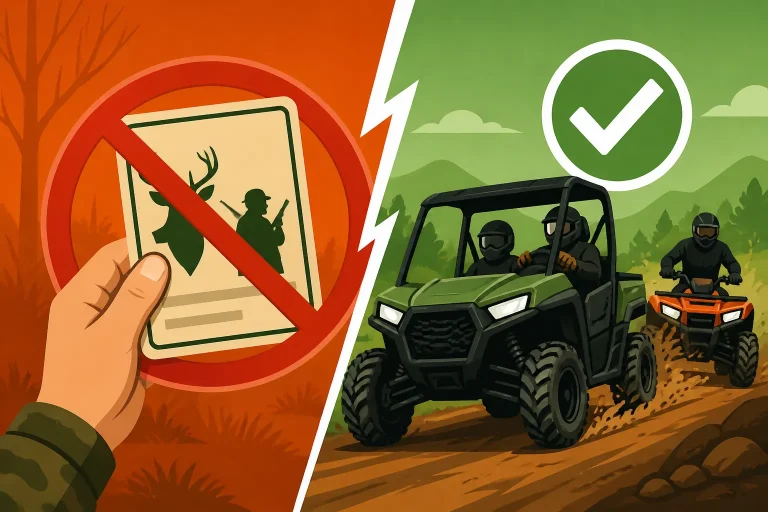
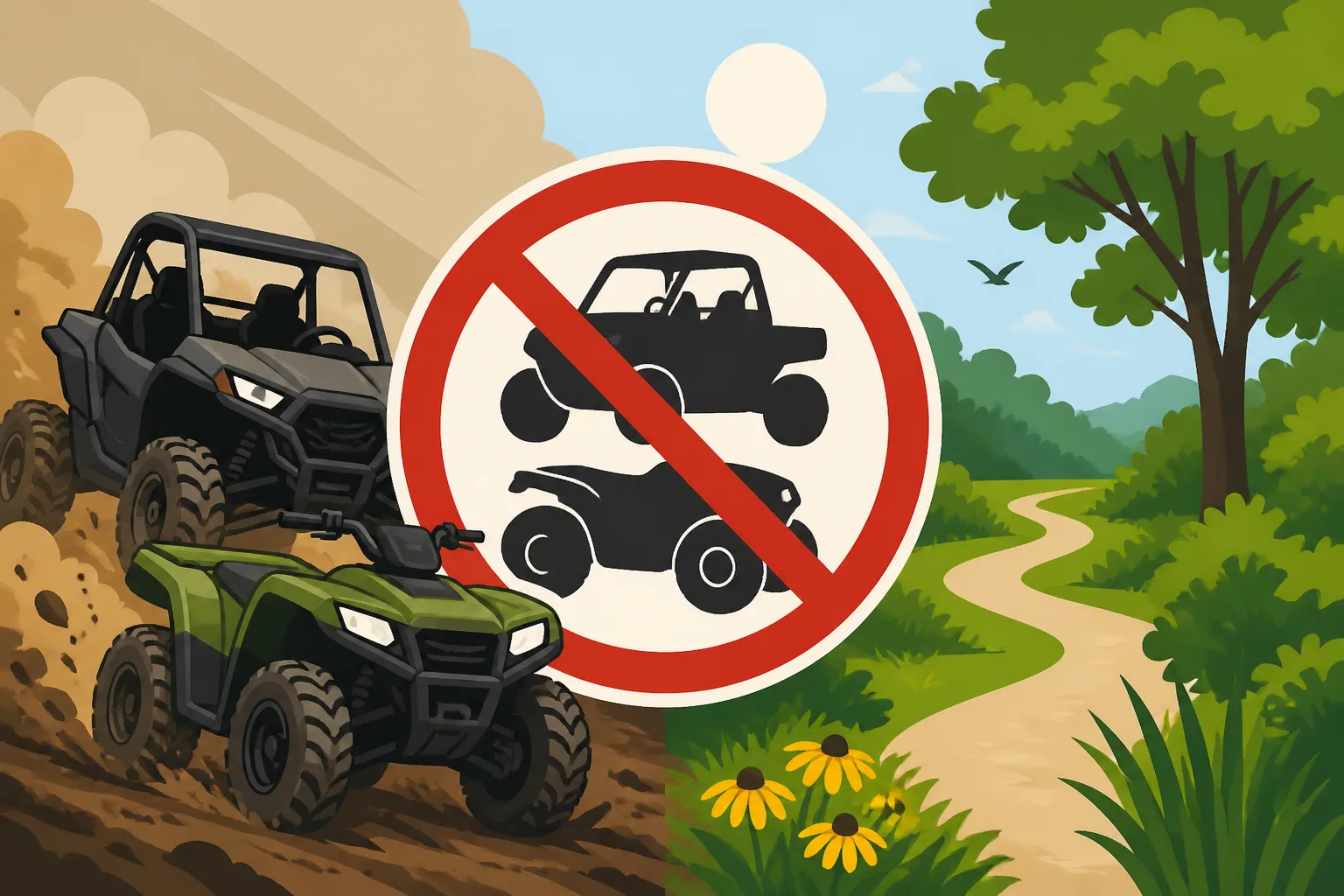
For riders, the practical rule is straightforward: treat a nature preserve as closed to ATVs, UTVs, dirt bikes, and other off-highway machines unless the managing authority clearly identifies a route or activity as permitted. Do not assume that a road, trail, parking area, or open-looking gate is approval to ride.
Preserves may have walking paths, service roads, or routes used by staff. Their presence does not establish public motorized access. A path may be meant for pedestrians, while a service road may be restricted to maintenance or emergency use. Even a route that appears wide enough for a UTV can be off limits.
Nature preserves can also be managed by different entities. A preserve might be associated with a state agency, local government, conservation organization, or private owner. The access rules for a particular property depend on its designation and management. That is why checking the rules for the specific site matters more than relying on a general map symbol or a friend’s recollection.
A useful way to think about it is:
- Public ownership does not automatically mean public ATV access.
- A hiking trail is not a motorized trail unless it is expressly designated for motorized use.
- A nearby riding area does not make adjoining preserve land open to machines.
- A valid stamp, decal, park permit, or out-of-state registration does not override a land-use restriction.
This is part of the broader rule for Illinois public land: riding is limited to areas where motorized use is authorized, not simply to land that appears accessible. For more context, see Illinois Public Land Not Designated for ATVs and Illinois Trails Closed to Machines.
What the Ban Means on the Ground
“Closed to riding” applies to the route and the land, not just to the place where you might park. A rider can still violate a restriction by entering from an adjoining road, using a short connector, or crossing a preserve to reach another destination.
| What you see | What it does not prove | Safer approach |
|---|---|---|
| A public parking lot or roadside pull-off | That motorized vehicles may enter the preserve | Check the property’s posted rules and managing authority |
| A marked hiking trail | That an ATV or UTV may use it | Ride only on routes specifically designated for motorized use |
| A dirt or gravel access road | That it is open to recreational riding | Confirm whether the road is public, restricted, or for management access |
| A riding area beside preserve land | That you may cross the boundary | Stay within the riding area’s marked limits |
| A current Illinois decal or stamp | That every public site is open to you | Confirm that the site allows riding and that your permit applies |
| No sign at the point where you enter | That access is allowed | Look up the property rules before arrival; do not treat missing signs as permission |
The restriction can apply even when the machine is quiet, the ground is dry, or no one else is present. A small detour can still enter protected land. Riding off a marked route may also damage plants, compact soil, disturb wildlife, or create ruts that remain after the machine is gone.
Pay close attention to boundaries. A legal trail may pass near a preserve, a private parcel, or another protected area. Look for the riding area’s official map and stay on the route it identifies. A general online map may show land ownership or a trail line, but it may not show current closures, seasonal limits, or rules about motorized use.
Also distinguish a public road from a trail inside a preserve. A road may have its own travel rules, and the land on either side can remain closed to off-road riding. Being allowed to travel on an authorized road does not automatically allow you to leave it and ride across the surrounding property.
If a preserve has a gate, fence, sign, or marked boundary, follow it. If the entrance is open, that alone is not an invitation to ride. Some areas are open to walkers while vehicles remain restricted; others may have access only for property staff or specific authorized users.
Why Stamps, Decals, and Reciprocity Do Not Open Preserves
Illinois permits and land access answer different questions. A stamp or decal may meet a state requirement for a particular kind of riding or site, but it does not grant permission to enter every public property.
The Illinois OHV usage stamp and public access decal are especially easy to confuse. The stamp and decal have different roles, and an access decal applies to eligible grant-assisted riding sites. Neither is a general pass for nature preserves, trails, or all public land. Read Illinois OHV Permits: Two Stickers Explained and Illinois Public Access Decal Rules for the distinction.
A visitor’s permit or registration from another state does not change the site’s land-use rules either. Reciprocity can affect what documents a rider needs, but it cannot turn a closed preserve into an authorized riding area. Before relying on an out-of-state credential, check both the permit requirement and the destination’s rules.
A practical checklist is:
- Confirm the property name and boundary. Do not rely only on a nearby town, trailhead, or map pin.
- Identify who manages the property. The owner or managing agency is the best source for current access rules.
- Look for explicit motorized-use approval. A general statement that the property is open to the public is not enough.
- Check the route itself. Permission for one road or trail does not necessarily apply to adjoining land.
- Check for temporary restrictions. Closures or special conditions can change access even where a route is normally open.
- Bring the required documents for the site. Keep any permit, decal, confirmation, or registration accessible, but do not treat it as landowner permission.
For sites that receive support through Illinois’s riding-access programs, the site’s status and rules matter. A decal is not a statewide trail license. Read Illinois Grant-Assisted Riding Areas to understand why a site’s program status does not mean every nearby public property is open.
The same principle applies to private riding areas. A park can allow riding under its own rules, but that permission ends at its boundary. If a private trail connects to a preserve, do not assume the connection is lawful just because the park itself is open.
How to Check a Preserve Before You Tow
The simplest way to avoid a wasted trip is to verify access before leaving home. Search by the exact property name, then check the rules published by the land manager. If the information does not clearly say that ATVs or UTVs are allowed, contact the manager rather than interpreting silence as permission.
Find the right authority
Start with the preserve’s official page, posted signs, or the agency or organization responsible for the property. If a local government manages the site, check its current recreation rules. If a nonprofit or private owner is responsible, ask that owner or manager directly.
When contacting the manager, be specific. Ask whether the exact machine type is allowed, which routes are open, and whether access is limited by date, weather, or permit. “Can I ride there?” may not be precise enough if the property has multiple trails or different rules for roads and recreational routes.
Useful questions include:
- Are ATVs, UTVs, or dirt bikes allowed on this property?
- Is there a designated motorized route, and where does it begin and end?
- Are there seasonal closures or temporary restrictions?
- Does a permit apply to this property, or is separate permission required?
- Are there limits on vehicle size, passengers, or operating hours?
- Can riders cross the property to reach another trail or road?
If you call, note the date and the name or role of the person who answered. If the answer is unclear, ask for the official rule or map in writing. This is not a substitute for following posted restrictions, but it helps avoid confusion about a complicated property boundary.
Verify the exact route
A trail map can be useful, but check what the map actually represents. Some maps display hiking routes, public roads, property lines, or informal tracks without indicating that machines may use them. Look for language that specifically identifies a motorized trail or riding area and confirm that the route is currently open.
Do not navigate by tire tracks alone. Someone else’s tracks may be unauthorized, old, or left by maintenance vehicles. Likewise, a route shown on a public mapping app may not be an approved route. If the official map and a third-party map disagree, follow the managing authority’s information and ask for clarification.
When you reach a site, take a moment to confirm that you are at the right entrance. Read signs before unloading. If the trailhead serves hikers as well as riders, check whether motorized access is limited to a separate area. Do not use a walking trail as a shortcut to the vehicle route.
Keep permission separate from the permit
A state credential, a property permit, and landowner permission are not interchangeable. A rider may need more than one, and none should be presumed to cover the others. A preserve can remain closed even when a rider has every required document for a different Illinois riding site.
For a broader overview of legal riding options, see Illinois ATV Trails: Where You Can Actually Ride. If you are considering private land, read Illinois Private Land Permission Rules before entering; landowner consent is essential, and it still does not override restrictions attached to protected property.
What to Do If You Find Yourself Near a Closed Area
If you realize that your route is entering a preserve or another closed property, stop in a safe place and turn around using an authorized route. Do not continue farther in the hope that the trail will reconnect with an open area. If the machine is already on restricted land, leave calmly and avoid creating additional tracks or damage.
If you are unsure whether a line on a map marks a boundary, do not cross it until you can verify. Use the official site map or contact the property manager. If no one is available, choose a clearly authorized route instead. A delay is easier to manage than a citation, property conflict, or damage claim.
If an officer or property representative asks about your route, be respectful and provide the documents you have. Do not argue that a stamp, decal, or another rider’s use created permission. A current permit may show that you complied with a permit requirement, but it does not establish that you were on an open trail. What a Conservation Officer Can Ask to See explains the types of information a rider may be asked to provide.
The consequences of riding in a closed area can depend on the property, the governing rule, and what happened. Possible problems include being directed to leave, a citation, a trespass complaint, or responsibility for damage. Do not assume that a warning is guaranteed or that a first visit will be treated differently. For general information on entering land without permission, see Illinois Trespass Law for Riders.
If you receive a citation, read it carefully and follow the instructions on it. Keep relevant documents, such as a permit confirmation, the map you used, and any communication with the property manager. If you plan to challenge the citation, consider speaking with a qualified legal professional rather than relying on a general online explanation.
The better alternative is to choose an established riding area with current, explicit motorized-use rules. Confirm that the site accepts your machine type, check its operating conditions, and plan your route so you do not cross a preserve to get there. If a riding area is near protected land, stay within its signed boundary, even when a path appears to continue beyond it.
Frequently Asked Questions
Can I ride an ATV through a nature preserve if I have an Illinois decal?
No. A decal does not provide blanket access to Illinois land. Ride only where motorized use is specifically authorized and follow the site’s rules.
Does a public trail inside a preserve mean UTVs are allowed?
Not necessarily. A trail may be intended for walking, maintenance, or another limited use. Confirm that the exact route is designated for motorized riding.
Can I cross a preserve to reach an open riding area?
Do not assume that you can. Permission to use one property does not automatically authorize a crossing through another. Ask the relevant land manager and use a route that is expressly permitted.
What should I do if the rules are unclear?
Contact the property manager before unloading. Ask about the specific vehicle and route, and choose another riding area if you cannot confirm that access is allowed.
Disclaimer
This article is for general informational purposes only and does not constitute professional advice. Laws, prices and regulations vary by location and change over time. Consult a qualified professional for guidance on your specific situation.