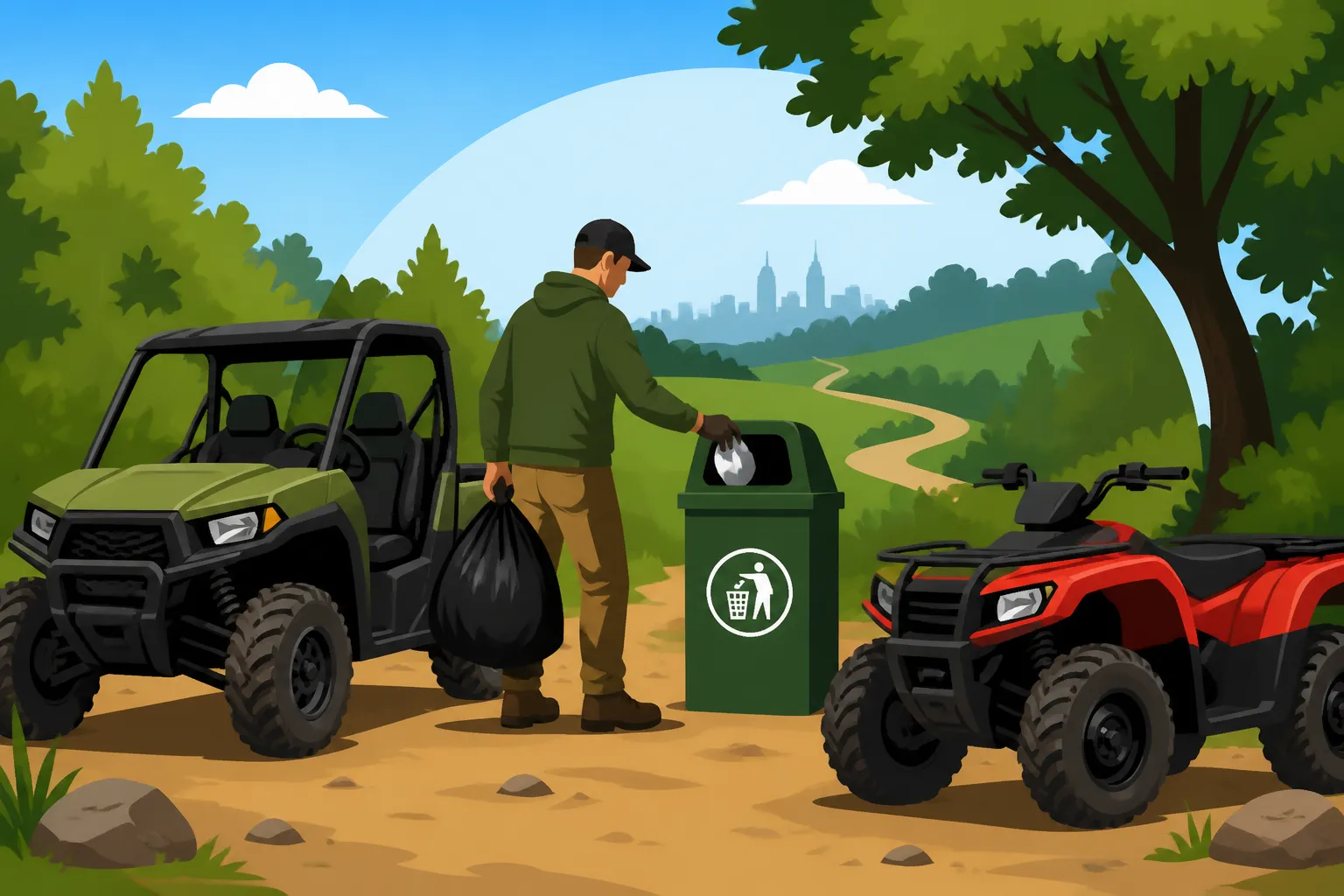
Leaving a Trailhead the Way You Found It
A good ride can leave a trailhead looking worse than you found it: snack wrappers blow under parked trucks, muddy tires track across the lot, and a trailer blocks the access lane while someone straps down. This guide explains how Illinois ATV and UTV riders can pack out waste, park thoughtfully, protect trails and nearby land, and leave a riding area ready for the next group.
Before You Leave the Trailhead
Do a slow, deliberate walk-around
It’s tempting to load up and head home as soon as the ride is over, especially after a long day on dusty or muddy trails. Take a few minutes before you start the truck to check your parking space, the area around your trailer, and any spot where your group stopped to gear up. Look for food packaging, drink containers, zip ties, gloves, broken straps, and small pieces of trash that can be easy to miss in tall grass or gravel.
A useful habit is to assign one person to check the front of the vehicle and trailer, and another to look behind them. If you’re riding with kids, make the final walk-around part of packing up. They can collect lightweight litter while an adult checks for tools, fuel cans, and equipment that might have been set down beside the vehicle.
Check under the trailer and around the tires, too. A dropped washer or a snapped plastic tie may seem trivial, but it can become litter or a hazard. If you find trash that clearly belongs to your group, take it with you even if it has blown a short distance away. Leaving a trailhead tidy is not just about your exact parking rectangle; it’s about not passing avoidable mess on to the next visitor.
Keep trash and ride-day waste contained
Bring a sturdy bag for rubbish and keep it somewhere it can’t blow out of the truck bed or trailer. A lidded container works well for loose wrappers and food waste, particularly on windy days or when the drive home includes open highway speeds. Empty the container at an appropriate disposal point rather than leaving it beside a full bin or in the parking lot.
Don’t assume every Illinois riding area has the same facilities. A county-managed property, a club-run park, and a privately operated riding area can have different arrangements for waste, restrooms, and cleanup. Check the site’s rules before you go, and be ready to pack out what you bring in if disposal options are limited. This is especially useful when planning a longer trip to a southern Illinois riding area where you may be far from a convenient stop after leaving the trail.
If a bin is overflowing, don’t balance a bag on top or leave it on the ground. Wind and animals can scatter the contents. Keep your rubbish secured and take it to a suitable disposal point elsewhere. For more on what riders commonly overlook in shared riding spaces, see Illinois Trail Etiquette Locals Expect.
Protect the Parking Area and Trail
Avoid creating new tracks around the lot
A muddy shoulder, grassy edge, or open-looking patch beside the parking area can seem like an easy place to turn around. But repeated vehicle traffic can tear up vegetation, widen a muddy section, or create a rut that collects water. Use the marked parking and turnaround areas, even if taking the longer route feels inconvenient.
This matters in Illinois because riding conditions can shift quickly from firm ground to slick soil after rain. Clay and soft earth can cling to tires and make a short maneuver surprisingly damaging. If a marked lane is muddy or congested, don’t solve the problem by driving around a barrier or making a fresh path through grass. Pause, follow staff directions, and wait for room to move safely.
The same principle applies when loading. Keep your ATV or UTV on the established surface while you secure it, and avoid running the machine back and forth over the same soft patch. If a vehicle is stuck, stop before repeated throttle attempts dig it in deeper. Ask for help or use an appropriate recovery method that won’t pull down fencing, damage vegetation, or block other visitors.
Don’t wash mud where it can run into the ground or a drain
Cleaning a machine before hauling home can prevent mud from covering your trailer, truck, or public road. But a trailhead is not automatically a wash station. Spraying mud, fuel residue, or cleaning products across a parking area can carry material into a ditch, drain, or nearby soil. Follow the property’s rules and use a designated wash area when one is provided.
If there is no authorized wash area, remove only what you need to make the machine safe to transport, and do so without spraying runoff into the surroundings. A scraper or brush can help knock off heavy clumps before loading. Keep the mess contained, and don’t dump buckets of muddy water beside the lot or in a roadside ditch.
Check whether your destination offers approved cleanup facilities before leaving home. Illinois Riding Areas With Wash Stations can help you think through that planning question. For a site-specific visit, confirm the facility’s current availability and rules directly with the operator; the presence of a wash station at one park doesn’t mean it’s available at another.
| Trailhead situation | Better choice | Avoid |
|---|---|---|
| Parking area is crowded | Wait for a marked space or follow staff directions | Parking in an access lane or on vegetation |
| Ground is soft or muddy | Stay on established surfaces and limit extra movement | Cutting across grass to turn around |
| No trash bin is available | Keep rubbish secured and take it with you | Leaving a bag beside an overflowing bin |
| Machine is coated in mud | Use an authorized wash area, if available | Spraying runoff into a ditch or drain |
| Trail appears wet or damaged | Check posted guidance and ask site staff | Riding around a closure or barrier |
Pack Out, Park Safely, and Respect Other Visitors
Make loading and departure predictable
A trailhead can get hectic when several groups arrive or leave at once. Keep your trailer and tow vehicle within designated spaces, leave access routes clear, and avoid spreading gear across neighboring parking spots. If you need time to load, organize tie-downs and equipment so you can work efficiently without turning the lot into an obstacle course.
Before moving your machine, look for pedestrians, children, pets, and riders backing trailers nearby. Don’t assume someone has seen you just because they’re standing beside a vehicle. Use a spotter when backing into a tight space, and agree on clear hand signals before you start. If the area is busy, a calm pause is usually safer than trying to squeeze through a gap.
Once loaded, check that ramps, tools, fuel containers, and loose equipment are secured. A strap left behind is litter; a strap that comes loose on the road is a hazard. Then take one final look at the space you used. If your group left a small spill of snacks or mud, clean it up before pulling out.
Leave room for the next group
Trailheads serve more than one group, and the next visitors may include a family unloading a youth quad, a club group organizing a ride, or park staff trying to move equipment. Leave enough room for people to pass, keep noise reasonable, and avoid lingering in a way that blocks traffic. A friendly wave and a little patience can make a crowded lot feel much less tense.
Don’t treat a trailhead as an extension of the riding area. Avoid test rides, spinning tires, or revving for fun in the parking lot unless the site specifically allows the activity. If you need to check a machine, ask staff where that can be done safely. The same goes for pets, open containers, and other activities that may be restricted by the property.
Different riding areas have different expectations. A private park may have its own check-out process, while a public or grant-assisted site may post separate access and parking instructions. Read signs before unloading and again before leaving if you’re unsure. For more on shared-space manners at an operator-run site, see Riding Etiquette at a Pay-to-Ride Park.
Plan Ahead for Conditions and Site Rules
Check closures before you travel
A route that was rideable last weekend may be closed after heavy rain, maintenance, or a change in site conditions. Don’t assume that a visible track is open just because it appears on a map or someone has posted a photo of it online. Follow signs and barriers, and ask the land manager or park operator when the situation isn’t clear.
This is particularly important when the ground is saturated. Riding around a closure can damage a trail edge, create a second track, or make repairs harder. It can also put you on land where riding is not allowed. If a section is closed, treat that as a firm boundary and choose an authorized route instead of trying to find a way around it. See Illinois Trail Closures After Rain and Illinois Trail Conditions Before You Tow when you’re planning around weather.
A mapping app such as onX Offroad can be a useful planning aid for reviewing routes and getting oriented, but a map should not override posted signs or the site operator’s instructions. Check the property’s official information before setting out, especially if your group is traveling a long distance. Conditions and access details can change, and your route plan should leave room for a closure or detour.
Carry the information you’ll need at the gate
Save or write down the site address, entry instructions, and any check-in details before you lose reliable phone service. If the riding area provides a printed map or asks riders to carry one, keep it accessible. Carrying a Paper Map to a Grant Site offers a practical reminder that a phone map is not always a complete backup.
You can also use onX Offroad as one part of your trip-planning routine, alongside official park information and any maps supplied by the land manager. Before departure, make sure everyone in your group understands the planned entrance and where trailers can be left. If you’re meeting riders who are arriving separately, agree on a designated meeting point rather than relying on a vague landmark.
On the way out, use the approved exit and follow any instructions about stickers, wristbands, check-out, or gate operation. Don’t leave a gate open for the next vehicle unless the site’s rules explicitly say to do so. If you encounter a damaged sign, a spill, a blocked lane, or a new trail hazard, tell the responsible staff or land manager rather than trying to fix it in a way that could cause further damage.
Leaving a trailhead in good shape is mostly a matter of small, repeatable habits: stay in designated areas, secure what you bring, respect closures, and take a final look before driving away. Those habits help protect Illinois riding areas and make the next group’s arrival safer and more pleasant. For other ways to support local riding opportunities, look for Illinois Trail Volunteer Days and follow each site’s instructions for reporting issues or participating.
Disclaimer
This article is for general informational purposes only and does not constitute professional advice. Laws, prices and regulations vary by location and change over time. Consult a qualified professional for guidance on your specific situation.