Riding Through Reclaimed Mine Ground
A ride across reclaimed mine ground can look deceptively straightforward: a broad ridge, a grassy basin, and a trail disappearing around a hill. But former mining land can hide steep drops, soft edges, drainage cuts, and routes that are closed or private. This guide explains how to choose an authorized Illinois riding area, read the terrain, and prepare for changing conditions.
What reclaimed mine ground is like to ride
Why the landscape can feel different
Reclaimed mine land has been reshaped after mining, so it may not ride like a natural woodland trail. Riders can encounter rolling hills, broad benches, sharp elevation changes, and open areas where wind and weather are more exposed. In southern Illinois, riding areas may include terrain shaped by the region’s mining history, but conditions differ from site to site.
A slope that looks gentle from the bottom may become much steeper near the crest. A flat patch can also conceal a drainage channel or a sudden change in soil firmness. Grass and brush may make the ground look uniform even when the underlying surface is uneven. Keep your speed low when approaching a blind rise, unfamiliar dip, or narrow ridge.
These features can make a ride interesting, but they also leave less room for an impulsive turn. If you cannot see what lies beyond a rise, stop at a safe distance and check the route before continuing. Do not assume that a visible track is an approved trail; it could be an old service road, an unauthorized shortcut, or a route that has since been closed.
Hazards to watch for
Former mining areas can have steep banks, loose material, erosion channels, soft ground, and abrupt edges. Water may collect in low areas, while runoff can wash out sections of trail or expose ruts. Vegetation can hide a ditch or obscure the edge of a slope. Even a familiar route can change after heavy rain, maintenance work, or seasonal vegetation growth.
Give particular attention to:
- Blind crests and sharp drop-offs
- Soft shoulders along raised trails
- Loose gravel or material that shifts under the tires
- Deep ruts and washouts
- Water-filled depressions where depth and bottom firmness are unknown
- Narrow routes where passing another machine could force one rider toward an edge
Do not use a water-filled pit or basin as a shortcut or assume that it is shallow because other riders have crossed it. If an obstacle cannot be assessed safely, turn around rather than testing it. A spotter can help with visibility, but a spotter cannot make unstable ground safe.
Ride only routes the site has opened
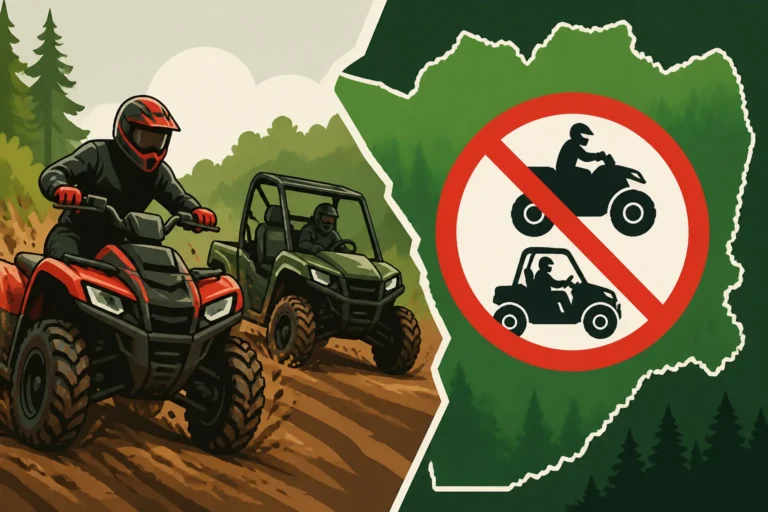
Reclaimed land is not automatically open for riding. A route may cross private property, land managed for another purpose, or an area that is closed for restoration, maintenance, or safety. Stay on the designated routes and follow signs, barriers, and staff directions. Avoid creating new tracks around mud, puddles, or obstacles; those detours can widen damage and take riders into unapproved terrain.
For a broader explanation of how supported riding areas work, see What a Grant-Assisted Riding Site Actually Is and Illinois Grant-Assisted Riding Areas. Illinois also has designated riding locations such as Sahara Woods: Illinois’s Only State OHV Park. Check the rules for the specific place you plan to visit instead of assuming that access requirements carry over from one site to another.
Choosing an authorized Illinois riding area
Confirm permission before loading the trailer
The most frustrating trip is the one where you drive for hours, unload, and then discover the property is closed or your machine is not allowed. Before leaving home, confirm that the riding area is open to your type of machine, that the trails suit your group, and that you have completed any required registration, permit, waiver, or check-in steps.
An Illinois OHV riding opportunity may be a designated public or grant-assisted site, a privately operated park, or another property that has expressly allowed riding. Those categories are not interchangeable. A public parcel is not necessarily open to off-highway vehicles, and a route on a map is not proof of permission. Review Illinois Public Land Not Designated for ATVs and Illinois Private Off-Road Parks to understand why the land’s status matters.
If a site has an official website, phone number, or management office, use it to confirm current operating details before you travel. Ask whether the riding area has any machine-width restrictions, route closures, weather-related limits, or check-in requirements. A short call can save a long, disappointing drive.
Use maps as planning tools, not permission slips
A GPS track can help you understand where you are, but it does not establish that you have permission to ride there. Map layers may show roads or trails that are not intended for OHVs, and a route recorded by another user may be outdated or outside the authorized riding boundary.
Tools such as onX Offroad can help riders review mapped routes and plan navigation. Use onX Offroad alongside the riding area’s own directions, posted signs, and current site information—not in place of them. Before you leave, save or download the information you will need in case cell service is weak. It is also sensible to carry a paper map, especially when riding in an unfamiliar area; [Carrying a Paper Map to a Grant Site] covers that backup approach.
When using onX Offroad, treat an unfamiliar line as a question to verify, not an invitation to explore. Compare it with the site’s official map and the boundaries shown by the property manager. If the app and the signs disagree, follow the site’s instructions and ask staff for clarification.
Check conditions close to departure
A route that was open and manageable on your last visit may be muddy, rutted, or temporarily closed after rain. This matters on reclaimed land because runoff can concentrate in low spots and cut across trails. Wet ground also makes it easier for tires to break down the surface, deepen ruts, and push riders toward the edge of a track.
Check Illinois Trail Conditions Before You Tow before setting out, and review Illinois Trail Closures After Rain when the forecast has been wet. If the site reports a closure, do not try to work around it. A closed route may be protecting the land, allowing repairs, or avoiding a hazard that is not obvious from the trailhead.
| What to check | Why it matters | What to do |
|---|---|---|
| Site status and hours | Access can change by season, weather, or management decision | Confirm directly with the site before traveling |
| Machine eligibility | Width, type, or other site rules may limit access | Ask whether your ATV or UTV is permitted |
| Route closures | A mapped trail may not be open for riding | Follow signs and the current official map |
| Weather and ground conditions | Rain can create ruts, washouts, and soft edges | Recheck conditions near departure |
| Cell coverage | Navigation and contact options may be limited | Download maps and carry a backup |
| Group experience | Different riders may handle hills and obstacles differently | Choose routes and pace that suit the least experienced rider |
Preparing your machine and your group
Match the ride to your experience
Do not judge difficulty by the trail’s appearance from the parking area. A broad, open route can narrow around a hill or lead to a steep section. A group with new riders should start on the site’s easier marked routes and avoid following faster riders onto terrain they have not assessed.
Talk through basic group expectations before starting: keep enough distance to stop, wait at junctions, and do not leave a rider behind. Choose a meeting point in case the group separates. On blind hills, have one machine approach at a time, and stop where other riders can see you without blocking the trail.
A UTV and an ATV may handle the same ground differently. A wider machine can have less room on a narrow trail, while a shorter ATV may be more affected by ruts or abrupt changes in grade. Check site restrictions and do not assume that a route suitable for one vehicle will be suitable for every machine in your group.
Do a practical pre-ride check
Before unloading, inspect the tires, brakes, throttle, steering, lights, and visible suspension components. Confirm that your fuel level is adequate for the planned outing and that you have water, basic first aid, and a way to contact someone if the group is delayed. Secure loose equipment so it cannot shift during a climb or become caught in brush.
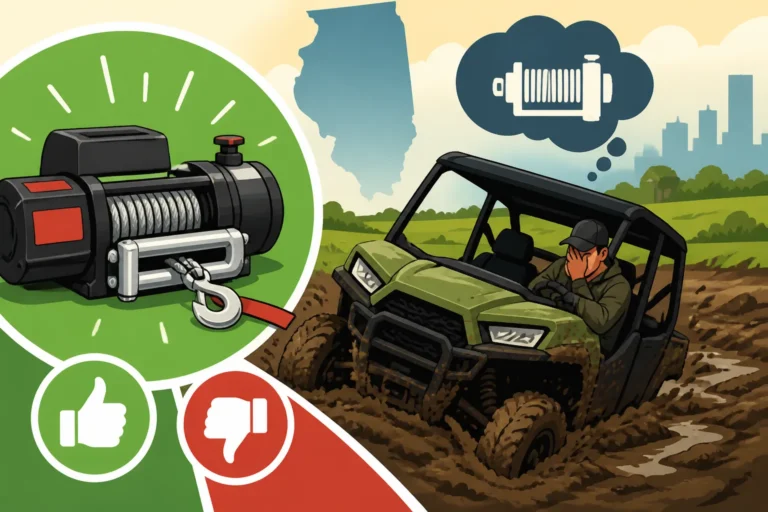
For an unfamiliar reclaimed-land route, carry a tool kit and recovery equipment suited to your machine and your ability to use it. A winch, strap, or traction aid can help in some situations, but recovery gear is not a reason to attempt unstable slopes or unknown water crossings. If a machine becomes stuck near a steep edge, avoid attaching recovery equipment to a point that could fail or pull the vehicle toward the hazard. Ask site staff for help when the situation is beyond your experience.
Tell someone who is not riding where you plan to go and when you expect to return. If the site’s map has numbered junctions or named areas, note them before you start. A clear location description is more useful in an emergency than “we’re somewhere past the big hill.”
Respect other riders and the land
Dust, noise, and limited visibility can affect everyone on the trail. Slow down near trail intersections, staging areas, and places where riders may be stopped. Give others room to pass only where the route is wide and stable. Never ride around a barrier or cut across vegetation to get past a muddy patch.
Reclaimed ground can be vulnerable to erosion, especially where water already follows a trail. Spinning tires can deepen ruts and send loose material downhill. If a route is too soft to cross without damaging it, turn back and report the condition to site staff. Following Illinois Trail Etiquette Locals Expect is not just good manners; it helps protect access and reduces the chance that a trail will need repair or closure.
Making a safer day of the ride
Plan the route around daylight and fatigue
Set a turnaround time before the group gets tired. It is easy to underestimate how long a route will take when riders stop for photos, wait at difficult sections, or reroute around closures. Reclaimed mine terrain can also make distance feel misleading: a short line on a map may include steep climbs, uneven surfaces, and slow navigation.
Start with an easier loop or a route recommended by site staff, then reassess before adding distance. If a rider is uncomfortable, the group should adjust the plan rather than pressure that person to continue. Fatigue can make it harder to judge slopes, braking distance, and changing ground conditions.
Keep track of where you are using trail signs, official maps, and your navigation device. onX Offroad may support route awareness, but a downloaded map and a clear group plan are valuable backups. When the site provides numbered markers or designated routes, use those references when checking in with staff or explaining your location.
Know when to stop or turn around
Turn back if you encounter a closed route, a damaged trail, an unmarked drop, or ground that you cannot assess. Also stop if the weather changes enough to make visibility or traction unsafe. A group ride is not a test of nerve; there is no shame in choosing a different route or ending early.
If someone is injured or a machine is disabled, move the group to a safe place away from traffic and unstable edges. Contact site staff or emergency services as appropriate, and share the clearest location details you have. Do not send riders off in different directions to search unless the group has a safe, agreed plan.
Riding reclaimed mine ground in Illinois can be rewarding when the site is authorized, the route is open, and the group respects the terrain. Confirm access before you tow, stay on designated trails, and treat unfamiliar slopes and water as hazards until proven otherwise. Those habits help make the day safer for riders and help keep the riding area usable for the next visit.
Disclaimer
This article is for general informational purposes only and does not constitute professional advice. Laws, prices and regulations vary by location and change over time. Consult a qualified professional for guidance on your specific situation.