Choosing a Winch Before You Sink in Clay
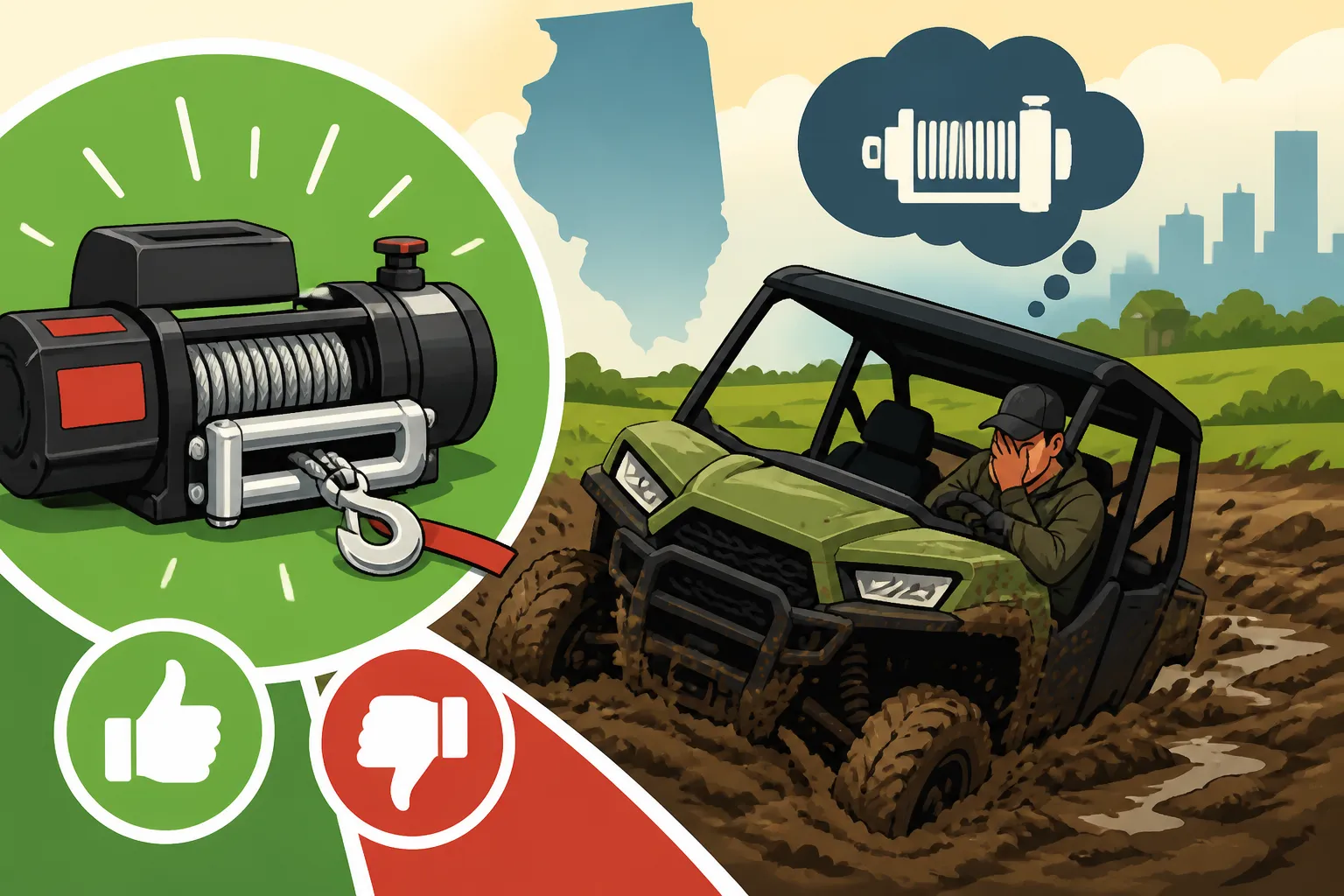
A quad or side-by-side can look unstoppable until Southern Illinois clay packs around the tires and the machine settles into a rut. Choosing a winch before that happens means matching capacity, line, mounting hardware, and recovery gear to your loaded machine and likely riding conditions. This guide walks through those choices, plus safer ways to plan a recovery before you need one.
Start with the machine and the kind of mud you ride
Calculate capacity using your loaded machine
Winch capacity should be based on the weight you may actually need to recover, not just the dry weight in a brochure. Add the machine’s weight, occupants, fuel, accessories, cargo, and anything else you commonly carry. A two-seat UTV headed to a trail with passengers and gear is a different recovery job from a lightly equipped ATV ridden solo.
A common starting point is to choose a winch with a rated pulling capacity at least 1.5 times the machine’s loaded weight. Treat that as a baseline, not a guarantee that every stuck situation will be easy. Mud can create strong suction around tires and the chassis, and a machine buried to its frame may demand considerably more effort than one with a tire slipping at the edge of a shallow rut.
Think through a realistic scenario before buying. If you ride with a passenger, carry a cooler, and have added a plow mount or cargo box, include those items in your estimate. Then check the machine manufacturer’s guidance and the winch maker’s capacity information. If the figures are close, choosing more capacity can give you a more useful margin—but your machine’s mounting structure and electrical system must be suited to the winch, too.
Consider where and how the machine gets stuck
Clay, standing water, steep banks, and narrow trails create different recovery challenges. A machine that loses traction on a mild slope may be recoverable with a straight pull to a nearby anchor. A UTV sunk deep in sticky clay may need a longer, more careful pull, a different anchor point, or help from another rider. More winch capacity does not make every recovery safe or appropriate.
Trail conditions matter as much as machine specifications. Heavy rain can soften a route, deepen existing ruts, and make a trail that was manageable on the way in difficult on the way out. Check Illinois Trail Closures After Rain and Illinois Mud and What It Does to a Machine before planning a wet-weather ride. If conditions are poor, turning around early is often the better recovery plan.
Consider the places you ride in Illinois, too. A private park, a club-run area, and a grant-assisted riding site may have different rules or expectations for vehicles and recovery practices. Read posted instructions and ask staff when you are unsure. A winch is useful equipment, but it is not permission to leave a designated route, damage trees, or pull a machine through an area that is closed.
Choose the winch, line, and mount as a system
Compare synthetic rope with steel cable
Synthetic rope is lighter and easier to handle than steel cable, which can make a difference when you are working in mud beside an ATV. It does not develop the same sharp wire strands that can form on damaged steel cable. However, synthetic rope needs care: grit can work into the fibers, and abrasion or heat can damage it. Keep it clean, inspect it often, and follow the manufacturer’s care instructions.
Steel cable is generally more tolerant of some kinds of abrasion and can be a practical choice for riders who prioritize durability over easier handling. It is heavier, can develop broken strands, and may require gloves to handle safely. Either type can be damaged by poor spooling, sharp edges, kinks, or pulling at an angle. The right choice depends on your machine, riding habits, and willingness to inspect and maintain the line.
| Feature | Synthetic rope | Steel cable |
|---|---|---|
| Handling | Lighter and often easier to manage | Heavier and can be harder to handle |
| Common concern | Abrasion, heat, and embedded dirt | Kinks and broken wire strands |
| Care | Clean and inspect for cuts, wear, and contamination | Inspect for frays, kinks, and sharp strands |
| Best fit | Riders who value light weight and easy handling | Riders who prefer cable and can maintain it carefully |
Whichever line you choose, check its rated capacity and compatibility with the winch drum and fairlead. A fairlead guides the line onto the drum; it does not make an unsuitable rope or cable safe. Use the components specified for your winch rather than mixing parts based only on appearance.
Check mounting, power, and controls before you buy
A winch is only as dependable as its mounting setup. Look for a mount designed for your specific ATV or UTV, and confirm that the machine’s frame or mounting points can handle the loads involved. A universal-looking plate that does not fit correctly can shift or stress the machine during a pull. Installation instructions should explain the required hardware, wiring, and clearances.
Electrical compatibility matters as well. Confirm that the winch is suitable for your machine’s battery and charging system, and route wiring away from hot, moving, or sharp-edged parts. Mud and water exposure make tidy connections especially important, but no component should be assumed waterproof simply because it is marketed for off-road use. Check the manufacturer’s stated limits and care instructions.
Think about how you will operate the winch when you are cold, muddy, or wearing gloves. A handlebar control, wired remote, or wireless option may suit different riders, but each should be used according to its instructions. Make sure you can control the winch while staying out of the line’s path and keeping a clear view of the recovery. Ask a qualified installer or your dealer to clarify fitment if your machine has a bumper, plow, lift, or other accessory that may interfere.
Prepare recovery gear and practice safe pulling
Pack the anchor and connection gear
A winch needs a suitable anchor and compatible accessories. A tree-saver strap can spread the load around a tree without wrapping the winch line directly around the trunk. Rated shackles or recovery connectors, a compatible snatch block, and gloves can help complete a recovery kit. Check that every component is rated for the job and is compatible with the winch line and machine.
A snatch block can redirect a pull and, in some setups, reduce the force required at the winch by changing the mechanical advantage. It also adds setup steps and puts additional loads on the anchor and connecting hardware. Use it only as directed by the manufacturers of the winch and accessories. Never improvise with a tow ball, an unrated strap, or hardware whose working limits you cannot identify.
Before riding, inspect your gear for cuts, crushed areas, corrosion, bent parts, or damaged stitching. Store straps and rope so that they are not constantly rubbing against sharp tools or dirty metal. A quick inspection at home is easier than discovering a frayed strap after your machine has settled into the mud.
Use a controlled recovery, not a desperate one
Before operating the winch, assess the route of the pull, the anchor, and the footing under the machine. Clear loose obstacles only when it is safe to do so, and ask passengers or bystanders to stand well away from the line and its path. Keep people out of the space between the machine and the anchor. A loaded line can cause serious injury if equipment fails or a connection releases.
Use a proper tree-saver strap when anchoring to a tree, and never wrap the winch line around a tree and hook it back to itself. Do not attach to a trailer ball or another part that is not designed for recovery loads. Follow the winch maker’s instructions for line placement and operation, and stop if the machine, anchor, or recovery gear begins to move in an unexpected way.
Pull steadily and avoid repeated, extended pulls that can overheat the winch or stress the electrical system. Allow the equipment to rest as its instructions require. Once free, inspect the line and connections again, and clean mud from the winch area when you get home. For maintenance tips after a messy ride, see Washing Clay Out of a Radiator and Frame and Skid Plates for Strip Mine Rock.
Plan the ride so the winch is the backup
Check routes, conditions, and access before towing
A winch cannot fix a poor route choice. Before driving downstate or heading to an unfamiliar trail, check the site’s current access information, posted rules, and any conditions that could affect the ride. Illinois Trail Conditions Before You Tow is a useful starting point for building that habit. At the site, follow signs and staff directions rather than assuming a route shown in an app is open.
Mapping tools such as onX Offroad can help riders review routes and orient themselves before a trip. Use mapping as one planning aid, not as proof that a road or trail is open to your machine. Confirm access with the riding area or land manager, pay attention to closures, and carry a backup way to navigate if your phone loses service or power. onX Offroad can be useful for reviewing the route at home, while local rules and signs determine where you may ride.
A map can also help your group agree on a turnaround point and identify where you may have limited communications. Before setting out, share the plan with everyone riding, note the location of the trailhead, and consider carrying a paper map for places where cell service is unreliable. onX Offroad may support route planning, but it should not replace checking the site’s own instructions or carrying practical backup gear.
Match your riding decisions to the conditions
When clay is slick, a small change in throttle or steering can turn a minor loss of traction into a buried machine. Avoid charging into deep ruts just to see whether you can get through. If a route is already torn up or a machine is repeatedly spinning its tires, stop and reconsider. Spinning can dig the tires deeper, damage the trail, and make a later recovery more difficult.
Good group habits matter. Agree on who will operate the winch, where everyone should stand, and how the group will communicate before a recovery begins. If the pull is beyond your gear, the anchor is questionable, or the machine is positioned in a way that could roll or slide, stop and seek appropriate assistance rather than improvising. Illinois Trail Etiquette Locals Expect offers a helpful reminder that riding responsibly includes leaving routes in good condition for the next group.
A winch is best treated as one part of a broader plan: suitable tires and recovery gear, a route that fits your experience, and the judgment to turn back when conditions change. For a broader look at route choices and terrain, see Illinois Trail Difficulty Ratings. A careful decision before entering deep clay is often safer—and less damaging—than trying to winch your way out after the machine is fully stuck.
Disclaimer
This article is for general informational purposes only and does not constitute professional advice. Laws, prices and regulations vary by location and change over time. Consult a qualified professional for guidance on your specific situation.