Illinois Rules for an Out-of-State Machine
Bringing your ATV or UTV into Illinois for a riding adventure can feel like navigating a maze, especially when you're used to your home state's rules. Many riders assume that what's legal in Iowa, Missouri, or Indiana will automatically fly here, only to discover a tangled web of titles, stamps, decals, and local ordinances that can quickly turn a fun trip into a headache. This guide is here to untangle those knots, helping you understand precisely what Illinois expects from out-of-state machines, whether you're hitting the trails or hoping to cruise a village street.
Understanding Illinois's Approach to Off-Road Machines for Visitors
Illinois has a unique way of managing off-road vehicles (OHVs), which can be a little confusing if you're coming from a state with a different system. Unlike many places that might require a full registration with license plates for off-road use, Illinois operates on a "title-only" basis for ATVs and UTVs. This means that while every machine needs a title to prove ownership, it generally doesn't get a traditional license plate for off-road riding. For out-of-state riders, this distinction is crucial because it affects what permits and documentation you'll need to carry. You'll want to review [Illinois ATV Title Certificates Explained] to understand the local system, but essentially, Illinois cares about your ownership proof, and then separate stickers for riding.
Titles, Registration, and Proof of Ownership: What Illinois Expects
While your out-of-state title or registration is perfectly valid for proving ownership of your ATV or UTV, Illinois won't issue you an Illinois title unless you become a resident. The key is simply to have that proof of ownership with you. A valid title or registration from your home state is what a conservation officer or law enforcement official will expect to see if they stop you. This is true whether you're riding on a designated trail or even just transporting your machine. Think of it as carrying your vehicle registration for your car; it's essential proof that the machine belongs to you and isn't stolen.
What Illinois doesn't require for an out-of-state machine is to register it here in the same way a car or truck is registered. You won't be getting an Illinois license plate for your UTV just for visiting. Instead, the state focuses on specific stickers and decals that grant you access to various riding areas. This system is designed to fund and maintain the trails that you'll be enjoying, rather than for general road-use purposes. Keep your home state's paperwork readily accessible, as you may be asked to present it, just like you would if you were driving your car through another state. You can learn more about why Illinois has this system by checking out [Illinois Titles but Does Not Register ATVs].
The Illinois Usage Stamp for Trail Riding
If you're planning to ride on most designated off-road trails in Illinois, your out-of-state machine will need an Illinois Off-Highway Vehicle (OHV) Usage Stamp. This sticker is essential for almost all public and grant-assisted riding areas. It's Illinois's way of ensuring that everyone who uses the trails contributes to their upkeep and development. The stamp signifies that your machine is authorized for use on these specific trail systems, regardless of where your vehicle is titled.
The good news is that obtaining a usage stamp is relatively straightforward. You can usually purchase them from licensed vendors, often found at bait shops, sporting goods stores, or even online through the Illinois DNR's ExploreMoreIL portal. It's highly recommended to buy your stamp before you head out to the trails, as some remote locations may not have vendors nearby. Remember, even if your machine is fully registered and street-legal in your home state, the Illinois Usage Stamp is still a separate requirement for trail access. Think of it as a trail pass specific to Illinois, covering your machine for a specific period. For more details, explore [Illinois OHV Usage Stamp Explained] and [Whether Each Machine Needs Its Own Usage Stamp].
The Illinois Public Access Decal for Grant Sites
Beyond the general Usage Stamp, Illinois has another important sticker, especially if you plan to visit specific public riding areas that have received grant funding from the state. This is called the Public Access Decal. These grant-assisted sites, like Sahara Woods OHV Park, often have unique requirements because they benefit directly from these funds. The decal helps Illinois track usage and ensure that resources are allocated appropriately.
For an out-of-state machine, you will need to purchase an Illinois Public Access Decal if you intend to ride at one of these specific grant-assisted locations. In many cases, if you have this decal, it actually supersedes the need for the general Usage Stamp at those specific grant sites. Essentially, the decal is a higher tier of permission for those particular parks. It's critical to check the requirements of the specific park you plan to visit, as they might have their own permit systems in addition to state-mandated stickers. Often, these decals are purchased directly from the park or through the Illinois DNR's online portal. Remember, one decal is typically required per machine. You can learn more about this by reading [Illinois Public Access Decal Explained] and [One Decal Per Machine].
Here's a quick summary of the main Illinois stickers for out-of-state riders:
| Sticker Type | Purpose | Who Needs It | Where to Get It | Notes |
|---|---|---|---|---|
| Usage Stamp | General access to most Illinois public/grant-assisted OHV trails | All OHVs, including out-of-state machines | Licensed vendors, IL DNR online | Required unless you have an Access Decal for a specific site. |
| Public Access Decal | Specific access to certain grant-assisted OHV parks (e.g., Sahara Woods) | All OHVs, including out-of-state machines, for these sites | Park office, IL DNR online | Often negates the need for a Usage Stamp at grant-assisted sites. |
Navigating Illinois's Varied Street Legal Landscape
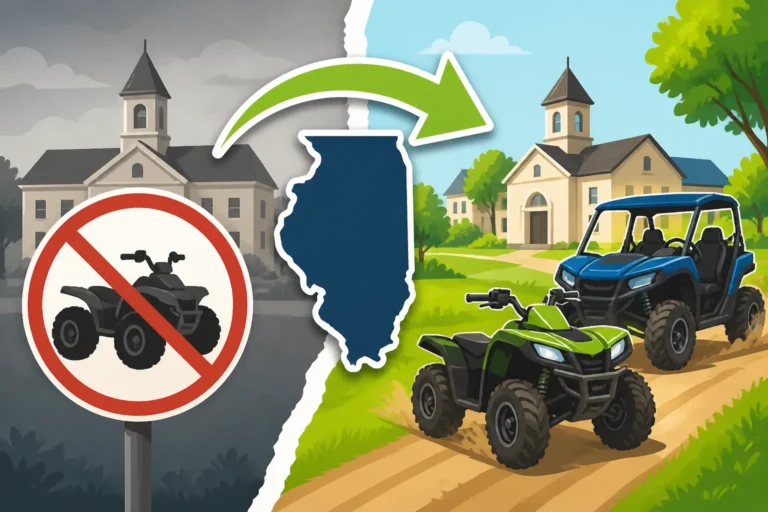
This is where things get particularly interesting and often frustrating for out-of-state riders. Unlike many states that have blanket statewide rules for making ATVs or UTVs street legal, Illinois largely leaves this decision to individual municipalities (villages, cities, townships, and counties). This means that a UTV that's perfectly legal on the streets of one Illinois town might be strictly forbidden in the next one over. For out-of-state visitors, this patchwork of rules requires careful planning and research.
How Local Ordinances Govern Street Use
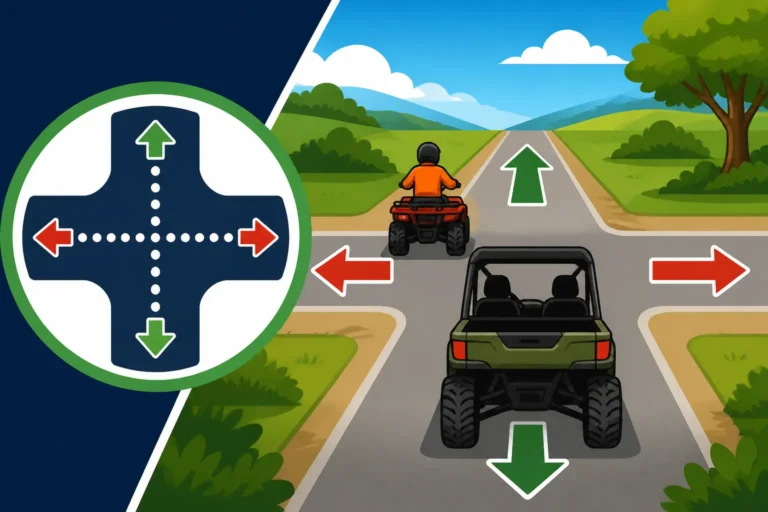
If you're hoping to ride your UTV on the streets of an Illinois town, the very first thing you absolutely must do is check that specific town's local ordinances. There is no statewide law in Illinois that automatically allows UTVs on public roads. Instead, the state law actually prohibits it, but then provides an exception that allows local governments to pass their own ordinances to permit UTV use on their roads, typically those with speed limits of 35 mph or less. This means what flies in Byron, Illinois, might be totally illegal just a few miles down the road in another community. [Illinois UTV Street Legal Rules by Town] delves into this in more detail.
These local ordinances will outline everything: which roads are open, what equipment is required beyond factory standards, whether a permit fee is necessary, and if there are any restrictions on hours of operation. Some towns are quite welcoming, seeing UTVs as a benefit for local commerce or recreation. Others have decided against it, citing safety concerns or traffic volume. It's not enough to assume; you must verify. A quick call to the village hall or a visit to their website before you even load up your machine is highly recommended to avoid potential tickets or confrontations with local law enforcement.
Equipment Requirements for Street-Legal UTVs
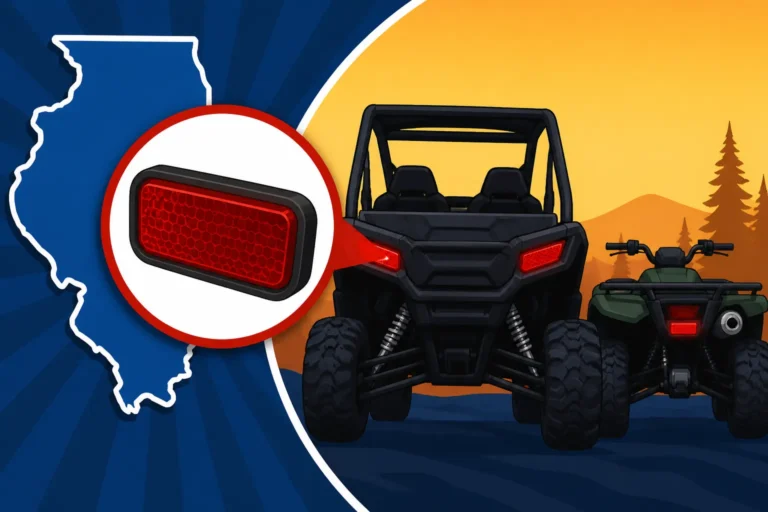
Even if you find a welcoming Illinois municipality, your out-of-state UTV will need to meet specific equipment requirements, which are often outlined in both state statutes and amplified by local ordinances. These requirements are put in place to ensure safety when sharing the road with traditional vehicles. Common equipment mandates include items like rearview mirrors, functioning brake lights, turn signals, and a horn. Many ordinances also require a slow-moving vehicle emblem if the UTV typically travels at lower speeds. These are common-sense safety items for on-road use.
For riders thinking about upgrading their machine to meet these standards, companies like SuperATV offer a wide range of aftermarket parts specifically designed to make UTVs street legal. From turn signal kits to DOT-approved windshields and rearview mirrors, you can find almost everything you need to comply with the rules. However, it's crucial that any modifications you make are indeed compliant with the specific requirements of the Illinois municipality you plan to ride in. Just because a part is marketed as "street legal" doesn't mean it meets every local ordinance's exact wording. Always double-check! You'll want to review the full [Illinois Non-Highway Vehicle Equipment List] to ensure you're squared away.
Insurance and Driver's License for Road Use
If you're operating your out-of-state UTV on Illinois public roads, even those allowed by local ordinance, you absolutely must carry appropriate liability insurance. Illinois state law mandates minimum liability coverage for any motor vehicle operated on public roadways, and UTVs are no exception when granted street access. This isn't just a suggestion; it's a legal requirement designed to protect all parties in the event of an accident. While your out-of-state insurance policy might cover your UTV for off-road use, verify with your insurer that it extends to on-road use in Illinois, especially when subject to local ordinances. [Illinois Requires Insurance for Street Use] for more information.
In addition to insurance, the operator of the UTV on public roads must possess a valid driver's license. This means your driver's license from your home state is perfectly acceptable, as long as it's current and in good standing. Illinois doesn't require a special endorsement or a separate Illinois driver's license for visitors. However, if you're a younger rider or don't have a standard driver's license, you likely won't be able to operate a UTV on public roads, even in towns that permit them. It's about responsible operation and ensuring that anyone behind the wheel has demonstrated basic driving competency. Familiarize yourself with [Illinois Requires a Driver's License] for further clarity.
What to Carry and What to Expect on the Trail or Road
Being prepared is key to a hassle-free experience when riding your out-of-state machine in Illinois. Knowing what documents to have on hand, understanding common pitfalls, and knowing where you can and cannot ride will save you a lot of stress and potential fines.
Essential Documents for Out-of-State Riders
When you're out riding in Illinois, whether on a designated trail or a permitted village street, it's vital to have your paperwork ready. For your out-of-state machine, this includes:
- Proof of Ownership: Your valid title or registration from your home state. Keep a copy in a waterproof bag on your machine and a digital copy on your phone.
- Illinois Usage Stamp/Public Access Decal: Ensure these are properly affixed to your machine in the designated locations (often on the forward half or front and center).
- Driver's License: Your valid driver's license from your home state, if operating on public roads.
- Proof of Insurance: If operating on public roads, have proof of your liability insurance that covers your UTV for on-road use.
A conservation officer or local law enforcement may ask to see any or all of these documents. Being organized and able to produce them quickly will make any interaction smoother. Thinking ahead and having these readily available in a secure, waterproof spot on your machine, perhaps a utility box or a zippered compartment, is always a good idea. To be fully prepared for interactions, check out [What a Conservation Officer Can Ask to See].
Common Misconceptions and Penalties
One of the biggest misconceptions for out-of-state riders is that their home state's "street legal" status automatically carries over to Illinois. As we've discussed, this is almost never the case due to Illinois's reliance on local ordinances. Another common mistake is assuming that an Illinois Usage Stamp allows you to ride anywhere. Remember, the stamp is primarily for designated OHV trails, and it does not grant you permission to ride on public roads or private land without explicit permission.
Penalties for non-compliance can range from warnings to significant fines, and in some cases, even impoundment of your machine. Riding on a street without a valid local permit and proper equipment can result in a ticket, similar to a traffic violation. Riding on a trail without the proper stamp or decal can also lead to fines. Ignorance of the law is generally not considered a valid defense. So, taking the time to understand these rules, including [Illinois Penalties for Illegal Street Riding], beforehand is always worth it. Don't let a misunderstanding ruin your trip; take a moment to ensure your SuperATV accessories meet local regulations and you have all your papers in order.
Where to Ride and Where Not to Ride
Illinois offers a variety of riding opportunities, but it's crucial to understand where you can and cannot take your machine. For trail riding, your primary options are the state's designated OHV parks and grant-assisted sites, such as Sahara Woods State OHV Park or private parks like The Cliffs Insane Terrain Off-Road Park. These areas are specifically designed and managed for off-road vehicle use, and they are where your Illinois Usage Stamp or Public Access Decal will be honored. [Illinois ATV Trails: Where You Can Actually Ride] lists many options.
What you absolutely cannot do is ride your out-of-state machine on state highways, interstates, or tollways, or in state parks and nature preserves that are not specifically designated for OHV use. This includes many state forests and wildlife areas where motorized vehicle access is strictly limited to paved roads or service roads. Private land is also off-limits without explicit permission from the landowner; "no trespassing" signs are to be taken seriously. When in doubt, always err on the side of caution. A fun day of riding is always better when it's legal and safe, respecting both the land and other users.
Disclaimer
This article is for general informational purposes only and does not constitute professional advice. Laws, prices and regulations vary by location and change over time. Consult a qualified professional for guidance on your specific situation.