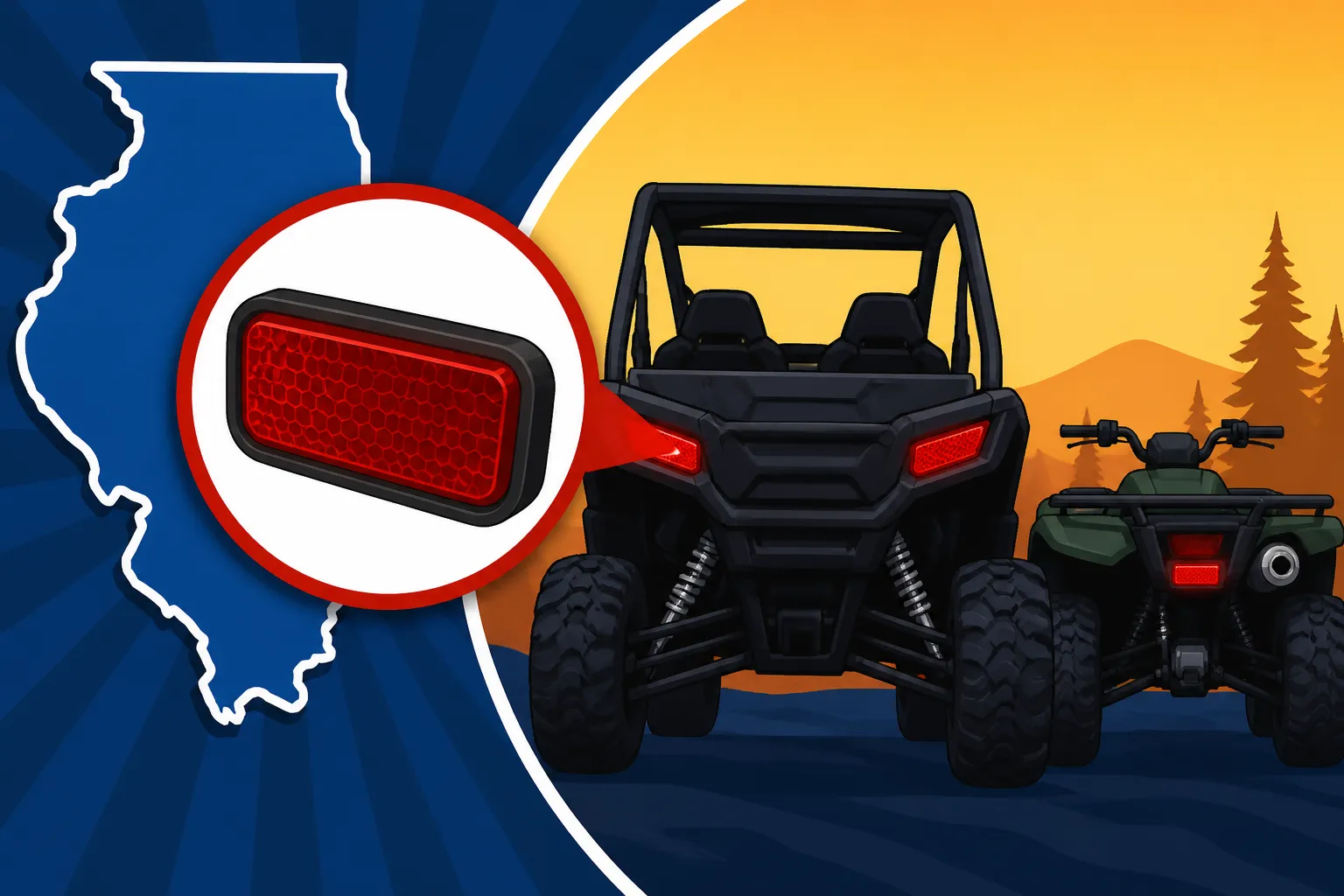
Illinois Requires Red Reflectors
Navigating the roads of Illinois with your ATV or UTV can feel like trying to solve a puzzle with missing pieces. One minute you're enjoying a trail, the next you're wondering what exact equipment you need to legally cross a county road or ride down a permitted village street. Among the myriad of rules, one requirement often sparks confusion: the need for red reflectors. This guide will walk you through exactly why and where your machine needs those critical reflective elements, ensuring you can ride with confidence and compliance.
The Core Requirement: Red Reflectors on Your Machine
When you take your off-highway vehicle (OHV) anywhere beyond private property in Illinois, especially if you're trying to leverage a local ordinance that permits street use, understanding the legal equipment requirements is paramount. The state is serious about visibility, and red reflectors are a foundational part of that. These aren't just suggestions; they're mandated elements designed to protect you and others, especially during low-light conditions or when a driver might not otherwise see your machine. It’s a simple piece of equipment that makes a huge difference in accident prevention, ensuring that even if your lights aren't on or aren't seen, your presence is still signaled to oncoming traffic or vehicles approaching from the rear.
Understanding the "Non-Highway Vehicle" Definition
In Illinois, your ATV or UTV falls under the category of a "Non-Highway Vehicle." This isn't just a label; it's the legal classification that triggers a whole host of specific rules, including those for equipment. The state views these machines as distinct from cars, trucks, or motorcycles, which means they have their own set of safety standards if they're going to interact with public roads. This classification is the bedrock upon which all the equipment requirements, including red reflectors, are built. It's why you can't just slap a license plate on your side-by-side and call it a day; the law wants to make sure that these inherently off-road machines are made as safe as possible for occasional, limited street use. Understanding [What a Non-Highway Vehicle Includes] is the first step toward true compliance.
The legislative intent behind this definition is to acknowledge the unique design and operating characteristics of ATVs and UTVs. They often sit lower, have different lighting configurations, and handle differently than conventional vehicles. Because of these differences, specific measures must be taken to integrate them safely into traffic patterns, even for brief stints. Without clear guidelines, the risk of accidents would skyrocket. The reflector requirement, then, isn't arbitrary; it's a direct response to the need to enhance the visibility profile of these machines, particularly from the rear, where red is universally recognized as a warning color.
The Purpose of Reflectors: Visibility and Safety
Think about it: many of us have had a close call on a rural road, maybe encountering a slow-moving vehicle or even a bicycle without adequate lighting at dusk. It's startling, right? Red reflectors on your ATV or UTV serve precisely to prevent such scares, especially in situations where your machine might blend into the background or be obscured by shadows. They passively enhance visibility by bouncing light back to its source, whether that's a car's headlights or a streetlamp. This is particularly crucial for machines that might not have continuous, bright rear lighting or when a bulb might burn out.
Beyond just being seen, reflectors communicate your presence and direction. When a driver sees a red reflector, their brain instantly registers "rear of a vehicle." This immediate recognition can shave off precious seconds in reaction time, giving them more opportunity to adjust their speed or trajectory. For an OHV that might be traveling at lower speeds than other traffic, or making frequent stops and starts, this passive safety measure is invaluable. It’s about building layers of protection, ensuring that even if one safety system (like your tail lights) isn't optimal, another (like your reflectors) is still working to keep you safe. [Illinois Requires a 100-Foot Tail Lamp], but reflectors add an extra layer of passive visibility.
Where Illinois Law Mandates Reflectors
While the general rule of "red to the rear" is common sense, Illinois law has specific stipulations for where these reflectors must be placed on your machine if you're venturing onto public roads. This isn't just about sticking them anywhere; it's about strategic placement to maximize their effectiveness and ensure compliance with the letter of the law. Ignoring these specifics could still leave you vulnerable to a citation, even if you think you've met the requirement. The devil, as they say, is in the details, and for reflectors, those details often revolve around making sure they're visible from multiple angles and at specific distances.
Reflectors for Street-Legal UTVs in Permitting Towns
This is where the real complexity often begins. Illinois law starts by generally banning OHVs from public roads, but then it carves out exceptions, mainly through local ordinances. Many towns and counties across the state have passed resolutions or ordinances allowing UTVs on certain municipal or county roads. However, these local permissions almost always come with a strict list of required equipment, which mirrors or expands upon the state's baseline for non-highway vehicles. Among these requirements, red reflectors on the rear are consistently present. They ensure that even on a quiet village street, your UTV is clearly discernible to other traffic.
When a town like Byron or Winnebago passes an ordinance, they're essentially saying, "Yes, you can ride here, but only if your machine is equipped to be as safe as possible for shared road use." This includes not just reflectors, but also working headlights, tail lights, brake lights, turn signals, and a rearview mirror. The exact placement and number of reflectors might be specified in the local ordinance itself, so it's always crucial to check the specific rules of any municipality where you plan to ride. Remember, what's legal in one town might not be in the next, so staying informed about [Illinois UTV Street Legal Rules by Town] is vital.
Crossing State Highways and Reflective Needs
Even if a particular street or county road is open to your UTV, you'll inevitably encounter situations where you need to cross a state highway. Illinois law is very clear on these crossings: they must occur at an intersection, and they are typically the only time an OHV is permitted on a state route. While it's a brief interaction, the potential for high-speed traffic means visibility is paramount. Your red reflectors become even more critical here, providing an immediate visual cue to fast-moving vehicles that a slower-moving machine is entering or exiting the roadway.
In these fleeting, high-stakes moments, the passive visibility offered by reflectors can literally be a lifesaver. They can catch a driver's eye before your brake lights fully illuminate or if there's a moment of glare that obscures your other lighting. It's a layer of redundancy that contributes significantly to overall road safety during these brief but potentially dangerous crossings. Ensure your reflectors are clean and free of mud or grime before you head out, as even a thin layer of dirt can drastically reduce their effectiveness, especially when interacting with vehicles traveling at highway speeds. [Illinois Rules for Crossing a State Highway] emphasizes the need for caution and proper equipment in these scenarios.
Choosing the Right Red Reflectors for Compliance
So, you know you need them, and you know roughly where they go. But what kind of red reflectors should you choose, and what are the best practices for mounting them? This isn't a "one-size-fits-all" situation, as ATVs and UTVs come in a huge variety of shapes and sizes. The key is to select reflectors that are durable, highly visible, and securely attached to withstand the rigors of off-road and limited street use. Don't cheap out on these; a flimsy reflector that falls off after one muddy ride is no good to anyone.
Types of Reflectors and Mounting Best Practices
When it comes to reflectors, you generally have a few types: adhesive-backed, bolt-on, or integrated into a light housing. For ATVs and UTVs, bolt-on reflectors are usually the most robust and recommended option. They can withstand vibrations, mud, water, and occasional bumps without falling off. Look for reflectors that are specifically designed for vehicles, ensuring they meet minimum reflectivity standards. As for placement, the general guidance is to have at least two red reflectors on the rear of your machine, placed symmetrically as far apart as practical, and at a height that makes them easily visible to other drivers. This usually means somewhere on the rear fenders, bumper, or tailgate area of a UTV.
- Adhesive-backed: While convenient, these are best for flat, clean surfaces and might not hold up to extreme conditions or frequent washing. If you use them, make sure the surface is thoroughly cleaned and prepped.
- Bolt-on: These are the gold standard for OHVs. They provide a secure, long-lasting attachment. Ensure you use appropriate hardware (rust-resistant nuts and bolts) and that they are tightened securely to prevent vibration-induced loosening.
- Integrated: Some aftermarket bumpers, light bars, or even stock components might have reflectors built in. Double-check that these meet the size and visibility requirements.
Always ensure the reflectors are unobstructed by cargo, mud flaps, or anything else that might block light from reaching and reflecting off them. A quick visual check before each ride on public roads is a good habit.
Aftermarket Options and Brand Considerations
The good news is that the aftermarket industry for ATVs and UTVs is absolutely brimming with options for adding or upgrading your safety equipment. You're not stuck with just one choice. Many manufacturers, including well-known names like SuperATV, offer a wide range of accessories that include high-quality, durable red reflectors designed specifically for off-road machines. When considering aftermarket parts, it’s important to look for products that are designed for vehicle use and can withstand the elements.
Brands like SuperATV often focus on robust construction, meaning their reflectors are less likely to crack, fade, or lose their reflective properties over time. You might find options that integrate reflectors into rear bumpers, fender flares, or even specialized UTV turn signal kits, making installation cleaner and often more aesthetically pleasing. When you're shopping, consider the following:
- Durability: Choose reflectors made from tough plastics or acrylics that can handle impacts and UV exposure.
- Mounting: Look for strong mounting points or integrated designs that will stay put.
- Visibility: Ensure the reflective material is bright and covers a sufficient surface area.
- Compliance: While most aftermarket reflectors are good, it never hurts to check if they explicitly state compliance with any DOT or state-level reflectivity standards.
Investing in quality reflectors is a small expense that offers a huge return in terms of safety and peace of mind. They are an often-overlooked but crucial component of making your machine street-legal in Illinois.
Beyond Reflectors: Other Essential Safety Equipment
While red reflectors are a key piece of the puzzle, they are by no means the only requirement for operating your ATV or UTV on Illinois roads where permitted. The state, and local municipalities, demand a suite of equipment to ensure your machine is as safe as possible for shared road use. Think of reflectors as one ingredient in a full recipe for road legality. Neglecting any other part of this recipe could lead to tickets, accidents, or even having your riding privileges revoked.
Lights, Mirrors, and Slow-Moving Vehicle Emblems
The list of mandatory equipment for street-legal OHVs in Illinois is comprehensive. Beyond your red reflectors, you absolutely need functional lighting. This includes a headlight visible from at least 500 feet, a red tail lamp visible from at least 100 feet, and working brake lights. If your machine is a UTV, you will also typically need turn signals. These lights are active safety measures, alerting other drivers to your presence and intentions. [Illinois Requires a 500-Foot Headlight] and [Illinois Requires Brake Lights] are non-negotiable.
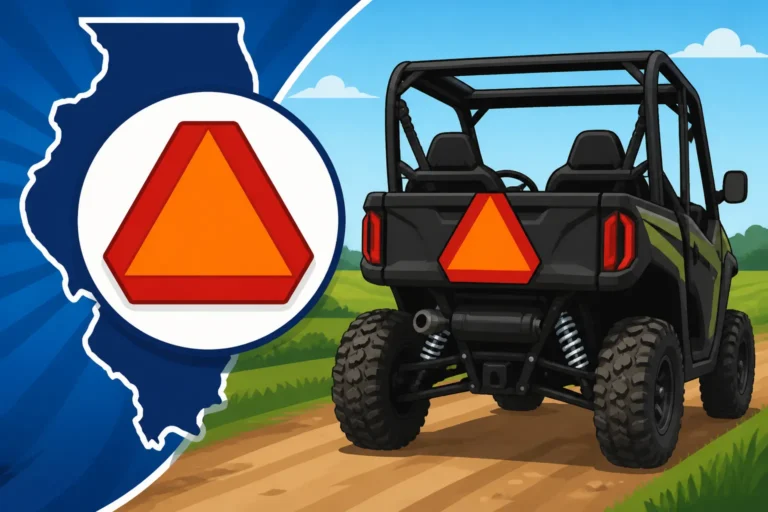
Another crucial item is a rearview mirror. Just like in a car, this allows you to monitor traffic behind you, making lane changes or turns much safer. Illinois law explicitly calls for this. And finally, for machines traveling at lower speeds, a Slow-Moving Vehicle (SMV) emblem is often required. This distinctive orange triangle with a red border is internationally recognized as a warning that the vehicle ahead is moving slowly, giving others ample time to react. The combination of these items — reflectors, lights, mirrors, and the SMV emblem — forms a robust visual safety package for your OHV. Ensuring your UTV carries [The Orange Farm Emblem Your UTV Must Carry] is part of this comprehensive approach.
Here's a quick overview of essential equipment:
| Equipment Type | Purpose | General Placement | Visibility/Requirement |
|---|---|---|---|
| Red Reflectors | Passive rear visibility, especially at night | Rear, symmetrically | Visible to the rear, unobstructed |
| Headlight | Forward illumination, forward visibility | Front | Visible from 500 feet, illuminates path |
| Tail Lamp | Rear visibility at night | Rear | Visible from 100 feet |
| Brake Lights | Alert traffic to braking | Rear | Must illuminate when brakes are applied |
| Turn Signals (UTV) | Indicate turns/lane changes | Front & Rear | Clearly visible to other drivers |
| Rearview Mirror | View traffic behind | Cab/Handlebar | Provides clear view to the rear |
| Slow-Moving Vehicle Emblem | Warn of slow speed | Rear, center | Distinctive orange triangle, clearly visible |
| Insurance Proof | Financial responsibility | With operator | Minimum liability coverage for street use |
| Driver's License | Operator qualification | With operator | Valid driver's license required |
Insurance and Licensing for Street Use
Beyond the physical equipment on your machine, there are two administrative requirements that are absolutely critical for legal street operation in Illinois: insurance and a valid driver's license. You might think, "It's just my UTV, not my car," but the moment you put rubber on a public road, even a permitted one, the stakes change dramatically. Illinois law generally requires that any motor vehicle operating on its public roads carry liability insurance. This isn't just a suggestion; it's a legal mandate designed to protect other drivers and yourself in the event of an accident. [Illinois Requires Insurance for Street Use] specifies the minimum coverage levels, often referred to as 25/50/20.
Similarly, the person operating the ATV or UTV on public roads must possess a valid driver's license. This isn't just about knowing how to steer; it demonstrates that you've passed the state's requirements for operating a motor vehicle safely, understand traffic laws, and have been deemed capable of sharing the road. Operating without a license or adequate insurance can lead to significant penalties, including fines, impoundment of your machine, and even criminal charges in some cases. Don't let your excitement to ride override these essential legalities; they are just as important as the reflectors and lights on your machine. [Do You Need a License for a UTV in Illinois?] makes it clear.
Navigating Local Ordinances and Enforcement
The biggest frustration for many Illinois OHV enthusiasts isn't just what the rules are, but which rules apply where. The state's approach to allowing ATVs and UTVs on local roads is, by design, a patchwork of varying regulations, which can make it incredibly difficult to know if you're truly compliant from one town to the next. This complexity is often born from local control and the need for each municipality to weigh the unique traffic conditions and safety concerns of their specific community.
The Patchwork of Illinois UTV Ordinances
Unlike some states that have broad statewide laws permitting or restricting OHV use on roads, Illinois delegates much of this authority to local governments. This means that a village, city, or county must specifically pass an ordinance or resolution to allow ATVs and UTVs on their roads. And when they do, they get to set the specific parameters: which roads are allowed, what hours of the day, what equipment is required, and what the permitting process entails. This is why you can legally ride your UTV down Main Street in one town, but then be pulled over for doing the exact same thing just a few miles down the road in the next municipality. [The Illinois Law Behind Every Local UTV Ordinance] explains this delegation of power.
This decentralized approach means that researching the local laws before you ride is not just recommended, it's absolutely essential. Websites like that for the Village of Byron or the County of Winnebago will often publish their specific UTV ordinances online. If you can't find it, a call to the local village hall or county clerk's office is your best bet. Always assume that if you haven't seen an ordinance specifically allowing UTVs, they are prohibited on that jurisdiction's roads. It's a "permission, not presumption" situation.
Penalties for Non-Compliance and What to Expect
Ignoring the equipment requirements, including the need for red reflectors, or riding on unauthorized roads can lead to more than just a stern talking-to. Illinois law provides for specific penalties for illegal street riding and operating non-compliant vehicles. These penalties can range from fines to having your machine impounded. A conservation officer, sheriff's deputy, or local police officer can issue citations, and these fines can quickly add up, especially if coupled with court costs. [Illinois Penalties for Illegal Street Riding] are no joke.
In some cases, repeated offenses or particularly egregious violations might even lead to more serious legal consequences. Officers aren't just looking for an excuse to ticket you; they're enforcing laws designed to protect public safety. If your machine lacks proper reflective gear, has non-functioning lights, or you don't have the required insurance or license, you're creating a hazard. When pulled over, remain polite and cooperative, and be prepared to show your license, proof of insurance, and any local permits you might have. Ignorance of the law is rarely an excuse that will get you out of a ticket, so do your homework beforehand and ensure your machine is always compliant wherever you choose to ride.
Disclaimer
This article is for general informational purposes only and does not constitute professional advice. Laws, prices and regulations vary by location and change over time. Consult a qualified professional for guidance on your specific situation.