The Orange Farm Emblem Your UTV Must Carry
It’s a common frustration for UTV owners across Illinois: you've got this capable machine, perfect for navigating backroads or getting around your property, but the rules for taking it on public streets feel like a confusing maze. You're not alone in wishing for clearer guidance on what it takes to legally drive your side-by-side beyond your own land. This guide is here to untangle the complexities of Illinois law, particularly focusing on that often-misunderstood orange farm emblem, and help you understand the requirements for legal UTV street use in the Prairie State.
Understanding Illinois's Stance on UTVs on Public Roads
Navigating the legal landscape for UTVs on public roads in Illinois can feel like trying to find your way through a corn maze in the dark. The state's approach isn't a simple "yes" or "no," but rather a patchwork of general prohibitions punctuated by critical local exceptions. It's crucial for any UTV owner to understand this foundation before they ever consider putting tires on pavement.
The Baseline Rule: A Blanket Ban
At its core, Illinois law takes a pretty straightforward stance on off-highway vehicles (OHVs), which include UTVs: they’re generally not allowed on public roads. The initial legal framework was designed to keep machines primarily intended for off-road recreation or utility tasks off the same roads as cars and trucks. This isn't about singling out UTVs, but rather a broader classification that views them as distinct from street-legal vehicles. [Illinois Law Starts by Banning Street Riding] means that if you just hop on your UTV and hit the main thoroughfare, you're likely breaking the rules right out of the gate.
This baseline ban serves several purposes from a legislative perspective. It aims to ensure road safety by limiting high-speed, heavy-traffic roadways to vehicles designed with specific safety features, crash ratings, and driver training requirements. UTVs, while robust and fun, don't always meet these same criteria, leading to the default restriction. It's not a personal affront to your machine; it's a structural approach to public road management that sees UTVs as different tools for different jobs.
Why Local Ordinances Matter More Than State Law
Here's where the plot thickens and hope emerges for UTV enthusiasts: while the state sets the general rule, it also gives significant authority to local units of government. This means that individual counties, townships, and especially villages can, and often do, pass their own ordinances allowing UTVs on certain local roads within their jurisdiction. This local control is why you might see UTVs freely cruising down main street in one small Illinois town, while the next town over has a strict "no UTVs" policy.
These local ordinances are a game-changer because they effectively create designated legal riding zones. When a village board or county commission votes to allow UTVs, they're typically doing so under specific conditions. They're weighing community needs, traffic patterns, and local safety concerns. For you as a rider, this means your first step in determining if you can ride on the street isn't to scour state statutes, but to call your local village hall or check the county clerk's website. [Illinois Municipalities That Pass Ordinances] and [Illinois Counties That Pass Resolutions] are the entities that truly open up the roads for your machine. Without that local blessing, the statewide ban generally holds sway, regardless of how "street-ready" your UTV might seem.
How "Non-Highway Vehicle" Defines Your Machine
The term "Non-Highway Vehicle" (NHV) is the legal classification that largely dictates how your UTV is treated under Illinois law. Essentially, an NHV is any motorized vehicle that's not designed for operation on a highway. This broad category includes not just UTVs and ATVs, but also things like golf carts and off-road motorcycles. The key here is "not designed for highway operation" – it speaks to the original intent and engineering of the machine, rather than just what accessories you might bolt onto it.
Understanding this classification is vital because it explains why the rules are different for your UTV than for your pickup truck. It means that even if you equip your side-by-side with turn signals, a horn, and all the bells and whistles from a company like SuperATV to make it look street-legal, it still fundamentally falls under the NHV definition in the eyes of state law. This distinction is the foundation for why local ordinances are needed to grant access and why certain safety equipment, like the slow-moving vehicle emblem, becomes mandatory. It’s not about your UTV’s capabilities, but its statutory identity as an off-highway machine.
The Critical Role of the Slow-Moving Vehicle Emblem (SMV)
When a UTV does get the green light from a local ordinance to operate on public roads in Illinois, there's one piece of safety equipment that almost universally becomes a non-negotiable requirement: the Slow-Moving Vehicle (SMV) emblem. This isn't just a suggestion; it's a critical safety device designed to prevent accidents and clearly communicate your machine's speed profile to other drivers.
What is the Orange Farm Emblem?
The orange farm emblem, officially known as the Slow-Moving Vehicle (SMV) emblem, is that distinctive fluorescent orange triangle with a dark red reflective border. You've undoubtedly seen them on the back of tractors, combines, and other agricultural equipment moving slowly on rural roads. Its design is very specific: the fluorescent orange center is highly visible during daylight hours, while the reflective red border ensures visibility in low light or at night when illuminated by headlights. This combination makes it effective around the clock, drawing immediate attention to a vehicle that might be traveling significantly slower than the posted speed limit.
This emblem isn't just a pretty sticker; it's a crucial piece of communication. In Illinois, its presence tells other drivers, instantly and unequivocally, "This vehicle is operating at 25 miles per hour or less." Imagine you're driving down a county road at 55 mph and suddenly come upon a UTV traveling at 25 mph. Without that bright orange warning, you might not register the speed differential until it's too late to react safely. The SMV emblem bridges that perception gap, giving faster-moving traffic ample warning to slow down and adjust.
Why Your UTV Needs It for Street Use
For UTVs that are granted permission to operate on public roads via a local ordinance, the SMV emblem is often a mandatory component of their street-legal equipment. This requirement stems directly from the UTV's classification as a "Non-Highway Vehicle" and the inherent difference in top speeds compared to cars. While your UTV might be capable of speeds exceeding 25 mph, the SMV emblem acknowledges that it can operate at slow speeds, and on most roads where UTVs are permitted, those slower speeds are expected. [The Orange Farm Emblem Your UTV Must Carry] highlights this specific requirement that sets UTVs apart from typical passenger vehicles.
The primary reason for its mandatory presence is accident prevention. A significant percentage of accidents involving slow-moving vehicles occur when faster vehicles fail to recognize the speed difference in time. The SMV emblem acts as a clear, universally recognized visual cue that you're a slow-moving vehicle, prompting other drivers to exercise caution and adjust their speed and following distance. It's not about embarrassment; it's about making sure everyone on the road understands what to expect, particularly in rural areas where roads might be narrow, sightlines limited, and speeds higher.
Proper Placement and Visibility for Safety
Simply having the SMV emblem isn't enough; it must be correctly placed and maintained to be effective. Illinois law, and common sense, dictates that the emblem must be mounted on the rear of the UTV, centered, and as high as practicable. The goal is maximum visibility to any vehicle approaching from behind. This means it shouldn't be obscured by cargo racks, mud flaps, or any part of your machine or trailer.
Think about the sightlines of other drivers, especially those in larger vehicles like pickups or semi-trucks. If your emblem is too low or partially hidden, its critical warning message is lost. It's also vital that the emblem itself is clean and in good condition. Faded fluorescent orange loses its daylight warning power, and a dirty reflective border won't catch headlights at night. Consider using a sturdy bracket from a reputable supplier like SuperATV to ensure your emblem stays securely mounted and visible, even over rough terrain. Regularly check its condition, particularly if your UTV spends a lot of time outdoors or in dusty conditions, to ensure it remains a bright, clear signal to everyone else on the road.
Navigating Local Ordinances for Street-Legal UTV Use
Once you understand the fundamental state restrictions and the vital role of the SMV emblem, the next crucial step is diving into the local rules. Illinois has delegated the authority to permit UTV street use to its municipal and county governments, making local ordinances the true gatekeepers for street-legal riding. This means what's permissible in one town might be strictly forbidden just a few miles down the road.
How Villages and Counties Grant Access
The power to allow UTVs on public roads rests firmly with local governing bodies. This usually means a village board, city council, or county board must pass a specific ordinance or resolution. This isn't a casual decision; it often involves public hearings, community input, and careful consideration of local road conditions and safety concerns. When a town decides to open its streets to UTVs, they're typically defining very specific parameters, such as which roads are allowed, operating hours, and additional equipment requirements. [Illinois Towns That Allow UTVs on Streets] are a great example of places where these discussions have led to positive outcomes for riders.
If you're hoping to ride your UTV on the streets in your area, your journey starts at your local village or county government office. You'll need to inquire if an ordinance exists and, if so, get a copy of it. These ordinances usually spell out everything from required permits (including fees, which can vary widely, like [Byron's UTV Permit Fees in Illinois]) to specific inspection processes. Don't assume anything; what's true for your neighbor in another county might not apply to you. It's all about hyper-local regulations, and diligent research is your best friend here.
Essential Equipment Beyond the SMV
While the SMV emblem is paramount, a local ordinance permitting UTV street use almost always comes with a list of other mandatory equipment designed to enhance safety and make your machine more visible and controllable in traffic. These requirements are usually aimed at bringing your UTV closer to the standards of a low-speed vehicle or traditional automobile. You'll commonly find mandates for a functioning brake system, which is standard on most UTVs, but also specific lighting. [Illinois Requires a 500-Foot Headlight] and [Illinois Requires a 100-Foot Tail Lamp] are common stipulations to ensure you're seen day and night.
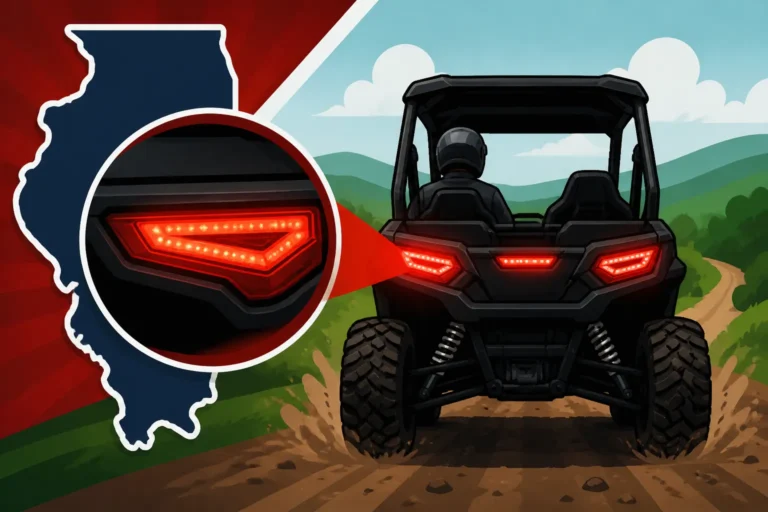
Beyond basic lighting, many ordinances require additional features. [Illinois Requires a Rearview Mirror] is often on the list, providing the driver with crucial rearward visibility. [Illinois Requires Brake Lights] and [Illinois Requires Turn Signals] are also frequently specified to allow clear communication with other drivers, just like a car. Some towns might even require a windshield or a horn. While aftermarket accessories from a company like SuperATV can help you meet many of these requirements, always double-check the exact wording of your local ordinance. Installing universal turn signal kits or side mirrors is a great step, but ensure they comply with local specifications.
Understanding Speed Limits and Road Types
Even when an ordinance allows UTVs on local roads, it's never a carte blanche to ride everywhere at full throttle. Local regulations typically impose strict limits on where and how fast you can operate. A common rule is that UTVs are only allowed on streets with a posted speed limit of 35 mph or lower. [Only Streets Posted 35 mph or Lower Qualify] is a widespread restriction, meaning interstates, state highways (except for crossing them at intersections), and faster county roads are almost always off-limits.
Moreover, towns will often designate specific roads or zones where UTVs are permitted. This might mean you can use residential streets but not the main commercial thoroughfare. Some ordinances might also specify operating hours, such as daylight hours only, or restrictions on night riding. It’s also important to remember that crossing a state highway is usually allowed only at an intersection, and often requires stopping and yielding to all traffic. You can't just drive your UTV down a state route for miles. Understanding these nuances—the specific roads, speed limits, and any time-of-day restrictions—is as important as having the right equipment to avoid fines and ensure your safety.
Here’s a quick overview of common street-legal requirements for UTVs under local ordinances:
| Requirement | General Street-Legal UTV (Local Ordinance) | Farm Use (Exemptions Apply) |
|---|---|---|
| Slow-Moving Vehicle Emblem | Required | Required |
| Rearview Mirror | Required (often 1 or 2) | Not always required for farm-only |
| Headlights | Required (visible at 500 ft) | Required for night operation |
| Tail Lights | Required (red, visible at 100 ft) | Required for night operation |
| Brake Lights | Required | Generally not required for farm-only |
| Turn Signals | Required | Not always required for farm-only |
| Windshield | Often required by local ordinance | Not typically required |
| Insurance | Required (25/50/20 minimum) | Exempt for farm-only operations |
| Driver's License | Required | Required for public road use |
| Local Permit/Sticker | Often Required | N/A |
Exemptions and Exceptions: When the Rules Bend
While the general rule is a ban and local ordinances provide specific access, Illinois law also carves out a few key exemptions where UTVs can operate on public roads without needing a full-blown local ordinance or even all the typical street-legal equipment. These exceptions are typically tied to specific uses, like agriculture, or very limited scenarios, and it's vital to understand their boundaries.
Agricultural Use: The Farm Exemption
One of the most significant and often utilized exemptions for UTVs on Illinois roads is for bona fide agricultural purposes. If your UTV is being used for farm work—like hauling tools, checking fences, moving livestock, or transporting supplies between fields—it generally enjoys more leeway. This exemption recognizes that UTVs are incredibly useful tools for farmers who need to cover ground efficiently on and between their properties. When operating under this exemption, your UTV isn't considered recreational; it's a piece of farm equipment.
However, "farm use" isn't a blanket pass for joyriding. The use must be directly related to farming operations. Transporting your hunting gear to a deer stand or taking the kids for a spin isn't typically covered by this exemption, even if your property is a farm. For machines truly engaged in farming, the Slow-Moving Vehicle (SMV) emblem is still a critical requirement, as these machines are expected to operate at slower speeds. [Illinois Farm Use Exemptions From Insurance] also illustrates how the legal framework adapts for these specific applications, often waiving certain insurance requirements that would otherwise apply to street use.
Residential Property and Short Crossings
Another area where UTVs get a bit more flexibility is on private property and for very limited, short crossings of public roads. You can, of course, operate your UTV freely on your own land, whether that's a sprawling farm, a large rural lot, or even a smaller residential property, as long as you're not disturbing the peace or trespassing. [Illinois Residential Property Exemption] means you don't need a permit or special equipment to ride in your own yard.
The rules also often permit brief crossings of public roads, typically at a 90-degree angle, to get from one section of your property to another, or to access an adjacent field. These crossings are meant to be direct and minimal, not an opportunity to drive down the road. During such crossings, the UTV operator is expected to yield to all oncoming traffic and exercise extreme caution. These are not exemptions for cruising, but for practical, necessary movements that avoid prolonged use of public roadways. Always check your local sheriff's department or police department for their interpretation of what constitutes a "short crossing" in your specific area.
Special Events and Temporary Permits
Beyond the regular agricultural and property-based exemptions, there are sometimes opportunities for UTVs to operate on public roads during special events. Think about parades, charity rides, or community festivals where UTVs might be featured or used by event organizers. In these situations, local governments might issue temporary permits or make specific allowances for a defined period and route. These are often one-off exceptions that require advance planning and approval from the relevant authorities.
These special event permissions are not ongoing, and they usually come with their own set of rules, which could include specific speed limits, escort vehicles, or modified equipment requirements for that particular event. It's not something you can just decide to do; it requires explicit permission. If you're planning on participating in or organizing an event that involves UTVs on public roads, you'll need to work closely with local law enforcement and municipal officials to ensure all necessary permits are secured and safety protocols are in place. These instances are truly exceptional and should never be confused with regular street-legal operation.
Common Pitfalls and Misconceptions for Illinois Riders
Despite the various rules, exemptions, and local ordinances, UTV owners in Illinois often fall victim to common misunderstandings that can lead to tickets, accidents, or impounded machines. Being aware of these pitfalls is just as important as knowing the rules themselves.
The Difference Between "Farm Use" and "Recreational Use"
This is perhaps the biggest area of confusion. Many UTV owners purchase their machines with the intent of using them for both work and play, especially those who live on larger properties or in rural areas. However, Illinois law draws a very sharp distinction between genuine "farm use" and "recreational use," even if that recreation happens on a farm. As discussed earlier, the farm exemption for road use applies strictly when the UTV is operating as agricultural equipment, directly supporting farming operations. [Illinois Machines Used Only on a Farm] is the key phrase here, implying direct operational context.
The moment that UTV is used to transport friends to a fishing pond on the property, to go for a trail ride, or to simply cruise around for enjoyment, it typically falls out of the "farm use" exemption and back into the "recreational use" category. This means that if you're on a public road, even a county road adjacent to your fields, and you're not actively engaged in farming activities, you'd better have an active local ordinance permitting UTVs and all the required street-legal equipment, including proper insurance. Misinterpreting this distinction can lead to tickets for illegal street riding, potentially with [Illinois Penalties for Illegal Street Riding] that include significant fines and court costs.
The Perils of Unsanctioned Riding Areas
Another common mistake is assuming that because a road or area looks unused or untraveled, it's fair game for UTV riding. This is a dangerous misconception. Illinois has strict trespass laws, and riding on private land without explicit permission from the landowner is illegal and can lead to severe penalties. This includes abandoned railway beds, private fields, timberland, or even old quarry roads. Just because there's no "No Trespassing" sign doesn't mean you have permission to ride.
Similarly, riding on public land that isn't specifically designated for OHV use is also illegal. This includes many state parks, nature preserves, and even some forest preserve districts. Unless there's a clear, marked trail system like at Sahara Woods [Sahara Woods: Illinois's Only State OHV Park], you should assume that cross-country travel or riding on undesignated paths is prohibited. Always do your homework and ride only on legal, sanctioned trails or property where you have explicit permission. Investing in a proper trail map or using apps that show designated riding areas can save you a lot of grief.
Ensuring Your Insurance Covers Street Riding
Many UTV owners have a general liability policy for their machine, covering them for accidents on their own property or at private riding parks. However, a significant pitfall arises when these machines venture onto public roads: does your existing insurance policy actually cover you for street use? The answer is often "no," or "not enough." Standard ATV/UTV policies typically treat public road use as a different risk category, and your basic policy might exclude it or offer insufficient coverage.
If you plan to utilize a local ordinance that allows street-legal UTV operation, you will almost certainly need to carry specific liability insurance that meets Illinois's minimum requirements for vehicles on public roads (often referred to as 25/50/20 coverage). [Illinois Requires Insurance for Street Use] for vehicles on public roads, and your UTV is no exception if it's legally operating there. Failing to have adequate coverage could result in fines, suspension of driving privileges, and, worst of all, being personally responsible for damages in the event of an accident. It's crucial to have a frank conversation with your insurance agent about your intentions to ride on public roads and ensure your policy provides the necessary protection, potentially adding a specific endorsement for street-legal UTV operation. Don't assume your homeowner's policy will cover it; it almost never does for motorized vehicles off your property.
Disclaimer
This article is for general informational purposes only and does not constitute professional advice. Laws, prices and regulations vary by location and change over time. Consult a qualified professional for guidance on your specific situation.