Applying for a UTV Permit at Village Hall
Riding your UTV on the streets of Illinois can feel like navigating a maze, especially with the confusing array of local rules and regulations. Many riders are left scratching their heads, wondering if their machine can ever legally leave the dirt roads and access town. This guide will walk you through the often-baffling process of applying for a UTV permit at your local Village Hall, helping you understand the steps, requirements, and what to expect to make your machine street-legal in your community.
The Patchwork Quilt of Illinois UTV Laws: Why Local Permits Are Essential
Let's be real: Illinois's approach to UTVs on public roads isn't exactly straightforward. Unlike some states with clear, overarching statewide laws, Illinois gives a lot of power to local municipalities – villages, cities, townships, and counties – to decide for themselves. This means that what's legal for your side-by-side in one town might get you a ticket just a few miles down the road in another. It's frustrating, certainly, but understanding this local control is the first step toward getting your UTV street-legal.
Why Local Ordinances Matter So Much
The core of the issue is that the State of Illinois generally prohibits off-highway vehicles (OHVs), which include UTVs, from operating on public roads. This isn't just a suggestion; it's the default legal stance. However, recognizing the practical needs of residents, especially in rural or semi-rural areas, the state legislature provided a specific carve-out. It allows local units of government – your village, city, or county – the authority to pass their own ordinances permitting UTVs on certain local roads. Without such an ordinance in place, no matter how equipped your UTV is, it simply can't legally operate on those public streets.
This often leads to a complex and sometimes maddening situation for riders. You might live in a county that allows UTVs on its roads, but if your village hasn't passed its own ordinance, those same machines are still banned within village limits. It's why doing your homework before you even think about hitting the pavement is absolutely critical. You can't assume that because your neighbor in the next town over rides his UTV to the gas station, you can too. Each municipality holds the power to say yes or no, and to dictate the terms if they say yes. Understanding this fundamental aspect of [Illinois Law Starts by Banning Street Riding] is paramount for any UTV owner hoping to navigate local roads.
Navigating the Village-Specific Regulations
Because each village is empowered to craft its own rules, the specific requirements for a UTV permit can differ significantly from one town to the next. One village might have a simple application process with minimal equipment demands, while another might require an extensive inspection and a higher permit fee. These variations cover everything from what specific roads are allowed (e.g., only those with speed limits under 35 mph), to the hours of operation (e.g., no riding after dark), to the required safety equipment.
This means you can't just download a generic form and expect it to work everywhere. You need to identify the precise ordinance for your village. Don't rely on word-of-mouth or what you heard from a buddy in another county. The details matter, and missing one small requirement could result in your application being denied or, worse, a costly ticket. It's a key reason why we emphasize the village-by-village nature of [Illinois UTV Street Legal Rules by Town]. These hyper-local regulations are truly the only ones that apply to you within your village's boundaries.
The Initial Research: What to Do Before You Go
Before you even set foot in Village Hall, your first task is thorough research. Start by checking your village's official website. Many municipalities, especially those with UTV ordinances, will post the full text of the ordinance, application forms, and a list of requirements online. Look for sections related to "recreational vehicles," "off-highway vehicles," or "UTV permits." If you can't find anything definitive online, the next best step is to call the Village Clerk's office. Explain that you're a resident UTV owner and you're inquiring about the possibility of obtaining a street-legal permit.
Be polite, patient, and prepared to ask specific questions: "Does the village have an ordinance allowing UTVs on public streets?" "If so, what are the equipment requirements?" "Is there an application form, and where can I find it?" "What are the permit fees?" Asking these questions upfront will save you a lot of time and potential frustration. It's far better to do your homework from the comfort of your home than to make multiple trips to Village Hall only to find you're missing a critical piece of information. Knowing [Where to Find Your Village's UTV Ordinance Online] is a fundamental part of preparing for this process.
Step-by-Step: The Village Hall Application Process
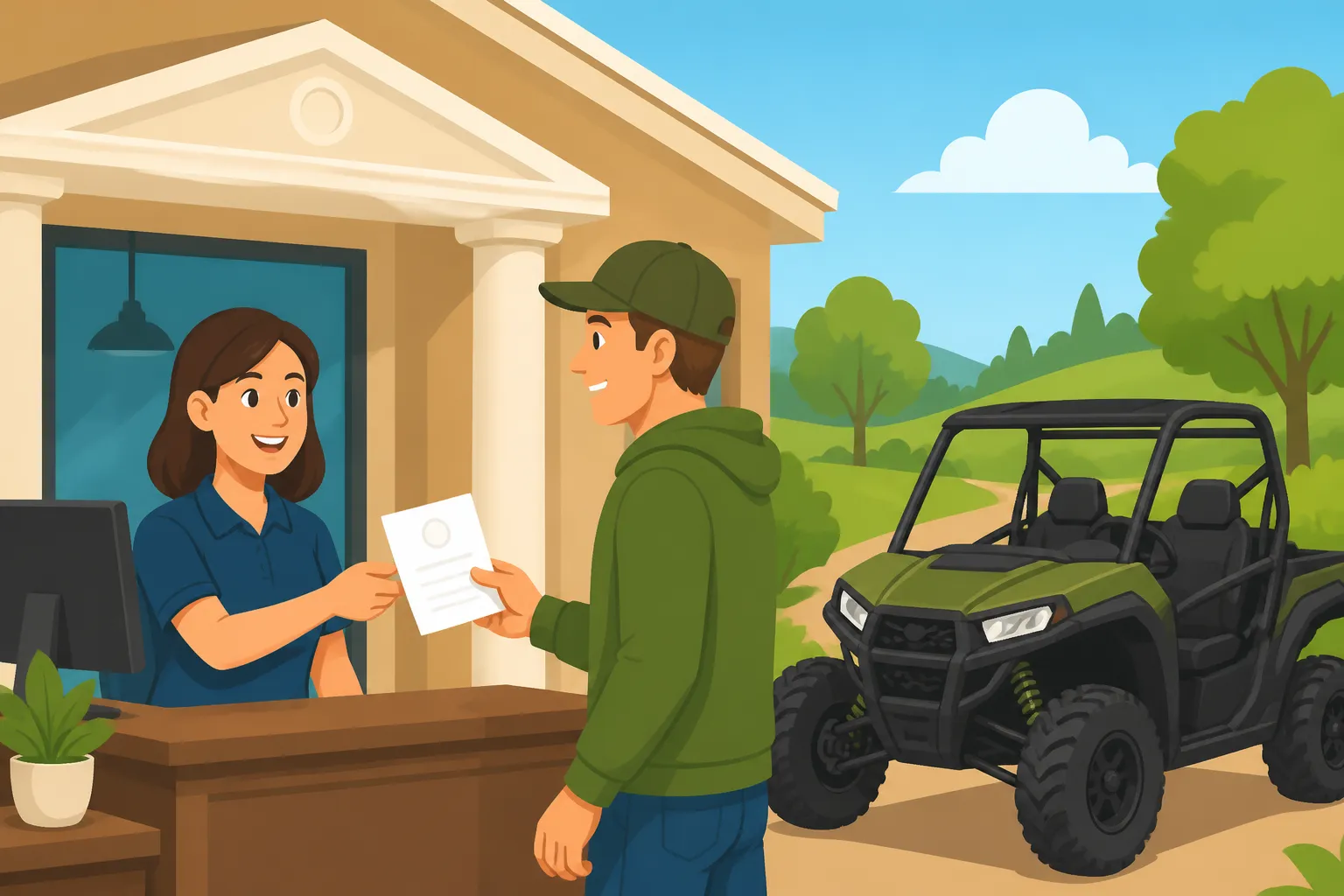
Once you've confirmed that your village does have an ordinance allowing UTVs on its streets and you understand the basic requirements, it's time to gather your documents and head to Village Hall. This isn't always a quick process, so patience is key. Think of it as applying for any other municipal permit; it requires attention to detail and readiness to provide all necessary information.
Gathering Your Paperwork: What You'll Need
Every village will have its own specific list of documents, but there's a common core that you should prepare. You'll almost certainly need proof of ownership for your UTV. This typically means your official Illinois Certificate of Title. If you've just purchased the machine, you might only have a Manufacturer's Certificate of Origin (MCO) or a bill of sale, in which case you'll need to work with the Illinois DNR to get it titled first. You'll also need proof of current liability insurance, meeting the state's minimum requirements (or whatever higher limit the village might mandate for street use). Your valid driver's license will be essential, as Illinois generally requires a licensed driver to operate a UTV on public roads, even where permitted.
Beyond these, be prepared to show proof of residency within the village, such as a utility bill or property tax statement. Some villages might also ask for your UTV's VIN (Vehicle Identification Number) to be visible and legible, or require photographs of your machine. It’s a good idea to create a folder with all these documents, ensuring you have both originals and copies, as some offices may need to keep copies for their records. Having a [Illinois Title Paperwork Checklist] handy can certainly make this initial step less daunting, ensuring you don't miss anything crucial before your visit.
Filling Out the Permit Application
The permit application form itself will likely be provided by the Village Clerk's office. It will typically ask for details about you, the applicant, including your name, address, phone number, and driver's license information. Then, it will delve into your UTV's specifics: make, model, year, VIN, engine size, and perhaps even its color. You'll likely need to affirm that your machine meets all the village's specified safety equipment requirements, such as having headlights, taillights, brake lights, turn signals, a horn, and mirrors.
Take your time filling out the form. Read every question carefully. If something is unclear, don't guess; ask the Village Clerk for clarification. Incomplete or inaccurate applications are a common reason for delays or outright denial. Some applications might also include an affidavit or declaration that you understand and agree to abide by all local ordinances pertaining to UTV operation. This isn't just a formality; it's a legal acknowledgment of your responsibilities as a permitted operator within the village. Double-checking everything before you submit it can save you a world of headaches later on.
Paying the Fees
Permit fees are a standard part of the process, and just like the other regulations, they can vary widely from one village to another. Some municipalities might charge a nominal annual fee, while others might have a more substantial one-time or recurring cost. These fees help cover the administrative costs of processing applications, conducting inspections, and sometimes even contributing to local road maintenance. Don't be surprised if there's a separate fee for the initial application versus annual renewal.
It's crucial to confirm the exact amount and acceptable payment methods with the Village Clerk. Most Village Halls will accept cash, checks, or debit/credit cards, but it's always wise to confirm this beforehand. Factor these fees into your overall budget for making your UTV street-legal. They are an unavoidable part of the process and must be paid in full before your permit can be issued. Understanding [Illinois Permit Fees Set by a Town] will help you budget appropriately and avoid any surprises when you're ready to submit your application.
The All-Important UTV Inspection
Even if you’ve filled out all the paperwork perfectly and paid your fees, your journey isn’t over. Most Illinois villages require a physical inspection of your UTV to ensure it meets all the safety and equipment standards outlined in their ordinance. This inspection is a critical step, as it's the village's way of verifying that your machine is safe for public road use and won't pose a hazard to other motorists or pedestrians.
What an Inspection Covers
The scope of the inspection is typically detailed in the village's UTV ordinance. Common requirements include a functional headlight visible from a specified distance (often 500 feet), a red taillight visible from 100 feet, and working brake lights. Your UTV will almost certainly need turn signals, both front and rear, to indicate lane changes or turns, just like any other road vehicle. A horn that can be heard at a certain distance is usually mandatory. Perhaps one of the most frequently overlooked requirements is a rearview mirror, or often, two, providing a clear view of traffic behind you.
Beyond lighting and signaling, the inspector will check for basic operational safety. This might include ensuring your brakes are in good working order, that tires are in decent condition with adequate tread, and that the exhaust system isn't excessively loud. Some ordinances also require a slow-moving vehicle (SMV) emblem on the rear, similar to what you'd see on farm equipment. It's a comprehensive check designed to ensure your UTV meets minimum safety standards before it's allowed onto public streets. Many riders find great success equipping their machines with high-quality aftermarket components from brands like SuperATV to ensure they meet every single safety standard outlined in the local ordinance.
Getting Your UTV Ready: Pre-Inspection Checklist
Before the official inspection, give your UTV a thorough once-over yourself. Treat it like you're preparing for a state vehicle inspection. Check all your lights: headlights (high and low beam), taillights, and especially brake lights. Test your turn signals to make sure they flash correctly and are clearly visible. Honk your horn. Verify that your rearview mirror, or mirrors, are securely mounted and provide an unobstructed view. If your UTV didn't come with some of these items from the factory, you'll need to install them. Consider upgrading your mirrors or adding a full turn signal kit, often available from reputable companies like SuperATV, long before your inspection date.
Check your tires for proper inflation and wear. Test your brakes to ensure they engage smoothly and stop the machine effectively. Also, make sure your VIN is clean and easily readable; the inspector will need to verify it against your paperwork. It's always better to over-prepare than to fail the inspection and have to reschedule. A little proactive maintenance and equipment installation can save you a lot of time and frustration in the long run. Having robust, clearly visible turn signals, perhaps a universal kit from SuperATV, is absolutely critical for road use and will be a key point of inspection.
Here's a handy checklist for common UTV inspection points:
| Item | Requirement (Common) | Ready? | Notes |
|---|---|---|---|
| Headlights | Visible 500 ft (high/low beam) | [ ] | [Illinois Requires a 500-Foot Headlight] |
| Taillight | Red, visible 100 ft | [ ] | |
| Brake Lights | Function when brake applied | [ ] | |
| Turn Signals | Front & rear, amber/red, functional | [ ] | Essential for signaling turns. [Illinois Requires Turn Signals] |
| Rearview Mirror(s) | One (or two) providing clear view | [ ] | [Illinois Requires a Rearview Mirror] |
| Horn | Audible from 200 ft | [ ] | Don't overlook this simple but critical item. |
| SMV Emblem | On rear, visible | [ ] | Often required for speeds under 25 mph. |
| Windshield | If equipped, clear & not cracked | [ ] | |
| Seatbelts/Restraints | Functional for all seating positions | [ ] | If applicable |
| Tires | Good tread, proper inflation | [ ] | No bald spots or severe damage. |
| Brakes | Operational and effective | [ ] | Test both primary and parking brakes. |
| Exhaust | Not excessively loud | [ ] | No modifications for noise. |
| VIN (Vehicle ID Number) | Clearly visible and legible | [ ] | Matches title/application. |
| Proof of Insurance | Valid & current | [ ] | Keep a copy in the machine. |
| Driver's License | Valid for operator | [ ] |
What Happens During the Inspection
The actual inspection typically takes place at a designated location, which could be the Village Hall parking lot, the local police department, or even your home if the village offers such a service (less common). An authorized village official – often a police officer, public works employee, or a designated inspection officer – will physically examine your UTV against the checklist of requirements. They’ll switch on your lights, test your horn, check your mirrors, and look for all the required safety gear.
This is not the time to be shy. If you have any questions during the inspection, ask them. The inspector is there to ensure compliance, and a clear understanding can help both parties. If your UTV passes, fantastic! The inspector will usually sign off on your application, and you'll be one step closer to getting your permit sticker. If it fails, don't despair. The inspector should provide you with a clear list of deficiencies that need to be corrected. You'll then need to make the necessary repairs or additions (like adding an aftermarket horn kit from SuperATV if you don't have one) and schedule a re-inspection. Don't overlook essentials like a working horn, which you can easily add with an aftermarket kit from providers like SuperATV, if your machine didn't come with one.
After Approval: Your Permit, Your Responsibilities, and What's Next
Once your UTV passes inspection and all fees are paid, the Village Hall will issue your permit. This is a moment to celebrate! However, getting the permit isn't the end of your responsibilities. It's the beginning of a new set of obligations that ensure you operate your UTV safely and legally within your community.
Receiving and Displaying Your Permit Sticker
Your UTV permit will typically come in the form of a sticker or decal that needs to be prominently displayed on your machine. The ordinance or the Village Clerk will specify the exact placement – often on the front fender, windshield, or another clearly visible area. This sticker serves as proof to law enforcement that your UTV is permitted for street use within that specific village. Without it, even if you’ve been approved, you could still be ticketed.
Make sure the sticker is affixed securely and is visible at all times. If it fades, gets damaged, or falls off, contact Village Hall immediately to inquire about a replacement. Most permits are valid for a specific period, typically one year, and will have an expiration date. Mark this date on your calendar! Timely renewal is crucial to avoid any lapse in your street-legal status. Knowing [Where to Put a Village Permit Sticker on a UTV] is essential for compliance and avoiding unnecessary stops.
Understanding Ongoing Compliance
Holding a UTV permit means you've agreed to abide by all the rules of the road and the specific conditions of your village's ordinance. This includes maintaining your liability insurance. [Illinois Requires Insurance for Street Use] for any street-legal vehicle, and your permit is contingent on this coverage remaining active. Always carry proof of insurance with you when operating your UTV, along with your driver's license and the permit itself.
Beyond insurance, pay close attention to the specific operational rules outlined in your village's ordinance. These might include speed limits (often lower than the posted car speed limits for UTVs), restrictions on passenger numbers or ages, hours of operation (many villages prohibit UTVs after dark), and restrictions on which roads can be used (e.g., no state routes or roads above a certain speed limit). Remember, the permit is a privilege, not an absolute right, and it can be revoked if you fail to comply with the rules. Staying informed and compliant ensures you can continue to enjoy the convenience of riding your UTV on village streets.
What to Do If Your Application Is Denied
It's certainly disappointing, but sometimes a UTV permit application might be denied. This can happen for several reasons: your machine didn't pass inspection, you didn't provide all the necessary documentation, your insurance wasn't adequate, or perhaps the village decided to change its ordinance or halt permits. If your application is denied, the first step is to understand why. The Village Clerk or the denying authority should provide a clear reason for the denial.
Once you know the reason, you can assess your options. If it's a correctable issue, like a missing document or a required piece of equipment, make the necessary adjustments and reapply. If the denial is based on a more fundamental issue, such as your UTV not meeting core ordinance requirements that can't be easily changed, or a shift in village policy, you might need to explore other options or respectfully inquire about an appeal process if one exists. Sometimes, the issue isn't with your machine but with broader community concerns. Remember, dealing with a [What to Do When a Village Board Says No] scenario requires a calm and methodical approach, understanding that local rules can and do change.
This article is for general informational purposes only and does not constitute professional advice. Laws, prices and regulations vary by location and change over time. Consult a qualified professional for guidance on your specific situation.