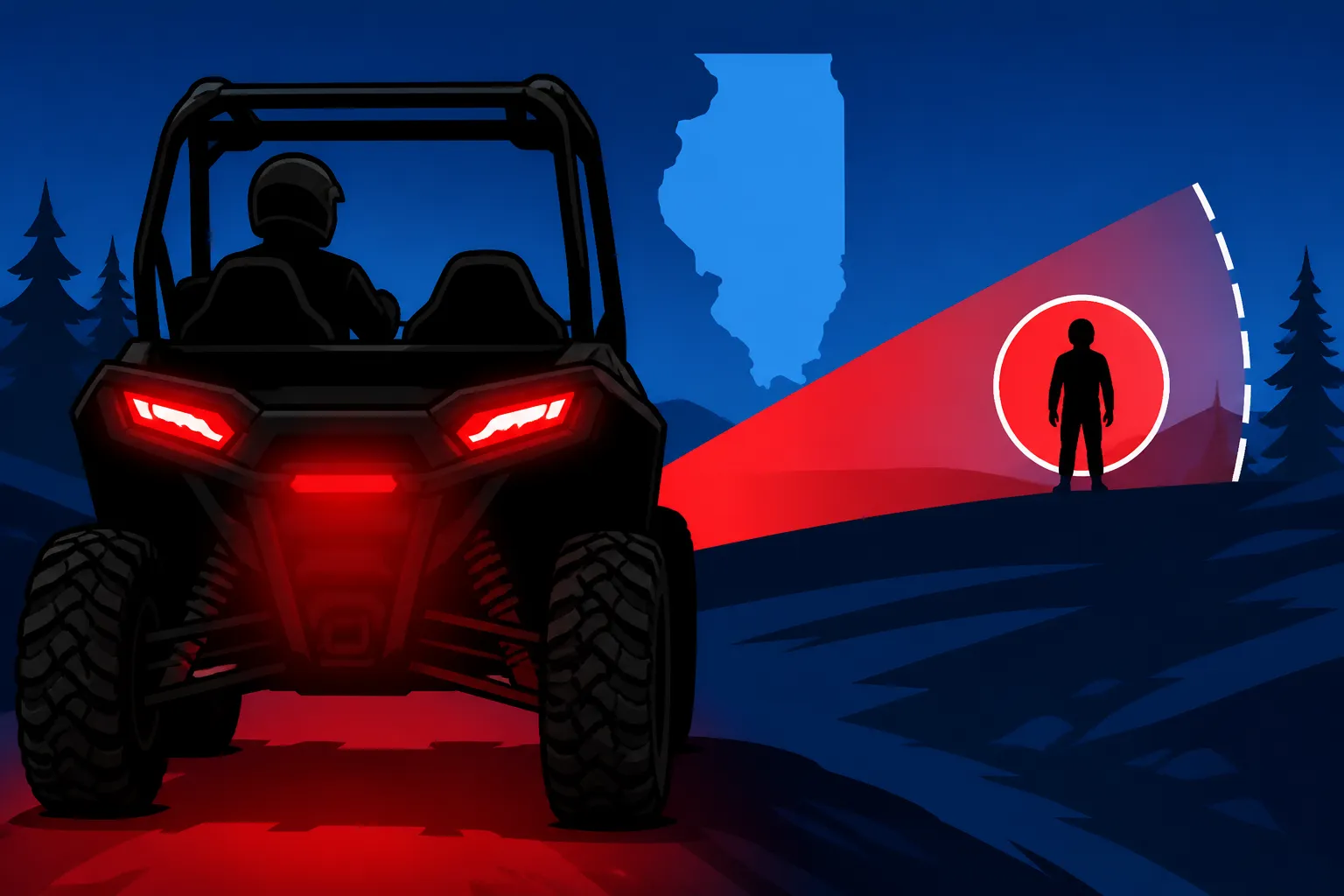
Your Tail Lamp Must Show Red at 100 Feet
One of the most common headaches for Illinois ATV and UTV owners dreaming of hitting local roads is navigating the maze of equipment requirements. It's not just about getting permission from your village or county; it's about making sure your machine is actually ready for public roads. A frequently overlooked but critically important piece of the puzzle is your tail lamp, specifically its ability to "show red at 100 feet." This guide is here to break down exactly what that means, why it matters, and how to ensure your off-highway vehicle (OHV) meets this crucial visibility standard for legal street use in the Prairie State.
The Foundation of Illinois Street Legality for OHVs
Let's be real, the default stance in Illinois is that ATVs and UTVs aren't meant for public roads. You can't just hop on your quad and cruise down a state highway or interstate. The good news is that local municipalities, like villages and counties, have the power to create ordinances that do allow OHVs on certain roads within their jurisdiction. But here's the kicker: they almost always come with a strict list of equipment requirements, and visibility is paramount. It’s not just about turning a key and going; it’s about meeting a checklist of safety items that make your machine visible to other motorists.
The General Ban on Street Riding and Its Exceptions
When you first get into the world of ATVs and UTVs in Illinois, you quickly learn that the state's baseline rule is simple: no street riding. This isn't just some arbitrary restriction; it's about road safety, the design differences between off-road vehicles and cars, and the flow of traffic. However, this isn't an absolute ban. The state legislature has carved out a path for local control, allowing villages, cities, and counties to pass ordinances that permit the use of these machines on their roadways, typically those with speed limits of 35 mph or lower. It's this local authority that opens the door, but it also means you've got to do your homework. You can't assume that because your neighbor in one town can ride their UTV to the gas station, you can do the same in yours. Every jurisdiction is different, and knowing your local rules is the first step toward legal street riding. This is why understanding [Illinois UTV Street Legal Rules by Town] is so vital before you even think about gearing up.
Why Equipment Matters So Much for Local Ordinances
If your local government decides to allow OHVs on its streets, they're not just giving you a free pass. They're typically implementing a strict set of rules that often mirror, or even exceed, what cars are required to have. This is where your machine's equipment becomes absolutely critical. Think about it: when you're on a public road, you're sharing space with cars, trucks, and motorcycles that are all designed with specific safety features for that environment. Your ATV or UTV, while rugged and capable off-road, often needs some modifications to be equally safe and visible on pavement. Things like proper lighting, mirrors, and even turn signals aren't just suggestions; they're usually non-negotiable requirements. These aren't just about avoiding a ticket; they're about preventing accidents and ensuring that your off-road machine can integrate safely into the flow of street traffic. The village isn't just trying to be a stickler; they're trying to protect everyone on the road.
The Importance of Visibility for Safety
Visibility isn't just a regulatory checkbox; it's a lifeline on the road. Off-road vehicles can sometimes be smaller or less conspicuous than cars, making them harder for other drivers to spot, especially in adverse weather conditions, at dawn or dusk, or at night. A functional and compliant tail lamp, along with other lighting, makes your machine stand out. It signals your presence and helps other drivers judge your distance and direction. Imagine approaching an intersection at night, and the vehicle in front of you has a dim, broken, or non-existent tail light. That's a recipe for a rear-end collision, and it’s exactly what these equipment laws are designed to prevent. From the moment you pull out of your driveway onto a public street, you need to be seen, and your tail lamp plays a starring role in that crucial communication with other road users. This focus on being seen is also why Illinois has specific rules about when [Illinois Rules for Riding After Dark] are in effect and what equipment is needed.
Decoding Illinois's Tail Lamp Requirements
So, let's get down to the nitty-gritty: what exactly does Illinois expect from your tail lamp when you're riding on an approved street? It's more than just having a light back there. The law is quite specific, focusing on visibility and performance, ensuring that your machine communicates its presence effectively to drivers behind you. This isn't a suggestion; it's a mandatory safety feature for any OHV operating on public streets where permitted by local ordinance.
What "Show Red at 100 Feet" Really Means
When the Illinois statute says your tail lamp must "show red at 100 feet," it's establishing a clear minimum standard for its effectiveness. It means that, under normal atmospheric conditions and at night, another driver behind you should be able to clearly identify your machine's rear-facing red light from at least 100 feet away. This isn't just about the color of the light; it's about its intensity and clarity. A dim, faded, cracked, or dirty tail lamp might emit a red glow, but if that glow isn't strong enough to be distinct and visible from 100 feet, it doesn't meet the legal requirement.
Think about standing 100 feet away from your machine in the dark. Can you clearly see the red light? Is it bright and unambiguous? If you have any doubt, it likely means your tail lamp isn't up to snuff. This standard ensures that drivers have enough warning to react to your presence, reducing the risk of a rear-end collision. It's a critical measure of safety, not just a guideline.
Distinguishing Tail Lamps from Brake Lights and Reflectors
It's easy to lump all rear-facing lights into one category, but Illinois law, like most state traffic codes, differentiates them for a good reason. Each has a distinct purpose:
- Tail Lamp: This is your constant, steady red light that illuminates the rear of your machine whenever your headlights are on. Its primary job is to indicate your presence to traffic behind you. It's a "running light" for the back of your vehicle.
- Brake Lights: These are typically brighter red lights that activate only when you apply the brakes. Their purpose is to signal deceleration or a stop to drivers behind you, providing a critical warning. While often integrated into the same housing as your tail lamps, they must be distinctly brighter when activated. Illinois specifically requires [Illinois Requires Brake Lights] for street-legal OHVs.
- Red Reflectors: These aren't lights at all, but passive safety devices. They use reflective material to bounce back light from other vehicles, making your machine visible even if your lights fail or are turned off. While essential, they are not a substitute for a powered tail lamp. In fact, [Illinois Requires Red Reflectors] to be mounted on the rear of your machine.
All three play a role in rear visibility, but your tail lamp is the constant indicator of your presence. Understanding these distinctions is important when outfitting your machine for street legality, as each has its own specific placement and performance standards.
Common Issues with Stock Tail Lamps and Street Use
Many ATVs and UTVs come from the factory equipped with tail lamps perfectly adequate for trail riding or farm use. However, these stock setups might not always meet the more stringent demands of street legal ordinances. Here are some common issues:
- Insufficient Brightness: A tail lamp designed for the trail might be bright enough for off-road conditions, but once you introduce it to the ambient light pollution of a town or the glare of other vehicles' headlights, it might simply not be powerful enough to "show red at 100 feet" clearly. Older incandescent bulbs can dim over time, too.
- Integrated Units: Some factory setups combine the tail lamp and brake light into a single, less distinct unit. While it might light up, the differentiation between "on" and "braking" might not be clear enough for road safety, or the tail lamp function itself might be too dim when not braking.
- Damage or Dirt: Off-road riding is tough on equipment. Mud, dust, branches, and impacts can all degrade the performance of your tail lamp. A cracked lens, a disconnected wire, or even just a thick layer of mud can significantly reduce the visibility of your light, making it non-compliant.
- Single Tail Lamp: Some older or smaller ATVs might only have one tail lamp. While this might be fine for off-road, many street ordinances implicitly (or explicitly) expect two, mirroring passenger vehicle standards, for better visibility and redundancy.
- Placement and Angle: A tail lamp designed for off-road might be mounted in a position that offers good visibility from directly behind but becomes obscured when the vehicle is traversing uneven terrain or viewed from an angle. On the street, consistent visibility is key.
Before you take your machine onto public roads, it's always a good idea to thoroughly inspect your tail lamp's performance, especially if it's an older or heavily used machine.
Ensuring Your Machine Meets the Standard and Stays Safe
So, you've decided to pursue street legality for your OHV, and you understand the importance of your tail lamp. Now, how do you make sure it actually meets and exceeds the "show red at 100 feet" requirement, keeping you safe and legal? It's about proactive checking, smart upgrades, and regular maintenance.
Checking Your Current Tail Lamp's Performance
Before investing in new equipment, do a simple test of your existing tail lamp. This doesn't require any special tools, just a tape measure (or a good estimation of 100 feet) and a dark environment.
- Find a Safe, Dark Area: A quiet street at night, a large parking lot, or even your driveway if it's long enough.
- Position Your Machine: Turn on your headlights, which should also activate your tail lamp.
- Measure 100 Feet: Have a friend stand exactly 100 feet directly behind your machine. If you don't have a friend, mark the spot yourself and then walk back to it.
- Observe: From the 100-foot mark, can you clearly see a distinct, bright red light? Is it unambiguous that a vehicle is present? If there's any doubt, or if the light seems dim, hazy, or indistinguishable, it's likely not meeting the standard.
- Check for Damage: While you're at it, physically inspect the tail lamp housing. Look for cracks, chips, or fogging on the lens. Make sure all wires are securely connected and there's no corrosion on the terminals. Even a thin layer of mud or dust can significantly reduce light output, so give it a good cleaning before testing.
This simple test can quickly tell you if you need to consider an upgrade or repair.
Upgrading for Compliance and Enhanced Safety
If your stock tail lamp isn't cutting it, or you simply want to enhance your safety, there are plenty of aftermarket options available. LED tail lamps are often the go-to choice for upgrades due to their superior brightness, longer lifespan, and lower power draw compared to traditional incandescent bulbs.
When choosing an upgrade, look for:
- High Lumen Output: Brighter is better for visibility on the road.
- Durable Construction: Something designed to withstand the rigors of off-road and on-road use.
- DOT Compliance: While not always explicitly required for every component in Illinois local ordinances, a DOT-compliant light generally means it meets federal standards for brightness, color, and beam pattern for on-road use.
- Integrated Solutions: Many aftermarket tail light kits will also incorporate brighter brake lights and sometimes even integrated turn signals, streamlining your upgrade process and ensuring you meet multiple requirements at once.
Brands like SuperATV offer a range of lighting solutions specifically designed for ATVs and UTVs, including LED tail light kits that significantly boost visibility. When selecting, consider not just the tail lamp, but also how it integrates with other rear-facing equipment. A comprehensive upgrade can often take care of multiple requirements at once. Remember, it's not just about meeting the letter of the law, but enhancing your overall safety profile on public roads.
Beyond the Tail Lamp: Other Essential Rear-Facing Equipment
While the tail lamp is crucial, it's part of a larger system of rear-facing safety equipment you'll need for street legality. Don't overlook these other components:
- Brake Lights: As mentioned, these must be distinctly brighter than your tail lamp when activated. Many aftermarket tail lamp kits include improved brake light functionality. [Illinois Requires Brake Lights] and they must be fully functional.
- Turn Signals: If your local ordinance allows street use, turn signals are almost always a requirement. These are vital for communicating your intentions to other drivers, especially when making turns or changing lanes. [Illinois Turn Signal Requirements] will specify visibility and color.
- Rear-View Mirrors: Though not a light, a rearview mirror is essential for knowing what's behind you, which is critical for safe braking and turning. While it doesn't help others see you, it helps you react to them.
- Slow-Moving Vehicle Emblem (SMV): This orange triangular sign with a red border is required for vehicles traveling at 25 mph or less on public roads. Since many OHV street ordinances limit speeds to 35 mph or below, the SMV emblem is often a requirement to alert faster-moving traffic. [Illinois Requires a Slow-Moving Vehicle Emblem] on the rear of your machine.
- Reflectors: Beyond the powered lights, passive red reflectors on the rear (and often amber on the sides/front) are typically required to ensure some visibility even if your electrical system fails.
Think of it as a layered approach to visibility and communication. Each piece of equipment works together to ensure you're seen and understood by other motorists, making your street rides as safe as possible.
| Equipment Type | Primary Function | Visibility Requirement (Rear) | State Requirement (Generally) |
|---|---|---|---|
| Tail Lamp | Indicate presence when lights are on | Red, visible at 100 feet | Yes, for street use (often locally enforced) |
| Brake Lights | Signal deceleration/stop | Brighter red, visible at 100 feet | Yes |
| Turn Signals | Indicate turning/lane change | Amber/Red, visible clearly | Yes, for street use (locally enforced) |
| Red Reflectors | Passive visibility, reflects light | Red, visible at 100-600 feet | Yes |
| SMV Emblem | Alert faster traffic to slow-moving vehicle | Orange triangle, reflective | Yes, for vehicles traveling 25 mph or less on public roads |
Real-World Scenarios and Avoiding Penalties
Having the right equipment is one thing; understanding how it plays out in real-world scenarios and what happens if you don't comply is another. Being prepared means knowing what law enforcement looks for and the potential consequences of falling short of the legal requirements.
What a Law Enforcement Officer Looks For
When a police officer, sheriff's deputy, or even a conservation officer sees an ATV or UTV on a public road in Illinois, their first thought often isn't just "Are they allowed here?" but "Is this machine safe and properly equipped for the road?" They'll be looking for several things, and your tail lamp is high on that list.
- Functionality: Is the tail lamp actually on when the headlights are on? Does it illuminate steadily?
- Brightness and Color: Does it clearly emit a red light, and is it bright enough to be seen from a distance? They might even pull out a tape measure or estimate the 100-foot distance to verify compliance, especially if it seems dim.
- Condition: Is the lens clean and unbroken? Are there any obvious signs of damage or obstruction?
- Integration with Other Lights: Do your brake lights work and appear distinctly brighter? Are your turn signals (if required by local ordinance) functioning correctly?
- Overall Compliance: They'll also check for other required equipment like mirrors, the SMV emblem, and, crucially, whether you have the proper local permit or sticker if required by the village or county. Remember, [What a Conservation Officer Can Ask to See] includes proof of compliance with all applicable laws.
Officers are trained to spot non-compliant equipment for a reason – it's a safety issue. Don't give them a reason to pull you over.
The Consequences of Non-Compliance
Operating an ATV or UTV on a public road without the required equipment, including a proper tail lamp, can lead to various penalties. It’s not just a minor slap on the wrist; these are often considered moving violations or equipment infractions.
- Fines: The most immediate consequence is a fine, which can vary depending on the local jurisdiction and the specific violation. These tickets can add up, especially if you have multiple equipment deficiencies.
- Warning or Fix-It Ticket: In some cases, an officer might issue a warning or a "fix-it" ticket, requiring you to remedy the issue and provide proof of repair. While this avoids an immediate fine, it still means time and money spent on repairs.
- Impoundment: In more serious or repeated cases, or if the machine is deemed dangerously un-roadworthy, your OHV could be impounded. This means towing fees, storage fees, and administrative costs to get your machine back, on top of any fines.
- Denial of Permit: If your local municipality requires an equipment inspection before issuing a permit for street use (as many do), a non-compliant tail lamp will cause you to fail the inspection, preventing you from legally riding on their streets. This is directly related to [Illinois Equipment Inspections by a Village] where they check for such items.
- Accident Liability: Perhaps the most severe consequence is if non-compliant equipment contributes to an accident. If your dim tail lamp made you less visible, you could be held partially or fully liable for damages or injuries, even if the other driver was also at fault. This can have serious financial and legal ramifications.
It's far better to spend a little time and money upfront ensuring your machine is compliant than to face these potential headaches and costs down the road.
Maintaining Your Tail Lamp for Long-Term Legality
Meeting the "show red at 100 feet" standard isn't a one-time check; it's an ongoing commitment. Regular maintenance ensures your tail lamp (and all other safety equipment) continues to function optimally.
- Regular Cleaning: Mud, dust, and grime are the enemies of light output. After every ride, especially off-road, give your tail lamp lens a quick wipe down to remove any obstructions.
- Periodic Inspection: Routinely check the lens for cracks, chips, or fogging. Even small damage can compromise light output or allow moisture to enter the housing, leading to electrical issues.
- Bulb/LED Check: If you have incandescent bulbs, check them periodically to ensure they're not dimming or about to burn out. For LEDs, while more durable, ensure all individual diodes are still illuminating.
- Wiring Inspection: Off-road vibrations and environmental exposure can cause wires to come loose, fray, or corrode. Periodically inspect the wiring leading to your tail lamp for any signs of damage. Secure any loose connections.
- Test Functionality: Make it a habit to quickly check all your lights (headlights, tail lamps, brake lights, turn signals) before you head out, especially if you're planning to ride on public roads. A quick walk-around can save you a lot of trouble.
By integrating these maintenance practices into your routine, you ensure that your ATV or UTV remains safe, visible, and compliant with Illinois's street-legal requirements, letting you enjoy your rides with peace of mind.
Disclaimer
This article is for general informational purposes only and does not constitute professional advice. Laws, prices and regulations vary by location and change over time. Consult a qualified professional for guidance on your specific situation.