What a Non-Highway Vehicle Includes
It’s a common scenario across Illinois: you’ve got your ATV or UTV, you love hitting the trails or getting work done on your property, but then you wonder, "Can I just hop on the road to get to the gas station? Or to a neighbor's house?" The answer often comes down to understanding what the state of Illinois defines as a "Non-Highway Vehicle" (NHV) and how that classification impacts where you can legally ride. This guide is here to untangle that knot, helping you grasp the nuances of NHV rules and how they might affect your ride, especially when local roads are involved.
Understanding the "Non-Highway Vehicle" Definition in Illinois
Let's start at the very beginning. The concept of a "Non-Highway Vehicle" is fundamental to how Illinois regulates ATVs, UTVs, and other recreational machines. It’s the foundational classification that dictates their primary use and, more importantly, where they are generally not permitted to go.
What the Law Says About Off-Road Machines
In Illinois, the law clearly defines certain vehicles as being designed and manufactured for off-highway use, not for operation on public streets or highways. This designation isn't just a suggestion; it's a legal framework that places significant restrictions on where these machines can be ridden. Think of it this way: when you buy an ATV or UTV, it's inherently understood that its natural habitat is the dirt trail, the field, or the designated riding park, not the asphalt roads shared with cars and trucks.
The spirit of the law is to separate vehicles designed for high-speed, multi-lane traffic from those built for rugged, often slower, and more maneuverable off-road conditions. This means that, by default, your quad or side-by-side is presumed to stay off public thoroughfares unless a specific exception or local ordinance says otherwise. Ignoring this default classification can lead to a world of legal trouble, which we’ll dive into a bit later. It’s not just about what your machine can do, but what it's legally allowed to do.
Distinguishing NHVs from Traditional Road Vehicles
When you pull up next to a car or a pickup truck, the differences are obvious, right? But beyond the visual, there are core engineering and regulatory distinctions that set NHVs apart from traditional road vehicles. Cars and trucks are designed with specific safety features, crash-worthiness standards, and emissions controls mandated for highway speeds and heavy traffic. They have enclosed cabins, airbags (in most cases), crumple zones, and highly regulated lighting and braking systems.
NHVs, by contrast, are built for durability, traction, and maneuverability over uneven terrain. Their suspension systems, tire choices, and open-cabin designs are optimized for off-road performance. While many UTVs now come with seatbelts and roll-over protection structures, they generally lack the extensive passive and active safety features found in road-going automobiles. They typically aren't designed to withstand impacts at typical road speeds, nor do they often come equipped with Department of Transportation (DOT) approved components like specific windshields, lighting, or tires. This distinction is critical because it highlights why operating an NHV on a public road, even at lower speeds, introduces different risks and requires different considerations than operating a car.
Why This Classification Is Crucial for Illinois Riders
Understanding the NHV classification isn't just about technical definitions; it has very real, practical, and sometimes painful implications for riders in Illinois. It affects your wallet, your legal standing, and your safety.
Legal Ramifications of Misuse
The most immediate consequence of operating an NHV on an unauthorized public road is the legal penalty. Illinois law is quite clear: if you're caught riding your ATV or UTV on a street or highway where it's not explicitly permitted, you could be facing a citation. These aren't just minor infractions; they can carry significant fines, and in some cases, your machine could even be impounded. Imagine the frustration of having your weekend ride cut short, your machine towed away, and then having to pay not only a hefty fine but also impound and storage fees to get it back. That’s a headache no one wants.
Furthermore, repeated offenses or riding in particularly egregious locations (like state highways or interstates) can escalate the penalties. It's not just about a single ticket; it's about potentially losing your riding privileges or facing more severe legal consequences. That’s why knowing [Illinois Penalties for Illegal Street Riding] is so important. The state sets the baseline prohibition, and while local municipalities can carve out exceptions, those exceptions are often very specific about where and how you can ride.
Insurance and Liability Considerations
This is where things can get truly complicated and expensive if you're not careful. Your typical ATV or UTV insurance policy is designed to cover your machine for off-road use, theft, damage, and perhaps liability for accidents that occur on private property or designated trails. However, if you're involved in an accident while illegally operating your NHV on a public road, your insurance company might deny coverage.
Think about it: an insurance policy is a contract based on specific risks. If you use your vehicle in a manner that's outside the scope of that contract (i.e., operating an off-highway vehicle on a highway), the insurer may argue that you voided your coverage. This means you could be personally liable for any damages, injuries, or medical bills that result from the accident. This could include damage to other vehicles, property, or injuries to other people. The financial ruin from such an event can be devastating, far outweighing the convenience of a quick road trip on your quad. It’s always best to check with your insurance provider to understand the exact terms of your policy, especially if you plan to operate your machine on roads where local ordinances allow it and require specific coverage. [Illinois Requires Insurance for Street Use] when applicable.
Safety Differences Between NHVs and Road Vehicles
While many modern UTVs are incredibly robust, they are not cars. Their fundamental design prioritizes off-road performance, not crash safety on paved roads. NHVs often have a higher center of gravity, making them more prone to rollovers on uneven terrain, but this characteristic can also make them less stable during sudden maneuvers or impacts on hard surfaces. Their braking systems are tuned for dirt and gravel, which can behave very differently on asphalt, potentially leading to longer stopping distances or skidding.
Visibility is another major concern. Many NHVs, especially ATVs, are smaller and lack the reflective surfaces or bright, comprehensive lighting systems of road vehicles. This makes them harder for drivers of cars and trucks to see, particularly in low light or adverse weather conditions. The open nature of ATVs and many UTVs also means riders are far more exposed in a collision, without the protection of a vehicle chassis, airbags, or crumple zones. The blend of their design characteristics, lack of traditional road safety features, and the often-faster speeds of public roads creates a significant safety disparity that riders must acknowledge.
Common Types of Non-Highway Vehicles in Illinois
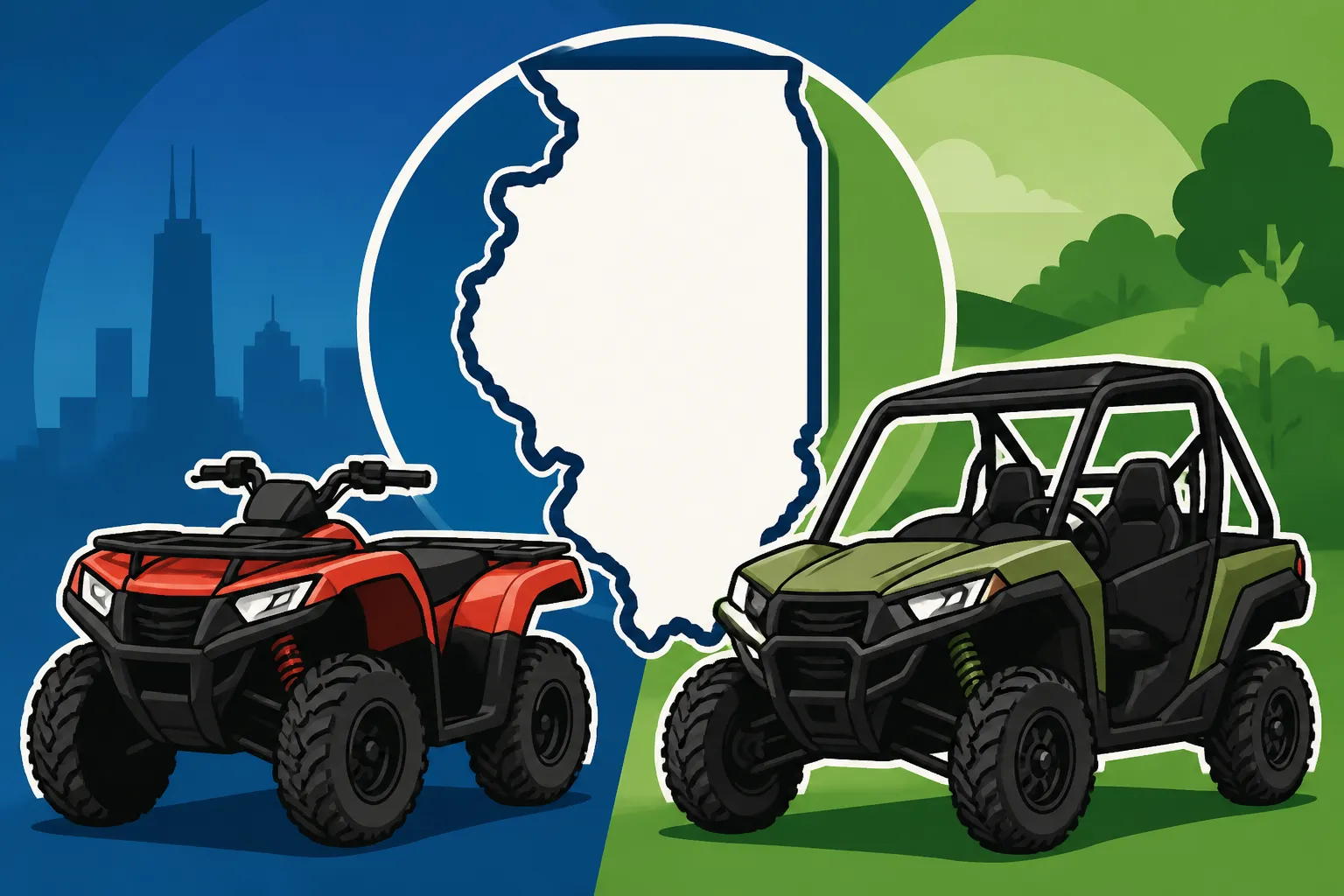
The term "Non-Highway Vehicle" covers a broad range of machines. While ATVs and UTVs are the most common ones that come to mind when we talk about recreational riding, the classification extends to other vehicles as well.
ATVs and Quads
All-Terrain Vehicles, commonly known as ATVs or quads, are quintessential NHVs. They are characterized by their straddle seating, handlebar steering, and low-pressure tires. Their design makes them incredibly agile and capable over diverse off-road terrain, from muddy trails to rocky paths. They are built for individual or sometimes two-up riding (if designed for it) and are primarily used for recreation, sport, or light utility tasks on private land or designated trails.
When you purchase an ATV, the manufacturer's certificate of origin (MCO) will typically indicate its status as an off-highway vehicle. This documentation, along with the machine's physical characteristics, firmly places it in the NHV category under Illinois law. While incredibly fun and useful in their intended environment, their lack of a full chassis, minimal lighting (often just headlights and taillights), and exposed riding position make them inherently unsuited for road traffic.
Utility Terrain Vehicles UTVs and Side-by-Sides
Utility Terrain Vehicles (UTVs), often called side-by-sides, have exploded in popularity. These machines typically feature side-by-side seating (hence the name), a steering wheel, foot pedals, and a roll-over protection structure (ROPS). They are incredibly versatile, used for everything from heavy-duty farm work and hunting to serious trail exploration. Because of their enclosed feel, larger size, and often more robust build, many owners eye them as potential candidates for street-legal conversion. [Illinois Title for a Side-by-Side] is also a thing, but that doesn't automatically mean road-legal.
Despite their car-like controls and increasing number of available accessories, UTVs are still classified as NHVs in Illinois. Like ATVs, they are engineered for off-road performance, prioritizing ground clearance, suspension travel, and traction over high-speed road stability and crash-worthiness. However, the market for UTV accessories that mimic road vehicle features – such as turn signal kits, rearview mirrors, and windshields – is booming. This demand is largely driven by riders hoping to meet specific local ordinance requirements to operate their NHVs on approved public roads.
Other Machines: Dirt Bikes, Golf Carts, and More
Beyond ATVs and UTVs, other machines also fall under the NHV umbrella, or a similar classification that restricts their road use. Dirt bikes, for instance, are classic off-road machines designed for motocross tracks, trails, and unpaved terrain. Like ATVs, they lack the necessary equipment and design characteristics for safe, legal operation on public roads by default.
Golf carts are another interesting case. While they are low-speed vehicles, they are generally restricted to golf courses and private property. However, many Illinois municipalities have passed specific ordinances allowing golf cart use on certain local streets, much like they do for UTVs. Snowmobiles, though seasonal, are also off-highway vehicles, permitted on designated trails or frozen waterways, but not public roads. The common thread among all these machines is that their primary design and intended use keep them off the public road network unless very specific, localized exceptions are made.
Navigating Road Access: When an NHV Can Hit Illinois Streets
This is where the flexibility (and potential confusion) comes in. While the state generally prohibits NHVs on public roads, Illinois law provides a pathway for local communities to allow them under specific, controlled circumstances.
The Power of Local Ordinances
The single most important factor in determining if your NHV can be ridden on a public road in Illinois is whether your local municipality – be it a village, city, or county – has passed a specific ordinance permitting it. The state grants these local governments the authority to allow ATVs and UTVs on certain designated streets within their jurisdiction. This means what's legal in one town might be completely illegal in a neighboring one. There isn't a blanket statewide "street legal" status for NHVs.
This hyper-local approach means the onus is entirely on the rider to research and understand the rules for every community they intend to ride in. You cannot assume that because your buddy can ride his UTV to the grocery store in his village, you can do the same in yours. This is why resources like [Illinois UTV Street Legal Rules by Town] are so valuable. These ordinances will typically specify which roads are open, what hours are permitted, and what equipment your machine must have to be compliant.
Specific Equipment Requirements for Permitted Roads
Even if a local ordinance allows NHVs on its roads, it almost always comes with a list of mandatory equipment upgrades to enhance safety and visibility. These requirements are designed to bring NHVs closer to the standards of road vehicles, making them safer to share the road. Common requirements include:
- Headlights and Tail Lights: Often, these must be illuminated at all times, and some ordinances might specify brightness or visibility ranges.
- Brake Lights: Essential for signaling deceleration to other drivers.
- Turn Signals: Required for clearly indicating turns, similar to a car.
- Rearview Mirrors: Typically at least one, often two, to provide visibility of traffic behind.
- Horn: An audible warning device for safety.
- Slow-Moving Vehicle Emblem: A reflective orange triangle sign, especially if the machine doesn't meet certain speed thresholds.
- Windshield: Some ordinances may require a windshield, and it might need to be DOT-approved.
- Seatbelts: Most UTVs have these from the factory, but they must be functional and worn.
- Tires: Occasionally, ordinances might specify DOT-approved tires, rather than aggressive off-road treads.
Meeting these requirements often means investing in aftermarket parts. For instance, if your local village has approved UTVs for street use, you'll almost certainly need to equip your machine with turn signals and a horn. Companies like SuperATV offer comprehensive kits designed to integrate seamlessly, ensuring you meet local requirements. Visibility is key, especially on public roads. Adding a robust set of rearview mirrors, perhaps from a brand like SuperATV, is often a mandatory requirement. You can find more details on this in [Illinois Non-Highway Vehicle Equipment List].
| Equipment Feature | Common Purpose on Road | Typical NHV Status (Factory) | Often Required by Local Ordinance |
|---|---|---|---|
| Headlights | Forward visibility | Yes (often for off-road) | Yes (often specific brightness) |
| Tail Lights | Rear visibility | Yes (often for off-road) | Yes (often specific visibility) |
| Brake Lights | Signal deceleration | Yes | Yes |
| Turn Signals | Indicate turns | No | Yes |
| Rearview Mirrors | Rearward visibility | No (sometimes one small one) | Yes (one or two) |
| Horn | Audible warning | No | Yes |
| Slow-Moving Vehicle Emblem | Alert faster traffic | No | Yes (for speeds < 25 mph) |
| Windshield | Driver protection | Optional/Partial | Yes (sometimes DOT-approved) |
| DOT-Approved Tires | Road traction & safety | No (off-road treads) | Sometimes |
Restricted Road Types and Speed Limits
Even when local ordinances grant some road access, there are still significant limitations. Generally, NHVs are universally prohibited from state highways, interstates, and tollways. These high-speed thoroughfares are deemed too dangerous for off-highway machines, regardless of local rules. You can find more information on [Illinois Crossings of State Highways], but the general rule is to avoid them unless it's a designated crossing at an intersection.
Furthermore, most local ordinances allowing NHVs on roads will specify strict speed limits, often much lower than the posted limit for cars. For example, a village might allow UTVs on streets posted 35 mph or less, and then impose a further maximum speed limit of 25 mph for the UTV itself. These restrictions are put in place for safety, acknowledging the design limitations of NHVs compared to conventional vehicles. It's crucial to always adhere to these speed limits and understand that even if a street is open to NHVs, not all roads within that jurisdiction will be. Moreover, you need to be aware of [Illinois Roads Under Two Jurisdictions] where both the county and the township might need to approve UTV use on a shared road.
Steps for Illinois Riders Seeking Local Road Access
If you're an Illinois rider hoping to take your NHV onto public roads within your community, there's a clear, sequential process you need to follow. Skipping any of these steps could put you at risk of fines, impoundment, or even worse, an accident.
Researching Your Local Municipality's Rules
This is the absolute first step, and it cannot be stressed enough: do your homework. Contact your village hall, city clerk's office, or county administrator's office. Many municipalities also post their ordinances online. You need to specifically ask about ordinances related to the operation of ATVs and UTVs on public roads. Don't rely on hearsay or what a friend in another town told you. The rules can be vastly different from one jurisdiction to the next, even if they're just a few miles apart.
When you find an ordinance, read it carefully, paying close attention to:
- Which specific types of machines are allowed (e.g., UTVs only, no ATVs?).
- Which roads are designated (e.g., only those with a speed limit of 35 mph or less, or only certain named streets).
- Hours of operation (e.g., dawn to dusk, no night riding).
- Any age or licensing requirements for operators.
- Specific equipment mandates.
It’s about being informed and responsible. Remember, ignorance of the law is not a valid defense. You're responsible for knowing [Illinois ATV Road Rules: Local Ordinances Decide] for your specific area.
Obtaining Necessary Permits and Registrations
If your local government does allow NHVs on its roads, there will almost certainly be a permit or registration process. This is separate from your state title. For instance, you might already have an [Illinois ATV Title Certificates Explained], but that's for ownership, not for road use. Many villages require you to apply for an annual permit, which often involves a fee and an inspection of your machine to ensure it meets all the required safety equipment standards.
The permit process typically involves:
- Application: Filling out paperwork with your machine's information (VIN, make, model) and your personal details.
- Fee Payment: A local administrative charge for processing the permit.
- Inspection: An official (often a police officer or village employee) will physically inspect your ATV or UTV to verify it has all the mandated equipment (lights, mirrors, signals, etc.).
- Permit Issuance: Once approved, you'll receive a sticker or plate that must be prominently displayed on your machine, signaling that it is permitted for local road use.
This local permit is your golden ticket for road access within that specific jurisdiction. Without it, even if your machine is equipped, you could still be ticketed for non-compliance.
Equipping Your Machine for Compliance
Once you know the specific equipment requirements from your local ordinance, it's time to get your machine up to snuff. This often means installing aftermarket parts. Don't assume your factory lights or horn (if it even has one) will be sufficient. Many riders find that equipping their UTV for local road use requires more than just basic additions. For example, if your local ordinance mandates DOT-approved tires for street use, you might need to upgrade. Brands such as SuperATV offer a wide selection of tires and other accessories specifically designed to enhance both off-road performance and on-road compliance, helping you meet those specific local requirements.
Here's a checklist of things to consider when equipping your machine:
- Lighting Kits: Full turn signal kits, often with a horn.
- Mirrors: Robust rearview mirrors that stay put, even on bumpy rides.
- Windshield: If required, ensure it's made for your machine and meets any specific material requirements.
- Tires: If DOT-approved tires are a must, you'll need to swap out your aggressive mud tires for street-friendly ones.
- Slow-Moving Vehicle Emblem: Securely mount this on the rear of your machine.
Always prioritize quality and proper installation for any aftermarket additions. These aren't just cosmetic changes; they are crucial safety features. It's about making your NHV as visible and predictable as possible to other road users, ensuring that your decision to utilize local road access is both legal and responsible.
Disclaimer
This article is for general informational purposes only and does not constitute professional advice. Laws, prices and regulations vary by location and change over time. Consult a qualified professional for guidance on your specific situation.