Illinois Private Park Age Minimums
Illinois private ATV and UTV parks do not all use the same age minimum. One may set rules by a child’s age, another by the machine they plan to ride, and a third may require an adult nearby. Before you make the drive, confirm the park’s current policy for your child, vehicle, passengers, and waiver.
Why Illinois Private Parks Set Their Own Age Rules
A private park’s minimum age is a condition of riding at that property. It is not a single age limit that applies to every private riding area in Illinois. Each operator can set rules based on its trails, machines, insurance requirements, and approach to supervision.
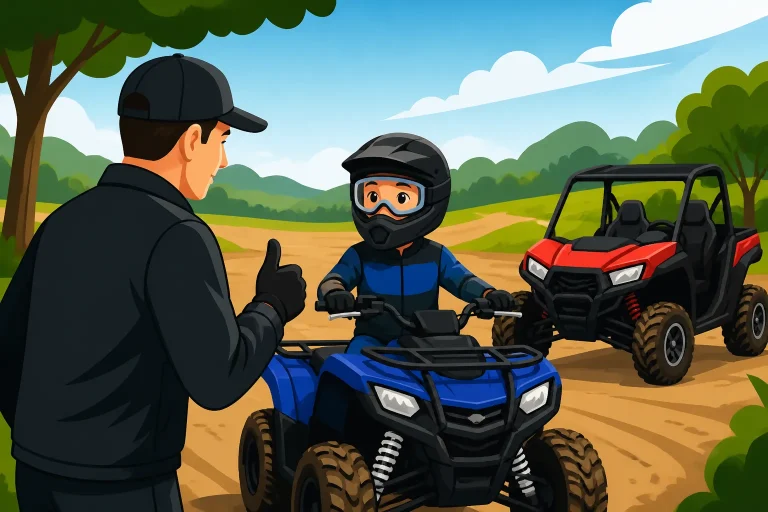
That means the rules at one park may not tell you what to expect at another. A facility might allow children to ride certain youth machines but restrict them from adult-sized vehicles. It might require a parent to remain on site, supervise from a nearby trail, or ride along in a UTV. Another park might not allow young children on the trails at all.
Age rules can also distinguish between operating a machine and being a passenger. A child who is too young to drive a particular UTV may still be permitted as a passenger if the park allows it and the vehicle has an appropriate seat. Never assume that a passenger is automatically allowed because a driver meets the age minimum. Check Which Passengers a Riding Park Will Allow for more on why passenger rules deserve their own confirmation.
There are practical reasons for these differences. Trail surfaces, hills, traffic, visibility, and the size of the riding area all affect how a park manages younger riders. A compact youth quad on a beginner route presents a different situation from a powerful adult machine on a narrow, steep trail. Parks may also have different equipment and staffing, so their supervision policies can vary.
A useful starting point is to treat the park’s age rule as one part of a broader eligibility check. Ask whether it applies to:
- Entry onto the property
- Driving a machine
- Riding as a passenger
- Riding without an adult beside the child
- Particular types or sizes of vehicles
- A child’s participation in a group or family ride
A child may meet one requirement and still be restricted by another. For example, a park might permit a child on the property but require an adult to accompany them on every trail, or allow a young rider only on a smaller machine.
What to Confirm Before You Go
Do not rely on a general age statement, a social media comment, or another family’s past visit. Policies can differ by venue and may change. Contact the park directly before planning around a child’s participation, especially if the child is near a stated minimum age.
Give the park enough detail to answer your question accurately. Instead of asking only, “Can my child ride?”, explain the child’s age, the machine’s type, and whether the child will drive or ride as a passenger. If the park asks for the machine’s make, model, or engine size, provide it rather than describing it only as a “small quad.”
| Question to ask | Why it matters |
|---|---|
| What is the minimum age to enter or ride? | Entry and operating eligibility may be separate rules. |
| Does the rule depend on the machine? | A park may treat youth machines and adult machines differently. |
| Can a child ride as a passenger? | Passenger permission may have a separate minimum or conditions. |
| Must a parent or guardian be present? | Supervision may be required even when the child can operate. |
| Does the adult have to ride with the child? | Being on the property may not satisfy a trail-supervision rule. |
| What must the child wear or bring? | The park may set equipment or identification conditions. |
| Who signs the waiver? | A minor generally cannot sign an adult waiver on their own; ask the operator how it handles minors. |
| Are any trails or machines off limits to young riders? | A park’s rules may vary within the property. |
It is also worth asking whether the policy applies to the specific day you plan to visit. A special event, organized group ride, or unusually busy day can have additional restrictions. Confirm the answer with the staff member or office responsible for current admissions and riding rules, and keep a record of the information if it affects a long trip.
If the park has a written rule page, read the full policy rather than relying on a short age summary. Look for separate sections on riders, passengers, supervision, helmets, and waivers. Illinois Private Park Waivers and Rules covers the broader role park-specific policies can play.
Age, Machine Size, and Supervision
A child’s age is only one measure of whether a ride is appropriate. The park may have a minimum age, but the parent or guardian still needs to consider whether the machine suits the child’s size, coordination, judgment, and experience. A child who meets a park’s minimum is not automatically ready for every vehicle or trail.
Some parks refer to manufacturer guidance for youth machines. These recommendations are tied to the vehicle, not a universal promise that a child can safely handle it. Check the age guidance for the particular model and compare it with the park’s rules. If the two do not line up, follow the stricter requirement and ask the park before arriving. Manufacturer Age Guidance at a Park explains why the manufacturer’s recommendation and a venue’s admission policy are separate checks.
Supervision needs the same careful reading. “Adult supervision required” can mean different things in practice. It might mean a responsible adult must remain on the property, ride in the same group, or be close enough to respond immediately. Ask what the park means rather than assuming that an adult waiting at the parking area will meet the requirement. For more on this distinction, see Illinois Supervision at a Riding Park.
Before deciding whether a child is ready, consider:
- Whether they can reach and use the controls comfortably
- Whether they can stop, turn, and respond to instructions
- Whether they understand trail signs and the need to keep distance
- Whether they can manage the route without pressure from faster riders
- Whether an adult can supervise at the level the park requires
- Whether the machine fits the child and is in suitable condition
A child may have ridden at home or on private land and still be unfamiliar with a park’s terrain, traffic, or group-riding expectations. Start with the park’s least demanding permitted route, if one is available, and do not let a child feel pushed into keeping up with older or more experienced riders. If the park does not offer a suitable route for the child, the safest choice may be to postpone the ride.
Ask whether a parent can accompany the child on the same machine or in the same group, and whether the park allows that arrangement for the vehicle involved. A UTV passenger seat is not a substitute for a park-approved supervision plan. Likewise, an adult riding nearby may not be enough if the child needs direct help or the park requires a different setup.
Waivers, Safety Rules, and Common Planning Mistakes
Parks commonly use waivers and other participation rules to explain risks and set expectations. When a rider is a minor, confirm in advance who must complete the paperwork and whether the parent or guardian needs to be present at check-in. Do not assume that a waiver signed at home, or a form signed by a relative who is not the child’s guardian, will be accepted. See Parents Must Sign the Waiver for a Child for this specific issue.
A waiver does not replace the age rule, machine requirements, or a parent’s judgment. It also does not mean a park will admit a child who does not meet its conditions. Ask what identification or proof of age the park expects, especially if the child’s age is close to the threshold.
Other safety requirements may apply regardless of age. Check the park’s current rules for helmets, clothing, vehicle condition, speed, and passenger seating. If the machine has been modified, ask whether those changes are allowed; a vehicle that differs from factory specifications may face restrictions at some venues. Why a Modified Machine Gets Turned Away discusses why it is sensible to check before loading up.
Common planning mistakes include:
- Assuming a rule at one park applies statewide. Private facilities set their own admission policies, so confirm with the specific venue.
- Checking only the driver’s age. A child riding as a passenger may be covered by a different rule.
- Treating a machine’s size as proof of eligibility. The park may use model, type, or other criteria, not just how small the vehicle looks.
- Confusing supervision with presence. Ask whether an adult must be on site, riding along, or directly accompanying the child.
- Waiting until the gate to ask. A child can be turned away if the park’s minimum or paperwork rules are not met.
- Assuming a waiver settles every question. It does not override the park’s operating conditions or establish that the child is ready to ride.
- Relying on old information. Contact the park before each visit if the policy affects your plans.
If your plans involve a child who is close to the minimum age, ask the park for a clear answer about that child’s exact situation. Confirm the type of machine, whether the child will drive or ride as a passenger, the adult’s required role, and what paperwork is needed. Make the decision before you leave home, not after arriving with a trailer and a disappointed young rider.
For the wider rules that can affect younger participants at riding venues, Illinois Rules for Young Riders is a useful companion. Keep the distinction clear: park admission policies apply at that facility, while other rules may apply to riding elsewhere. A private park’s permission is not a general authorization to ride on roads or public land.
Disclaimer
This article is for general informational purposes only and does not constitute professional advice. Laws, prices and regulations vary by location and change over time. Consult a qualified professional for guidance on your specific situation.