Illinois Mirror Requirements for an ATV
Riders in Illinois often feel a real headache trying to understand exactly what it takes to make their beloved ATV or UTV truly "street legal." It's not just about getting permission from your local village or county; there's a whole list of equipment requirements that can feel like deciphering ancient texts. One of the most overlooked, yet absolutely critical, pieces of the puzzle is the rearview mirror. This guide will cut through the confusion and walk you through everything you need to know about Illinois's mirror requirements, ensuring your machine is not only compliant but also safe for the road.
The Essential Role of Mirrors for Illinois ATV & UTV Street Legality
Let's be honest, when you think about off-road machines, mirrors aren't usually the first thing that comes to mind. Your focus is likely on power, suspension, and tackling challenging trails. However, the moment you consider taking your ATV or UTV onto any public road in Illinois, even just to cross a street, the game changes entirely. Mirrors transition from an optional accessory to a non-negotiable legal requirement and, more importantly, a vital safety feature. Many riders feel frustrated by the constant back-and-forth about what's allowed on which roads, and this feeling often extends to the seemingly mundane details of equipment like mirrors.
Beyond the Law: Why Visibility is Your Best Friend
While the law dictates the need for a rearview mirror, the practical safety benefits are immense. Off-road machines, by their nature, aren't designed with the same peripheral vision considerations as cars or trucks. Without adequate mirrors, you're operating with significant blind spots, especially when merging, turning, or even just checking for traffic behind you. Imagine pulling out from a side road onto a busier street, or even just crossing a country lane, and not being able to see that rapidly approaching car or another machine. It’s a recipe for disaster. Mirrors give you the awareness you need to react to changing traffic conditions, other vehicles, cyclists, and pedestrians, transforming your machine into a more predictable and safer presence on the road.
This isn't just about avoiding a ticket; it's about avoiding an accident that could have serious consequences. Riding an ATV or UTV on a public road, even if your local [Illinois Rules for Riding a Village Street] allows it, puts you in a different league than trail riding. You're sharing space with heavier, faster vehicles whose drivers might not be expecting an off-road machine. Having a clear, unobstructed view of what's behind and to your sides is crucial for defensive driving. Think of it as your machine's extra set of eyes, giving you the confidence to navigate shared roadways safely and responsibly.
The Frustration of Unclear Regulations and How Mirrors Fit In
One of the biggest complaints from Illinois riders is the patchwork of regulations. What's legal in one town might be forbidden just a few miles down the road. This can lead to significant frustration, as riders just want clear, consistent guidelines. When it comes to equipment like mirrors, the state provides a baseline, but local ordinances can sometimes add nuances. However, the requirement for a rearview mirror for street use is fairly universal across the state wherever road riding is permitted. It's one of those foundational elements that helps bridge the gap between an off-road vehicle and a road-worthy one.
The reason for this common requirement is simple: consistency in safety. Lawmakers understand that if off-road machines are going to share space with conventional vehicles, they need to meet certain basic safety standards. A rearview mirror falls squarely into this category. It's a critical component of the [Illinois Non-Highway Vehicle Equipment List] that helps standardize what a "street legal" ATV or UTV should look like. While you might still need to contend with local rules regarding [Illinois UTV Street Legal Rules by Town], the mirror requirement is a fundamental aspect of making your machine road-ready, reducing confusion for both riders and law enforcement.
Decoding Illinois's Specific Mirror Requirements for Road Use
So, what exactly does Illinois law say about mirrors for your ATV or UTV when you're on the asphalt? It’s not as complicated as some other regulations, but paying close attention to the details can save you from a traffic stop or worse. The state's vehicle code is pretty clear on the necessity of rearview mirrors for vehicles operating on public roadways. This applies directly to ATVs and UTVs when they transition from the trail to the street.
What the Illinois Law Actually Says About Rearview Mirrors
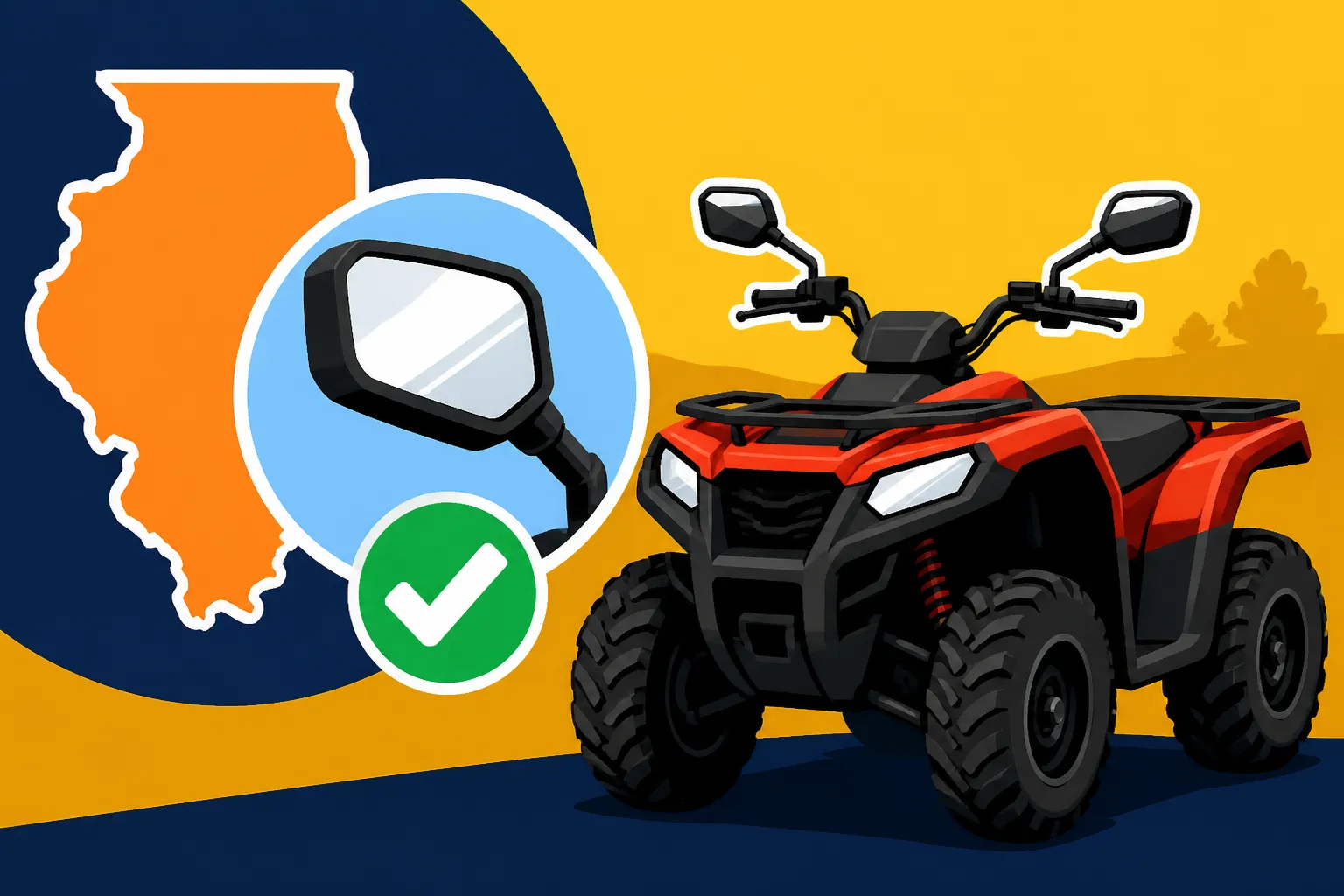
For any non-highway vehicle, which includes ATVs and UTVs, that is operated on a public street or highway in Illinois where permitted, the law generally requires it to be equipped with a rearview mirror. Specifically, the Illinois Vehicle Code states that "every motor vehicle, operated singly or when towing another vehicle, shall be equipped with a mirror so located as to reflect to the driver a view of the highway for a distance of at least 200 feet to the rear of such motor vehicle." This isn't just a suggestion; it's a mandate. This is why you will find [Illinois Requires a Rearview Mirror] on any list of required equipment for street-legal machines.
What this means for your ATV or UTV is that you need at least one mirror. While many cars have three mirrors (a center rearview and two side mirrors), for an ATV or UTV, typically one properly positioned rearview mirror is considered sufficient to meet this specific legal wording, as long as it provides that 200-foot view. However, for enhanced safety and to minimize blind spots, many riders opt for a combination of a wide-angle center mirror and perhaps one or two side mirrors. More visibility is always better when sharing the road with cars and trucks.
Understanding "Adequate" Vision: What Does That Even Mean?
The phrase "reflect to the driver a view of the highway for a distance of at least 200 feet to the rear" is key. "Adequate" vision, in this context, means you can clearly see vehicles approaching from behind you within that specified distance. This isn't about seeing the top of your own helmet or a sliver of the landscape; it's about seeing traffic. This is why the placement and type of mirror are so important. A small, vibrating mirror that only shows you your own shoulder won't cut it. You need a mirror that is stable, appropriately sized, and positioned so that you have an unobstructed view directly behind you.
Consider the common issue of vibration on an ATV or UTV. These machines are built for rugged terrain, and often that means a lot of vibration. A mirror that rattles excessively will make it impossible to get a clear image, thus failing the "adequate view" test. This is where investing in quality mirrors designed for off-road use, but with street functionality in mind, pays off. The goal is a steady, clear image that allows you to confidently assess the traffic situation behind you without straining or guessing.
When and Where These Mirror Rules Apply
The mirror requirement kicks in whenever your ATV or UTV is operated on a public roadway. This includes village streets, county roads, township roads, and even when crossing state highways. If you're riding exclusively on private property, designated off-road trails like Sahara Woods, or [Illinois Machines Used Only in a Yard], then the rearview mirror is optional, purely a matter of personal preference for convenience and safety. However, the moment your wheels touch public pavement, the mirror becomes a legal necessity.
This even applies to brief crossings. Let's say you're moving your UTV from one field to another across a public road. Even for that short traverse, your machine must be equipped with the required mirror. The law doesn't differentiate between short and long distances when it comes to basic equipment. If you're contemplating a ride that includes any public road segment, even a short one, ensure your mirrors are installed and correctly adjusted. Ignoring this simple requirement could lead to [Illinois Penalties for Illegal Street Riding], which no one wants.
Selecting and Installing the Right Mirrors for Your Machine
Choosing the right mirror for your ATV or UTV isn't just about slapping the first one you find onto the handlebars or roll cage. It requires a bit of thought to ensure it meets legal requirements, provides optimal visibility, and stands up to the rigors of both road and trail use. With so many options out there, it can feel a bit overwhelming, but focusing on key features will help you narrow down the best choice for your machine and riding style.
Types of Mirrors: From Basic to Advanced
When it comes to mirrors for ATVs and UTVs, you generally have a few main categories:
- Handlebar Mirrors: These are common for ATVs and some UTVs, mounting directly to the handlebars. They are usually compact but can be prone to vibration and may not offer the widest field of view. Their primary advantage is ease of installation and typically lower cost.
- Side Mirrors (Roll Cage Mounted): These are extremely popular for UTVs, attaching to the roll cage or A-pillar. They offer excellent side visibility, mimicking a car's side mirrors. They come in various sizes and mounting styles, often with breakaway features to prevent damage on trails.
- Center Rearview Mirrors: Mounted in the center of the UTV's roll cage or windshield frame, these provide a wide, unobstructed view directly behind the machine. Many riders find these essential for road use, often pairing them with side mirrors for comprehensive rear vision. These mirrors often come in wide-angle or panoramic designs.
Each type has its pros and cons, and the best setup often involves a combination. For example, a UTV rider might opt for a center rearview mirror for a broad view behind, complemented by two side mirrors to cover blind spots. For an ATV, a sturdy handlebar mirror might suffice legally, but some riders add a helmet-mounted mirror for extra awareness.
Key Considerations When Shopping for ATV/UTV Mirrors
When you're ready to buy, keep these factors in mind to ensure you get mirrors that work for you:
- Durability: Off-road machines take a beating. Look for mirrors with robust housings, shatter-resistant glass (or acrylic), and strong mounting hardware. Materials like aluminum and high-impact plastics are good indicators of quality. Products from reputable brands like SuperATV are often designed with this kind of durability in mind, understanding that your machine will encounter bumps and branches.
- Vibration Resistance: As mentioned earlier, vibration is a mirror's enemy. Seek out designs with secure mounting systems, internal dampeners, or sturdy arms that minimize shake. Mirrors specifically advertised as "vibration-dampening" or "heavy-duty" are a good bet.
- Field of View: A wider field of view means better visibility. Look for convex or panoramic glass in center mirrors, and adjustable arms on side mirrors to fine-tune your perspective. Remember, you need to see at least 200 feet behind you.
- Breakaway Feature: For UTV side mirrors, a breakaway or folding feature is highly desirable. This allows the mirror to pivot or fold in if it hits a tree branch or obstacle on the trail, preventing damage to the mirror itself or the roll cage. SuperATV offers several mirror options with this practical feature.
- Mounting Compatibility: Ensure the mirrors you choose are compatible with your machine's handlebars (diameter) or roll cage (tube size). Most manufacturers offer different clamps for various tube diameters.
- Adjustability: Easy adjustment is crucial for setting up your mirror for optimal rear visibility, especially if multiple riders use the machine or if you change your riding position.
Installation Tips: Getting It Right the First Time
Proper installation is just as important as choosing the right mirror. A poorly installed mirror won't stay put, will vibrate excessively, or might even fall off on a bumpy ride.
- Read the Instructions: It sounds obvious, but different mirrors have different mounting hardware and procedures. Don't assume you know best.
- Choose the Right Location: For ATVs, handlebar mirrors should be positioned to give you a clear view behind you without obstruction from your body or other accessories. For UTVs, side mirrors should be placed far enough out to clear the machine's width, while center mirrors should be high and central. Remember, the goal is to see at least 200 feet to the rear.
- Secure Mounting: Use all supplied hardware and tighten clamps firmly. For roll cage mounts, ensure the clamps are snug against the tube to prevent rotation and vibration. A little Loctite on threads can prevent screws from backing out over time due to vibration.
- Adjust for Optimal View: Once installed, sit on your machine in your normal riding position and adjust the mirror(s) to give you the best possible view directly behind you. Check for blind spots by having someone walk around the rear of your machine. This is a critical step, as [Illinois Equipment Inspections by a Village] will likely check this.
- Test Ride: Take a short, slow ride to ensure the mirrors stay in place and maintain clarity. Make any final adjustments as needed.
Common Mirror Challenges and Practical Solutions for Illinois Riders
Even with the perfect mirrors chosen and installed, you might run into some common issues when using your ATV or UTV on Illinois roads. Understanding these challenges beforehand and knowing how to address them can save you a lot of headaches and keep you in compliance with the law. After all, what good is a mirror if you can't actually see anything in it?
Dealing with Vibration and Poor Visibility
Vibration is arguably the number one enemy of clear mirror vision on an ATV or UTV. These machines are inherently prone to transmitting engine and terrain vibrations through the frame, and unfortunately, that can make its way to your mirrors. If your mirrors are constantly shaking, they're not providing that "adequate view" required by law.
Solutions for Vibration:
- High-Quality Mirrors: This goes back to choosing wisely. Higher-quality mirrors often have better internal construction and mounting systems designed to absorb or dampen vibrations. Look for heavy-duty components and robust clamping mechanisms.
- Rubber Isolators: Many mirror kits come with rubber shims or sleeves for mounting. If yours didn't, adding rubber washers or strips between the mirror mount and the handlebar/roll cage can help absorb some of the vibration before it reaches the mirror housing.
- Tighten All Fasteners: Loose bolts and clamps are a primary source of mirror wobble. Periodically check and tighten all mounting hardware for your mirrors, but be careful not to overtighten and strip threads or crack plastic.
- Add Support: For some handlebar-mounted ATV mirrors, adding a small brace from the mirror housing to a more stable point on the handlebars might help. For UTV roll cage mirrors, ensure the roll cage itself isn't flexing excessively, which might require a different mounting point or a more rigid mirror arm.
Poor visibility can also stem from dirt, mud, or water spray. Regularly cleaning your mirrors, especially before you head out on the road, is essential. Carrying a small microfiber cloth on longer rides isn't a bad idea, especially if you're traversing dusty country roads where [Dust on a Gravel Township Road] can quickly obscure your view.
Ensuring Compliance: What to Expect from Law Enforcement
When you're out riding on public roads in Illinois, whether it's a village street or a county road, law enforcement officers (which could include local police, sheriff's deputies, or even conservation officers if you're near a park entrance) have the authority to pull you over to check for compliance. They'll be looking at all the required equipment, and mirrors are definitely on that checklist.
What they'll likely check for:
- Presence of a Mirror: Is there actually a rearview mirror on your machine?
- Placement: Is it positioned to give the driver a clear view to the rear?
- Functionality: Does it offer an "adequate" view (i.e., not constantly vibrating, not cracked, not obstructed)? They won't usually get out a tape measure for the 200-foot rule, but they will look for clear, unobstructed visibility.
If your machine is found to be non-compliant, you could face a citation. While a mirror violation might not be as severe as a DUI, it's still a headache and can result in fines and court costs. Some villages that issue [Illinois Towns With UTV Permits] might even conduct an [Illinois Equipment Inspections by a Village] before granting you a permit, specifically checking that your mirrors (along with other items like [Illinois Requires a Slow-Moving Vehicle Emblem] or [Illinois Requires a 500-Foot Headlight]) meet their standards. It’s always best to be proactive and ensure your equipment is squared away before you even leave your driveway.
Mirror Maintenance for Long-Term Safety and Legality
Just like any other part of your ATV or UTV, your mirrors need a little TLC to keep them in top working order. Regular maintenance ensures they remain safe, effective, and compliant.
Maintenance Tips:
- Regular Cleaning: As mentioned, dust, dirt, and mud are common enemies. A quick wipe-down with a soft cloth and mild cleaner will keep the reflective surface clear. Avoid abrasive cleaners that could scratch the mirror.
- Check for Cracks or Damage: Off-roading can lead to bumps and scrapes. Inspect your mirrors periodically for cracks in the glass, damage to the housing, or bent arms. Even a small crack can impair visibility and potentially lead to bigger problems. Replace damaged mirrors promptly.
- Inspect Mounting Hardware: Vibration can loosen bolts and clamps over time. Before each ride that involves road use, quickly check that all mounting hardware is tight and secure. Address any wobbling or excessive play immediately.
- Adjust as Needed: Your riding position, cargo load, or even tire pressure can subtly change your machine's stance and affect your mirror's optimal adjustment. Take a moment before each ride to ensure your mirrors are still providing the best possible view of the rear.
- Winter Storage: If you're storing your machine over winter, especially outdoors, consider covering the mirrors or removing them if they're easily detachable. This protects them from harsh weather conditions and prolongs their life.
By being diligent with your mirror choices, installation, and ongoing maintenance, you'll not only meet Illinois's legal requirements for operating your ATV or UTV on public roads but also significantly enhance your safety and peace of mind.
Comparing Mirror Types for Your Illinois Machine
To help you decide which mirror setup might be best for your specific machine and riding habits, here's a quick comparison of common mirror types. Remember that often, a combination provides the best overall visibility.
| Mirror Type | Best For | Pros | Cons | Key Consideration for Illinois Roads |
|---|---|---|---|---|
| Handlebar Mirror | ATVs, some UTVs (if handlebar-mounted) | Simple installation, direct view for ATV rider | Can be prone to vibration, smaller field of view, potential obstruction on tight trails | Must provide 200 ft view to rear; choose vibration-dampening models |
| Side Mirror | UTVs (roll cage mounted) | Excellent side/rear visibility, mimics car mirrors, often have breakaway features | Can be wider than machine, potential for branch hits off-road | Essential for comprehensive UTV road visibility, look for durable construction |
| Center Rearview Mirror | UTVs (roll cage/windshield mounted) | Wide panoramic view directly behind, great for assessing traffic | Can be obstructed by passengers/cargo, not always useful for blind spots | Great primary mirror, especially when paired with side mirrors for full coverage |
Whether you're looking for [Illinois Rules for Riding a County Road] or just trying to quickly cross a local street, having the right mirrors—and knowing they're properly set up—is a crucial step in responsible riding. Don't let this seemingly small detail be the reason you run into trouble.
Disclaimer
This article is for general informational purposes only and does not constitute professional advice. Laws, prices and regulations vary by location and change over time. Consult a qualified professional for guidance on your specific situation.