Illinois ATV Clubs Worth Joining
Choosing an Illinois ATV club can be harder than it sounds: some groups organize rides, while others help maintain or operate a place to ride. This guide explains what membership may offer, how to find a club that fits your machine and riding style, and what to check before you join or tow to a new area.
What Illinois ATV clubs can offer
Riding community, organized events, and local knowledge
A good club can make riding feel less like planning a solo expedition. Members may share trail updates, organize group outings, volunteer at work days, or help newcomers understand local etiquette. That practical knowledge matters when you’re trying to learn where a group can ride legally, how a site handles check-in, or whether a particular route suits a beginner.
Clubs can also make it easier to meet riders with similar interests. A family with a youth quad may want a different pace and terrain from a group focused on technical trails. Side-by-side owners may need routes that accommodate wider machines, while dirt-bike riders may be looking for single track. Before joining, ask what kinds of rides the club usually arranges and whether members commonly ride machines like yours.
Local knowledge is especially useful in Illinois, where riding opportunities can be limited to designated areas, private parks, or land where you have clear permission. A club’s advice can help you narrow down options, but membership alone does not grant permission to ride on someone else’s property or on land that is closed to machines. Review [Illinois Land You May Not Ride] and confirm access rules directly with the site or landowner.
Volunteering and supporting riding areas
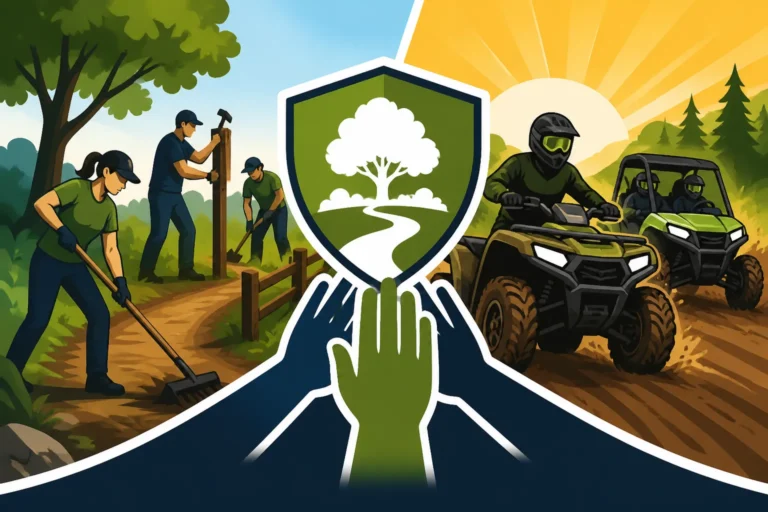
Some clubs help keep riding opportunities available by contributing volunteer time, organizing events, or supporting a club-run riding area. That involvement may be appealing if you want more than a place to ride: you might enjoy helping with trail upkeep, event setup, or the less glamorous work that keeps a riding community functioning.
A local example is Little Egypt Off Road, a club-run riding area outside Marion. It can be a useful starting point for researching organized club riding in southern Illinois, but don’t assume every club has the same membership structure, access terms, or volunteer expectations. Ask what joining means in practice: whether membership includes any riding privileges, whether there are separate day-use requirements, and whether volunteers are expected to help at specific events.
Membership is not automatically a substitute for site rules or permits. A club-run park may set its own admission, age, equipment, waiver, and operating rules. If you’re comparing membership with a one-day visit, read [What a Club Day Pass Buys Near Marion] and [Illinois Private Park Waivers and Rules] so you understand what access and paperwork are handled separately.
How to find a club that fits your riding
Start with the kind of riding you actually do
Before searching for an Illinois ATV club, describe your usual riding day. Are you looking for family-friendly routes, mud, single track, a place to ride a side-by-side, or organized weekend events? Do you want to camp nearby, meet other riders, or volunteer? A club may be active and welcoming but still be a poor match if its rides focus on terrain or machines that don’t suit you.
Location matters, too. A club that rides near Marion may not be a convenient choice for someone based around Chicago, Rockford, Peoria, or Springfield. If you’re willing to tow farther, think about how often you’ll realistically make the trip. A group with a strong calendar several hours away may be less useful than a smaller local community that can help you find occasional rides closer to home.
For a broader view of where riding is possible, compare [Illinois Southern Riding Areas] and [Illinois Northern Riding Areas]. Then check whether the club’s events take place at a private park, a club-run area, or another designated site. Don’t treat a general trail map or a club discussion as proof that an unmarked road or property is open to ATVs.
Ask direct questions before you pay dues
A short conversation can reveal whether a club is a good fit. Ask how often members ride together, where events are generally held, whether new riders are welcome, and how the group handles different experience levels. If you have children, a passenger, or a wide side-by-side, ask about the practical constraints before you make plans.
Also ask what the membership actually covers. It may provide community access or participation in club activities without including riding fees, a site pass, an Illinois access decal, or a separate permit. Get that distinction clear before budgeting. For state requirements, see [Illinois OHV Permits: Two Stickers Explained] and [What the Stamp Covers and What the Decal Covers].
If you’re using onX Offroad to explore routes or save potential destinations, treat it as a planning aid, not confirmation of legal access. Maps can help you organize a trip and orient yourself, but they don’t replace a club’s current directions, posted site rules, landowner permission, or official closure notices. Ask the club or riding site which roads and trails are approved for your machine.
| What to ask | Why it matters |
|---|---|
| Where do club rides usually take place? | Helps you judge travel time and confirm the riding area |
| What machines and experience levels are common? | Shows whether the group suits your ATV, UTV, or dirt bike |
| What does membership include? | Separates club benefits from site fees, permits, and decals |
| Are guests or new riders welcome at events? | Clarifies how to try a ride before committing |
| Are there volunteer expectations? | Helps you understand the time commitment |
| What rules apply to children and passengers? | Prevents surprises at check-in or on the trail |
| How are closures and schedule changes shared? | Gives you a way to check before towing |
Compare club riding with other Illinois options
Club-run areas and independently operated parks
A club-run riding area can offer a stronger sense of community and may provide ways to participate beyond riding. You may meet local riders, learn what to bring, or have opportunities to help with events and upkeep. But the details vary. Confirm the riding area’s operating schedule, admission process, machine requirements, and membership benefits directly rather than assuming that every club operates like Little Egypt Off Road.
Other Illinois riding options are run by different kinds of organizations. Mill Creek Park is run by Clark County, while Heartland Lodge runs a riding area at Nebo. Those places may be useful alternatives if you’re mainly looking for a destination rather than club membership. The operator matters because it determines whom to contact about access, rules, reservations, and closures. Compare [How a County Park District Runs an OHV Site] with [Illinois Riding Areas That Take Reservations] when deciding how much advance planning a trip may require.
A club can be a good social fit even if its riding area isn’t the closest one to home. Conversely, a nearby park may be more convenient if you prefer to ride independently. Think about whether you value scheduled group rides, a recurring community, volunteer opportunities, or simply a legal place to unload and ride. Those are related needs, but they are not the same thing.
Public access, private land, and site-specific rules
Illinois riders sometimes assume that public ownership means motorized riding is allowed. It doesn’t. A public parcel, forest, or conservation area may be closed to ATVs and UTVs unless a designated route or riding facility is provided. Similarly, a trail shown on a map is not necessarily open to motorized vehicles. Confirm the specific site’s rules before driving there.
A club’s ride announcement can be helpful, but follow the site’s instructions rather than relying on an old post or a route someone remembers from a previous season. Check whether the event is at a grant-assisted riding site, a private park, or private land with permission. The requirements can differ. [Illinois Grant Site Rules for Riders] explains why access rules are distinct from general riding permissions.
Don’t assume an Illinois usage stamp opens a riding area by itself. The stamp and access decal serve different purposes, and a decal may be required at grant-assisted sites. Learn the distinction in [Illinois Usage Stamp vs Access Decal]. If you ride with a club, ask the organizer what each participant must carry or display, then confirm any requirements with the site.
Make your first club ride go smoothly
Prepare your machine and paperwork
Once you’ve found an event, get the details before loading the trailer. Ask about check-in times, parking, permitted machine types, helmet requirements, waivers, and whether every rider needs a separate registration. If the group is heading to a private park, check its rules rather than assuming that your usual riding routine will apply there.
Prepare the machine for the conditions you expect. A muddy southern Illinois route may call for different tires and cleanup supplies than a dry, hard-packed ride. Make sure the machine is mechanically sound, bring basic tools, and carry water and a first-aid kit. If the destination has limited cell service, save directions and any necessary confirmation information before leaving home. [Illinois Trail Conditions Before You Tow] is a useful reminder to check conditions before committing to a long drive.
Keep documents and access information organized. A title or proof of ownership may be useful, and some sites require permits, waivers, or check-in materials. If you’re uncertain what to bring, ask the event organizer for a checklist. For permit placement and site-specific documentation, use [Illinois Permit Placement on a Machine] as a starting point, then verify the instructions for the actual riding location.
Be a considerate group rider
The first outing is a chance to learn how the group communicates and handles different paces. Ask whether riders are expected to stay together, wait at trail junctions, or use a buddy system. Don’t be embarrassed to say that you’re new to the area or need an easier route. A responsible group should be able to explain its pace and help you choose a ride that matches your experience.
Follow posted rules and the organizer’s instructions, even if you’ve ridden somewhere similar. Stay on approved routes, give other riders room, and avoid pushing beyond your comfort level to keep up. If you encounter a closure, a damaged trail, or a conflict over access, tell the organizer rather than trying to improvise a detour.
Afterward, consider what worked. Was the trip manageable? Did the group’s riding style suit your family or machine? Were the location and event communication clear? One ride can help you decide whether to join, attend another event as a guest, or look for a different club. You’re not choosing only a name on a membership form; you’re choosing a community, a travel pattern, and a way of accessing organized riding.
Disclaimer
This article is for general informational purposes only and does not constitute professional advice. Laws, prices and regulations vary by location and change over time. Consult a qualified professional for guidance on your specific situation.