Illinois Trail Closures After Rain
A rainy forecast can turn an Illinois ATV weekend into a long drive to a locked gate—or a muddy ride that damages trails and puts other riders at risk. This guide explains why parks close after rain, how conditions differ across the state, what to check before you tow, and how to decide whether a trail is genuinely ready to ride.
Why Illinois ATV trails close after rain
Rain affects more than how muddy a trail looks. Water can soften the ground beneath the surface, make slopes and turns slippery, wash out sections of trail, and leave standing water that takes time to drain. A route that seems passable from the parking area may be unsafe or vulnerable to damage farther in.
Closures are usually decisions made by the land manager or riding-area operator, not a single statewide rule that automatically closes every trail after a certain amount of rain. That means two areas in the same region can make different calls on the same day.
Soil, slopes, and trail design all matter
Illinois riding areas have varied terrain. A trail through wooded ground near the Shawnee Hills may shed water differently from a low, flat route in central Illinois. At a site built on reclaimed mining ground, steep grades and exposed soil can create their own problems after a storm. Even neighboring trails can dry at different rates depending on shade, drainage, and how heavily they are used.
Clay is a particular headache when it gets wet. It can become slick under tires, cling to treads, and pack into a machine’s frame or radiator. On a slope, a layer of wet clay can make steering and braking unpredictable. In low spots, water may hide ruts or soft ground, so a puddle that looks shallow from the seat can conceal a deeper hole.
Trail design also plays a part. A raised, well-drained route may be rideable sooner than a low trail that holds water. A trail crossing a hillside could be vulnerable to erosion even if most of the route feels firm. Managers may close only a section or restrict certain machine types, but those details depend on the site and its current conditions.
Why riding a closed or saturated trail causes harm
Tires can cut into saturated ground and create ruts that remain after the water disappears. The next rain can deepen those ruts, direct water down the trail, and carry soil away. What starts as one rider trying to get through a soft patch can turn into ongoing erosion and extra repair work.
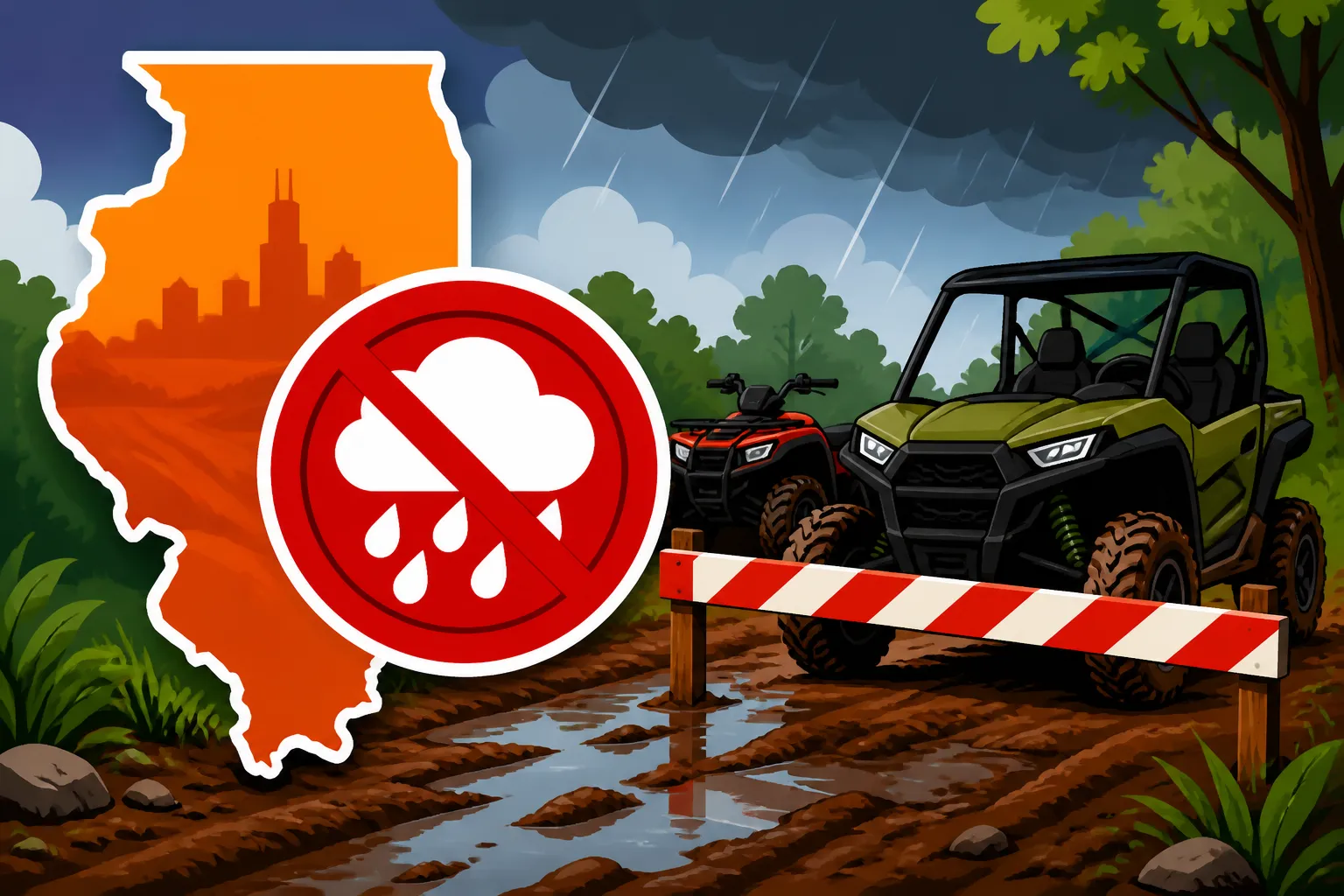
There is a safety issue, too. A machine can slide sideways on a wet incline, get stuck in a hole, or lose traction while climbing. Recovery may be difficult if the trail is soft, and trying to pull out a stuck ATV or UTV can damage the ground further. A closure is not just an inconvenience; it may be the operator’s way of preventing a minor wet spot from becoming a hazard or a long repair.
If an area is closed, respect the posted notice and the operator’s instructions. Do not assume that a gate left open means every trail is available, and do not ride around a barrier. For broader guidance on closures and their impact, see [Illinois Trail Closures After Rain] and [Illinois Trail Riding After Heavy Rain].
How to check conditions before you haul
A forecast is useful, but it cannot tell you whether a specific trail has dried out. A storm can miss one riding area and soak another, and a park may close in response to conditions on the ground rather than the rainfall total alone. Before loading up, check the riding area’s own announcements and make sure you know what kind of access is open.
Check the operator’s updates, not just the weather app
Start with the official website or social media account for the park, club, county park district, or other land manager. Look for same-day updates about closures, delayed openings, trail restrictions, or changes to reservations. If the announcement is unclear—or has not been updated since the storm—contact the operator directly before leaving.
This matters at both public and privately operated sites. Grant-assisted riding areas and private parks can have different operating procedures, staff, and closure decisions. A public-access decal or other riding document does not guarantee that a particular site is open. Learn how site types differ in [Illinois Grant-Assisted Riding Areas] and [Illinois Private Off-Road Parks].
For example, someone planning a Saturday trip to Sahara Woods near Harrisburg should check the site’s current operating information rather than assume the usual schedule applies after a storm. A rider heading toward a club-run area near Marion, or a private riding area around Nebo, should do the same with that operator. Conditions and decisions can vary from site to site; don’t treat an update from one park as confirmation about another.
Use maps as planning tools, not closure notices
A trail map can help you understand the route, nearby roads, and where you might turn around. Apps such as onX Offroad can be useful for planning a route and getting oriented, but a mapped trail is not proof that it is open or safe today. Temporary closures, washed-out sections, and last-minute restrictions may not appear on a map.
Use onX Offroad alongside the park’s own announcements, not instead of them. If the map shows a route but the operator says that area is closed, follow the operator’s notice. If the app’s information and the official update seem to conflict, call the site before you tow. The same principle applies to downloaded maps and screenshots: they can help with navigation but may not reflect a temporary change.
| What to check | Why it matters | Best next step |
|---|---|---|
| Official park or land-manager update | Confirms current closures and restrictions | Check close to departure and again before unloading |
| Direct phone or message to the operator | Helps clarify vague or outdated notices | Ask which trails or machine types are affected |
| Weather near the riding area | Conditions may differ from your hometown forecast | Check the location you plan to visit |
| Route map or navigation app | Helps with orientation and route planning | Treat it as a map, not a live trail-status guarantee |
| Reservation or admission information | A reservation may not mean every trail is open | Confirm whether rain affects access or permits |
Before a longer trip, make a quick condition-check routine. Review the operator’s latest notice, compare the forecast for the riding area, confirm any reservation or entry requirements, and contact the site if you still have questions. The [Illinois Trail Conditions Before You Tow] guide offers more trip-planning context, while [Checking Hours Before a Long Drive] is a useful reminder to verify operating details before setting out.
How to decide whether to ride after rain
Sometimes a park is open but trails remain wet. In that situation, the question is not simply whether your machine can make it through. Consider whether the route is safe, whether your tires are likely to churn up the ground, and whether the operator has asked riders to avoid particular trails.
Read the conditions beyond the parking lot
The entrance area can dry faster than shaded woods, low ground, or a steep section farther along the route. If you are permitted to ride, begin cautiously and pay attention to changes in traction. A tire slipping on a gentle section, deepening ruts, or water flowing down a trail are signs to stop and turn back rather than push farther in.
Do not use another rider’s tracks as proof that a trail is firm. A UTV may have crossed a soft area earlier, but repeated passes can make it worse. If a route is marked closed, do not try to reach it by taking a different trail or crossing private property. Ask staff where riding is currently allowed.
It also helps to be realistic about your group. A beginner, a young rider, or someone unfamiliar with a machine may have a harder time managing slippery turns and hills. A wet trail that feels manageable to an experienced rider can still be an inappropriate choice for a novice or a passenger-heavy UTV. Review [Illinois Trail Difficulty Ratings] when choosing routes that fit your group’s skills, and follow the site’s own rules and directions.
Know when turning around is the right call
Turn around if you encounter a posted closure, a deepening rut, a washout, water moving across the trail, or a section where your machine cannot maintain controlled traction. Avoid spinning the tires to escape a soft spot; that can dig the machine in and damage the trail. If you become stuck, follow the park’s recovery procedures or contact staff rather than improvising a route around the problem.
A simple example: your group reaches a muddy rise and the lead machine slides sideways while trying to climb. Continuing may leave the next rider with an even more damaged surface and less traction. Backing away carefully, if it is safe to do so, and choosing an open route—or ending the ride—is often the more responsible decision.
If you are unsure whether a trail is merely wet or officially closed, ask staff. Don’t rely on assumptions based on a previous visit, a friend’s report from another weekend, or a map that does not show temporary conditions. Good [Illinois Trail Etiquette Locals Expect] includes following closures, giving damaged sections room, and not leaving a mess for the next group.
Plan a rain-aware Illinois riding trip
You cannot control the weather, but you can avoid making a wet weekend more frustrating than it needs to be. Build a backup plan before you leave: know the operator’s cancellation or rescheduling process, identify another activity nearby, and decide in advance how far you are willing to drive if the riding area closes.
Pack for mud without treating it as permission to ride
Bring equipment that helps you handle ordinary cleanup and changing conditions: suitable footwear, gloves, towels, drinking water, and basic recovery supplies appropriate for your machine and experience. If you ride in clay, plan to clean mud from the tires, frame, and radiator afterward. Mud packed into a radiator can interfere with cooling, so check your owner’s manual for appropriate cleaning steps and avoid using pressure or tools in ways that could damage components.
Packing a winch or recovery gear does not make a closed or unsafe trail acceptable. Recovery equipment is for situations that can happen on an open, appropriate route; it is not a reason to enter saturated ground or bypass a barrier. For equipment and trip-preparation ideas, see [Choosing a Winch Before You Sink in Clay] and [Washing Clay Out of a Radiator and Frame].
Make your plan flexible
A practical rain plan has three options: ride if the operator confirms the site is open and conditions are suitable, switch to a different permitted activity if it is not, or reschedule. If your group is traveling from Chicago, Springfield, or St. Louis, a quick call before departure can save hours of towing and disappointment. For a destination such as southern Illinois, check the route and conditions near the riding area rather than relying only on the forecast where you live.
Keep in mind that opening hours and season dates may not answer the question of whether trails are usable after rain. Check the site’s specific update for the day you plan to visit, and confirm whether restrictions apply to particular trails, vehicles, or activities. The [Illinois Riding Season Considerations] guide can help with broader planning, but the operator’s current direction is the deciding information for that visit.
A flexible plan also makes the day better for everyone else. If a park asks riders to stay off certain trails, choosing another activity protects the route and makes it more likely to reopen in good condition. And when conditions are suitable, follow posted routes, avoid unnecessary wheel spin, and leave damaged or muddy sections as you found them rather than widening the trail to get around a puddle.
Disclaimer
This article is for general informational purposes only and does not constitute professional advice. Laws, prices and regulations vary by location and change over time. Consult a qualified professional for guidance on your specific situation.