Illinois Southern Riding Areas
Southern Illinois can make an excellent ATV or UTV weekend, but the riding options are not all alike: some are managed parks, some are club-run areas, and many public lands do not allow off-highway riding at all. This guide explains how to compare the region’s main destinations, check access rules, plan a practical trip, and avoid towing a machine to a closed or unsuitable trail.
How to Choose a Southern Illinois Riding Area
Start with the kind of ride you want
“Southern Illinois riding” can mean very different things depending on what you have in mind. One group may want a marked, managed trail system and a place to spend the day; another may be looking for challenging terrain, a club event, or a weekend that includes camping. Before choosing a destination, decide what a successful ride looks like for your group.
Think about who is coming and what they ride. A family with younger operators may value clear check-in procedures, beginner-friendly routes, and a short drive between the parking area and the trails. Experienced riders may be more interested in longer loops, steep or uneven terrain, or a place where their preferred type of machine is permitted. If your group includes ATVs, dirt bikes, and side-by-sides, confirm that the site accepts each vehicle category rather than assuming all off-road machines are treated the same.
Also be honest about your group’s tolerance for uncertainty. A managed riding site with advance registration may take more planning, but it can make arrival and access easier to understand. A club-run park may have its own schedule, membership or day-pass arrangements, and event calendar. Private parks can have separate rules about machine specifications, passengers, noise, helmets, and waivers. The best destination is not necessarily the one with the most dramatic reputation; it is the one whose rules and terrain suit the people and machines you are bringing.
Compare access before you compare mileage
Trail mileage is an easy number to focus on, but it does not tell the whole story. A site may have a large trail network and still be a poor fit if your machine is too wide for its routes, if the available terrain is beyond your group’s ability, or if access is limited to certain days. Conversely, a smaller area can deliver a satisfying day if the trails match your skill level and the site is easy to navigate.
Ask how access works before you plan around a destination. Find out whether you need to reserve, whether day permits are available, whether the park has a daily capacity, and whether riders must complete a waiver before unloading. Check whether the site welcomes walk-in visitors or expects you to arrange entry in advance. These details matter most on holiday weekends, when a long drive can end with a full parking area or no remaining permits.
It is also worth separating “nearby” from “available.” A map may show a forest, lake, or large block of land, but that does not mean ATVs and UTVs may ride there. Illinois public land is not automatically open to motorized recreation, and riding where it is not designated can lead to an unpleasant encounter with land managers or law enforcement. For a broader explanation, see [Illinois ATV Trails: Where You Can Actually Ride](Illinois ATV Trails: Where You Can Actually Ride) and [Illinois Land You May Not Ride](Illinois Land You May Not Ride).
Southern Illinois Riding Areas to Research
Sahara Woods near Harrisburg
Sahara Woods is one of the best-known places to investigate when planning an off-highway vehicle trip in southern Illinois. It is located west of Harrisburg, with the trailhead on Trail Head Lane. The site is associated with a substantial trail network and managed entry, so it is especially important to check its rules and booking arrangements before loading the trailer. A destination with formal entry procedures is not the kind of place to treat as a casual roadside pull-off.
The planning details can affect the entire day. Check the operating season, hours, registration requirements, permit availability, and any daily vehicle limit before setting off. If reservations or advance permits are part of the process, complete them before the drive rather than assuming you can buy access at the gate. Confirm whether your confirmation needs to be printed or can be shown on a phone, and make sure each rider understands the check-in steps.
Sahara Woods may suit riders who want a managed trail outing and are willing to plan ahead. Still, a listed trail total is not a promise that every route will be open, appropriate for every vehicle, or easy to complete in one visit. Weather, closures, site rules, and the pace of your group all affect how much ground you cover. For trip-specific planning, review [Sahara Woods' 30 Miles in Illinois](Sahara Woods' 30 Miles in Illinois), [Illinois Sahara Woods Permits](Illinois Sahara Woods Permits), and [Illinois Daily Caps and Sell-Outs](Illinois Daily Caps and Sell-Outs).
Little Egypt Off Road near Marion
Little Egypt Off Road is a club-run riding area near Marion that may be worth researching if you want a different experience from a state-managed site. Club-operated parks can have their own access schedules, event days, day-pass procedures, and rules for riders and passengers. Those details can change what a visit looks like, so check directly with the organization before building your weekend around a particular date.
The terrain and scale are part of the appeal for many riders, but the more challenging a park’s routes are, the more important it is to match the terrain to your machine and experience. A rider who is comfortable on a broad, familiar trail may not enjoy a technical route with deep ruts, steep grades, or narrow turns. A side-by-side driver should pay particular attention to trail width and restrictions; not every route that works for a quad will work for a wider vehicle.
Look closely at the park’s specific requirements: whether a passenger is allowed on your machine, whether every person needs to pay or register, which ages can ride, what protective gear is expected, and whether the park has separate rules for youth operators. You can use [Little Egypt Off Road in Illinois](Little Egypt Off Road in Illinois) and [Illinois Private Off-Road Parks](Illinois Private Off-Road Parks) as starting points for comparing access styles. Then confirm the details with the park before you travel.
Other options and nearby alternatives
Not every riding opportunity that appears on a regional search is actually in the southernmost part of Illinois. Mill Creek Park near Marshall and Heartland Lodge near Nebo, for example, may appear in broader state riding research, but their locations and operating arrangements make them different choices from a visit centered around Harrisburg or Marion. Whether they make sense depends on your starting point, desired terrain, and willingness to drive between destinations.
When considering a second location, do not assume it is interchangeable with your first choice. A county-operated park, lodge, and club-run area can each have different check-in processes, costs, vehicle restrictions, and overnight options. If you are thinking about splitting a trip between two sites, verify that both are open on the same dates and that the driving time between them is realistic with a trailer. Moving a loaded machine and finding a second place to stay can take longer than a map estimate suggests.
A simple comparison can help narrow the search before you call or book:
| Riding option | Location to research | Best first question | Details to confirm |
|---|---|---|---|
| Sahara Woods | West of Harrisburg | Is access available for my planned riding date? | Reservation, permit, hours, capacity, vehicle requirements |
| Little Egypt Off Road | Near Marion | Is the park open to visitors on my date? | Day-pass process, event schedule, trail suitability, passenger rules |
| Other regional parks | Locations vary | Is this site close enough to fit my trip? | Exact address, operating calendar, access rules, camping options |
For more regional comparisons, use [Illinois Southern Riding Areas](Illinois Southern Riding Areas) alongside [Illinois Riding Near Harrisburg](Illinois Riding Near Harrisburg) and [Illinois Riding Near Marion](Illinois Riding Near Marion). Treat each as a lead to verify, not as a substitute for checking a park’s own current instructions.
Understand the Two Illinois Stickers
A usage stamp and an access decal do different jobs
Illinois riders often get tripped up by the difference between the off-highway vehicle usage stamp and the public access decal. They are not simply two names for the same permit. Their purpose and the places where they matter differ, so identify what each one covers before you purchase anything or head to a riding site.
A usage stamp is associated with operating an off-highway vehicle under Illinois rules. An access decal is associated with riding at grant-assisted sites. That distinction matters because a machine owner may need one, the other, or both depending on where and how the vehicle will be used. Do not assume that buying one automatically provides every type of access you need.
A practical way to think about it is to ask two separate questions: “What does Illinois require for this machine?” and “What does this specific site require for entry?” The answers may overlap, but they are not identical. For a detailed comparison, read [Illinois Usage Stamp vs Access Decal](Illinois Usage Stamp vs Access Decal) and [What the Stamp Covers and What the Decal Covers](What the Stamp Covers and What the Decal Covers).
Check the site’s grant status and rules
The access decal question depends in part on the type of riding site you plan to visit. A grant-assisted site may require the decal even when you already have a usage stamp. A private park may set its own entry requirements, and a managed public site may have a specific permit system in addition to any state requirements. One sticker should never be treated as a universal pass for every trail or park.
Before you leave home, identify the exact site and ask what it requires for each machine. If you are bringing several vehicles, confirm whether each one needs its own sticker or permit. Keep in mind that the rider’s personal paperwork and the machine’s required decals are not necessarily interchangeable; a sticker attached to one vehicle may not meet the requirements for another.
If you have questions about where a decal is needed, check [Illinois Grant Site Decal Rules](Illinois Grant Site Decal Rules) and [One Access Decal Covers Every Grant-Assisted Site](One Access Decal Covers Every Grant-Assisted Site). Then confirm the policy with the individual riding area. A short phone call before departure is much easier than trying to solve a permit issue at the gate with a trailer behind you.
Avoid treating public land as an open trail system
Southern Illinois has forests, conservation areas, and other public lands that look inviting on a map. That does not mean they are open to ATV or UTV riding. Public ownership and motorized access are separate questions. A trail that permits hikers, bicycles, or horseback riding may still prohibit off-highway vehicles, and a forest road may have its own restrictions.
Shawnee National Forest is a particularly important example for riders to research carefully. It does not offer designated motorized OHV trails in the way a purpose-built riding park does. Some forest roads may allow vehicle travel under applicable rules, but that is not the same as permission to ride cross-country or use a trail as an ATV route. Do not turn a road-access rule into a general riding assumption.
Before using any public parcel, look for an explicit, current statement that the route or area is open to your vehicle type. If you cannot find one, ask the land manager rather than interpreting a map symbol or old online post as permission. Review [Why Shawnee National Forest Bans Illinois OHVs](Why Shawnee National Forest Bans Illinois OHVs) and [Illinois Trails Closed to Machines](Illinois Trails Closed to Machines) before planning a public-land ride.
Plan the Trip Before You Load the Trailer
Confirm the date, access, and arrival process
Start planning with the calendar, not the packing list. Riding areas may have seasonal schedules, limited operating days, special event weekends, or weather-related closures. A location that is open during one part of the year may not accept riders on the date you have available. Check the site’s operating information close to your trip and verify that the details apply to the specific area you intend to visit.
If the park uses reservations or capacity limits, secure access before making the rest of your plans. A group can lose a surprising amount of time if one rider has not registered, one machine is missing a required permit, or the site has filled its daily allotment. Make a shared checklist with the reservation confirmation, each rider’s waiver, machine details, and any required decals or passes. Have one person responsible for confirming that the whole group is ready.
Plan your arrival with enough time to complete check-in without rushing. The driver may need to park the trailer, unload, show documents, receive a wristband or vehicle sticker, and listen to a safety briefing before riding. If you arrive close to a gate closing time, a small delay can shorten the ride considerably. For tips on advance planning, see [Booking Before You Drive Down](Booking Before You Drive Down) and [Checking Hours Before a Long Drive](Checking Hours Before a Long Drive).
Build a realistic route and day plan
A full day of riding is not just trail time. It includes driving to the park, unloading, signing in, putting on protective gear, taking breaks, fueling or recharging, and loading up again. If your group is new to the area, leave room for a slow start while everyone learns the layout. A plan that assumes hours of continuous riding can feel exhausting by lunchtime.
Use the site’s map and route information to choose an initial loop that suits the least experienced rider in your group. You can always increase the challenge after everyone has a feel for the trail conditions. Agree on a meeting point and a plan for what to do if the group gets separated. In an area with limited phone reception, a prearranged turnaround time and a paper map can be more reliable than expecting a text message to go through.
Digital mapping tools such as onX Offroad can help you review routes and organize a trip before leaving, but a screen should not replace site rules, posted closures, or local instructions. Download or save the information you expect to need in advance, and carry a backup way to navigate. If you are planning a longer ride, [Illinois Trail Conditions Before You Tow](Illinois Trail Conditions Before You Tow) and [Carrying a Paper Map to a Grant Site](Carrying a Paper Map to a Grant Site) are useful reminders to account for conditions beyond the route line.
Sort out overnight arrangements separately
A riding area and a place to sleep are two separate parts of the trip. Some destinations may have camping or nearby lodging, but the options, reservation process, pet rules, quiet hours, and generator restrictions can vary. Do not assume that a park allows overnight stays just because it has a large parking area or hosts multi-day events.
If your group wants to camp, ask whether the campground is on-site or nearby, whether you need a separate reservation, and how far it is from the riding entrance. Check whether there is room for a truck and trailer, whether water and power are available, and whether the site has rules about fires or generators. Those details make a real difference when you are traveling with children, a large group, or a machine that needs to be secured overnight.
For lodging away from the park, consider how you will handle the trailer and machines after riding. A hotel may be comfortable but may not have suitable trailer parking. A cabin or campground may offer more room, but the drive back and forth can add time. Explore [Illinois OHV Camping With Trail Access](Illinois OHV Camping With Trail Access) and [Illinois Campgrounds Next to a Trailhead](Illinois Campgrounds Next to a Trailhead) as starting points, then confirm availability and parking directly with the property.
Match the Machine and Rider to the Terrain
Check vehicle type and trail width
A route that works well for a small ATV may not be suitable for a wide side-by-side. Trail width, turning radius, surface, bridge restrictions, and the site’s vehicle rules all affect whether a machine can safely use a route. This is an easy detail to overlook if a group has mixed vehicle types and everyone assumes the same trails are open to all.
Contact the riding area with your machine’s make, model, and approximate width if the rules are unclear. Ask whether there are restrictions on four-seat UTVs, modified machines, lifted vehicles, or tires that extend beyond the body. Some parks may inspect vehicles or enforce specifications at the entrance. A machine that is legal and comfortable on your property may still fail to meet a particular park’s requirements.
Do the same homework for trailers. Check whether the parking area has room to turn around, whether the entrance road is suitable for a trailer, and whether there is a designated unloading area. Avoid assuming a narrow access lane will be easy to negotiate with a long truck and loaded trailer. If your group is bringing a large vehicle, review [Illinois Trails That Allow Side-by-Sides](Illinois Trails That Allow Side-by-Sides) and [When Your Side-by-Side Is Too Wide for the Trail](When Your Side-by-Side Is Too Wide for the Trail).
Pick routes that fit the least experienced rider
It is tempting to plan a ride around the most skilled person in the group, especially if that rider is organizing the weekend. But the pace and challenge of the day are usually set by the person who needs the most support. Choose a route that everyone can manage safely, and treat difficult sections as optional rather than as a test the whole group must pass.
For a first visit, start conservatively. Watch how the machine handles the surface, how confident the rider feels on turns and slopes, and whether the group can stay together without creating pressure. A newer rider may be more comfortable on a wider, less technical route, while an experienced rider may enjoy more demanding terrain. A good day allows both people to enjoy the outing without one feeling hurried or left behind.
If younger riders are involved, check age rules, supervision requirements, and the park’s own minimum-age policies. Illinois requirements and individual park rules may not be identical. A child’s age, the machine’s size, passenger restrictions, and the adult-to-child arrangement can all matter. For further preparation, read [Illinois Rules for Young Riders](Illinois Rules for Young Riders) and [Illinois Private Park Age Minimums](Illinois Private Park Age Minimums).
Prepare for mud, dust, and changing conditions
Southern Illinois trail conditions can change with weather and traffic. A route that was manageable in dry weather may become slick, muddy, or rutted after rain. Dry stretches can bring dust that affects visibility, while wet clay can cling to tires, frames, and radiator areas. Rather than packing for an ideal day, prepare for the conditions that could reasonably occur.
Check the park’s updates before towing, especially after significant rain. Some sites close trails or adjust access when conditions are poor to protect the ground and keep riders safe. If the site has a closure notice, respect it even if a trail appears passable from the entrance. Trying to ride through a closure can damage the route and put you at odds with staff.
Pack tools and supplies appropriate to your machine and the kind of riding you expect. A basic tool kit, tire repair supplies, first aid items, water, and a way to clean mud from critical areas can help prevent a minor issue from ending the day. For terrain-specific preparation, see [Illinois Trail Closures After Rain](Illinois Trail Closures After Rain), [Choosing Tires for Southern Clay and Mud](Choosing Tires for Southern Clay and Mud), and [Washing Clay Out of a Radiator and Frame](Washing Clay Out of a Radiator and Frame).
Ride Safely and Respect the Site
Make a group plan before starting
A group ride feels relaxed when everyone knows the basics in advance. Agree on who leads, who rides at the back, where the group will stop, and how you will handle a mechanical problem. Share the route plan with everyone, including riders who are comfortable navigating, so the whole group is not dependent on one person having a working phone.
Set a pace that allows space between machines and gives riders time to react to changing surfaces. Avoid bunching up in dust or rushing to keep up with a more powerful vehicle. If someone needs a break, stop in a safe place where the group can get fully out of the way. Never assume that a rider who has fallen out of sight will automatically meet you at the next intersection.
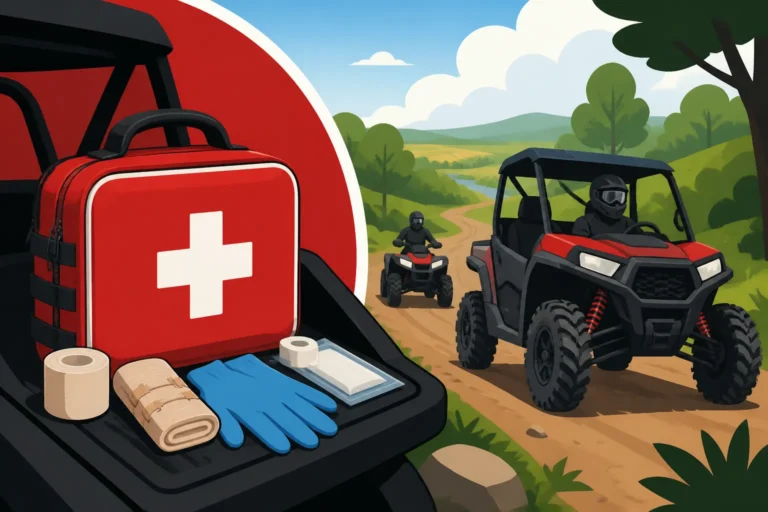
For a long loop, agree on a turnaround time and a check-in point. Carry essential contact information and any information the park says riders should have. Cell service can be inconsistent in rural areas, so do not make your whole safety plan depend on a call or live map. The practical guide [Carrying First Aid on a 30-Mile Loop](Carrying First Aid on a 30-Mile Loop) offers a useful prompt for thinking about what your group should have with it.
Follow park rules even when you know the machine
Park rules are part of the trail system, not a formality to get through before riding. They may cover speed, helmets, passenger seating, alcohol, sound levels, open containers, pets, and where machines may travel. A rider who ignores a posted restriction can put the group’s access at risk, even if the rest of the day has gone smoothly.
Read the rules before arrival and make sure every rider understands them. If a rule is unclear, ask staff rather than relying on what another visitor says. Site rules can be stricter than the minimum state requirements, and a rule that applied at one park may not apply at another. This is especially important for youth riders, passengers, modified machines, and large groups.
Respect closures, gates, private property boundaries, and marked routes. Riding off an authorized trail can damage land and create conflict with landowners and site managers. Treat other trail users courteously, slow down near people and parked vehicles, and leave the area as you found it. For a fuller overview, consult [Illinois Trail Etiquette Locals Expect](Illinois Trail Etiquette Locals Expect) and [Illinois Penalties for Riding a Closed Area](Illinois Penalties for Riding a Closed Area).
Keep street riding separate from park riding
A machine being allowed on an off-road trail does not automatically make it legal to ride on nearby streets. Illinois street use involves separate rules and local ordinances, and eligibility can depend on the road, municipality, equipment, insurance, and other requirements. Do not ride from a campground or trailhead onto a public road unless you have confirmed that the route is permitted and your machine qualifies.
This distinction matters around rural communities, where a short stretch of pavement may seem like a convenient connection between a lodging stop and a riding area. A road’s low traffic or proximity to a trail does not by itself authorize ATV or UTV use. The rules can vary between a village street, county road, township road, and state highway.
For a separate street-use research path, see [Can You Drive a UTV on the Road in Illinois?](Can You Drive a UTV on the Road in Illinois?) and [Illinois UTV Street Legal Rules by Town](Illinois UTV Street Legal Rules by Town). If your trip is strictly trail-based, the simplest approach is to haul the machine between locations and ride only where the site explicitly allows it.
A Practical Planning Checklist for a Southern Illinois Ride
Two to three weeks before the trip
Begin by choosing the riding area and checking its official information. Confirm that the park is open on your dates, that your vehicle type is accepted, and that the terrain is a reasonable match for your group. If the area uses reservations or has a capacity limit, do not leave that step until the night before. Make sure each rider knows what the trip will involve, especially if the group includes beginners or children.
Next, sort out the paperwork and access requirements. Find out whether a usage stamp, access decal, park permit, waiver, or proof of ownership is needed. If you are unsure how a requirement applies to a particular machine, ask the park or relevant office directly. Make a list by vehicle rather than by person so you do not overlook a second ATV or a rented machine.
Reserve lodging and confirm trailer parking at the same time. Ask whether you can leave a trailer on the property, whether the machines can be secured overnight, and whether the location has any rules that affect your group. If you are visiting a private or club-run area, check its event calendar and opening schedule before booking a nonrefundable stay. A little coordination early can prevent an expensive and frustrating change of plans.
The day before departure
Check trail and weather updates again. Conditions can change after rain, and parks may post closures or other instructions that were not in effect when you first planned the trip. Confirm your reservation, save directions, and make sure every rider has the information needed for entry. If you rely on a phone for maps or confirmation, charge it and save the relevant information for offline use where possible.
Inspect every machine before loading it. Check tires, brakes, lights where applicable, fluid levels, battery condition, tie-down points, and any equipment you need for the expected terrain. Make sure the trailer is ready as well, including its tires, lights, hitch, and safety connections. A small repair at home is inconvenient; the same issue discovered at a trailhead can cost a large part of the day.
Pack for more than the drive. Bring water, weather-appropriate layers, protective equipment, basic tools, first aid supplies, and a way to keep essential documents dry. Keep permits and confirmations easy to access instead of buried beneath riding gear. If the park expects riders to display a vehicle sticker or wristband, know where and when it will be issued so you do not mistake the check-in process.
At the trailhead and after the ride
On arrival, follow staff directions for parking, unloading, inspection, and check-in. Do not unload into a travel lane or block another trailer while you look for paperwork. If the site checks machines or gives a safety briefing, treat it as part of the ride rather than an avoidable delay. It is the best time to resolve questions about trail closures or vehicle restrictions.
Once you are riding, keep the day flexible. If a route is too difficult, turn around; if conditions are worse than expected, choose a shorter loop or stop. A good riding day is not measured by how many miles your group forces itself to cover. It is measured by whether everyone gets back safely and still wants to ride again.
Before leaving, check the machine and gear for damage, remove mud where it could interfere with safe transport, and make sure you have not left trash or personal items behind. Follow the site’s directions for exiting and disposing of waste. If you had an issue with a trail, report it through the appropriate park channel rather than creating an informal detour around a closure.
Plan a Better Southern Illinois Weekend
A first-time visit
For a first visit, choose one riding area and keep the schedule simple. Arrive early enough to complete check-in, learn the trail layout, and take a short first loop before committing to a longer route. That gives the group time to adjust if the terrain is rougher, the weather is hotter, or the machine mix is less compatible than expected.
Choose a destination based on confirmed access rather than reputation alone. A popular park is not automatically the right choice if the trails are too challenging or your preferred machine is not allowed. A managed site with a clear reservation process may suit a group that values predictability, while a club-run park may be a better match for riders who want a particular terrain style or event atmosphere.
After the ride, note what worked and what you would change next time. Record the route length your group was comfortable with, the gear you actually used, and how long unloading and check-in took. If you plan to return, those notes will help you pack more efficiently and choose a better ride plan. onX Offroad can be one way to keep personal route notes organized, but always compare your plans with the park’s official map and posted rules.
A family or mixed-experience group
For a family, spend extra time confirming age, supervision, passenger, helmet, and machine-size rules. A child’s ability to operate a machine safely is not established by age alone, and a park may have its own restrictions beyond general requirements. Ask what is expected before arriving so a child is not disappointed at the gate or placed on a machine that is too large for their experience.
Build in breaks and make the first ride short. Younger riders may tire sooner than adults, especially in heat, dust, or uneven terrain. Bring water and snacks, agree on a clear regrouping point, and keep a responsible adult positioned where they can help the group stay together. Avoid splitting into “fast” and “slow” groups unless both have a clear leader and a plan to reconnect.
A mixed group should choose trails that do not pressure inexperienced riders to keep up. Encourage people to speak up if they are uncomfortable, and treat turning back as a sensible decision rather than a failure. Park time is more enjoyable when the group can adapt without embarrassment. For additional ideas, see [Best Illinois ATV Trails for Beginners](Best Illinois ATV Trails for Beginners) and [Illinois Trails for Kids](Illinois Trails for Kids).
A club weekend or multi-day trip
A club weekend can make a southern Illinois trip more social, but it also means more coordination. Share the park rules and arrival instructions with everyone before the drive. Confirm how many machines are registered, who is carrying the group’s paperwork, and whether the site has limits on group size or organized rides. A group that arrives in several vehicles should agree on a meeting point and a backup plan if someone gets delayed.
For a multi-day outing, do not assume the same permit or access arrangement covers every day or every location. Check the site’s permit duration and rules, as well as whether you need separate access for a second park. Plan for meals, fuel, charging needs, and overnight security. Keep enough time between riding and the return drive to load carefully rather than rushing everyone out at closing time.
If the group wants a longer route or multiple destinations, use maps for planning but confirm the open route with the site. onX Offroad may help with organizing route ideas and keeping track of trip plans, while park staff remain the authority on current access and closures. For group planning, [Illinois Group Ride Planning](Illinois Group Ride Planning) and [Illinois Riding Areas With Group Rates](Illinois Riding Areas With Group Rates) can help you think through the logistics before you commit.
Disclaimer
This article is for general informational purposes only and does not constitute professional advice. Laws, prices and regulations vary by location and change over time. Consult a qualified professional for guidance on your specific situation.