Never Crossing an Interstate
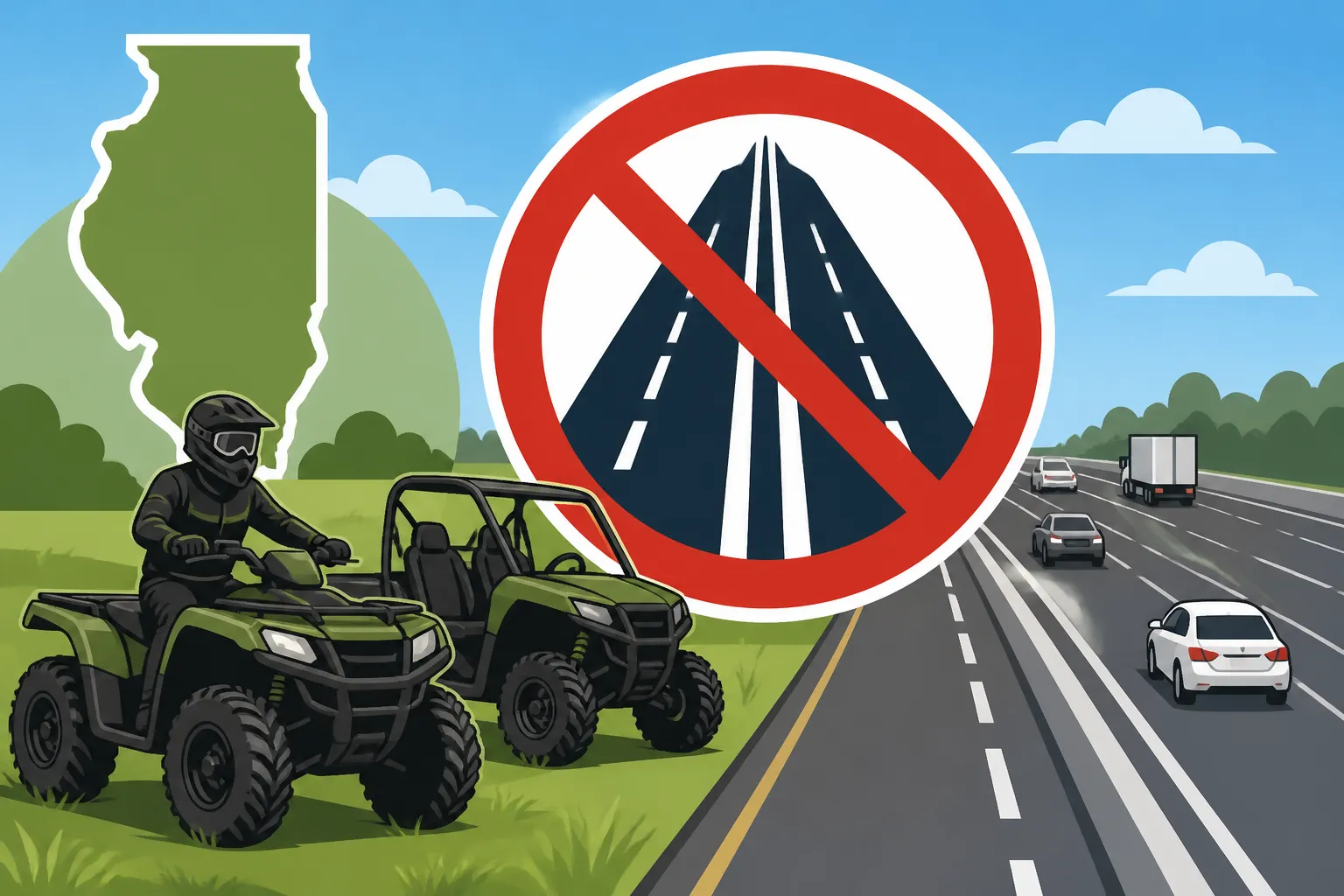
It's a common thought, especially when you're looking at a long haul across the Prairie State: "Could I just hop on the interstate for a few miles to get where I'm going faster?" The appeal of those smooth, high-speed lanes, designed for quick transit, can be tempting when you're perched on your ATV or UTV. But here's the absolute truth, right from the start: Illinois law makes it abundantly clear that interstates and tollways are strictly off-limits for your off-road machine, no exceptions. This guide is here to unravel why that rule exists, what dangers you avoid by following it, and how to safely and legally transport your quad or side-by-side to your next adventure.
The Absolute Ban: Why Interstates Are Off-Limits for Your Off-Road Machine
Let's face it, the idea of zipping along an interstate on your ATV or UTV might sound thrilling to some, or simply like a practical shortcut to others. However, the State of Illinois, like most states, has enacted clear legislation to prevent this for very good reasons. It's not about penalizing off-road enthusiasts; it's about public safety and the fundamental design differences between your machine and traditional highway vehicles.
Understanding the Legal Framework: What the Law Says
In Illinois, the Vehicle Code defines what constitutes a "highway" and specifies which vehicles are permitted to operate on certain types of roadways. When it comes to interstates and tollways, the law is unequivocal: Off-Highway Vehicles (OHVs), which include ATVs and UTVs, are explicitly prohibited. This isn't a gray area; it's a hard and fast rule. The state recognizes that these high-speed, limited-access arteries are designed for vehicles capable of maintaining specific speeds, with robust safety features, and a certain level of protection for their occupants. Your off-road machine simply doesn't fit that bill.
This prohibition extends not just to riding on the interstate, but also to using entrance or exit ramps. Even if you think you're just cutting across a short stretch, any presence on these roads is a violation. It's similar to how [Illinois Closes Tollways and Interstates to Every Machine] not explicitly designed for those high-speed, multi-lane environments. The legislative intent is clear: to maintain safety and traffic flow on roads where speeds often exceed 65 miles per hour and where large trucks and passenger vehicles dominate.
Vehicle Design vs. Highway Demands
Think about the fundamental differences between your ATV or UTV and a passenger car or truck. ATVs are built for agility, navigating challenging terrain, and providing an exhilarating, open-air experience. UTVs offer utility and passenger capacity, often designed for work, recreation, or light-duty travel over varied surfaces. Neither is engineered for the sustained high speeds, sudden stops, or significant air turbulence found on an interstate.
Here’s a quick rundown of why your machine isn't suited:
- Speed Differential: Most ATVs and UTVs, even with some aftermarket performance parts, cannot maintain the minimum speed limits on interstates, nor can they safely accelerate or decelerate to match traffic flow. This creates a dangerous speed differential, increasing the risk of rear-end collisions.
- Protection and Safety: Unlike cars and trucks, ATVs and UTVs offer minimal occupant protection in the event of a collision. There are no crumple zones, airbags, or steel cages designed for high-speed impacts. Even a minor fender bender with a car traveling at 70 mph could be catastrophic for an OHV rider.
- Handling Characteristics: The suspension, tire type, and steering geometry of an off-road vehicle are optimized for uneven terrain, not smooth asphalt at high speeds. This can lead to unstable handling, especially when encountering crosswinds or turbulence from passing semi-trucks.
- Visibility: While you can add bright LED lights or reflective tape, your smaller profile makes you harder to spot in fast-moving traffic, particularly for drivers in larger vehicles or those distracted by long commutes. Products from companies like SuperATV can enhance visibility for legal trail or street use, but they don't magically make an OHV safe for interstate travel.
In essence, your off-road machine is a specialist, perfectly adapted for its intended environment. The interstate, with its own specific demands, is simply not that environment.
Navigating Illinois Roads: Distinguishing Interstates from Permissible Paths
It’s easy to lump all major roads together, especially if you’re new to the off-road scene or just visiting Illinois. But understanding the hierarchy of roads and where your machine is (and isn't) allowed is critical for safe and legal riding. While interstates are a definitive no-go, other types of roads might offer possibilities, depending on local rules.
What Defines an Interstate Highway in Illinois
Interstate highways in Illinois are part of a nationwide network designed for long-distance, high-speed travel between major cities. They are characterized by:
- Multi-lane Design: Typically two or more lanes in each direction.
- Limited Access: Entry and exit are restricted to specific interchanges, eliminating cross-traffic and traffic lights.
- High Speed Limits: Often 65 mph or 70 mph, sometimes higher in rural areas.
- Separate Grade Crossings: No intersections at grade; all crossings are handled by overpasses or underpasses.
These features are what make them efficient for cars and trucks, but also what makes them inherently dangerous and illegal for ATVs and UTVs. The entire system is predicated on vehicles operating within a narrow range of speed and performance capabilities, which your OHV falls outside of.
Contrast this with other road types:
- State Highways: These are maintained by the Illinois Department of Transportation (IDOT) and connect towns and cities. Speed limits are generally lower than interstates, and they often have intersections and traffic lights.
- County Roads: Maintained by county governments, these roads typically serve rural and suburban areas. They can be paved or gravel.
- Township Roads: These are the most local roads, often serving agricultural areas or small communities. They are frequently gravel and have lower traffic volumes.
- Municipal Streets: Roads within cities, towns, and villages. Speed limits vary greatly.
It's on these state, county, township, and municipal roads where you might find legal allowances for UTVs, but never on an interstate.
Permissible Street Use: A Local Decision, Not a State One
While the state law is firm on interstates, it allows local units of government—counties, townships, and municipalities—to create their own ordinances regarding UTV use on their roads. This is why you'll hear about specific towns where UTVs are "street legal." However, this local permission comes with strict conditions and applies only to the roads within that specific jurisdiction, and absolutely never includes interstates or tollways.
For example, a town might pass an ordinance allowing UTVs on streets posted 35 mph or lower, provided the UTV is properly equipped and registered with the village. If you’re considering riding on any public road, you must thoroughly research [Illinois UTV Street Legal Rules by Town] or county ordinances before you even think about it.
Local ordinances often require:
- Equipment Upgrades: Your UTV will likely need specific equipment like turn signals, a rearview mirror, brake lights, and a slow-moving vehicle emblem. This is an area where aftermarket parts from companies like SuperATV can be very useful to bring your machine up to spec for local street legality.
- Insurance: You'll almost certainly need proper liability insurance coverage.
- Permits/Registration: Many municipalities require a special permit or registration sticker.
- Driver's License: The operator must possess a valid driver's license.
Even with all these checks in place, remember that permission to ride on a village street or county road does not grant you any access to an interstate. The local authority for [Illinois Municipalities That Pass Ordinances] and [Illinois Counties That Pass Resolutions] only extends to the roads they maintain, not the state or federal highway system.
Here's a simplified look at road access for OHVs in Illinois:
| Road Type | OHV Riding Permitted? | Notes |
|---|---|---|
| Interstate Highway | No | Strictly prohibited by state law. |
| Tollway | No | Strictly prohibited by state law. |
| State Highway | Generally No | Can be crossed at intersections; riding along them generally banned. |
| County Road | Depends on Ordinance | Local county resolution may permit use with conditions. |
| Township Road | Depends on Ordinance | Local township resolution may permit use with conditions. |
| Municipal Street | Depends on Ordinance | Local city/village ordinance may permit use with conditions. |
| Private Property | Yes | With landowner permission; follow all property rules. |
This table underscores the importance of local ordinances. Without one, you're generally restricted from public road use outside of specific crossings.
Risks and Ramifications: What Happens If You Break the Interstate Rule
Ignoring the clear legal restrictions against operating your ATV or UTV on an interstate isn't just a minor infraction; it's an extremely dangerous choice with potentially devastating consequences. The risks extend far beyond a simple ticket, encompassing severe injury, significant financial penalties, and lasting legal headaches.
Immediate Dangers and Accident Potential
Operating an off-road vehicle on an interstate highway is an invitation to disaster. The inherent design limitations of ATVs and UTVs, combined with the high-speed environment, create a perilous scenario.
Imagine this: You're trying to keep up with traffic flowing at 70 mph. A semi-truck passes you, creating a powerful gust of wind that could easily destabilize your lightweight machine. Your tires, designed for grip on dirt and rocks, offer less optimal traction on smooth asphalt, especially if you need to brake suddenly. The open cabin provides almost no protection if another vehicle misjudges your speed and rear-ends you. A collision at these speeds is almost guaranteed to result in severe injuries or fatalities, not just for you but potentially for others involved.
- High-Speed Collisions: Your machine simply isn't built to absorb the kinetic energy of a collision at interstate speeds.
- Loss of Control: Wind shear, sudden braking, or swerving to avoid debris can easily lead to a loss of control, especially for a vehicle with a higher center of gravity and different suspension characteristics than a car.
- Limited Evasive Maneuvers: The maneuverability you enjoy off-road is compromised at highway speeds, making it harder to react to sudden changes in traffic or road hazards.
These aren't hypothetical fears; they are direct, predictable outcomes of placing an inappropriate vehicle into a high-risk environment.
Penalties, Fines, and Legal Consequences
Beyond the physical danger, the legal ramifications of riding an OHV on an interstate in Illinois are significant. If a law enforcement officer spots you, expect to be pulled over immediately.
- Citations and Fines: You will almost certainly receive a citation for illegal operation of an OHV on a public highway. These fines can be substantial. [Illinois Penalties for Illegal Street Riding] details some of the consequences for street riding violations, and interstate infractions would be among the most serious.
- Vehicle Impoundment: It's highly likely your ATV or UTV will be impounded. Recovering an impounded vehicle is a costly and time-consuming process, involving impound fees, storage fees, and potentially other administrative costs. You'll want to understand [What It Costs to Recover an Impounded Machine] because it's not a small sum.
- Criminal Charges: Depending on the specific circumstances, such as reckless endangerment, you could face more severe criminal charges, not just traffic citations.
- License Points: Violations could add points to your driver's license, potentially leading to increased insurance premiums or even license suspension. Remember, even if you can legally drive a UTV on certain local roads after meeting all the [Illinois Non-Highway Vehicle Equipment List] requirements and having a [Illinois Requires a Driver's License], that permission never extends to the interstate.
The message is stark: the legal system takes interstate safety very seriously, and violations with ATVs or UTVs are treated with the gravity they deserve due to the extreme danger posed.
Insurance Implications and Financial Burden
Even if you have comprehensive insurance for your ATV or UTV, attempting to make a claim after an incident on an interstate will almost certainly be denied. Why? Because your policy is written with the understanding that you will operate the machine legally. Operating on a prohibited road type, especially one as dangerous as an interstate, voids many coverage clauses.
- Denied Claims: Your insurance company will likely consider this an unauthorized use of the vehicle, refusing to cover damages to your machine or any third-party liability if an accident occurs. This leaves you personally responsible for all medical bills, property damage, and legal fees.
- Personal Liability: If you cause an accident, you could be sued for damages, medical expenses, and lost wages by the injured parties. Without insurance coverage, your personal assets could be at risk.
- Increased Premiums: Even if somehow a claim went through, or if you simply received tickets, your insurance premiums would likely skyrocket, or your policy could be canceled outright.
The financial burden of an interstate incident involving an OHV could easily run into tens or even hundreds of thousands of dollars, making the cost of safe, legal transport seem incredibly trivial in comparison. It’s far better to invest in proper trailering gear and take the extra time to plan your route than to face these devastating consequences.
Smart Travel: Legal and Safe Ways to Move Your Machine Across Illinois
So, we've firmly established that interstates are a no-go for riding your ATV or UTV. But that doesn't mean your machine is confined to your backyard! Illinois offers fantastic riding opportunities, from state parks to private lands, and getting your machine there safely and legally is straightforward when you know how.
Trailering Is Your Only Interstate Option
When it comes to covering significant distances, especially across different regions of Illinois or through high-traffic corridors, a trailer is your only legal and sensible option. It's the standard, accepted method for transporting ATVs, UTVs, and other off-road vehicles.
- Safety First: A properly secured ATV or UTV on a trailer behind a capable tow vehicle is designed for interstate travel. It allows you to maintain highway speeds safely, without any of the inherent risks of riding the OHV itself.
- Legal Compliance: This method fully complies with all Illinois traffic laws regarding OHVs on public roads. You're transporting cargo, not operating a prohibited vehicle.
- Gear Capacity: Trailers also allow you to bring along all your essential riding gear, tools, fuel, and even camping equipment if you're headed for a weekend adventure. SuperATV, for instance, offers a range of cargo boxes and storage solutions that can be incredibly useful for organizing all your trailering necessities, ensuring everything is secure for the journey.
- Trailer Considerations:
- Proper Hitch and Tow Vehicle: Ensure your tow vehicle has the appropriate towing capacity and a hitch that matches your trailer's requirements.
- Secure Tie-Downs: Use heavy-duty straps to secure your ATV or UTV firmly to the trailer. Check them periodically during long trips.
- Weight Distribution: Load your machine correctly to ensure proper weight distribution on the trailer, preventing sway and maintaining stability.
- Trailer Registration: Make sure your trailer is properly titled and registered. You can find more information on [Plating a Trailer That Hauls an Unplated Quad] to ensure you're squared away.
Don't ever be tempted to "just drive it over." The investment in a trailer and proper tie-downs is a fraction of the cost you'd incur from a single violation or accident.
Planning Your Route: Legal Roads and Riding Areas
Once your machine is safely loaded onto a trailer, the next step is to plan your destination. Illinois has a variety of places where you can legally and safely enjoy your ATV or UTV.
- Designated Riding Areas: Focus your trips on official OHV parks and grant-assisted riding areas. For example, [Sahara Woods: Illinois's Only State OHV Park] offers miles of trails specifically designed for off-road vehicles. [Illinois Grant-Assisted Riding Areas] also provide sanctioned places to ride, often with specific rules and permit requirements. Always check the park's website or call ahead for current conditions, operating hours, and any necessary permits (like the [Illinois Usage Stamp vs Access Decal]).
- Private Land: If you have access to private land with permission from the owner, that's always an excellent option. Ensure you have clear, written permission, especially if you plan to ride frequently.
- Local Ordinances for Short-Distance Riding: For very short hops or to access a trail system directly from a nearby lodging, some municipalities or counties might have ordinances allowing UTVs on certain local roads. As discussed, this requires your UTV to be street-legal in that specific jurisdiction, with all required equipment and permits. Always double-check these rules, as they vary widely and can change. For example, you might have to equip your UTV with specific mirrors or turn signals for legal local road use, where SuperATV's product line could be helpful in finding compliant accessories.
A little planning goes a long way. Before you leave home, identify your destination, confirm it’s a legal riding area, and map out your trailering route, avoiding any potential detours that might involve prohibited roads. This preparation ensures a hassle-free journey and maximizes your time enjoying the trails.
Disclaimer
This article is for general informational purposes only and does not constitute professional advice. Laws, prices and regulations vary by location and change over time. Consult a qualified professional for guidance on your specific situation.